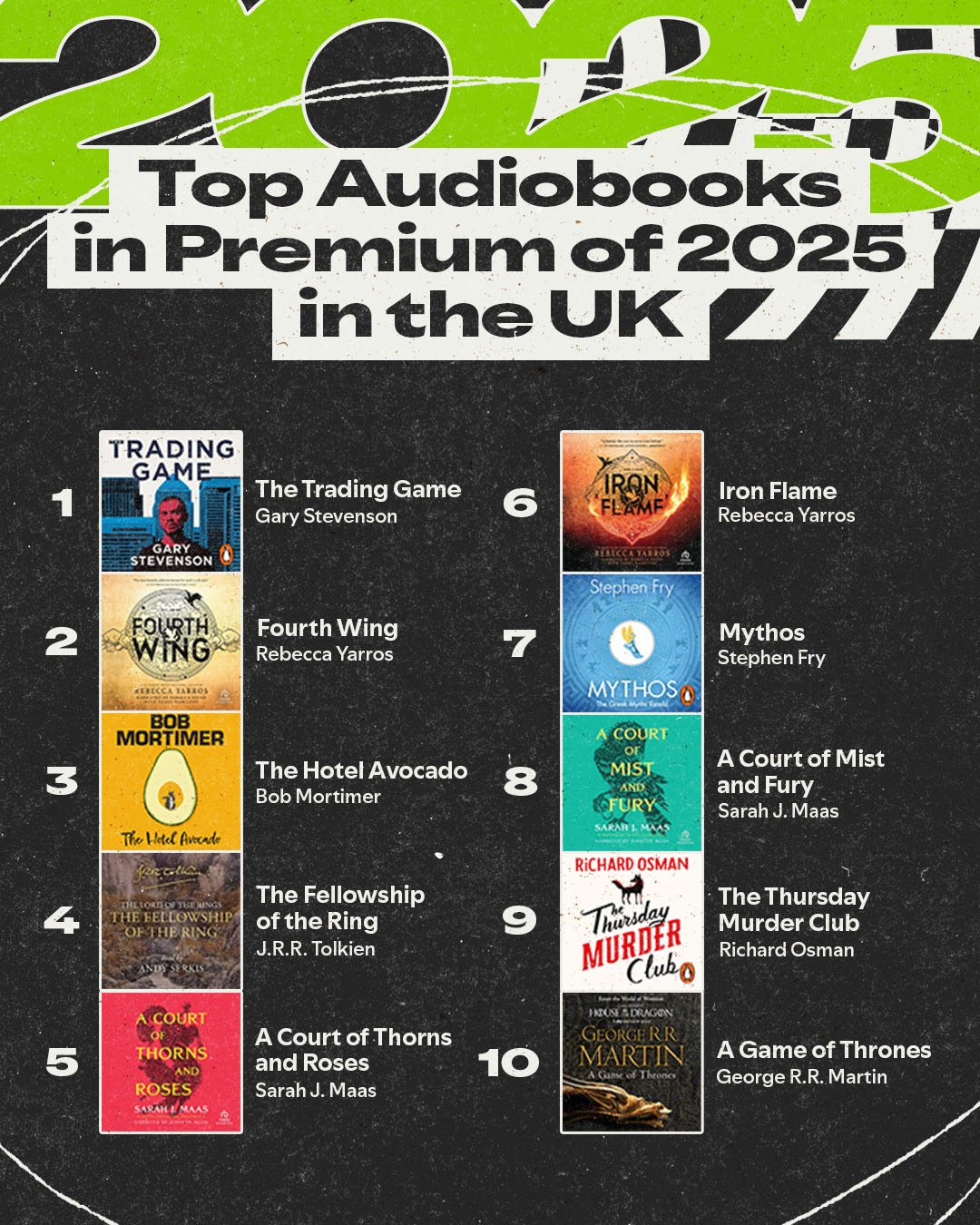
As we evaluate the literary landscape from the perspective of 2026, 2025 stands out as a transformative year for the audiobook industry. It was defined by the massive commercial success of "romantasy" sequels like Onyx Storm, the maturation of AI-assisted narration for backlist titles, and the aggressive expansion of streaming models that challenged traditional credit-based systems.
The Blockbuster Audiobooks that Defined 2025
The year 2025 was characterized by a few "tentpole" releases that dominated the charts for months. Perhaps the most significant was Rebecca Yarros’s Onyx Storm, the third installment in the Empyrean series. Released in January 2025, the audiobook version became a cultural phenomenon, driving record-breaking pre-orders on platforms like Audible and Libro.fm. The production quality, featuring high-intensity narration to match the dragon-riding stakes, set a new bar for the "romantasy" genre.
Beyond the fantasy realm, literary fiction saw a massive hit with new releases from established giants. These productions often utilized celebrity narrators to bridge the gap between film and literature, a trend that hit its peak in 2025. For listeners, the draw wasn't just the prose but the performance. High-profile actors brought a cinematic quality to domestic dramas and thrillers, making the "listen" as much of an event as a movie premiere.
In the non-fiction sector, memoirs continued to reign supreme. In 2025, the industry saw a shift toward "immersive memoirs," where authors didn't just read their text but incorporated archival audio, interviews, and ambient soundscapes. This hybrid format blurred the lines between traditional audiobooks and high-end investigative podcasts, providing a deeper value proposition for listeners who wanted more than just a direct reading of a printed book.
The Evolution of Narration: Human Artistry vs. AI Synthesis
A major point of contention and development throughout 2025 was the role of Artificial Intelligence in narration. While the technology had been nascent in previous years, 2025 was the year the industry reached a "two-tier" system.
The Rise of the "Human-Narrated" Badge
As AI voices became indistinguishable from humans for standard informational text, premium listeners began to demand—and publishers began to market—certified human narration. Professional narrators like Julia Whelan, Ray Porter, and Edoardo Ballerini became brands in their own right. In 2025, many listeners chose their next "2025 audiobook" based on the narrator rather than the author. This led to the widespread adoption of "Human-Narrated" stickers on digital covers, signaling a premium artistic product that captures the nuance, irony, and emotional depth that AI still struggled to replicate in complex fiction.
AI for the Mid-List and Backlist
Conversely, 2025 saw a massive influx of audiobooks that otherwise would never have been produced. Small indie authors and academic publishers utilized sophisticated voice synthesis to turn their entire catalogs into audio. This democratized access to information, allowing niche subjects and "mid-list" fiction to reach the growing audience of audio-first consumers. These productions were often labeled as "Virtual Voice" narrations, offered at a lower price point or included for free in various subscription tiers.
The Subscription Wars: How We Accessed Audiobooks in 2025
The way consumers paid for 2025 audiobooks underwent a seismic shift. For years, the "one credit per month" model pioneered by Audible was the industry standard. However, by 2025, the "Spotify Effect" had fully taken hold.
Spotify’s inclusion of 15 hours of audiobook listening for Premium subscribers forced other players to pivot. In response, we saw:
- Audible's Tiered Expansion: Audible expanded its "Plus" catalog significantly in 2025, including more high-demand titles to prevent churn toward Spotify.
- Libro.fm and Indie Support: The "socially conscious" listener moved toward Libro.fm, which maintained its model of sharing revenue with local bookstores while improving its app interface to compete with the tech giants.
- Library Integration: Apps like Libby and Hoopla saw record usage in 2025. As inflation impacted discretionary spending, the savvy listener returned to the digital library, though this led to longer wait times for "2025 audiobook" bestsellers like Onyx Storm.
| Feature | Audible (2025 Status) | Spotify Premium | Libby/OverDrive |
|---|---|---|---|
| Primary Model | Credit-based + Plus Catalog | Streaming (15hr limit) | Free (Library Card) |
| Ownership | You "keep" credited books | Access only while subbed | Temporary Loan |
| Selection | Largest in the world | Growing (250k+ titles) | Varies by library |
| Best For | Heavy listeners (2+ books/mo) | Casual listeners/Commuters | Budget-conscious readers |
| Exclusive Content | High (Audible Originals) | Moderate | None |
Dominant Genres and Spatial Audio Trends
While fantasy and thrillers are evergreen, 2025 saw the rise of the "Cozy Fantasy" and "Speculative Climate Fiction" genres in audio form. The immersive nature of audiobooks makes them the perfect vehicle for world-building.
Spatial Audio and Dolby Atmos
In 2025, "Spatial Audio" moved from a gimmick to a standard for major productions. Leading publishers began releasing "Atmos-ready" audiobooks, particularly for sci-fi and horror. These productions used 360-degree sound design to place the listener inside the environment. If a character in a 2025 thriller heard a floorboard creak behind them, the listener heard it behind them too. This level of technical depth required high-end headphones to fully appreciate, creating a secondary market for "audiophile-grade" listening gear specifically marketed to book lovers.
The "Full Cast" Experience
GraphicAudio and similar "full cast" productions saw a surge in 2025. Rather than a single narrator, these audiobooks featured a different actor for every role, along with cinematic music and sound effects. This "movie in your mind" approach became the preferred way to consume epic series, where the sheer number of characters could make a single-narrator experience confusing.
Prerequisites for the Modern Audiobook Listener
To navigate the 2025 audiobook landscape effectively, listeners had to manage more than just a pair of earbuds. The technical requirements and organizational hurdles became more complex as platforms diverged.
- Cross-Platform Syncing: In 2025, the ability to switch from an e-reader (like a Kindle) to an audiobook (Audible) without losing your place—known as Whispersync—remained a dominant feature. However, competitors struggled to replicate this, often leaving listeners locked into one ecosystem.
- Storage Management: With the rise of high-fidelity spatial audio files, 2025 audiobooks began to take up significantly more space on mobile devices. A standard 10-hour book in high definition could exceed 1GB, forcing users to manage their downloads more actively.
- App Compatibility: As smart cars and wearable tech (watches and VR headsets) became the primary listening devices, app stability became a major factor in choosing a platform. In 2025, Spotify's superior integration with car dashboards gave it a significant edge over smaller, glitchier niche apps.
Troubleshooting Common 2025 Audiobook Issues
Despite the technological leaps, 2025 was not without its frustrations for the digital listener. Many of these issues stemmed from the transition between different file formats and subscription limitations.
- The "15-Hour Limit" Confusion: Many Spotify users in 2025 were caught off guard when their book cut off mid-chapter because they exceeded their monthly allotted hours. The solution involved either waiting for the next billing cycle or purchasing top-up hours, which many found overpriced.
- DRM and Portability: Digital Rights Management (DRM) remained a hurdle. Users who wanted to move their purchased 2025 audiobooks to a dedicated high-res MP3 player often found themselves blocked by proprietary formats, leading to a resurgence in "DRM-free" marketplaces like Downpour.
- Narrator Swaps in Series: A frequent complaint in 2025 involved publishers changing narrators mid-way through a long-running series due to scheduling or AI cost-cutting. This often led to "review bombing" on platforms, as listeners have a deep emotional connection to the "voice" of their favorite characters.
Frequently Asked Questions
Which 2025 audiobook had the highest sales?
While final numbers are often proprietary, Onyx Storm by Rebecca Yarros is widely considered the highest-selling and most-streamed audiobook release of 2025. Its release triggered record traffic for Audible and helped solidify the "romantasy" genre as a permanent fixture in the audio market.
Is AI narration cheaper for the consumer?
Generally, yes. In 2025, many publishers offered AI-narrated titles at a 30-50% discount compared to human-narrated equivalents. Additionally, many of these titles were included for free in "Plus" or "Unlimited" style subscriptions, as the production cost was a fraction of a studio-based human recording.
Can I listen to 2025 audiobooks on my Kindle?
Yes, provided the Kindle is a Bluetooth-enabled model (such as the Paperwhite or Oasis released in recent years). In 2025, the integration between Kindle and Audible remained the most seamless way to transition between reading and listening, though it generally requires purchasing both versions or a "Kindle Unlimited" add-on.
Why do some audiobooks sounds better than others in 2025?
The difference usually comes down to the "bitrate" and the use of Dolby Atmos or Spatial Audio. High-end productions in 2025 used uncompressed audio formats and multi-channel sound design, whereas cheaper productions used standard mono or stereo tracks with higher compression to save on bandwidth.
How did Spotify change the audiobook market in 2025?
Spotify shifted the market from a "transactional" model (buying one book at a time) to a "consumption" model. By including audiobooks in their standard music subscription, they introduced millions of casual listeners to the format, though they also faced criticism from authors regarding the lower royalty rates compared to per-unit sales.
Final Recommendation for Current Listeners
As we look forward from 2026, the best way to enjoy the massive catalog of 2025 audiobooks is to adopt a hybrid approach. Utilize library apps like Libby for your "waitlist" items and high-volume listening, but continue to use credit-based systems like Audible or Libro.fm for the titles you wish to own permanently—especially those featuring award-winning human narrators. For the most immersive experience, invest in hardware that supports Spatial Audio, as the sound engineering of 2025 was specifically designed to be heard in a three-dimensional soundstage.