2000s cinema represents the industry’s most significant transition, moving from traditional celluloid film to digital production and distribution. Defined by the rise of massive multi-film franchises, the perfection of CGI, and a shift toward darker, post-9/11 thematic realism, the decade fundamentally reshaped how global audiences consume and interact with motion pictures.
The Technological Pivot: From Celluloid to Digital Dominance
The first decade of the 21st century was the primary battlefield for the "Digital vs. Analog" war in filmmaking. In 2000, the vast majority of theatrical releases were still shot on 35mm or 70mm film stock. By the time 2009 concluded, the industry had moved irreversibly toward digital acquisition and projection. This shift was not merely a matter of convenience; it altered the visual language of movies.
One of the most significant milestones occurred early in the decade when George Lucas released Star Wars: Episode II – Attack of the Clones (2002), which was the first major motion picture shot entirely on digital high-definition cameras (the Sony HDW-F900). While early critics argued that digital lacked the "warmth" of film grain, the practical benefits—such as instant playback and easier integration with Computer Generated Imagery (CGI)—made it the preferred choice for big-budget spectacles.
The refinement of CGI during this period cannot be overstated. At the turn of the millennium, digital effects often appeared "rubbery" or disconnected from real-world physics. However, companies like Weta Digital and Industrial Light & Magic (ILM) pushed the boundaries of photorealism. The character of Gollum in The Lord of the Rings: The Two Towers (2002) pioneered performance-capture technology, proving that a digital character could carry the emotional weight of a scene alongside live actors. This evolution culminated in James Cameron’s Avatar (2009), which utilized advanced stereoscopic 3D and motion capture to create a fully immersive digital world, setting a box-office record that would stand for nearly a decade.
The Rise of the Mega-Franchise and Cinematic Universes
Before the 2000s, sequels were often viewed as diminishing returns. The 2000s inverted this logic, establishing the "franchise" as the primary economic unit of Hollywood. This era saw the perfection of the trilogy and the birth of the "Cinematic Universe" model that dominates the industry as of 2026.
Peter Jackson’s The Lord of the Rings trilogy (2001–2003) was a landmark achievement in this regard. By filming all three installments simultaneously in New Zealand, Jackson demonstrated that massive literary epics could be adapted with fidelity and massive commercial success. Similarly, the Harry Potter series (2001–2011) showed that a franchise could grow alongside its audience, maintaining consistent quality and cast members over a decade.
The late 2000s also planted the seeds for the superhero saturation of the 2010s. While X-Men (2000) and Spider-Man (2002) proved that comic book movies could be mainstream hits, it was Iron Man (2008) that introduced the concept of the post-credits scene as a tool for interconnectivity. This launched the Marvel Cinematic Universe (MCU), a structural shift in storytelling where individual films served as chapters in a much larger narrative arc. This decade proved that audiences were willing to commit to long-term storytelling, provided the world-building was sufficiently compelling.
Social Reflection: Cinema in the Shadow of Global Uncertainty
Cinema is rarely produced in a vacuum, and the 2000s were deeply influenced by the geopolitical climate, specifically the aftermath of the September 11 attacks and the subsequent "War on Terror." This era saw a distinct move away from the polished, optimistic action of the 1990s toward a grittier, more cynical realism.
Christopher Nolan’s The Dark Knight (2008) is perhaps the definitive film of this trend. It reimagined the superhero genre as a contemporary urban thriller, dealing with themes of domestic terrorism, surveillance, and the moral compromises required to maintain order. This "gritty realism" extended to the spy genre as well; the James Bond franchise was rebooted with Casino Royale (2006), replacing the gadget-heavy camp of previous entries with a visceral, emotionally scarred protagonist.
In the horror genre, the "torture porn" subgenre—led by films like Saw (2004) and Hostel (2005)—reflected a collective cultural anxiety regarding violence and interrogation. Meanwhile, the "found footage" craze, ignited by the late 90s but popularized by Paranormal Activity (2007) and Cloverfield (2008), tapped into the burgeoning era of user-generated content and the pervasive nature of digital surveillance. These films suggested that the world was no longer safe, and the camera was the only witness to an increasingly chaotic reality.
The Golden Age of the "New Hollywood" Auteur
While blockbusters grew larger, the 2000s also provided a fertile ground for visionary directors to exert significant creative control within the studio system. These "auteurs" blended high-concept ideas with distinct visual styles, creating films that were both critically acclaimed and commercially viable.
- Christopher Nolan: After the non-linear success of Memento (2000), Nolan became one of the few directors capable of commanding massive budgets for original, complex ideas like Inception (though released in 2010, its development was a product of the late 2000s).
- Wes Anderson: With The Royal Tenenbaums (2001) and The Life Aquatic with Steve Zissou (2004), Anderson perfected his highly symmetrical, color-coded aesthetic, proving that highly stylized, idiosyncratic storytelling had a dedicated global audience.
- The Coen Brothers: This decade saw the Coens reach a creative zenith with No Country for Old Men (2007), a bleak, philosophical Western that won the Academy Award for Best Picture and redefined the pacing of the modern thriller.
- Paul Thomas Anderson: Films like There Will Be Blood (2007) cemented Anderson’s reputation as a master of the character study, utilizing long takes and intense performances to explore the dark underbelly of the American Dream.
International Breakthroughs and Globalized Storytelling
The 2000s saw a significant decrease in the "subtitle barrier" for English-speaking audiences. The globalization of the film market led to international titles achieving unprecedented success in the United States and Europe.
Ang Lee’s Crouching Tiger, Hidden Dragon (2000) was a watershed moment, grossing over $128 million in the U.S. alone—a staggering figure for a non-English language film. This paved the way for other international masterpieces to enter the mainstream consciousness, such as the Brazilian crime epic City of God (2002), the South Korean thriller Oldboy (2003), and Guillermo del Toro’s Spanish-language dark fantasy Pan’s Labyrinth (2006). These films were not just "foreign cinema" relegated to art houses; they were central to the global cinematic conversation, influencing the aesthetics and narrative structures of Hollywood productions.
| Feature Film | Year | Primary Innovation/Impact | Academy Award Wins |
|---|---|---|---|
| Gladiator | 2000 | Revived the "Sword and Sandal" epic genre. | 5 (incl. Best Picture) |
| Spirited Away | 2001 | Validated Japanese Anime as a global artistic force. | 1 (Best Animated Feature) |
| The Lord of the Rings: Return of the King | 2003 | Proved fantasy could dominate the Oscars and Box Office. | 11 (incl. Best Picture) |
| Brokeback Mountain | 2005 | Brought LGBTQ+ narratives into the mainstream awards circuit. | 3 |
| The Departed | 2006 | Represented Martin Scorsese’s long-awaited Best Director win. | 4 (incl. Best Picture) |
| Avatar | 2009 | Revolutionized 3D technology and digital world-building. | 3 |
The Transformation of Animation: The Pixar Era
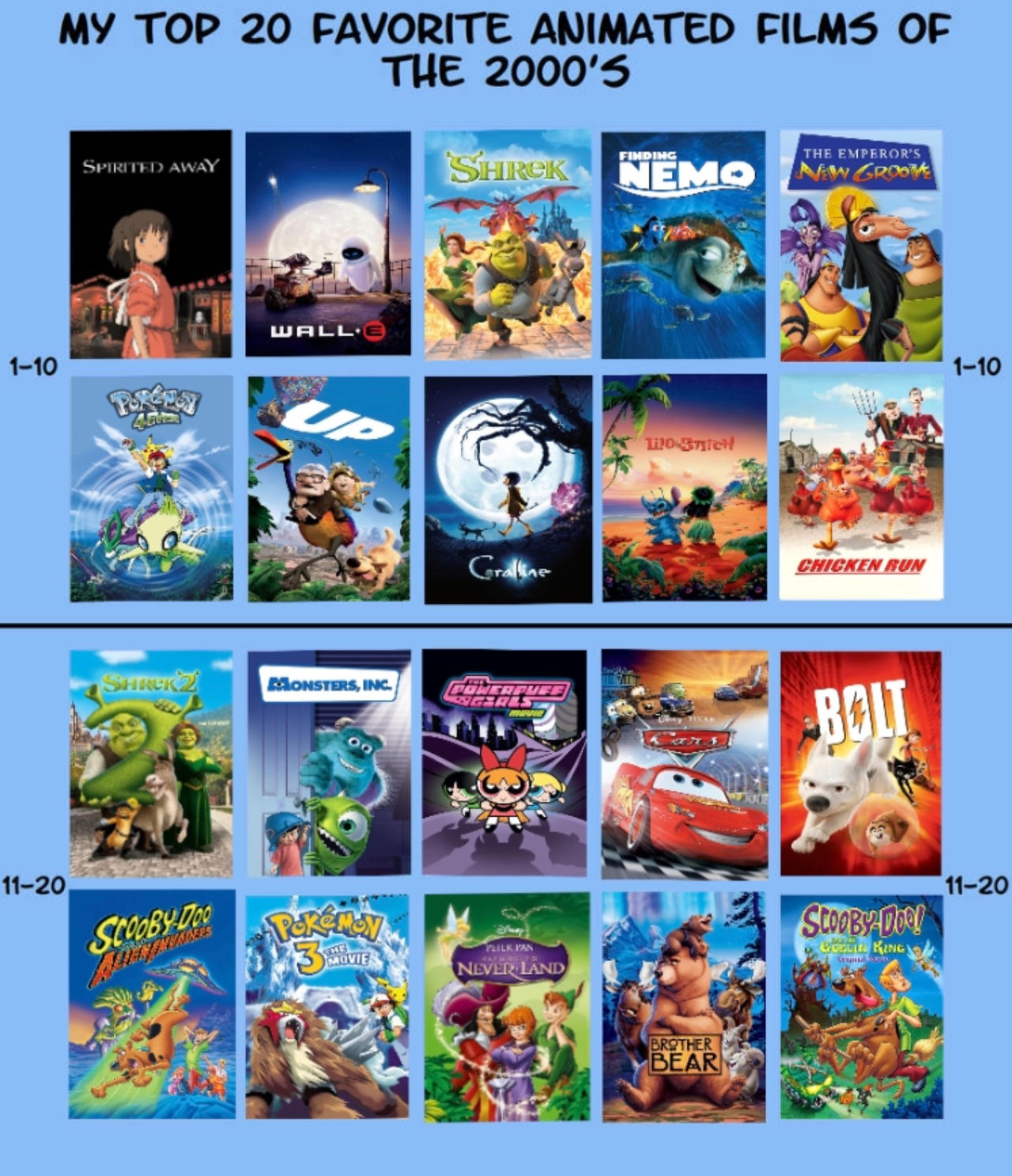
The 2000s marked the definitive decline of traditional hand-drawn animation in favor of 3D computer animation. Disney’s dominance was challenged, then bolstered, by its partnership with (and eventual acquisition of) Pixar Animation Studios. Pixar’s run during this decade remains one of the most successful creative streaks in film history.
Beginning with Monsters, Inc. (2001) and continuing through Finding Nemo (2003), The Incredibles (2004), Ratatouille (2007), and WALL-E (2008), Pixar demonstrated that "family films" could possess the thematic depth and emotional complexity of the best adult dramas. Up (2009) became only the second animated film in history to be nominated for the Academy Award for Best Picture.
While Pixar set the gold standard, DreamWorks Animation also found massive success with the Shrek franchise, which introduced a more irreverent, pop-culture-heavy approach to animation that would be widely imitated. This decade established that animation was no longer a "genre" for children but a medium capable of sophisticated storytelling for all ages.
FAQ
What was the highest-grossing film of the 2000s?
The highest-grossing film released between January 1, 2000, and December 31, 2009, was Avatar (2009), directed by James Cameron. It surpassed Cameron's previous record-holder, Titanic (1997), to become the first film to gross over $2 billion globally. Its success was largely attributed to its groundbreaking use of 3D technology, which commanded higher ticket prices and encouraged repeat viewings in theaters.
Which director is most associated with the 2000s cinematic style?
Christopher Nolan is often cited as the director who most accurately defined the decade's shift toward "elevated genre" filmmaking. Starting with Memento (2000) and culminating in The Dark Knight (2008), Nolan's emphasis on practical effects, non-linear narratives, and thematic depth within large-scale studio productions set a template that many other filmmakers attempted to follow throughout the 2010s.
How did the 2000s change the way movies are distributed?
The 2000s saw the beginning of the end for physical media dominance. While the DVD market peaked in the mid-2000s, providing studios with massive "home video" revenue, the decade ended with the rise of digital streaming and Video on Demand (VOD). Netflix began its transition from a DVD-by-mail service to a streaming platform in 2007, a move that would eventually decentralize the theatrical experience in the following decade.
What was the first movie to be nominated for Best Picture that was shot digitally?
While digital use was increasing, the first film shot primarily on digital video to win the Academy Award for Best Picture was Slumdog Millionaire (2008). Directed by Danny Boyle, the film used the Silicon Imaging SI-2K digital camera system for much of its footage, proving that the digital format was capable of meeting the aesthetic standards of the Academy.
Why did 3D movies become so popular in the late 2000s?
The surge in 3D popularity was a strategic move by theaters and studios to offer an experience that could not be replicated at home. With the rise of high-definition home theaters and piracy, the industry used "stereoscopic 3D" as a value-add. While Avatar was the most successful example, the late 2000s saw a massive influx of 3D conversions, though interest eventually waned as the 2010s progressed.
Navigating the 2000s Catalog Today
For those looking to explore or revisit 2000s cinema, the focus should remain on the decade’s dual identity: its massive technical advancements and its intimate, often darker character explorations. To understand the current landscape of 2026 cinema, one must look back at the 2000s as the era that established the "rules" of the modern blockbuster.
A practical next step for students of film is to compare the "Best Picture" winners of the decade with the highest-grossing films. The 2000s was one of the last periods where there was significant crossover between critical darlings and box-office giants. Watching the transition from Gladiator at the start of the decade to Avatar at the end provides a complete masterclass in how the industry learned to stop fearing digital technology and start using it to build entirely new worlds.