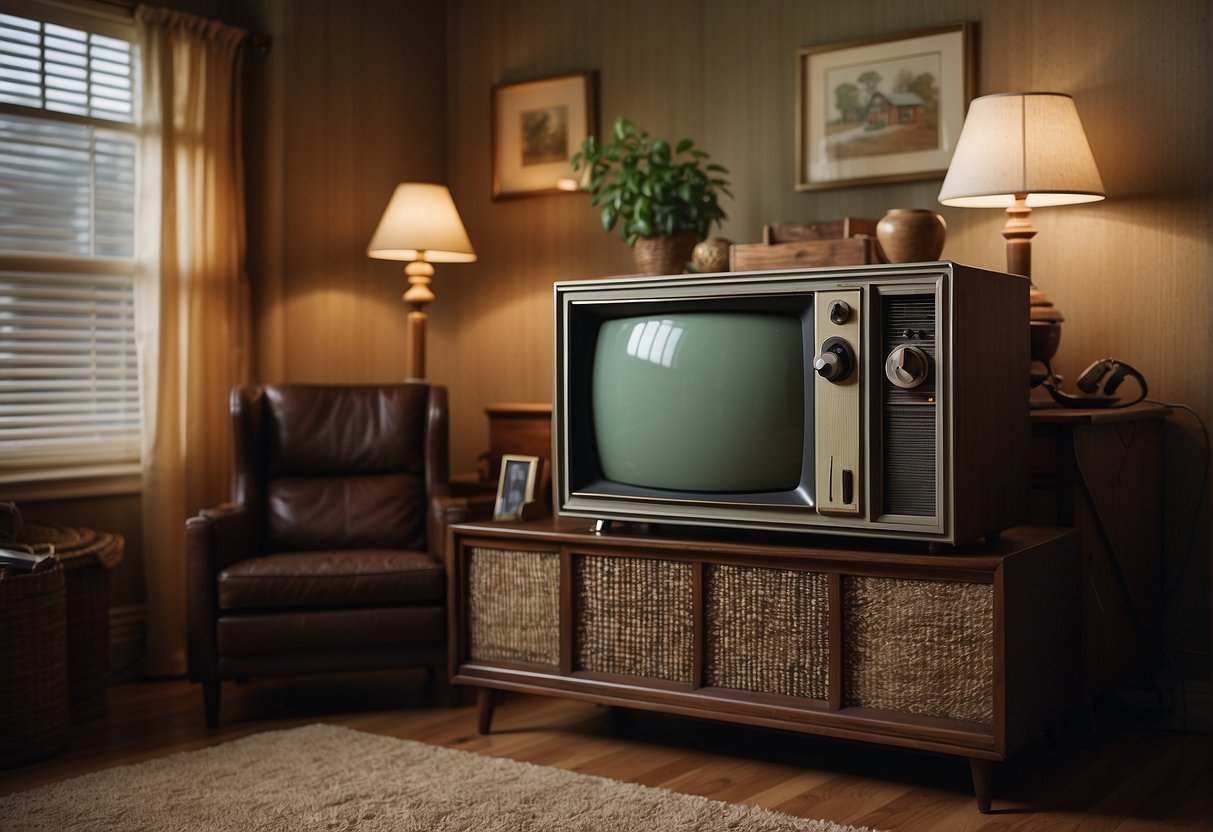
The 1970s television landscape transformed home entertainment through bold sociopolitical sitcoms, groundbreaking made-for-TV movies, and the widespread transition from monochrome broadcasts to vibrant color displays. This era redefined how households consumed media, laying the structural foundations for the modern cable and syndication networks we recognize today.
The Technological Transition: From Monochrome to Color Saturation
The technological identity of 1970s TV was defined by the definitive shift from black-and-white receivers to ubiquitous color television sets. While color broadcasting had technically commenced in the previous decade, it was during the 1970s that color set ownership crossed the 50 percent threshold in North American and European households, fundamentally altering set design, costuming, and cinematography.
Broadcasters could no longer rely on grayscale contrast to define spatial depth. Production teams adapted by utilizing saturated palettes, distinct lighting configurations, and higher-contrast set designs. Cathode-ray tube (CRT) technology evolved to become more reliable, though sets remained heavy, bulky pieces of furniture housing wood-grain veneers, rotary dials, and occasionally wired remote controls.
The introduction of solid-state components replaced vacuum tubes in many receivers, reducing warm-up times and equipment failure rates. Simultaneously, the launch of domestic communication satellites revolutionized signal distribution. Networks could transmit live events and syndicated programming coast-to-coast with unprecedented clarity, shrinking the technical gap between major metropolitan stations and regional affiliates.
The Evolution of the Sitcom: Reflecting Social Realism
Before the 1970s, network sitcoms largely favored escapist suburban fantasies and whimsical premises. The 1970s shattered this mold, spearheaded by television innovator Norman Lear and other visionary producers who introduced serialized social commentary, sharp satire, and gritty urban realism directly into prime-time living rooms.
Shows like All in the Family, Maude, Good Times, and The Jeffersons tackled previously taboo subjects head-on. Racism, inflation, feminism, the Vietnam War, and political corruption became regular fodder for comedic and dramatic exploration. Rather than presenting spotless, idealized family units, 1970s writers crafted deeply flawed, multi-dimensional characters whose interpersonal conflicts mirrored the polarization of the decade.
| Show Title | Network | Original Run | Primary Themes & Cultural Impact |
|---|---|---|---|
| All in the Family | CBS | 1971–1979 | Blue-collar conservatism, generational conflict, civil rights, and racial prejudice. |
| MASH* | CBS | 1972–1983 | Anti-war sentiment, gallows humor, institutional bureaucracy, and moral ambiguity. |
| The Mary Tyler Moore Show | CBS | 1970–1977 | Independent womanhood, workplace equality, and modern urban career lifestyles. |
| Good Times | CBS | 1974–1979 | Inner-city poverty, systemic inequality, and African American family resilience. |
This sub-genre of socially conscious television required viewers to engage critically with contemporary debates. Even workplace comedies like The Mary Tyler Moore Show elevated the cultural discourse by centering independent career women navigating professional ambitions without relying on traditional marital narratives.
The Rise of Serialized Drama and Epic Miniseries
While episodic police procedurals and medical dramas remained network staples, the 1970s birthed narrative formats that demanded sustained audience commitment. Crime dramas such as Columbo, Kojak, and The Rockford Files established complex anti-heroes and sophisticated storytelling mechanics that eschewed simple moral resolutions.
The most structural innovation of the decade, however, was the blockbuster television miniseries. Productions like Roots (1977) and Holocaust (1978) shattered viewing records by presenting expansive, multi-part historical narratives over consecutive nights. Roots, based on Alex Haley’s novel, drew an estimated 100 million viewers for its finale, effectively pausing American social life and demonstrating the unique unifying power of network broadcasting.
These multi-night events proved that television could sustain epic historical storytelling on a cinematic scale, paving the way for modern serialized prestige dramas and streaming event arcs.
The Birth of Cable Television and Home Recording
The monopolistic control held by the traditional "Big Three" networks (ABC, CBS, and NBC) began to fracture during the 1970s with the commercial expansion of cable television and home video recording technology.
Cable television, originally developed as Community Antenna Television (CATV) to deliver signals to geographically isolated regions, evolved into a distinct programming medium. Home Box Office (HBO) launched in 1972 as a pay-cable network, transmitting feature films and sports events via satellite to local cable operators. This model eliminated traditional advertising dependence and established subscription-based revenue models.
Simultaneously, the introduction of home video cassette recorders (VCRs)—specifically Sony’s Betamax in 1975 and JVC’s VHS format in 1976—empowered consumers to record live broadcasts for delayed viewing. This technological leap introduced "time-shifting" into the lexicon of media consumption, granting audiences unprecedented autonomy over their viewing schedules and initiating structural anxieties regarding copyright and advertising retention.
Variety Shows, Late Night, and Counterculture
No examination of 1970s TV is complete without acknowledging the dominance of the prime-time variety show and the maturation of late-night counterculture programming. Shows like The Carol Burnett Show and The Sonny & Cher Comedy Hour blended sketch comedy, musical performances, and celebrity guest appearances into weekly cultural touchstones.
Concurrently, Saturday Night Live (SNL), created by Lorne Michaels and debuting on NBC in 1975, captured the cynical, anti-establishment ethos of post-Watergate America. SNL bridged the gap between traditional television comedy and youth counterculture, utilizing sketch satire, recurring characters, and live musical acts to redefine late-night entertainment.
These programs thrived on unpredictability and live performance formats, creating water-cooler moments that galvanized public discourse the following morning in schools and offices.
Common Misconceptions About 1970s Programming
Modern audiences frequently misinterpret the production constraints and stylistic choices of 1970s television, applying contemporary aesthetic standards to a historically distinct medium.
- Myth: All 1970s shows were filmed on videotape. While soap operas, news broadcasts, and studio-bound sitcoms utilized multi-camera videotape setups, prestige dramas, action series, and location-shot comedies were predominantly captured on 16mm or 35mm film for cinematic texture and editing flexibility.
- Myth: Cable television was immediately accessible to all households throughout the decade. In reality, cable penetration remained a fraction of total television households well into the late 1970s, constrained by municipal franchising agreements and infrastructure costs.
- Myth: Television content was entirely sanitized prior to cable. In truth, the network broadcast standards committees engaged in fierce battles with producers over language, sexual content, and political critique, leading to some of the most provocative and socially subversive writing in television history.
Frequently Asked Questions
What were the dominant television networks during the 1970s?
The American television landscape was dominated by the "Big Three" commercial broadcast networks: ABC, CBS, and NBC. Public broadcasting also gained significant cultural footprint during this era with the establishment of the Public Broadcasting Service (PBS) in 1970, which introduced landmark educational and cultural programming such as Sesame Street and Masterpiece Theatre.
How did the introduction of the VCR change television viewing?
The introduction of the VCR enabled "time-shifting," allowing viewers to record television broadcasts onto magnetic tape cassettes and watch them at a later time. This capability dismantled the absolute necessity of appointment viewing, though it also sparked legal debates regarding copyright infringement between content producers and hardware manufacturers.
Why are 1970s sitcoms considered socially significant?
Unlike the escapist domestic comedies of the 1950s and 1960s, 1970s sitcoms directly engaged with contemporary sociopolitical realities, including civil rights, women's liberation, economic inflation, and political cynicism. Producers utilized humor as a vehicle to challenge ingrained cultural prejudices and foster national conversations about systemic inequality.
When did color television surpass black-and-white sets in popularity?
Color television sales surpassed black-and-white set sales in the United States around 1972. By the mid-to-late 1970s, the vast majority of prime-time network broadcasts were produced, transmitted, and received in full color, rendering monochrome sets increasingly obsolete except for portable or secondary household use.
What was the impact of HBO on the television industry?
Launched in 1972, HBO pioneered the premium pay-cable subscription model. By distributing uncut feature films and sports programming via satellite directly to cable systems, HBO demonstrated that viewers were willing to pay recurring fees for commercial-free, higher-tier entertainment, laying the groundwork for the modern subscription video-on-demand era.
Exploring and Preserving 1970s Media Heritage
For media historians, collectors, and enthusiasts seeking to explore 1970s television today, prioritize physical media releases, official streaming archives, and specialized restoration projects. Many classic series suffer from master tape degradation, music licensing replacements, or syndicated edits on standard broadcast reruns. Seek out curated Blu-ray collections, official network archives, and authorized streaming platforms that preserve original broadcast cuts, aspect ratios, and interstitial continuity to experience the era with historical accuracy.