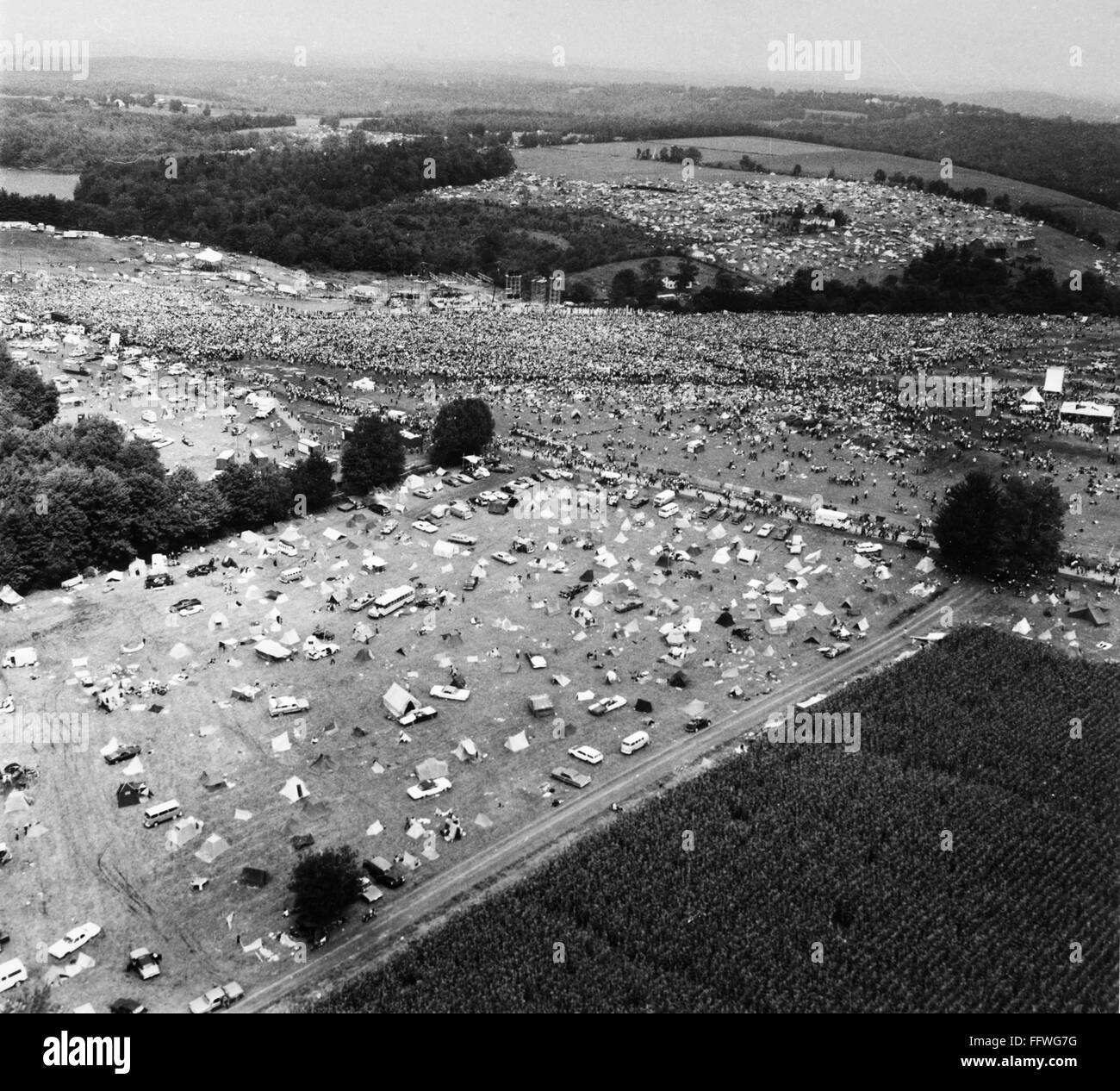
The 1969 Woodstock Music and Art Fair stands as a defining cultural milestone of the 20th century, drawing an estimated 400,000 to 500,000 attendees to a dairy farm in Bethel, New York, from August 15 to 18, 1969. Despite facing severe logistical failures, traffic gridlock, adverse weather, and inadequate sanitation infrastructure, the event achieved legendary status as a peaceful manifestation of the 1960s counterculture movement and a benchmark for modern open-air concert production.
Origins and Conceptualization of the 1969 Music Festival
The genesis of the 1969 music festival began as a commercial enterprise conceived by four young entrepreneurs: Michael Lang, Artie Kornfeld, John Roberts, and Joel Rosenman. Initially, the founders sought to build a recording studio in Woodstock, New York, a community already renowned for its thriving artistic colony and past residence of figures like Bob Dylan. However, the project quickly evolved from a local studio venture into a massive outdoor music festival designed to celebrate the burgeoning youth culture of the late 1960s.
Securing financial backing from Roberts and Rosenman, the promoters established Woodstock Ventures, Inc. They initially planned the event for an industrial park in the town of Wallkill, New York. Preparations proceeded with ambitious marketing campaigns, securing major musical acts, and selling advance tickets. However, the commercial ambition collided sharply with local resistance. In July 1969, just weeks before the gates were set to open, the Wallkill town board enacted a restrictive ordinance that effectively revoked the festival's permits, citing concerns over sanitation facilities and crowd control.
Faced with financial ruin and vanishing time, the promoters scrambled for an alternative location. Max Yasgur, a dairy farmer owning a 600-acre parcel in Bethel, New York—located approximately 43 miles southwest of the original site—stepped forward and agreed to lease his land. This eleventh-hour relocation saved the festival from cancellation but compressed the construction timeline into a frantic few weeks, setting the stage for an unprecedented logistical challenge.
Logistical Collapse and the Transition to a Free Event
The physical transformation of Max Yasgur’s alfalfa field into a temporary metropolis required massive civil engineering feats, including the rapid erection of stages, sound towers, medical tents, and fencing. Yet, the sheer volume of humanity descending upon rural Sullivan County overwhelmed every preparation. On opening day, the New York State Thruway experienced a 20-mile traffic jam, leading thousands of motorists to abandon their vehicles on the highway and walk miles to the festival grounds.
Faced with gridlock that rendered ticket-taking impossible and perimeter fences that were routinely knocked down by surging crowds, the organizers made a critical operational decision. On the morning of August 15, Michael Lang announced that the festival would officially become a free event. This declaration exacerbated the supply crisis. Organizers had prepared food, water, and sanitary facilities for an estimated 50,000 to 100,000 ticket holders, but the final attendance surpassed half a million people, creating critical shortages across all essential provisions.
| Operational Area | Initial Plan | Actual Reality | Consequence |
|---|---|---|---|
| Attendance | 50,000 – 100,000 paid | 400,000 – 500,000 estimated | Severe infrastructure strain and gridlock |
| Ticketing | Advanced sales and gate collection | Free admission declared on Day 1 | Loss of projected revenue; budget deficit |
| Sanitation | Limited portable restrooms | Severely inadequate facilities | Widespread contamination and public health concerns |
| Medical Services | Small local first-aid tent | Field hospital staffed by Hog Farm and volunteers | Treatment of thousands for injuries, bad trips, and dehydration |
Performances and Musical Highlights
Despite the environmental hardships, technical glitches, and torrential downpours that turned the sloping pasture into a vast sea of mud, the musical performances delivered iconic moments that transcended the era. The lineup featured a mix of folk, rock, blues, and psychedelic acts, many of which cemented their historical reputations through their festival appearances.
Richie Havens opened the festival on Friday afternoon, performing an extended, energetic set because subsequent artists were stuck in traffic. His improvised song "Freedom" became one of the defining anthems of the gathering. As the weekend progressed, legendary performances followed, including Ravi Shankar’s hypnotic evening raga, Santana’s explosive breakthrough set driven by the youthful percussion of Michael Shrieve, and Creedence Clearwater Revival’s gritty late-night rockabilly.
| Day / Date | Notable Artists & Bands | Key Set Highlights |
|---|---|---|
| Friday, Aug 15 – Saturday, Aug 16 | Richie Havens, Joan Baez, Ravi Shankar, Arlo Guthrie | Extended opening sets; acoustic performances during rain delays |
| Saturday, Aug 16 – Sunday, Aug 17 | Santana, Grateful Dead, Creedence Clearwater Revival, Janis Joplin, The Who | High-energy electric sets; iconic renditions of classic rock staples |
| Sunday, Aug 17 – Monday, Aug 18 | Joe Cocker, Ten Years After, The Band, Crosby, Stills, Nash & Young, Jimi Hendrix | Emotionally charged blues-rock; legendary festival-closing guitar solos |
Sunday evening and Monday morning brought the festival's climax. Joe Cocker delivered a ferocious, physically intense rendition of The Beatles' "With a Little Help from My Friends," followed by legendary sets from The Band, Mountain, and Crosby, Stills, Nash & Young. Finally, as dawn broke on Monday, August 18, Jimi Hendrix took the stage as the closing act. Backed by his temporary band, Gypsy Sun and Rainbows, Hendrix delivered a radical, feedback-laden deconstruction of "The Star-Spangled Banner," transforming the national anthem into a sonic commentary on the Vietnam War and industrial civilization.
Sociological Impact and Countercultural Mythos
The 1969 music festival functioned as a profound sociological experiment. For three days, a temporary city larger than most municipalities in the state of New York operated without conventional police presence, yet maintained a remarkably peaceful atmosphere. This phenomenon was widely attributed to the shared countercultural ethos of the attendees, who embraced values of pacifism, communal sharing, and anti-establishment sentiment.
Local law enforcement and state officials braced for widespread violence and property destruction, but violent crime remained exceptionally low. Instead, the primary medical emergencies involved exhaustion, foot lacerations from discarded glass, adverse reactions to psychedelics, and gastrointestinal illnesses caused by contaminated water. The Hog Farm, a California-based hippie commune led by Wavy Gravy, managed the on-site security and the free kitchen, distributing water and rice while defusing tensions with humor and empathy.
The media coverage played a transformative role in shaping the public perception of the event. While early mainstream news reports emphasized the impending disaster of traffic jams, drug use, and sanitation failures, later coverage shifted tone as reporters observed the remarkable cooperation among the attendees. This narrative of peace, music, and communal harmony crystallized the mythos of Woodstock, framing it as the high-water mark of the 1960s counterculture movement.
Financial Realities and Subsequent Legacies
While the cultural impact of the 1969 music festival was immeasurable, its immediate financial outcome was a disaster for its creators. Woodstock Ventures faced debts totaling over $1 million, equivalent to millions of dollars in modern currency. Promoters spent years paying off equipment rentals, property damage claims from local residents, and loans secured to cover production costs. It was only through the unexpected commercial success of Michael Wadleigh’s 1970 documentary film Woodstock and the accompanying soundtrack album that the founders eventually cleared their debts.
The festival also established a template for modern multi-day rock festivals, demonstrating the immense commercial viability of large-scale outdoor events. However, subsequent attempts to replicate the specific magic and sociological conditions of the 1969 gathering—such as Woodstock '94 and the disastrous Woodstock '99—demonstrated that the unique historical convergence of 1960s activism, generational alienation, and spontaneous improvisation could not be easily manufactured for profit.
Today, the original site in Bethel, New York, is home to the Bethel Woods Center for the Arts, a performing arts complex and museum dedicated to preserving the history of the 1969 festival. The historic field where the crowds gathered remains an open pasture, designated as a site of national historical significance, drawing thousands of visitors annually who seek to understand the physical birthplace of a cultural legend.
Frequently Asked Questions About the 1969 Music Festival
Where was the 1969 music festival actually held?
The festival was held on a 600-acre dairy farm owned by Max Yasgur in Bethel, New York. Although initially planned for Wallkill, New York, local zoning blocks forced a relocation just weeks before the event.
Why did the 1969 music festival become a free concert?
Organizers declared the event free on the morning of opening day because the overwhelming influx of hundreds of thousands of attendees made ticket collection and perimeter enforcement logistically impossible.
How many people attended the 1969 music festival?
Estimates place total attendance between 400,000 and 500,000 people, significantly higher than the 50,000 to 100,000 tickets originally sold by the promoters.
Who performed the final set at the 1969 music festival?
Jimi Hendrix performed the final set, taking the stage at dawn on Monday, August 18, 1969, accompanied by his group Gypsy Sun and Rainbows.
Did the organizers make a profit from the 1969 festival?
No, the promoters incurred over $1 million in debt due to unpaid ticket sales, property damage, and massive infrastructure costs, though they eventually broke even through the success of the 1970 documentary film.