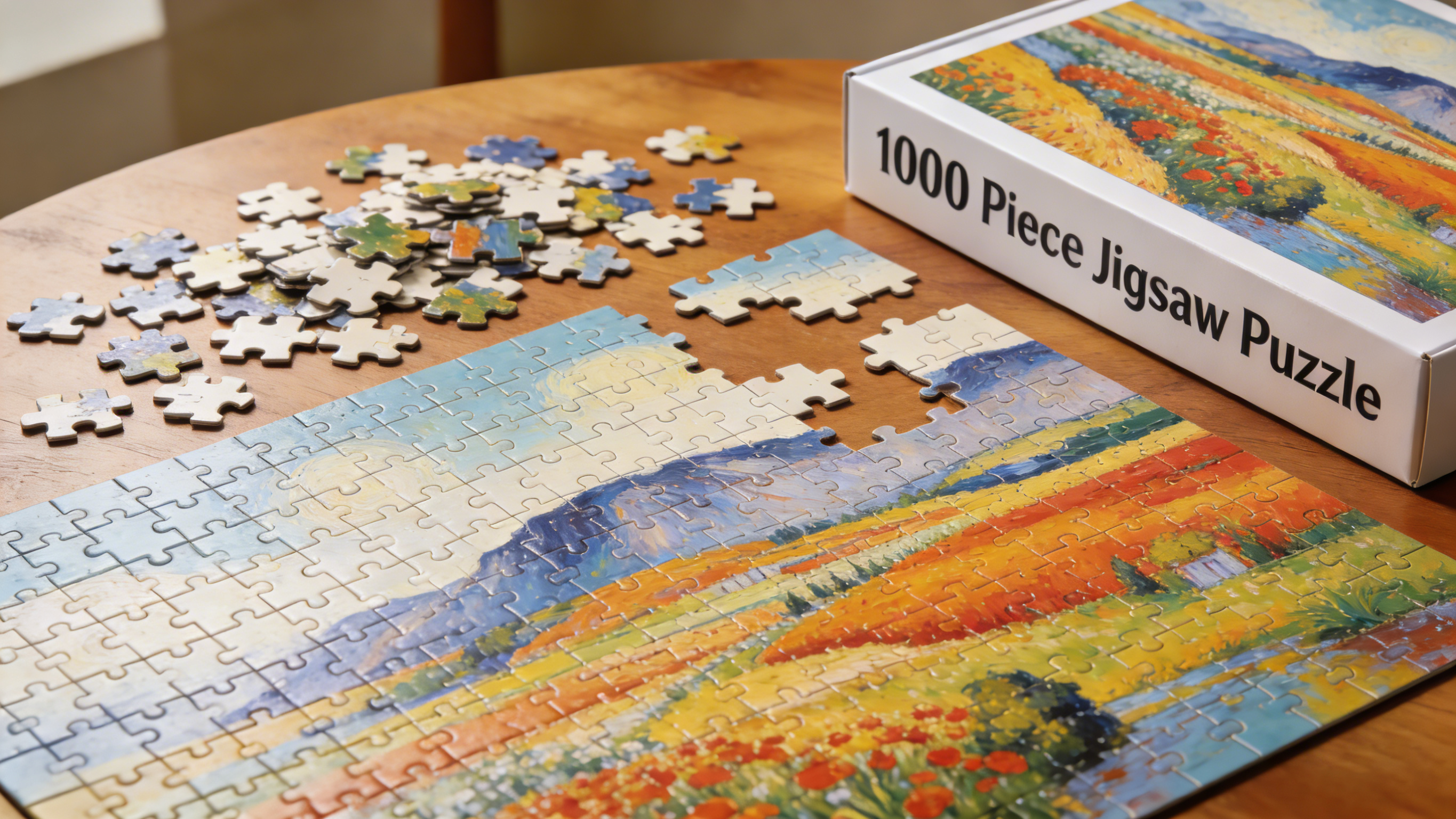
1000-piece jigsaw puzzles represent the sweet spot of tabletop puzzling, delivering an ideal balance of accessible fun and rigorous cognitive challenge. Requiring between 8 and 15 hours to complete on average, this standard format offers an engaging, screen-free project for individual solvers, pairs, and families seeking structured relaxation and shared achievement.
Why the 1000-Piece Format Is the Gold Standard of Puzzling
Across the global board game and hobby sector, the 1000-piece count has long maintained its status as the industry standard. While 300-piece and 500-piece puzzles serve as quick warm-ups or entry points for younger solvers, and 2000+ piece sets demand dedicated, semi-permanent furniture, the 1000-piece configuration hits a unique spatial and psychological target. It provides enough visual complexity to challenge seasoned adult solvers without overwhelming a standard dining table or living room setup.
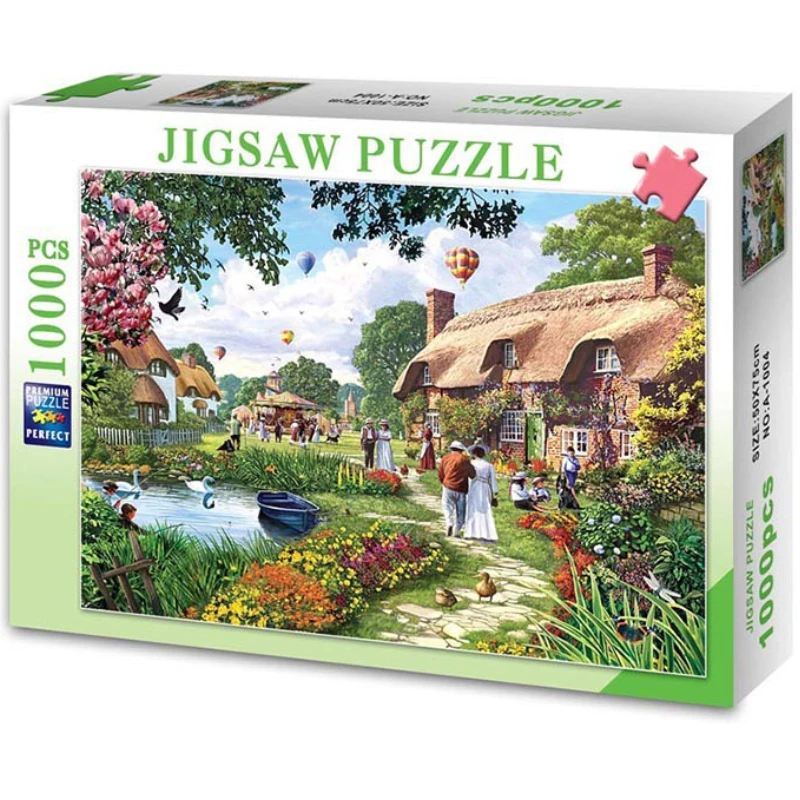
From a physical perspective, the finished dimensions of a standard rectangular 1000-piece puzzle generally measure around 20 by 27 inches (roughly 50 by 70 centimeters), though circular, panoramic, and custom shapes vary slightly. This standard footprint means almost any household table, kitchen island, or dedicated portable puzzle board can accommodate the assembly process.
The satisfaction derived from completing a 1000-piece assembly lies in its structured progression. Solvers experience distinct phases of discovery: the initial systematic sorting, the dopamine-driven early wins of framing the perimeter, the steady momentum of filling mid-ground patterns, and the thrilling final sprint when every remaining piece locks cleanly into place. This operational structure transforms a box of loose cardboard or wood into a tactile, rewarding experience suitable for solo retreat or collaborative family gathering.
Essential Workspace Setup and Physical Requirements
Attempting a 1000-piece puzzle on an unprepared surface creates unnecessary friction, leading to missing pieces, back strain, and ruined assembly progress. Setting up an ergonomic, stable environment is the single best step you can take before breaking the factory seal on a new box.
Surface Area and Clearance
A standard 1000-piece puzzle requires an assembly workspace of at least 24 by 30 inches to hold the main image frame comfortably. However, the total footprint needed is significantly larger once piece sorting comes into play. Unsorted or sorted pieces spread across a flat area take up roughly twice the surface space of the completed image itself. To work efficiently without overlapping pieces, aim for a total working space of approximately 36 by 48 inches.
- Total Workspace (36" x 48" recommended)
- Main Puzzle Area (Approx. 20" x 27")
- Sorting Trays & Loose Pieces
Lighting and Ergonomics
Lighting plays a crucial role in distinguishing fine color gradients and subtle surface textures. Direct sunlight or harsh overhead lights can create glare on glossy puzzle finishes, causing eye fatigue over extended sessions. Position your assembly area under natural, indirect light, or use an adjustable overhead desk lamp featuring daylight-spectrum LED bulbs (around 5000K).
Ergonomically, long hours spent leaning over a flat table put stress on the lower back and neck. Utilizing a slightly tilted puzzle board (angled between 15 and 30 degrees) reduces neck strain by bringing the top edge of the puzzle closer into view. Dedicated puzzle mats or felt-lined boards also prevent pieces from sliding around on smooth wooden surfaces.
Proven Strategies for Tackling a 1000-Piece Puzzle
While some casual solvers prefer a chaotic, random assembly style, applying a systematic approach streamlines the process, prevents frustration, and ensures steady progress through difficult sections.
- Phase 1: Sorting & Edges (Isolate frame pieces)
- Phase 2: Anchors & Colors (Build distinctive motifs)
- Phase 3: Texture & Grid Fill (Match piece shapes & cuts)
Step 1: The Master Sort and Frame Construction
The initial sorting phase sets the foundation for the entire project. Spread all 1000 pieces face-up across your designated tray system or secondary table surface. As you flip each piece, isolate all frame pieces—those with at least one flat, straight edge. Four specific corner pieces will feature two perpendicular straight edges.
Assemble the outer boundary first. Constructing the frame establishes the true physical boundary of your project, confirms the scale of the image, and provides immediate structural reference points for interior details.
Step 2: Categorization by Color, Pattern, and Focal Points
Once the edge is built, sort your remaining interior pieces into distinct groups using stackable plastic sorting trays or cardboard inserts. Group pieces based on obvious visual elements:
- High-contrast focal points: Text, bright objects, faces, logos, or distinct architectural features.
- Color blocks: Groups of distinct hues, such as a red barn, a blue sky, or green foliage.
- Texture patterns: Striated wood grains, polka dots, water ripples, or sharp geometric lines.
Assemble these high-contrast "islands" first on your board. Building independent sections outside the main frame allows you to move finished blocks into position once their anchoring connection points become clear.
Step 3: Piece Shape Sorting for Difficult Monochromatic Zones
When facing large areas of uniform color—such as vast blue skies, deep oceans, or dark background dropouts—color sorting reaches its limit. At this stage, sort remaining pieces purely by physical geometry:
- Standard two-in, two-out: The conventional knob-and-hole configuration.
- Three-in, one-out or three-out, one-in: Asymmetrical pieces useful for directional matching.
- Four-in or four-out: Distinctive solid "cross" pieces or "hole-only" configurations.
- Line-cut or irregular pieces: Non-standard cuts found in random-cut designs.
By organizing monochrome sections by shape, you turn a guess-and-check ordeal into a process of elimination, matching specific knob shapes to open grid spaces.
Mental and Cognitive Benefits of High-Count Puzzling
Assembling a 1000-piece jigsaw puzzle is far more than a simple pastime; it offers tangible cognitive and psychological rewards supported by neurological research. Engaging with spatial visual challenges activates multiple areas of the brain simultaneously.
Visual Processing (Occipital Lobe)
- Spatial Reasoning (Parietal Lobe) and Problem Solving (Prefrontal Cortex)
- Dopamine Release & Mindfulness (Neurochemical Reward)
- Spatial Reasoning (Parietal Lobe) and Problem Solving (Prefrontal Cortex)
Enhanced Visual-Spatial Reasoning: Finding where an individual piece fits within a large layout requires evaluating shape, size, color, and directional orientation. This mental rotation exercise strengthens spatial awareness and short-term visual memory.
Dopamine Release and Neuroplasticity: Every successful connection releases a small amount of dopamine, the neurotransmitter responsible for reward, motivation, and attention. This consistent reward mechanism reinforces focus and supports long-term mental sharpness.
Meditative Stress Reduction: The focused effort required by high-count puzzles encourages a state of "flow"—a psychological condition where external stressors dissolve in favor of single-task immersion. Concentrating on tactile, non-digital tasks provides a welcome break from screen fatigue and constant digital notifications.
Cooperative Problem-Solving: Working on a 1000-piece puzzle with family members or friends fosters non-competitive collaboration. It encourages natural conversation, shared spatial goal-setting, and joint celebrated milestones without the pressure of digital entertainment.
Choosing the Right Puzzle: Material Quality, Piece Cut, and Image Design
The experience of assembling a 1000-piece puzzle depends heavily on manufacturing quality and image selection. Understanding the technical specifications of puzzle construction helps you select a product that matches your personal preference and skill level.
| Feature Category | Parameter / Specification | Impact on Puzzling Experience | Recommendation |
|---|---|---|---|
| Material Base | Premium European Blueboard | Resists bending, eliminates dust, ensures crisp piece snap | Ideal for repeated assemblies and long-term durability |
| Material Base | Recycled Standard Cardboard | Budget-friendly option, prone to minor layer peeling | Great for casual, single-use puzzling |
| Material Base | Natural Hardwood / Birch | Rigid, produces distinct tactile click, highly durable | Excellent for display pieces and sensory feel |
| Cut Style | Grid Cut (Ribbon Cut) | Uniform matrix of systematic rows and columns | Preferred for structured, methodical solvers |
| Cut Style | Random Cut (Victorian Style) | Unique, non-traditional piece shapes with slanted edges | Best for solvers seeking maximum visual challenge |
| Surface Finish | Linen / Matte Anti-Glare | Reduces light reflections under bright indoor lamps | Essential for evening sessions under artificial light |
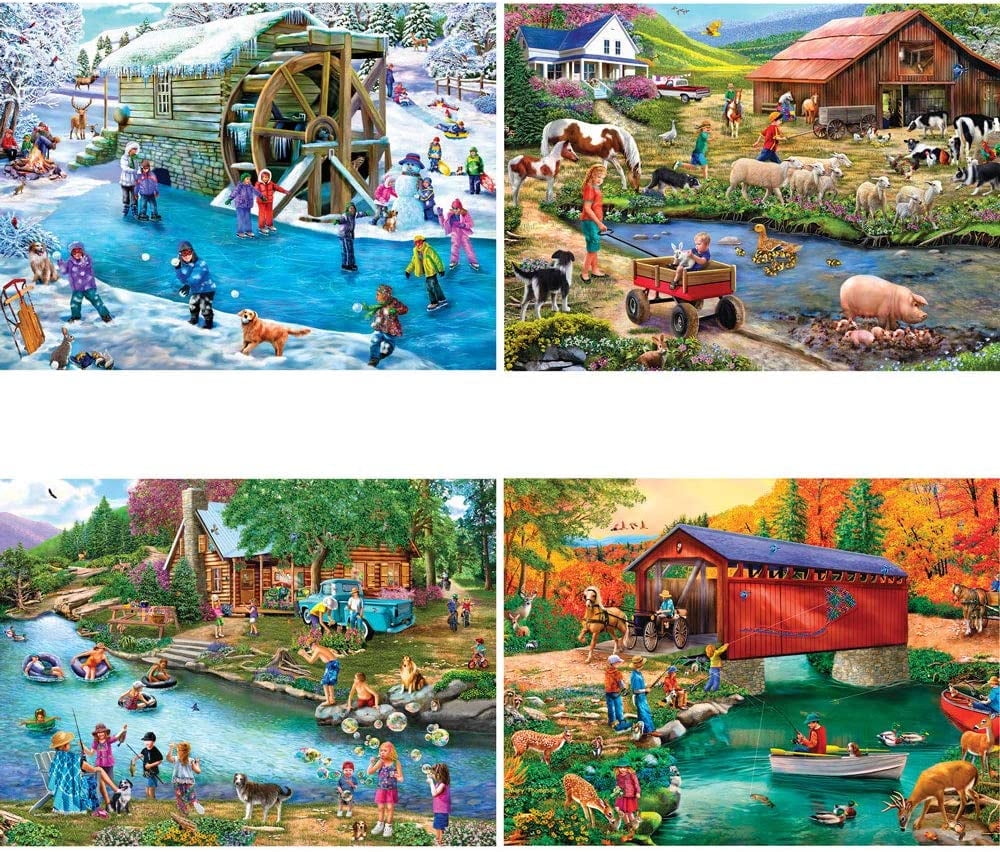
| Image Art | Busy Collage / Fine Art / Gradient | Determines spatial complexity and completion speed | Collages are easier; fine art and gradients offer maximum difficulty |
Assessing Manufacturing Standards
When evaluating puzzle brands, pay attention to piece thickness and cut precision. High-quality pieces generally measure around 1.8 to 2.0 millimeters thick, preventing warp over time. Premium manufacturers utilize customized punch dies that ensure a "soft click" or snap fit, allowing small assembled sections to be lifted and moved across the board without falling apart.
Additionally, pay attention to the surface coating. A textured linen finish minimizes light glare, making late-night assembly under artificial desk lamps much easier on the eyes compared to high-gloss cardboard finishes.
Preserving and Displaying Completed Puzzles
Finishing a 1000-piece puzzle represents hours of focus and dedication. Rather than immediately breaking down your completed masterpiece back into its box, you can preserve and frame it as permanent wall art.
- Step 1: Clean & Flatten (Remove dust/debris)
- Step 2: Apply Adhesive (Glue front/sheets back)
- Step 3: Cure & Mount (Wait 4-12 hours dry)
- Step 4: Frame & Hang (Insert into 20x27" frame)
Method 1: Liquid Puzzle Glue
- Prepare the Base: Slide a sheet of wax paper, parchment paper, or smooth silicone craft mat underneath your completed puzzle to protect your workspace from adhesive run-off.
- Apply the Glue: Pour a moderate amount of specialized liquid puzzle saver glue (such as liquid acrylic sealer) directly onto the center of the image.
- Spread Evenly: Using a plastic squeegee, flexible scraper, or foam brush, work the glue outward from the center toward the outer frame. Ensure the liquid fills all seams between the pieces without pooling excessively in localized areas.
- Cure Time: Allow the front side to dry completely for 4 to 6 hours. For extra rigidity, flip the sealed puzzle over and apply a light coat to the cardboard backing.
Method 2: Self-Adhesive Saver Sheets
If you prefer a clean, mess-free application without liquid adhesives, use clear self-adhesive plastic sheets:
- Carefully flip the completed puzzle face-down onto a flat protective board.
- Peel the backing off the sticky sheet and apply it firmly across the cardboard back of the puzzle.
- Smooth out air bubbles using a hard plastic card or squeegee, overlapping adjacent sheets by a quarter-inch.
- Press firmly down across all edges to ensure maximum stick strength.
Once sealed, mount the puzzle on a sturdy foam-core backing board and place it into a standard poster frame (typically 20x27 inches or 50x70 centimeters, depending on exact brand dimensions).
Frequently Asked Questions
How long does a 1000-piece puzzle typically take to finish?
For an individual adult solver, a standard 1000-piece puzzle takes between 8 and 15 total hours of focused work. Completion speed varies based on image complexity, piece cut style (grid vs. random), lighting conditions, and the solver's experience level. Working in pairs or groups can reduce this time significantly.
What surface size do I need for a standard 1000-piece puzzle?
While the average assembled 1000-piece puzzle measures roughly 20 by 27 inches (50 by 70 cm), your workspace should be at least 36 by 48 inches (90 by 120 cm). This extra space provides room for sorting trays, loose pieces, and organized assembly zones alongside the main puzzle footprint.
How do I find a missing piece in a 1000-piece puzzle?
Start by systematically checking all sorting trays, under the puzzle board, inside the cardboard box flaps, and around floor areas near your chair. If a piece is genuinely lost, contact the manufacturer; many premium brands offer a missing-piece replacement policy or can send a replacement bag from the same printing batch.
Are random-cut or ribbon-cut puzzles better for beginners?
Ribbon-cut (grid) puzzles are generally easier for beginners because pieces align in clean, predictable rows and columns, making it straightforward to identify missing shapes. Random-cut puzzles feature unusual, non-traditional shapes and slanted edge lines, which adds extra visual difficulty for experienced solvers.
What is the best way to move an unfinished 1000-piece puzzle?
Use a specialized portable puzzle board, a felt-lined roll-up puzzle mat, or a thick piece of foam-core board. Roll-up mats secure pieces around a central hollow tube for compact storage, while rigid felt-lined boards keep pieces flat and can be slid under a couch or bed between sessions.
Elevating Your Puzzling Experience
To get the most enjoyment out of your 1000-piece puzzle projects, refine your approach by selecting high-quality materials and creating a comfortable, organized setup. Start by investing in a dedicated puzzle board fitted with stackable sorting trays and an anti-glare tilting surface. This setup protects your back and neck while keeping loose pieces organized and secure from pets or accidental spills.
Next, choose your designs based on your desired difficulty level. If you are looking for a relaxing, low-stress evening project, opt for colorful collages, detailed illustrations, or vibrant landscapes with distinct color blocks. If you want a deep, challenging puzzle project, tackle fine art reproductions, monochromatic prints, or complex gradient patterns.
By taking the time to set up your workspace and choose the right image, you turn every 1000-piece jigsaw puzzle into an engaging, rewarding project that provides hours of screen-free focus and clear mental satisfaction.
EDITORIAL CATEGORY METADATA: