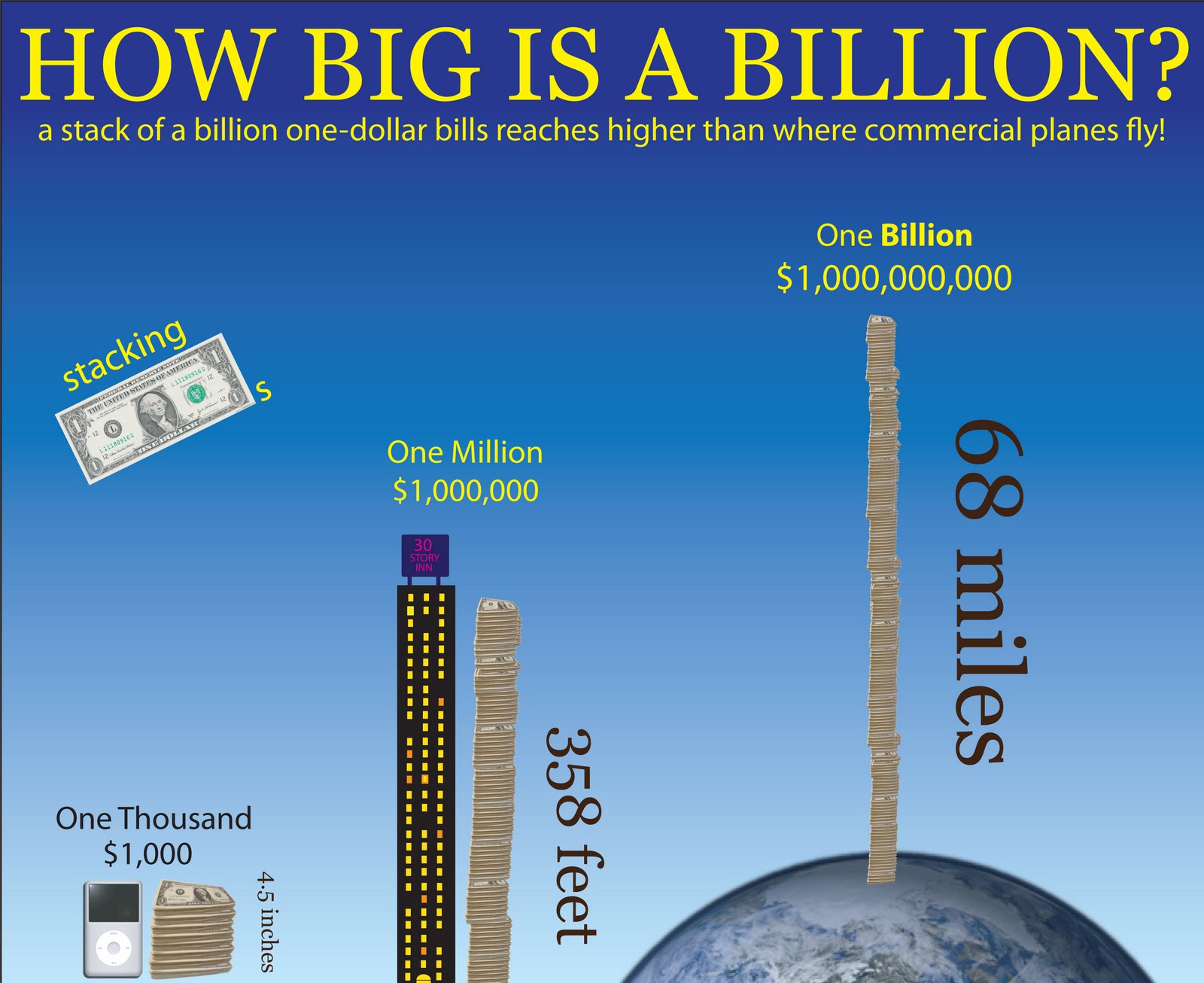
The fundamental difference between 1 billion and 100 million is a factor of ten, representing an order of magnitude shift that fundamentally alters financial strategy, data processing, and social impact. While 100 million represents the peak of individual or regional success, 1 billion enters the realm of global dominance and systemic complexity.
Visualizing the Gap: The Mathematical Reality of Scale
When we look at the numbers 100,000,000 and 1,000,000,000, the addition of a single zero might seem incremental on paper. However, in practical application, this shift is transformative. Human cognition is famously poor at conceptualizing large numbers, a phenomenon often referred to as scope insensitivity. We tend to view "millions" and "billions" as broadly "large," without respecting the vast chasm between them.
To truly understand this showdown, consider the dimension of time. If you were to count from one to 100 million, at a rate of one number per second without stopping, it would take you approximately 3.17 years. If you were to do the same for 1 billion, it would take you roughly 31.7 years. In this context, the difference isn't just a number; it is nearly three decades of a human life. This temporal comparison illustrates why a business reaching 100 million users is a success story, but reaching 1 billion users is a generation-defining achievement.
Mathematically, 100 million is exactly 10% of 1 billion. This means you would need to stack ten units of "100 million" to equal a single billion. In the world of physics, engineering, and finance, a 10x increase is rarely linear. It usually involves a "phase shift" where the old rules of management and operation no longer apply.
The Wealth Perspective: Centimillionaire vs. Billionaire
In the landscape of 2026, the financial distinction between having 100 million dollars and 1 billion dollars is the difference between personal freedom and institutional power. An individual with $100 million—a centimillionaire—possesses enough capital to sustain a life of extreme luxury, including multiple properties, private travel, and significant philanthropic contributions. However, they are still subject to market forces and must manage their "burn rate" to ensure the principal lasts for generations.
A billionaire, conversely, operates at a level where their wealth often generates more income than they can reasonably spend on lifestyle alone. The sheer gravity of 1 billion dollars allows for "market-making" capabilities. While a centimillionaire might buy a large estate, a billionaire might buy the entire development firm or the land surrounding a city to influence urban planning.
The Spending Power Breakdown
If you spent $10,000 every single day:
- $100 Million would last you approximately 27.4 years.
- $1 Billion would last you approximately 273.9 years.
In terms of investment, the "100 million" tier is often the threshold for entering elite private equity and hedge fund circles. However, the "1 billion" tier allows an individual to act as their own venture capital firm. They don't just participate in the economy; they shape it. This wealth gap also creates a disparity in political and social influence, where the billionaire has the resources to fund entire movements or research institutions that operate over decades.
Business Milestones: Scaling from Region to Globe
In the corporate sector, the "showdown" between 100 million and 1 billion often defines the lifecycle of a company. Revenue is a primary metric here, but user base is equally telling.
Revenue and Market Valuation
A company with $100 million in annual recurring revenue (ARR) is a formidable "Centaur" in the tech world. It has proven product-market fit and has a clear path to an IPO (Initial Public Offering). However, reaching $1 billion in revenue marks the transition into the "Big League." At $1 billion, a company is usually a household name, possessing the infrastructure to survive global economic downturns and the capital to acquire smaller competitors.
User Acquisition
When a social media platform or app hits 100 million users, it has achieved "critical mass." It is likely a dominant force in several major countries. But the "Billion User Club"—which includes entities like WhatsApp, YouTube, and Instagram—represents a different level of existence. Reaching 1 billion users means the product has transcended cultural and linguistic barriers. It has become a utility rather than a choice. The technical challenges of serving 1 billion users are exponentially harder than serving 100 million, requiring specialized server architectures, content delivery networks (CDNs), and global regulatory compliance teams.
Technical Infrastructure: The 10x Complexity Shift
From a data engineering perspective, the jump from 100 million to 1 billion records is where many systems break. This is often where linear scaling ends and the need for sophisticated distributed systems begins.
- Database Management: A table with 100 million rows can often be managed by a well-tuned single instance of a relational database (like PostgreSQL or MySQL). Once that table reaches 1 billion rows, "sharding" (splitting the database into smaller pieces across multiple servers) or moving to NoSQL architectures often becomes mandatory to maintain performance.
- Latency and Throughput: Handling 100 million requests per month is roughly 38 requests per second—manageable for a standard web server. Handling 1 billion requests per month is 385 requests per second. While this sounds manageable, the "burstiness" of traffic at that scale can easily overwhelm traditional load balancers.
- Storage Costs: At 100 million files, storage is an operational expense. At 1 billion files, storage becomes a strategic challenge involving cold storage tiers, data deduplication, and massive backup redundancies.
| Metric | 100 Million Scale | 1 Billion Scale | Complexity Multiplier |
|---|---|---|---|
| Time (Seconds) | ~3.17 Years | ~31.7 Years | 10x Duration |
| Business Status | High-growth Startup / Regional Leader | Global Conglomerate / Industry Standard | Institutional |
| Computing | Single Instance / Vertical Scaling | Distributed Systems / Horizontal Scaling | Exponential |
| Wealth Status | Ultra-High Net Worth (UHNW) | Institutional Capital / Economic Influence | Intergenerational |
| Population | Large Nation (e.g., Egypt, Vietnam) | Continent-Sized Entity (e.g., India, China) | Geopolitical |
Sociology and Demographics: People as Numbers
When we apply the 100 million vs. 1 billion showdown to populations, we see the difference between a "large country" and a "global titan." As of 2026, there are many nations with populations around the 100 million mark, such as Egypt, Vietnam, and Ethiopia. Managing such a nation requires a robust internal infrastructure and a strong regional presence.
However, only two nations—India and China—maintain populations well over the 1 billion mark. The logistical requirements for a 1 billion-person nation are staggering. Every 1% of the population represents 10 million people. A "small" policy shift in a billion-person country affects more people than the entire population of many European nations combined.
In digital marketing, the distinction is equally sharp. Reaching an audience of 100 million allows for highly targeted, lucrative niche marketing. Reaching 1 billion people is "mass market" in its truest sense. It requires a message so universal that it resonates across every demographic, from teenagers in Tokyo to retirees in Rome.
Cognitive Biases and the "Numbskull" Effect
Why is this showdown so "stunning"? Because our brains aren't wired for it. Evolutionarily, humans needed to count things they could see: ten fingers, twenty members of a tribe, maybe a few hundred head of cattle. The jump from 100 million to 1 billion exists only in the abstract for most people.
This leads to significant errors in judgment, such as:
- The "Millionaire" Fallacy: People often group millionaires and billionaires together in their minds as "the rich." In reality, a billionaire is 1,000 times richer than a millionaire, but only 10 times richer than a centimillionaire.
- Budgeting Errors: In government spending, a 100 million dollar program sounds expensive, but in a 1 billion dollar budget, it is only 10%. If the public doesn't grasp the scale of the total budget, they cannot accurately judge the value of the individual expenditure.
Frequently Asked Questions
Why is 1 billion often called a "thousand million"?
In the "short scale" system (used in the US, UK, and most English-speaking countries), 1 billion is $10^9$ (1,000,000,000). In some European and South American countries using the "long scale," a billion refers to a million million ($10^{12}$), and the term "milliard" is used for 1,000 million. This can cause significant confusion in international finance.
Is the jump from 100 million to 1 billion the hardest leap in business?
Many venture capitalists argue that the "Traction Gap"—moving from 1 million to 100 million—is the hardest because it requires proving a business can scale. However, the move from 100 million to 1 billion is the "Efficiency Gap," where a company must professionalize and automate every process to avoid collapsing under its own weight.
How does the difference affect scientific measurements?
In science, these scales are handled by SI prefixes. 100 million is 100 "Mega-" units. 1 billion is 1 "Giga-" unit. In terms of data, 100 million bytes is 100 MB, while 1 billion bytes is roughly 1 GB. This distinction is vital in physics, where an error of one order of magnitude can be the difference between a working engine and an explosion.
Can a single person effectively manage 1 billion of anything?
Psychologically, no. "Dunbar's Number" suggests humans can only maintain stable social relationships with about 150 people. To manage 100 million or 1 billion of anything—whether it's dollars, users, or citizens—requires layers of hierarchy, algorithmic intervention, and institutional structures. The individual at the top is managing the system, not the units.
What is the next step after reaching 1 billion?
The next major milestone is 10 billion. In terms of global population, we are currently approaching 8.5 to 9 billion. The 10 billion mark is often cited by demographers as the potential "plateau" for human population on Earth. In finance, the next step is the trillion (1,000 billion).
Developing Numerical Literacy for the Future
As we progress through 2026, the ability to distinguish between these scales is becoming a vital skill. Whether you are an investor looking at market caps, a citizen evaluating government infrastructure projects, or a developer building global apps, you must respect the 10x multiplier.
To improve your numerical literacy, always convert these large numbers into units of time or tangible objects. Don't just see "1 billion" as a word; see it as the 31-year journey it represents compared to the 3-year journey of 100 million. Recognizing the "stunning" nature of this showdown allows for better decision-making, more realistic expectations, and a deeper appreciation for the massive systems that power our modern world.