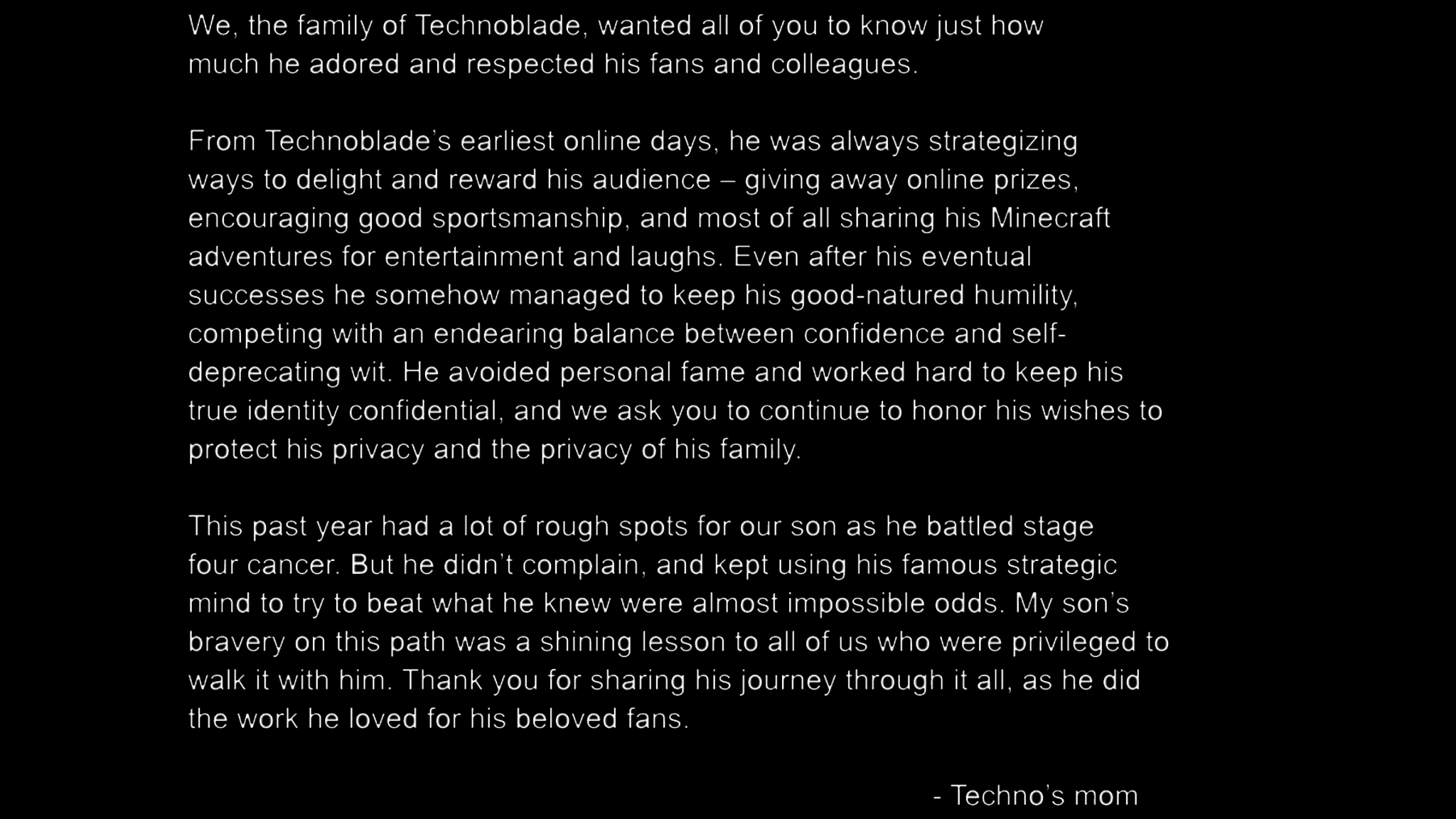
Technoblade, the world-renowned Minecraft creator known as Alex, developed cancer due to a rare biological occurrence known as sarcoma. Like the majority of sarcoma cases, his diagnosis was the result of random genetic mutations within his connective tissue cells, rather than specific lifestyle choices, environmental factors, or external behaviors.
The Discovery and Early Symptoms of Technoblade’s Cancer
The journey began in the summer of 2021 when Technoblade first noticed a persistent ache in his right arm. As a professional gamer and content creator, it was easy to dismiss such discomfort as a repetitive strain injury (RSI) or typical "gamer’s cramp." However, by early August, the pain became accompanied by significant swelling in his shoulder. After seeking medical attention, imaging and biopsies revealed a much more serious reality: a malignant tumor.
Technoblade officially announced his diagnosis to his millions of fans on August 27, 2021, in a video titled "where I've been." He revealed he had been diagnosed with sarcoma, a rare and aggressive form of cancer. At the time of his diagnosis, the cancer was already in an advanced stage, which complicated the treatment path significantly. The rapid progression from a seemingly minor ache to a life-threatening diagnosis is a hallmark of many sarcomas, which often grow deep within limbs or tissues before becoming visible or causing severe pain.
In the medical community, the "why" behind such a diagnosis is rarely linked to a single event. For a young, otherwise healthy individual like Alex, the onset of such a disease is typically viewed as a catastrophic "glitch" in cellular replication. While the gaming community searched for answers, the reality remained rooted in the complex and often unpredictable nature of human biology.
What is Sarcoma? The Technical Reality of the Disease
To understand why Technoblade got cancer, one must first understand what sarcoma is. Unlike more common cancers like lung or breast cancer (which are carcinomas that form in the epithelial tissues), sarcomas are a group of cancers that arise in the mesenchymal cells. These are the cells that make up the body’s "glue"—the bones, muscles, tendons, cartilage, nerves, fat, and blood vessels.
Sarcomas are notoriously rare, accounting for only about 1% of all adult cancer diagnoses. Because they are so uncommon, they are often difficult to research and treat compared to more prevalent malignancies. There are over 70 different subtypes of sarcoma, which are broadly categorized into soft tissue sarcomas and bone sarcomas (osteosarcomas).
Technoblade’s cancer was located in his right arm, affecting the soft tissue and bone structure. This type of cancer is particularly dangerous because it can metastasize (spread) to the lungs or other parts of the body through the bloodstream. Once a sarcoma reaches Stage 4, as was the case with Alex, the survival rates drop significantly because the cancer cells have moved beyond the primary site, making local treatments like surgery or radiation less effective on their own.
The Biological "Why": Genetic Mutations and Cellular Errors
The most common question fans ask is whether something specific caused Technoblade’s cancer. In the vast majority of sarcoma cases, there is no identifiable external cause. Unlike lung cancer, which is heavily linked to smoking, or skin cancer, which is linked to UV exposure, sarcomas are largely considered sporadic.
The biological "why" lies in DNA mutations. Every day, the cells in our bodies divide and replicate. During this process, errors in DNA copying can occur. Usually, the body has "checkpoints"—proteins like p53—that identify these errors and either fix them or trigger "cell suicide" (apoptosis) to prevent the damaged cell from multiplying.
In cancer, these checkpoints fail. A specific mutation may turn off a tumor-suppressor gene or turn on an oncogene (a gene that promotes growth). When this happens in the mesenchymal cells of a limb, a sarcoma begins to grow. For Alex, this was an internal biological failure of cell regulation. There is no evidence to suggest that his diet, his career as a gamer, or his environment played any role in the development of the disease. It was, in the most tragic sense, a matter of biological "bad luck."
Treatment Challenges and the Path Alex Followed
Treating sarcoma requires a multidisciplinary approach, often involving "the big three" of oncology: surgery, chemotherapy, and radiation. Technoblade underwent all of these in an attempt to stop the progression of the tumor.
- Chemotherapy: The goal of chemotherapy in sarcoma is to shrink the primary tumor and kill any microscopic cancer cells that may have traveled to other parts of the body. Technoblade described this process as incredibly taxing, leading to significant fatigue and the loss of his hair.
- Radiation Therapy: This uses high-energy beams to target the tumor directly, damaging the DNA of the cancer cells so they can no longer divide.
- Limb-Salvage Surgery: One of the most difficult decisions in treating limb sarcomas is whether to perform an amputation or limb-salvage surgery. Technoblade initially underwent a limb-salvage procedure, where surgeons removed the tumor and some surrounding tissue while trying to preserve the functionality of his arm.
Despite these aggressive interventions, sarcomas are known for their resilience. If even a few cells remain or if the cancer has already seeded itself in the lungs (a common site for sarcoma metastasis), the disease can return or continue to grow. Throughout 2026, medical research continues to look for better ways to prevent this recurrence through targeted immunotherapies.
Impact of Technoblade’s Diagnosis on Cancer Awareness
While the world lost a massive personality in June 2022, the legacy of his diagnosis has had a measurable impact on the field of oncology. Technoblade’s openness about his struggle brought unprecedented attention to sarcoma research.
| Entity/Metric | Impact/Details |
|---|---|
| Primary Beneficiary | Sarcoma Foundation of America (SFA) |
| Total Funds Raised | Over $1,000,000 (as of 2022/2023) |
| Awareness Milestone | SFA awarded Technoblade the "Courage Award" posthumously. |
| Key Research Focus | Adolescent and Young Adult (AYA) sarcoma subtypes. |
| Blood Donation Drives | Thousands of fans donated blood in his honor globally. |
The massive influx of funding provided by the "Technoblade Never Dies" movement allowed the SFA to fund new research grants specifically looking into the genetic markers of sarcomas. This research is crucial because, as established, the "why" of sarcoma is genetic. By identifying the specific mutations that lead to these tumors, scientists in 2026 are closer to developing "targeted therapies" that can kill cancer cells without the devastating side effects of traditional chemotherapy.
The Role of the p53 Gene in Sarcoma Research
In the years following Technoblade’s passing, public interest in the p53 gene has increased. Often called the "Guardian of the Genome," the p53 protein is responsible for preventing the very mutations that cause sarcomas. In many sarcoma patients, the TP53 gene (which creates the p53 protein) is either mutated or deleted.
When TP53 is compromised, the body loses its most effective defense against tumors. Research funded by Technoblade’s community has contributed to our understanding of how to potentially "reactivate" or bypass these genetic failures. While this technology was not available in time to save Alex, it represents the front line of cancer treatment in 2026. Understanding that his cancer was a genetic malfunction rather than a lifestyle consequence has helped shift the focus toward these high-tech genetic solutions.
Common Questions Regarding Technoblade's Health
What specific type of sarcoma did Technoblade have?
While the exact subtype was not publicly detailed in his medical records released to the fans, his symptoms and the location of the tumor were consistent with soft tissue sarcoma or osteosarcoma. Both types are aggressive and require intensive treatment involving surgery and chemotherapy.
Did Technoblade’s gaming career cause his cancer?
No, there is no scientific evidence linking gaming, computer use, or sedentary lifestyles to the development of sarcoma. Sarcomas are rare cancers of the connective tissues and are generally caused by internal genetic mutations rather than external activities or radiation from electronic devices.
At what stage was Technoblade’s cancer discovered?
Technoblade’s cancer was discovered at an advanced stage. By the time he sought medical attention for the swelling in his arm, the tumor was already significant. In his final video, it was indicated that the cancer had reached a terminal stage, meaning it had likely metastasized to vital organs.
How old was Technoblade when he was diagnosed?
Alex was 22 years old at the time of his diagnosis in August 2021. Sarcomas are one of the more common types of cancer found in adolescents and young adults (AYA), a demographic that is often overlooked in broader cancer research initiatives.
Why is sarcoma so hard to treat?
Sarcomas are difficult to treat because they are often "chemo-resistant," meaning they do not always respond well to standard drugs. Additionally, because they are so rare, there are fewer clinical trials and specialized treatments available compared to more common cancers.
How to Support Ongoing Sarcoma Research
If you are looking for ways to honor Technoblade’s memory or help answer the "why" of cancer for future patients, the most direct action is to support specialized research organizations. Because sarcomas are rare, they often receive less federal funding than other cancers, making private donations from communities like Technoblade’s essential.
The Sarcoma Foundation of America remains the primary organization dedicated to this cause. They use donations to fund research into the molecular biology of tumors, improve early detection methods, and support patients currently undergoing treatment. Additionally, participating in local blood drives is a practical way to help, as cancer patients—especially those undergoing aggressive chemotherapy—often require frequent blood and platelet transfusions.
In 2026, the Minecraft and gaming communities continue to host annual charity events. These marathons not only keep Technoblade’s memory alive but also provide the financial backbone for the scientists working to ensure that "Technoblade Never Dies" becomes a reality through the lives saved by their research.