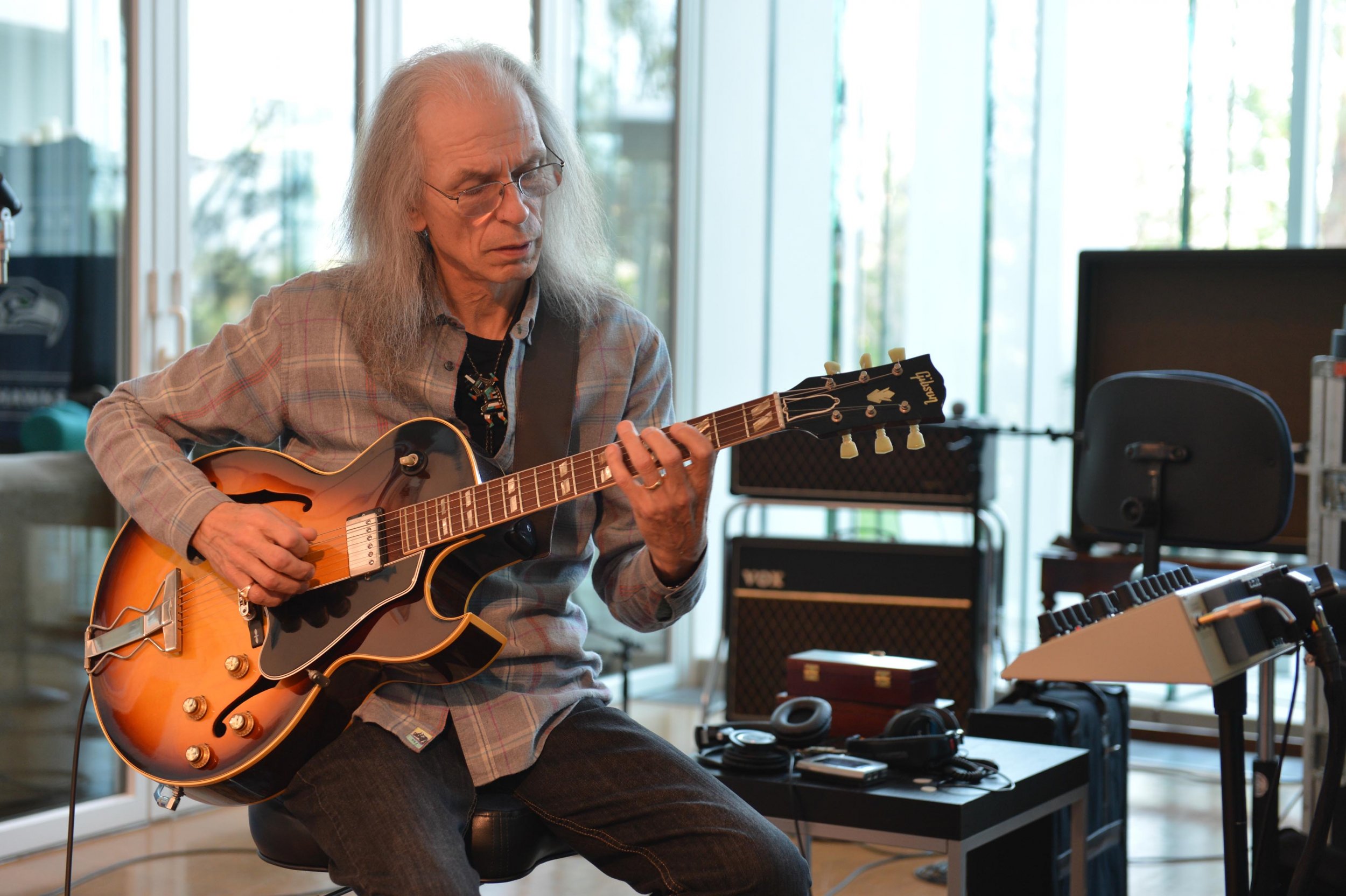
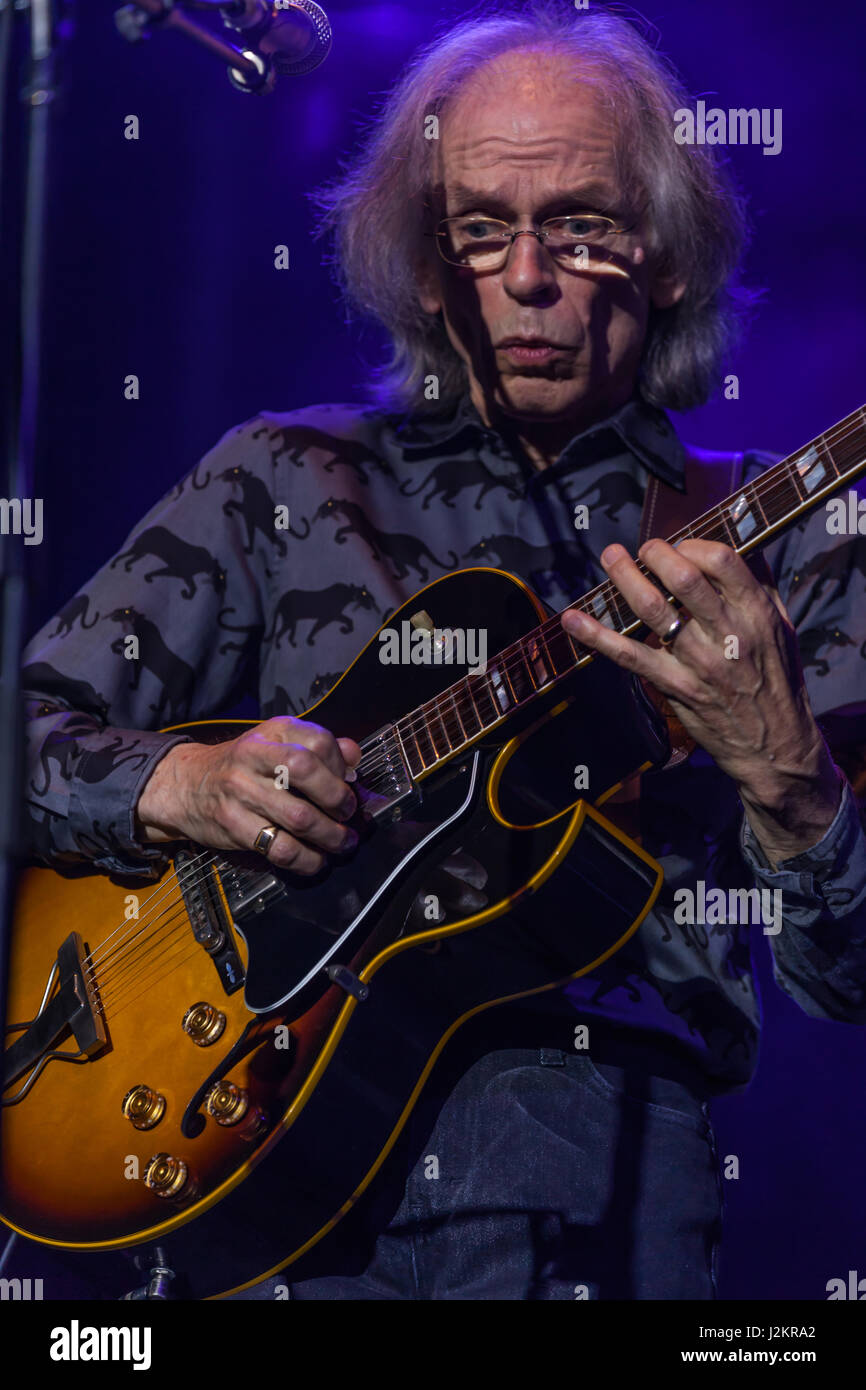
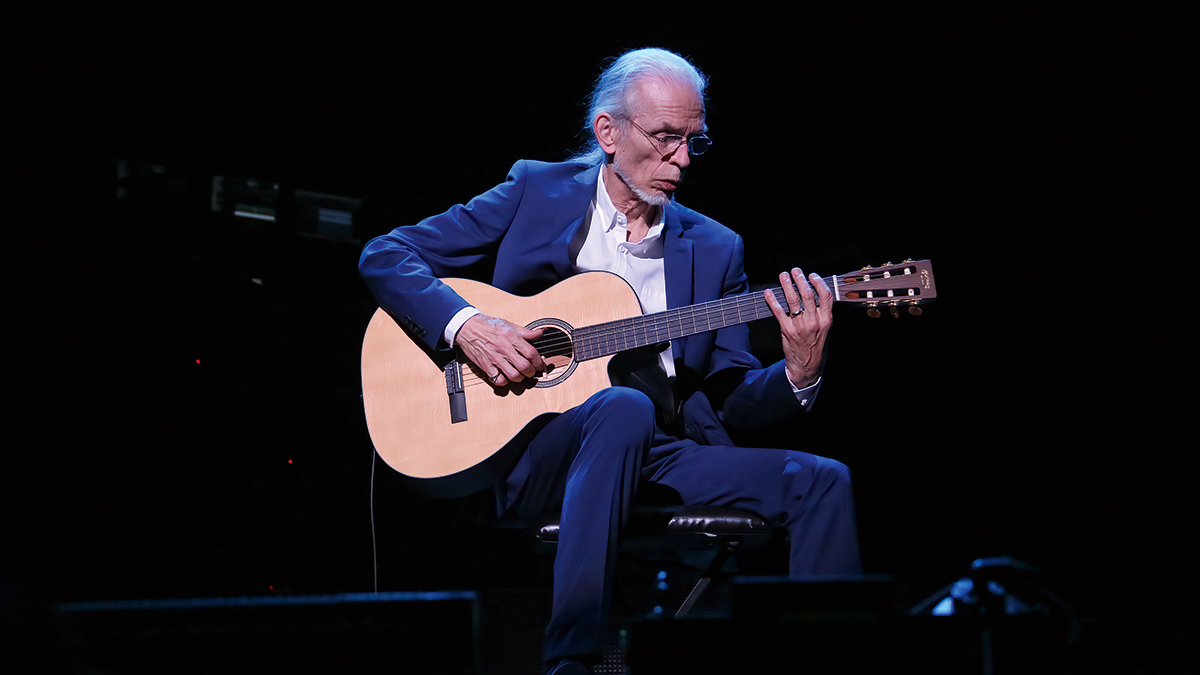
Steve Howe is a legendary English guitarist renowned for his pioneering work with progressive rock band Yes, supergroup Asia, and GTR. Fusing fingerstyle classical, jazz, country, and rock techniques, Howe transformed electric and acoustic guitar composition. His distinct sound relies heavily on vintage hollowbody electrics, acoustic flat-tops, lap steel, and complex hybrid picking.
Early Life and Career Evolution: From London Clubs to Progressive Rock Royalty
Born Stephen James Howe on April 8, 1947, in Holloway, North London, Steve Howe developed a passion for the guitar during the British pop boom of the 1950s and early 1960s. Unlike many of his contemporaries who drew inspiration exclusively from Chicago blues masters, Howe immersed himself in a diverse array of genres. His primary influences included country thumb-picker Chet Atkins, jazz innovator Wes Montgomery, gypsy jazz virtuoso Django Reinhardt, and classical guitar masters such as Andrés Segovia.
Howe began his professional performing career in the mid-1960s with several notable British beat and psychedelic groups:
- The Syndicats (1964–1965): Howe’s early recordings displayed his rapid development in aggressive rhythm-and-blues and rockabilly-influenced lead work, produced in part by the legendary Joe Meek.
- The In Crowd / Tomorrow (1965–1968): Evolving into Tomorrow, the group became a landmark act of the British psychedelic movement. Their singles "My White Bicycle" and "Revolution" featured Howe’s early experimentation with feedback, backwards guitar tracking, and rapid scalar runs.
- Bodast (1968–1969): Featuring intricate song structures, Bodast served as a stylistic bridge between psychedelic pop and the emerging progressive rock style Howe would soon perfect.
In 1970, Howe replaced original guitarist Peter Banks in Yes. His debut recording with the group, The Yes Album (1971), altered the trajectory of rock guitar playing. By eschewing standard blues-rock tropes in favor of classical counterpoint, ragtime fingerpicking, and jazz-inflected chord voicings, Howe helped establish Yes as an international force. Over the subsequent decades, he recorded iconic albums including Fragile (1971), Close to the Edge (1972), Tales from Topographic Oceans (1973), and Relayer (1974).
In 1981, Howe co-founded the supergroup Asia alongside bassist/vocalist John Wetton, drummer Carl Palmer, and keyboardist Geoff Downes. Their 1982 self-titled debut became an international multi-platinum success, propelled by hits like "Heat of the Moment." Howe later formed GTR in 1985 with former Genesis guitarist Steve Hackett, further expanding his arena-rock footprint before returning to various Yes lineups, where he continues to perform and produce.
The Signature Sound: Deconstructing Steve Howe's Guitar Techniques
Steve Howe’s technical reputation rests on his ability to seamlessly blend disparate musical traditions within a single composition. Rather than relying on standard pentatonic soloing, his phrasing incorporates counterpoint, polyrhythms, and rapid arpeggios executed with extreme rhythmic clarity.
Hybrid Picking and Fingerstyle Precision
One of Howe's defining physical techniques is his alternating use of a standard flatpick (plectrum) and bare fingers, often called hybrid picking. When playing electric lead passages, he frequently holds a medium-heavy pick between his thumb and index finger while using his middle and ring fingers to pluck higher strings simultaneously. This allows for:
- Wide String Jumps: Executing rapid arpeggios across non-adjacent strings without interrupting the rhythmic flow.
- Polyphonic Voicings: Playing low bass lines with the plectrum while simultaneously plucking upper chordal harmonies with the free fingers, a technique inherited from Chet Atkins.
- Dynamic Touch: Switching instantaneously from sharp, picking-attack articulation to softer, flesh-on-string fingerstyle tones.
On acoustic tracks such as "Clap" (written in celebration of his son Dylan's birth), Howe demonstrates mastery of ragtime and country-style Travis picking, balancing a steady alternating bassline with syncopated treble melodies.
Classical and Flamenco Finger Work
Howe’s acoustic compositions frequently incorporate formal classical and flamenco fingerstyle techniques. On the famous solo acoustic track "Mood for a Day" from Fragile, he executes rest-strokes (apoyando) and free-strokes (tirando) using traditional classical right-hand positioning. He incorporates classical voice leading, scalar ornamentation, and precise rasgueado-style flourishes. Notably, Howe rarely uses long fingernails on his picking hand, preferring the meat of the fingertip to achieve a warmer, thicker acoustic timbre.
Lap Steel, Pedal Steel, and Slide Innovations
While steel guitar was predominantly associated with American country music in the 1970s, Howe introduced the instrument into progressive rock soundscapes. Utilizing a Fender Dual Professional lap steel and various Sho-Bud pedal steel models, he created sustained, vocal-like textures that served as lead melodies or ambient beds.
On tracks like "And You and I" and "To Be Over," Howe uses volume pedal swells combined with precise pitch bends on the pedal steel to emulate synth pads or lush string sections. On "Going for the One," he utilizes a lap steel tuned to open chords, played through cranked tube amplifiers to deliver a driving, distorted slide lead.
Gear Blueprint: Guitars, Amplifiers, and Effects Over the Decades
Steve Howe’s instrument collection is legendary among equipment historians. Unlike many rock guitarists who favor solidbody electrics, Howe achieved his seminal progressive rock tones using archtop hollowbody instruments played at stage volume.
| Category | STEVE HOWE MAIN GEAR SUMMARY |
|---|---|
| Core Electric Instrument | 1953 Gibson ES-175D Archtop |
| Primary Acoustic Guitars | Martin 00-18, Martin 00-45, Shop Customs |
| Slide & Steel Instruments | Fender Dual Professional, Sho-Bud Steel |
| Amplification | Fender Twin Reverb, Dual Showman, Line 6 |
| Essential Effects | Electro-Harmonix Big Muff, Delay, Tremolo |
Key Guitars in the Howe Collection
The cornerstone of Howe's sound is his 1953 Gibson ES-175D, which he purchased secondhand at Selmer's music shop in London in 1964. This archtop guitar, featuring twin PAF-style humbucking pickups, became his primary writing and recording instrument for Yes. Managing stage feedback from a fully hollow archtop at high volume required precise physical damping and positioning relative to his amplifiers.
| Instrument Model | Primary Eras / Albums | Notable Tracks & Applications | Tone & Technical Characteristics |
|---|---|---|---|
| 1953 Gibson ES-175D | 1964–Present (The Yes Album, Fragile, Close to the Edge) | "Roundabout," "Close to the Edge," "Yours Is No Disgrace" | Warm, mid-range-heavy archtop tone; delicate attack; highly responsive to volume knob dynamics. |
| Martin 00-18 (1953) | 1970–Present | "Clap," acoustic sections on early Yes recordings | Small-body mahogany acoustic; punchy mid-range projection suited for ragtime and fingerpicking. |
| Martin 00-45 | 1971–Present | "Mood for a Day," live acoustic interludes | Classical/nylon-string and high-end acoustic fingerstyle; crystalline highs and balanced resonance. |
| Fender Telecaster (1955) | 1974 (Relayer) | "Sound Chaser," "Gates of Delirium" | Bright, cutting single-coil attack; highly distorted, aggressive fusion-style leads. |
| Gibson Les Paul Junior | 1979–1980 (Drama) | "Machine Messiah," "Tempus Fugit" | Single P-90 pickup simplicity; thick, raw rock tone used for heavier 1980s riffs. |
| Danelectro Coral Sitar | 1971–1972 | "Close to the Edge" (Middle section), "Into the Lens" | Buzzing bridge drone effect emulation; exotic harmonic overtones. |
| Fender Dual Professional Steel | 1972–Present | "And You and I," "Going for the One" | Console lap steel; long sustain, smooth slide intonation, vibrant high-end frequency response. |
Amplification and Signal Chains
Throughout the 1970s, Howe relied predominantly on Fender Dual Showman and Fender Twin Reverb amplifiers. The high headroom and clean output of vintage Fender tube circuits allowed the acoustic-like snap of his hollowbody pickups to translate clearly without muddying complex chord voicings.
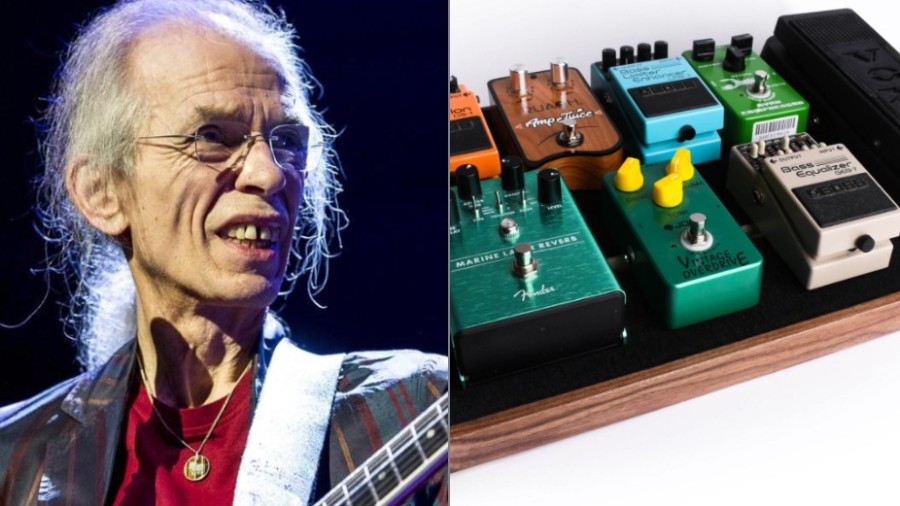
In terms of effects, Howe was an early adopter of floor pedals and rack processors, utilizing:
- Electro-Harmonix Big Muff Pi: Used for sustained, singing lead solos (such as the main motif on "Starship Trooper").
- Tape Delays (WEM Watkins Copicat / Echoplex): Applied to create ambient repeating patterns and spatial depth in long instrumental suites.
- Volume Pedals: Essential for steel guitar swells and controlling output gain directly into tube preamps.
- Line 6 Digital Modeling: In later touring eras, Howe adopted digital modeling technology alongside traditional amplifiers to reproduce his vast catalog of acoustic and electric sounds accurately on stage.
Key Historical Milestones and Career Facts
Understanding Steve Howe’s impact requires examining key facts spanning his six-decade career:
- Rock and Roll Hall of Fame: Howe was inducted into the Rock and Roll Hall of Fame as a member of Yes in 2017.
- Multi-Instrumental Mastery: Beyond standard electric six-strings, Howe has recorded with the mandolin, 12-string guitar, Spanish classical guitar, koto, bass guitar, pedal steel, lap steel, and electric sitar.
- Compositional Credits: Howe is co-writer on Yes’s biggest hits, including "Roundabout" and "Owner of a Lonely Heart" (additional arrangement credit), as well as Asia’s top-charting singles.
- Solo Output: Beyond group projects, Howe has released over two dozen solo studio and live albums, beginning with 1975's Beginnings and extending through projects like Time and Guitar Collection.
- Guitar Player Magazine Recognition: Howe was the first rock guitarist voted "Best Overall Guitarist" five years in a row (1977–1981) in Guitar Player magazine's annual readers' poll, earning him inclusion in their inaugural Gallery of Greats.
- Signature Models: Martin Guitars released the Martin MC-38 Steve Howe Signature Model and the Martin 00-18SH, honoring his contributions to acoustic fingerstyle music. Gibson also produced an official Steve Howe Signature ES-175.
Tone Setup Guide: Emulating Steve Howe’s Sonic Palette
Guitarists seeking to capture Howe’s classic 1970s progressive rock tone can follow these technical adjustments:
- Select the Right Pickup Voice: Set a neck humbucker or archtop neck pickup to roughly 7 or 8 on the guitar's volume dial. Reduce the guitar’s tone control slightly (to around 6–7) to smooth out harsh high-frequency spikes while maintaining mid-range articulation.
- Amp Settings (Clean Headroom): Use a vintage-style American tube amplifier (such as a Fender Twin or Deluxe Reverb). Set EQ controls to:
- Bass: 4 – 5
- Mids: 6 – 7
- Treble: 5 – 6
- Volume: Keep gain low enough to prevent preamp clipping when strumming heavily.
- Pedal Placement for Lead Lines: Place a smooth fuzz or transparent overdrive pedal before an analog or tape delay pedal. Set delay time to approximately 350ms with 3–4 repeats for spacey lead solos.
- Picking Technique Adjustment: Angle your plectrum slightly against the string to reduce harsh pick click. Integrate the middle finger of your picking hand to snap treble strings on accented notes during scalar runs.
Frequently Asked Questions About Steve Howe
What main guitar is Steve Howe best known for playing?
Steve Howe is most famous for playing a 1953 Gibson ES-175D hollowbody electric guitar. He purchased it in 1964 and used it as his primary instrument for writing and recording most of Yes's classic 1970s catalog, including The Yes Album, Fragile, and Close to the Edge.
How does Steve Howe achieve his unique hybrid picking sound?
Howe holds a flatpick between his thumb and index finger for fast scalar runs and alternate picking, while simultaneously using his middle and ring fingers to pluck higher strings. This hybrid technique allows him to perform complex counterpoint, wide arpeggios, and multi-voiced fingerstyle arrangements on electric guitar.
Did Steve Howe play on all classic Yes albums?
Steve Howe joined Yes in 1970 for The Yes Album and played on their seminal 1970s records through 1980's Drama. While he left the group prior to 1983's 90125 (where Trevor Rabin played guitar), he rejoined for the Union project in 1991 and has remained the principal guitarist for Yes across multiple subsequent eras.
What acoustic guitar did Steve Howe use for "Mood for a Day"?
Howe recorded the solo acoustic piece "Mood for a Day" (from the 1971 album Fragile) using a classical nylon-string guitar, primarily a Martin 00-45 and Spanish classical instruments. Live performances often feature his custom Martin models.
Was Steve Howe a founding member of Asia?
Yes, Steve Howe co-founded Asia in 1981 alongside former King Crimson bassist/vocalist John Wetton, former Emerson, Lake & Palmer drummer Carl Palmer, and former Buggles/Yes keyboardist Geoff Downes. Their 1982 debut album reached number one on global charts.
Exploring the Steve Howe Discography and Legacy
To fully appreciate Steve Howe’s contribution to modern guitar technique, musicians and listeners should examine his work chronologically across different genres:
- For Classical & Acoustic Fingerstyle: Study "Clap" (The Yes Album) and "Mood for a Day" (Fragile) to examine his ragtime timing and classical rest-stroke technique.
- For Electric Fusion & Counterpoint: Analyze "Sound Chaser" (Relayer) and "Close to the Edge" (Close to the Edge) for rapid alternate picking, exotic scale selection, and amp overdrive management.
- For Steel Guitar Textures: Listen to "And You and I" (Close to the Edge) and "Going for the One" (Going for the One) to analyze ambient slide control and pedal steel pitch bending within a rock context.
Transcribing Howe's compositions offers invaluable insights into chord voicings, multi-genre fusion, and non-standard guitar arrangements.