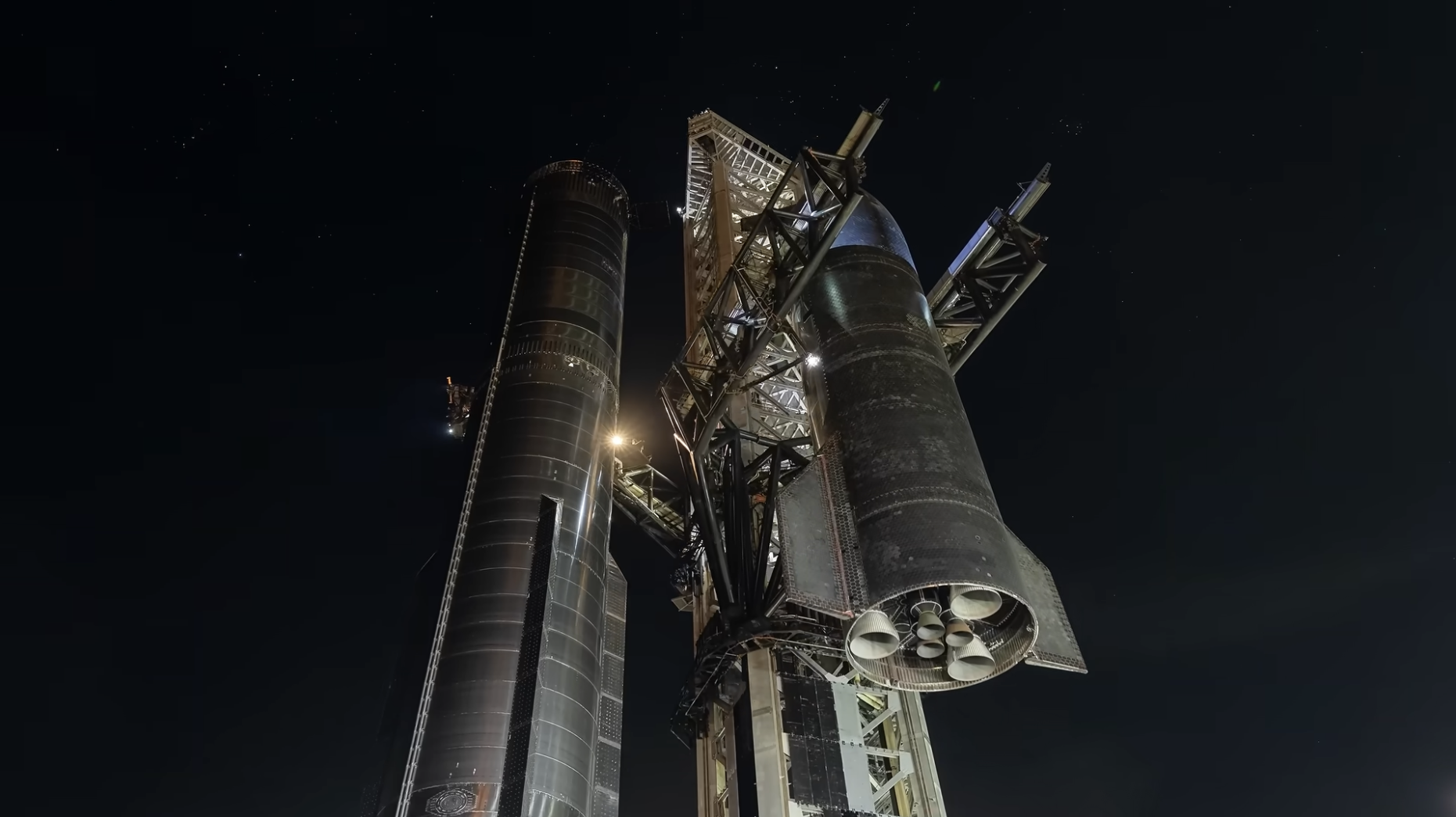
SpaceX Starship is a fully reusable, super heavy-lift launch system designed to transport cargo and passengers to Earth orbit, the Moon, Mars, and beyond. Composing a two-stage architecture powered by liquid methane and liquid oxygen, the vehicle represents a fundamental shift in launch economics, orbital refueling mechanics, and deep-space payload delivery capacity.
Structural Design and Propulsion Architecture
The Starship launch architecture relies on two distinct structural stages: the Super Heavy booster (Stage 1) and the Starship spacecraft (Stage 2). Both stages utilize cold-rolled 304L stainless steel as their primary structural material. While legacy aerospace designs relied heavily on carbon fiber composites or aluminum-lithium alloys to minimize dry mass, SpaceX selected stainless steel due to its structural strength at cryogenic temperatures, high melting point during atmospheric reentry, and significantly lower raw manufacturing costs.
- Starship Upper Stage (Stage 2)
- Height: 50m | Diameter: 9m | Dry Mass: ~100t | Propellant: 1200t
- Engines: 3 Sea-Level Raptors + 3 Vacuum Raptors
- Features: TPS Heat Shield Tiles, Thermal Actuated Flaps
- Staging Mechanism
- Super Heavy Booster (Stage 1)
- Height: 71m | Diameter: 9m | Dry Mass: ~200t | Propellant: 3400t
- Engines: 33 Sea-Level Raptor Engines (Outer Ring + Inner Vector)
- Features: Grid Fins, Quick Disconnect Plate, Catch Pins
Powering both stages is the Raptor engine family, a full-flow staged combustion cycle engine operating on liquid methane ($CH_4$) and liquid oxygen ($LOX$), collectively referred to as methalox. The full-flow staged combustion cycle routes all fuel and oxidizer through separate preburners to drive their respective turbopumps before injecting the gases into the main combustion chamber. This eliminates the need for complex turbopump shaft seals, reduces thermal stress on components, and maximizes specific impulse ($I_{sp}$).
Sub-cooled methalox provides high propellant density, allowing larger fuel masses to fit within given tank volumes. Liquid methane also leaves virtually no soot residue inside turbomachinery compared to RP-1 kerosene, making rapid engine reuse without intensive refurbishment realistic.
The Super Heavy booster integrates 33 Raptor engines arranged in concentric rings. The outer ring of 20 engines remains fixed, while the inner rings gimbal to provide thrust vector control during ascent, boostback burns, and landing maneuvers. The upper stage Starship spacecraft integrates six Raptor engines: three sea-level engines with standard nozzles for low-altitude flight and three vacuum-optimized engines ($Raptor\ Vac$) featuring oversized expansion nozzles designed for maximum efficiency in space.
Technical Specifications and Flight Performance Metrics
The overall dimensions and payload performance metrics of the integrated Starship vehicle dwarf all prior operational launch platforms, including the Saturn V and the Space Launch System (SLS).
| Metric / Feature | Super Heavy Booster (Stage 1) | Starship Spacecraft (Stage 2) | Integrated Vehicle |
|---|---|---|---|
| Height | ~71 meters (~233 ft) | ~50 meters (~164 ft) | ~121 meters (~397 ft) |
| Diameter | 9 meters (29.5 ft) | 9 meters (29.5 ft) | 9 meters (29.5 ft) |
| Propellant Mass | ~3,400 metric tons | ~1,200 metric tons | ~4,600 metric tons |
| Engine Configuration | 33 Raptor Sea-Level | 3 Raptor Sea-Level / 3 Raptor Vacuum | 39 Total Engines |
| Total Thrust | ~7,500 tf (~16.7 million lbf) | ~1,500 tf (~3.3 million lbf) | ~7,500 tf at Liftoff |
| Payload Capacity (LEO) | N/A (Booster Stage) | 100–150+ metric tons (Reusable) | 100–150+ metric tons |
| Structural Material | AISI 304L Stainless Steel | AISI 304L Stainless Steel | Stainless Steel Alloy |
| Primary Propellant | Sub-cooled $CH_4$ / $LOX$ | Sub-cooled $CH_4$ / $LOX$ | Methalox ($CH_4$ / $LOX$) |
The core payload capacity target of 100 to 150 metric tons to Low Earth Orbit (LEO) in a fully reusable mode represents a order-of-magnitude shift in launch economics. In an expendable configuration—where the upper stage is not recovered—the vehicle's LEO payload capacity expands to over 250 metric tons.
Launch operations at facilities like Starbase in Boca Chica, Texas, utilize massive ground infrastructure, including a liquid fuel tank farm, an orbital launch mount, and a dedicated integration tower designed to capture returning boosters.
The Mechanics of In-Space Orbital Refueling
To execute deep-space missions to trans-lunar injection (TLI) or trans-Mars injection (TMI) with massive payloads, Starship does not rely on a single launch with an impossibly large single-rocket design. Instead, SpaceX uses in-space orbital propellant transfer, commonly referred to as orbital refueling.
- Target Starship (Depot / Crew)
- Mass: High Payload
- Propellant Transfer
- Direct Docking via Stern Fluid Connectors
- Tanker Starship (Delivers LOX/CH4)
- Mass: Fuel Cargo
When Starship launches to Low Earth Orbit, it expends the vast majority of its onboard propellant just to achieve orbital velocity (~7.8 km/s). Once in orbit, the spacecraft is intact and structural, but its tanks are nearly empty. To send 100+ tons of payload to the Moon or Mars, a dedicated tanker variant of Starship rendezvous with the primary vehicle or an orbital fuel depot.
The refueling procedure involves several key technical steps:
- Orbital Rendezvous and Docking: The target Starship and the tanker Starship perform low-relative-velocity navigation and dock tail-to-tail, aligning their aft Quick Disconnect (QD) fluid interfaces.
- Settling Ullage Acceleration: Because liquids float freely in microgravity, small thrusters apply continuous low-g acceleration (ullage burn) to settle the cryogenic methane and oxygen at the bottom of the tanker's tanks.
- Fluid Transfer: Pressure differential or mechanical pump systems transfer liquid oxygen and methane from the tanker into the target vehicle's main propellant tanks.
- Separation: The tanker disconnects, performs a retro-burn, and re-enters Earth's atmosphere to land, while the fully refueled target Starship executes its trans-planetary injection burn.
Without orbital refueling, sending a 100-ton payload to the lunar surface would require a single launch vehicle nearly four times larger than Starship. Refueling distributes the total launch energy across multiple Earth-to-orbit flights, using standard Earth launch logistics to support deep-space exploration.
Artemis HLS and Deep-Space Operational Roles
NASA selected a specialized variant of Starship for the Artemis program's Human Landing System (HLS) under the NextSTEP-2 Option H and Option B contract awards. The Artemis HLS variant is optimized purely for operation between lunar orbit and the surface of the Moon.
- Earth Launch
- Orbital Refueling in LEO
- Trans-Lunar Injection (TLI)
- Starship HLS Lunar Descent
- Docking with Orion Spacecraft / Gateway
- Moon Landing & Return to Orbit
Because the lunar lander variant never re-enters Earth's atmosphere, it omits several heavy atmospheric reentry systems:
- No Heat Shield: The ceramic thermal protection system (TPS) tiles are absent, reducing dry mass significantly.
- No Aerodynamic Control Surfaces: Actuated body flaps are removed because there is no atmosphere on the Moon to generate aerodynamic lift or drag.
- Landing Thrusters: In addition to its main vacuum-optimized Raptor engines, Starship HLS incorporates a ring of high-altitude RCS landing thrusters mounted around its mid-body. These thrusters ignite during the final phase of lunar descent to prevent the high-thrust Raptor engine plumes from excavating deep craters in the lunar regolith or kicking up damaging debris.
The massive volume of Starship's payload bay (over 1,000 cubic meters) gives Artemis astronauts unprecedented crew quarters, workspace, and life-support reserve volume compared to historical lunar landers. It allows multi-ton science equipment, rovers, and surface habitats to land on the Moon in a single operational mission.
Reusability, Heat Shields, and Catch-Tower Landing Dynamics
The financial viability of the Starship architecture hinges entirely on rapid, complete reusability of both stages. While Falcon 9 achieves partial reusability by landing its first stage on autonomous droneships or landing pads, Starship targets zero-refurbishment reusability for both the Super Heavy booster and the upper stage spacecraft.
- Reentry & Landing Cycle
- Upper Stage Reentry: Belly-Flop descent angle (~60°)
- Thermal Control: ~18,000 ceramic TPS tiles withstand ~1,400°C
- Terminal Guidance: Flip-and-burn maneuver to vertical before touchdown
- Super Heavy Reentry: Boostback burn, Grid fin trajectory control
- Tower Catch: "Mechazilla" chopstick arms catch booster via pins
Thermal Protection System (TPS)
The upper stage enters Earth's atmosphere at orbital speeds (~27,000 km/h), converting kinetic energy into extreme thermal energy. To survive temperatures reaching 1,400°C (2,550°F), the windward side of Starship is covered by approximately 18,000 hexagonal, high-purity silica ceramic heat tiles.
The hexagonal shape avoids straight gap paths where hot plasma could penetrate down to the stainless steel hull. The tiles are mechanically mounted over thin insulation blankets, allowing for differential thermal expansion between the cold steel hull and the hot ceramic surface.
"Belly-Flop" Reentry and Flip Maneuver
Unlike traditional capsule-shaped spacecraft that re-enter apex-first or space shuttles that glide like aircraft, Starship uses a unique high-angle belly-flop descent maneuver:
- High-Alpha Entry: Starship enters the upper atmosphere broadside at roughly a 60-degree angle of attack, using its flat belly to maximize surface area and atmospheric drag.
- Active Aerodynamic Control: Four electromechanically actuated body flaps (two forward, two aft) continuously adjust their positions to maintain roll, pitch, and yaw stability during hypersonic, supersonic, and subsonic flight.
- Landing Flip: At an altitude of approximately 1 to 2 kilometers, the ship's control system fires its sea-level Raptor engines, gimbaling them sharply to flip the spacecraft from a horizontal orientation to a vertical position.
- Vertical Landing: The engines throttle down precise thrust vectors to touch down gently on a landing pad or be caught by ground support equipment.
Catch-Tower Landing Mechanics ("Mechazilla")
To eliminate the mass penalty of landing legs on the Super Heavy booster and Starship upper stage, SpaceX designed a landing architecture integrated into the launch tower. Dubbed "Mechazilla," the tower features massive motorized mechanical arms (chopsticks).
During descent, the Super Heavy booster guides itself back toward the launch mount using grid fins and vector control. In the final seconds of flight, the booster hovers between the open chopsticks. The tower arms close beneath hardpoints (load-bearing catch pins) located on the upper section of the booster, absorbing the vehicle's residual momentum.
By removing landing legs from the vehicle, SpaceX transfers structural landing mass from the flying vehicle to the permanent ground tower. This directly improves payload mass fractions to orbit while enabling rapid restacking of the booster onto the launch mount for subsequent flights.
Frequently Asked Questions
What is the core difference between SpaceX Starship and Falcon 9?
Falcon 9 is a partially reusable, medium-to-heavy launch vehicle that burns kerosene (RP-1) and liquid oxygen. Only its first stage is recovered. Starship is a super heavy-lift launch system that uses liquid methane and liquid oxygen, with both the first stage (Super Heavy) and second stage (Starship) engineered for rapid and full reusability. Starship also provides significantly higher payload capacity (100+ tons vs. Falcon 9's ~22.8 tons expendable to LEO).
Why did SpaceX choose methane instead of RP-1 kerosene or liquid hydrogen?
Liquid methane ($CH_4$) offers a balanced compromise between the high density of RP-1 kerosene and the high specific impulse ($I_{sp}$) of liquid hydrogen ($LH_2$). Unlike kerosene, methane burns cleanly without leaving thick carbon soot inside the engine, simplifying rapid reuse. Unlike liquid hydrogen, methane is denser, does not cause hydrogen embrittlement in structural metals, requires much less thermal insulation, and can be synthesized on Mars using the Sabatier reaction ($CO_2 + 4H_2 \rightarrow CH_4 + 2H_2O$).
How does Starship land without traditional landing legs?
Super Heavy boosters and operational Starship spacecraft utilize integrated catch pins that rest on heavy-duty motorized arms mounted to the launch tower ("Mechazilla"). The vehicle hovers precisely between the arms, which close to capture the vehicle by these hardpoints. This system eliminates the mass penalty and mechanical complexity of deployable onboard landing gear.
How many engine ignitions are required for a standard Starship orbital flight?
A standard flight involves 33 Raptor engines on the Super Heavy booster at liftoff. After stage separation, the upper stage fires its 6 Raptor engines to achieve orbital velocity. For landing, Super Heavy ignites a subset of its engines (typically 13 for the boostback burn, then 3 for the final landing burn). The Starship upper stage ignites its 3 sea-level engines to perform its belly-flop flip-and-land maneuver.
What role does Starship play in NASA's Artemis program?
Starship HLS serves as the human landing vehicle for the Artemis III and Artemis IV missions. NASA's Orion spacecraft carries astronauts from Earth to lunar orbit, where it docks with the orbiting Starship HLS. Starship transfers the astronauts down to the lunar surface, serves as their habitat during the surface stay, and returns them to lunar orbit to transfer back to Orion for the return trip to Earth.
Technical Considerations for Satellite Operators and Mission Planners
For satellite operators, mission planners, and commercial payload integrators, Starship fundamentally alters payload packaging dynamics:
| Starship Payload Integration Advantages | Description |
|---|---|
| Volumetric Envelope | 8m internal diameter, up to 17m height |
| Mass Margins | 100-150t allows heavy shielding, off-the-shelf components |
| Deployment Mechanisms | PEZ dispensers (Starlink), large clamshell doors |
- Volumetric Envelope: The 9-meter outer diameter translates to an internal usable payload bay diameter of roughly 8 meters, with total usable volume exceeding 1,000 cubic meters. Payload designers no longer need to restrict instruments to tight folding configurations required by standard 4-meter or 5-meter payload fairings.
- Structural Mass Margins: With 100 to 150 metric tons of payload capacity to LEO, satellite engineers can replace delicate, ultra-lightweight titanium or exotic composite components with heavier, cheaper, and more robust structural materials like steel or aluminum alloys. Mass constraints yield to volumetric and cost optimization.
- Secondary Deployments and Constellation Delivery: The volume and lift capacity allow high-density satellite constellation deployment in fewer launches. Custom payload dispensers—such as the internal elevator or "pez dispenser" mechanism used for Starlink satellites—allow automated, high-frequency deployment of dozens of large satellites per mission.
To take full advantage of Starship's operational profile, organization launch strategists should focus on designing modular payload interfaces, re-evaluating mass-versus-cost trade-offs in satellite manufacturing, and evaluating orbital refueling opportunities for deep-space payloads.