While the Rothschild family was the most powerful financial dynasty of the 19th century, there is no historical evidence linking them to the Bavarian Illuminati. The theories connecting the two emerged decades after the Illuminati was dissolved in 1785, primarily fueled by 19th-century anti-Semitic pamphlets and modern internet-based misinformation.
The Historical Origins of the Rothschild Banking Dynasty
To understand why the Rothschilds became a focal point for conspiracy theories, one must first understand their unprecedented rise in the European financial sector. The dynasty began with Mayer Amschel Rothschild (1744–1812), a court factor in the Free City of Frankfurt. Unlike many of his contemporaries, Mayer Amschel envisioned a trans-European financial network.
He strategically placed his five sons in the major financial hubs of Europe:
- Amschel Mayer remained in Frankfurt to manage the core house.
- Nathan Mayer moved to London, establishing N M Rothschild & Sons.
- James Mayer settled in Paris, founding de Rothschild Frères.
- Salomon Mayer went to Vienna, integrating into the Austrian aristocracy.
- Carl Mayer established the family's presence in Naples.
By the mid-1800s, the Rothschilds had created the first truly international bond market. Their ability to move vast sums of capital across borders more quickly than governments made them indispensable during the Napoleonic Wars and the subsequent industrialization of Europe. This level of influence was historically unique for a Jewish family during an era of widespread systemic discrimination, which inadvertently provided the fertile ground for "secret society" narratives to take root.
The Bavarian Illuminati: A Brief and Documented History
The Order of the Illuminati was a real organization, but its lifespan and goals are often misrepresented. Founded on May 1, 1776, by Adam Weishaupt, a professor of canon law at the University of Ingolstadt, the society was an Enlightenment-era group. Its primary objectives were to oppose religious influence on public life, limit the abuse of state power, and promote the education of women and social equality.
The Illuminati operated on a secret, hierarchical structure, largely modeled after Freemasonry. However, internal dissent and the aggressive surveillance of the Bavarian government led to its downfall. In 1785, Charles Theodore, the Elector of Bavaria, issued an edict banning all secret societies. The government seized the Illuminati’s internal documents and published them to expose the group’s radical ideas. By 1787, the organization was effectively defunct.
Crucially, the historical timeline shows that the Illuminati was suppressed before the Rothschild family had achieved significant international prominence. Mayer Amschel Rothschild was still a relatively local merchant in Frankfurt when Weishaupt’s group was dismantled in Bavaria.
Decoding the Intersection: When Fact Met Fiction
The conflation of the Rothschilds with the Illuminati is a product of 19th-century polemical literature. Following the French Revolution, many conservative theorists sought to explain the upheaval not as a social movement, but as a coordinated plot by secret societies.
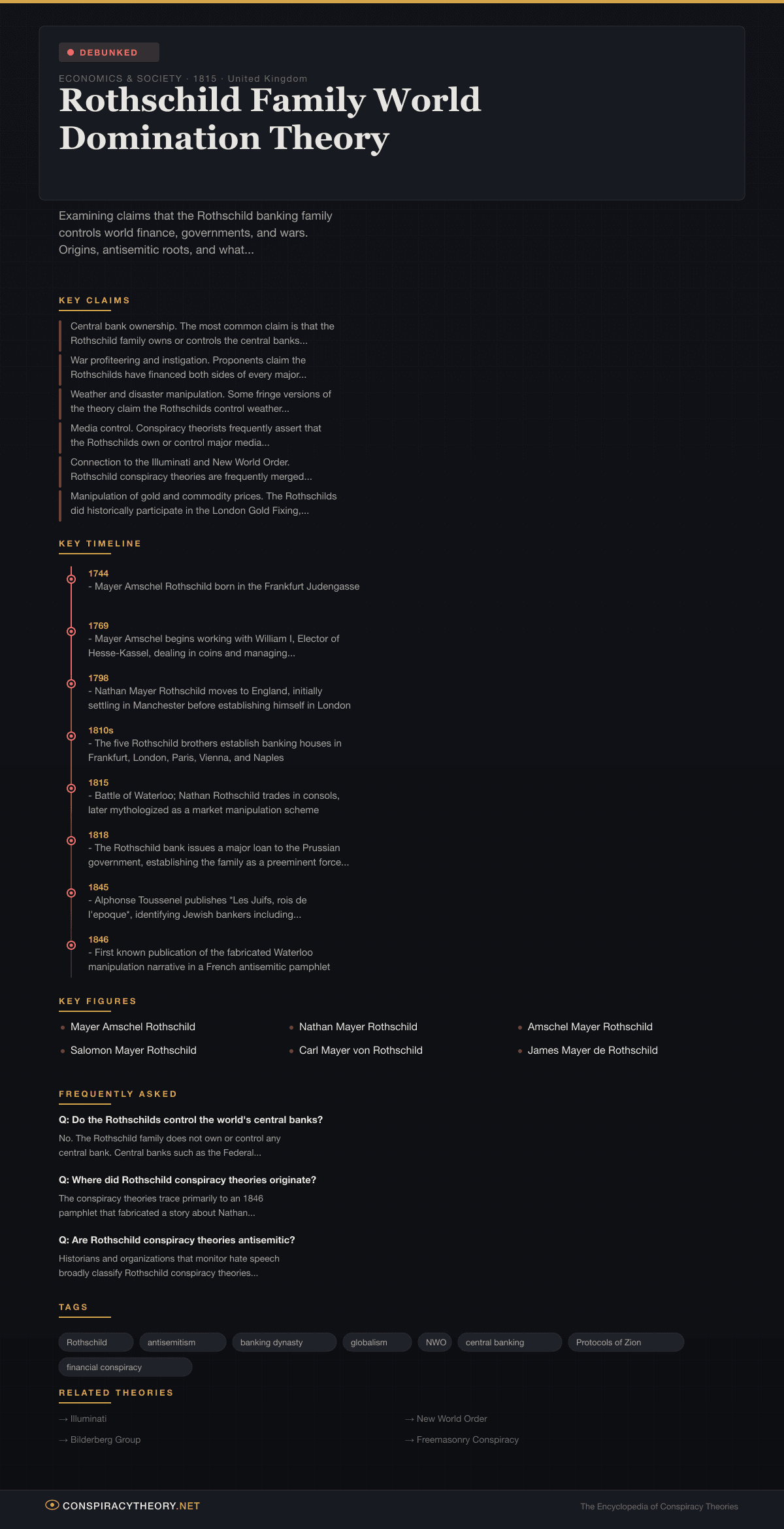
The first major "evidence" cited by conspiracy theorists often traces back to an 1846 pamphlet written under the pseudonym "Satan." This document alleged that Nathan Rothschild had gained an unfair advantage during the Battle of Waterloo (1815) by receiving news of the victory before the British government and using that information to "crash" the stock market and buy it back for pennies.
Historical research, including the family's own archives and contemporary records, reveals a different reality. While Nathan Rothschild did receive news of the victory early via his private courier network, he did not use it to crash the market. In fact, he was a major financier of the British war effort, and his wealth grew through the appreciation of government bonds following the peace, a standard—albeit highly successful—investment strategy.
The anti-Semitic overtones of these early narratives were later formalized in the late 19th and early 20th centuries through fabricated texts like The Protocols of the Elders of Zion. These forgeries claimed that a "Jewish elite," often personified by the Rothschilds, controlled the world’s finances and secret societies to subvert Christian civilization.
Evaluating the "Evidence": Common Myths vs. Verifiable Reality
Modern conspiracy theories frequently cite several points as "evidence" of a Rothschild-Illuminati alliance. Below is a breakdown of these claims compared to documented facts as of 2026.
The Claim of Central Bank Ownership
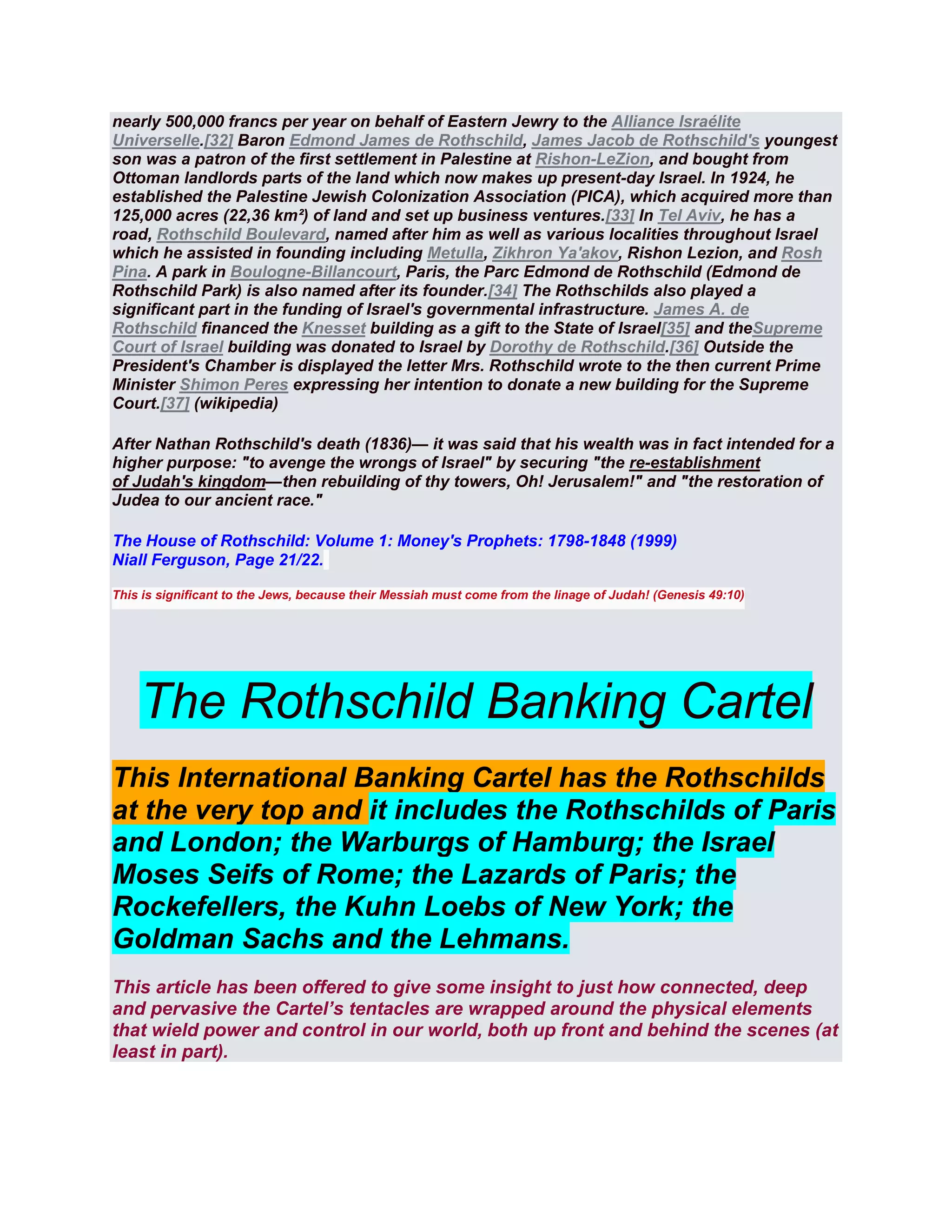
A pervasive myth suggests that the Rothschild family owns "80% of the world's central banks," including the U.S. Federal Reserve. In reality, central banks are either state-owned institutions or, in the case of the Federal Reserve, a complex public-private hybrid. The Federal Reserve is governed by a Board of Governors appointed by the President and confirmed by the Senate. While private commercial banks are members of the regional Fed banks, they do not "own" the system in a way that allows for personal or familial control over monetary policy.
The "Red Shield" and the Occult
Conspiracy theorists often point to the name Rothschild (meaning "Red Shield") and the family crest as evidence of occult or Illuminati symbolism. Historically, the red shield was simply the house sign used by the family in the Frankfurt ghetto. The family’s actual coat of arms, granted by the Austrian Empire, features symbols of unity (the five arrows representing the five brothers) and concord, which were standard heraldic practices of the time.
The Scale of Current Wealth
Claims that the Rothschilds possess "trillions of dollars" are not supported by financial audits or wealth tracking services like Bloomberg or Forbes. In 2026, the family's wealth is highly fragmented among hundreds of descendants. Most of their business interests are managed through Rothschild & Co and the Edmond de Rothschild Group. While they remain very wealthy, their combined assets are significantly smaller than the market capitalization of modern tech giants or the net worth of 21st-century billionaires like Elon Musk or Jeff Bezos.
| Feature | Historical Rothschild Family | The Conspiracy "Illuminati" Myth |
|---|---|---|
| Origin | 18th-century Frankfurt merchant class | 18th-century Bavarian academic elite |
| Primary Goal | Financial stability and dynastic expansion | Intellectual enlightenment and secularism |
| Timeline | Peak power in the 19th century | Active 1776–1785; defunct since |
| Wealth Source | Government bonds, mining, and banking | "Infinite" wealth from global manipulation |
| Status in 2026 | Fragmented private/public banking groups | A monolithic "New World Order" |
| Verified Links | None to Weishaupt or Illuminati | Alleged secret bloodline connections |
The Psychological and Sociological Drivers of the Theory
Why does the Rothschild-Illuminati theory persist in 2026? Sociologists point to the "complexity-reducing" function of conspiracy theories. Global finance is an abstract, highly technical, and often opaque system. Attributing the fluctuations of the world economy to a single family or a secret society provides a tangible villain and a narrative structure to events that might otherwise feel chaotic.
Furthermore, the "echo chamber" effect of the internet allows these theories to bypass traditional fact-checking. Algorithmic recommendations often steer users toward sensationalist content, where historical nuances are replaced by "hidden knowledge." Because the Rothschilds were objectively influential in the 19th century, they provide a "kernel of truth" that makes the subsequent fabrications seem more plausible to the uncritical reader.
Modern Operations of the Rothschild Family in 2026
As of 2026, the Rothschild name is primarily associated with specialized financial services and significant philanthropic endeavors. The family has largely transitioned away from the retail and commercial banking sectors that defined their 19th-century success.
- Financial Advisory: Rothschild & Co remains a top-tier global advisor for mergers and acquisitions (M&A). Their role is that of a consultant, not a clandestine "controller" of economies.
- Asset Management: The Edmond de Rothschild Group focuses on private banking and asset management for high-net-worth individuals and institutional investors.
- Philanthropy: The various Rothschild foundations are major contributors to arts, science, and social justice. These include the Rothschild Foundation (Hanadiv) in Israel and the various foundations associated with Waddesdon Manor in the UK.
- Agriculture and Viticulture: The family owns some of the world's most prestigious vineyards, such as Château Lafite Rothschild and Château Mouton Rothschild, which are managed as high-end luxury businesses.
Frequently Asked Questions
Did the Rothschilds fund both sides of World War II?
No. There is no historical evidence to support this. During World War II, the Rothschilds were targets of the Nazi regime due to their Jewish heritage. Their assets in Germany, Austria, and France were seized or "Aryanized," and many family members had to flee to the United States or the United Kingdom. The idea that they funded the very regime that sought their destruction is factually incorrect and logically inconsistent.
Why is the "Five Arrows" symbol used?
The five arrows represent the five sons of Mayer Amschel Rothschild. This symbol is derived from a story about a father who shows his sons that while a single arrow is easily broken, a bundle of five is unbreakable. It was intended to signify family unity and strength through cooperation across different European capitals.
Are the Rothschilds members of the Council on Foreign Relations (CFR)?
Individual family members or employees of Rothschild-affiliated firms may have held memberships in organizations like the CFR or the Bilderberg Group, but this is common for high-level executives in the financial and diplomatic sectors. Membership in these discussion forums is not evidence of a secret global conspiracy to rule the world.
Do the Rothschilds own the central bank of every country except three?
This is a popular internet meme with no basis in reality. Central banks like the Bank of England, the Bank of Japan, and the People’s Bank of China are state-controlled. The Rothschilds have no ownership stake in the vast majority of the world's central banks.
Critical Thinking and Verifying Historical Claims
When researching topics involving the Rothschilds and the Illuminati, it is essential to apply rigorous critical thinking and verify sources. To distinguish between historical evidence and conspiracy rhetoric, consider the following steps:
- Check the Chronology: Does the timing of the alleged event match the lifespans of the individuals involved?
- Evaluate the Source: Is the information coming from a peer-reviewed historical journal, an official government archive, or a self-published website without citations?
- Identify Bias: Does the narrative rely on tropes or stereotypes (e.g., "international bankers," "shadowy elites") that have a history of being used in propaganda?
- Seek Corroboration: If a major historical event was "controlled" by a single family, there would be physical evidence in diplomatic cables, bank records, and legal documents. In the case of the Illuminati link, no such evidence has ever surfaced.
Disclaimer: This article is for informational purposes only. It does not provide financial or legal advice. Historical interpretations are based on currently available records as of 2026.