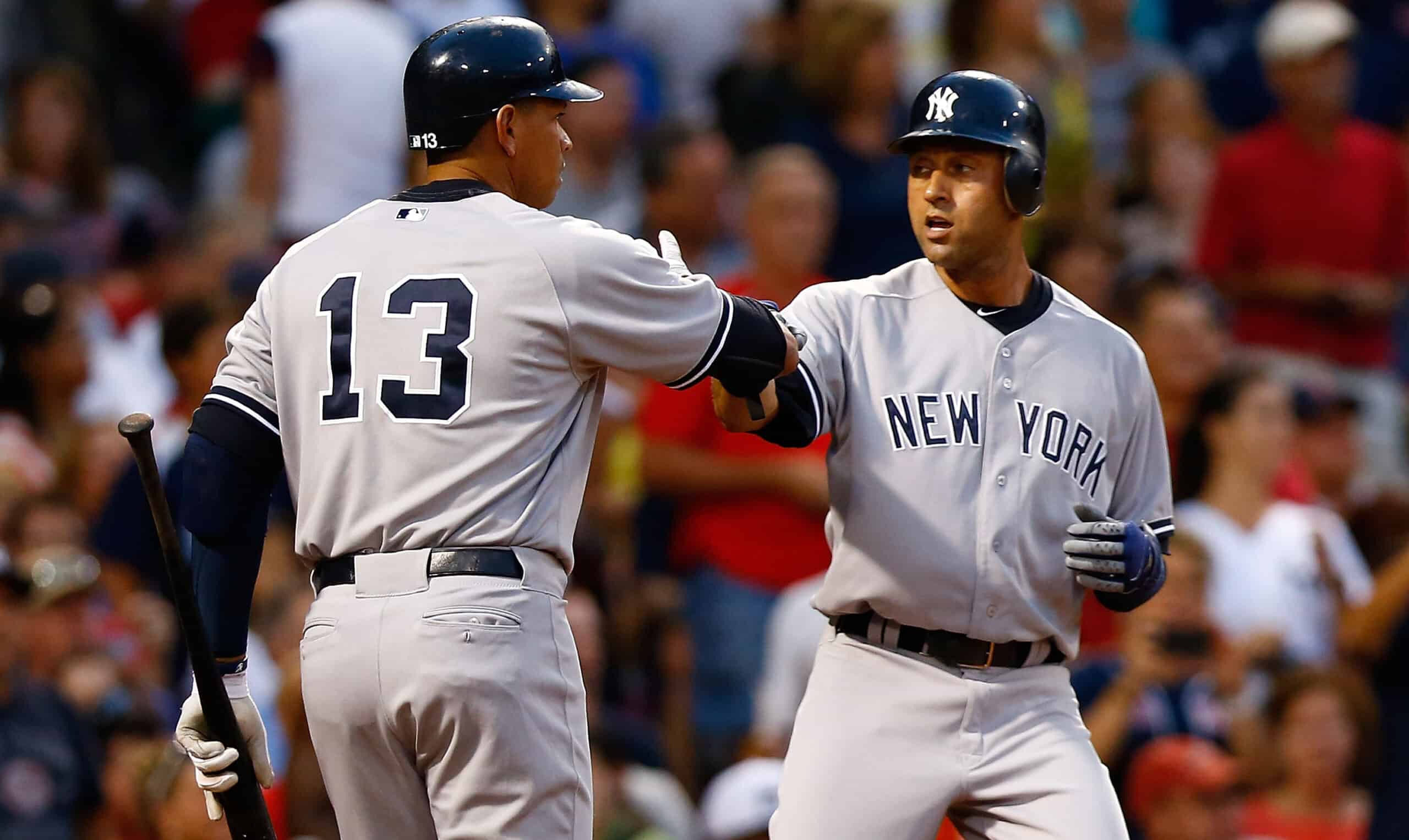
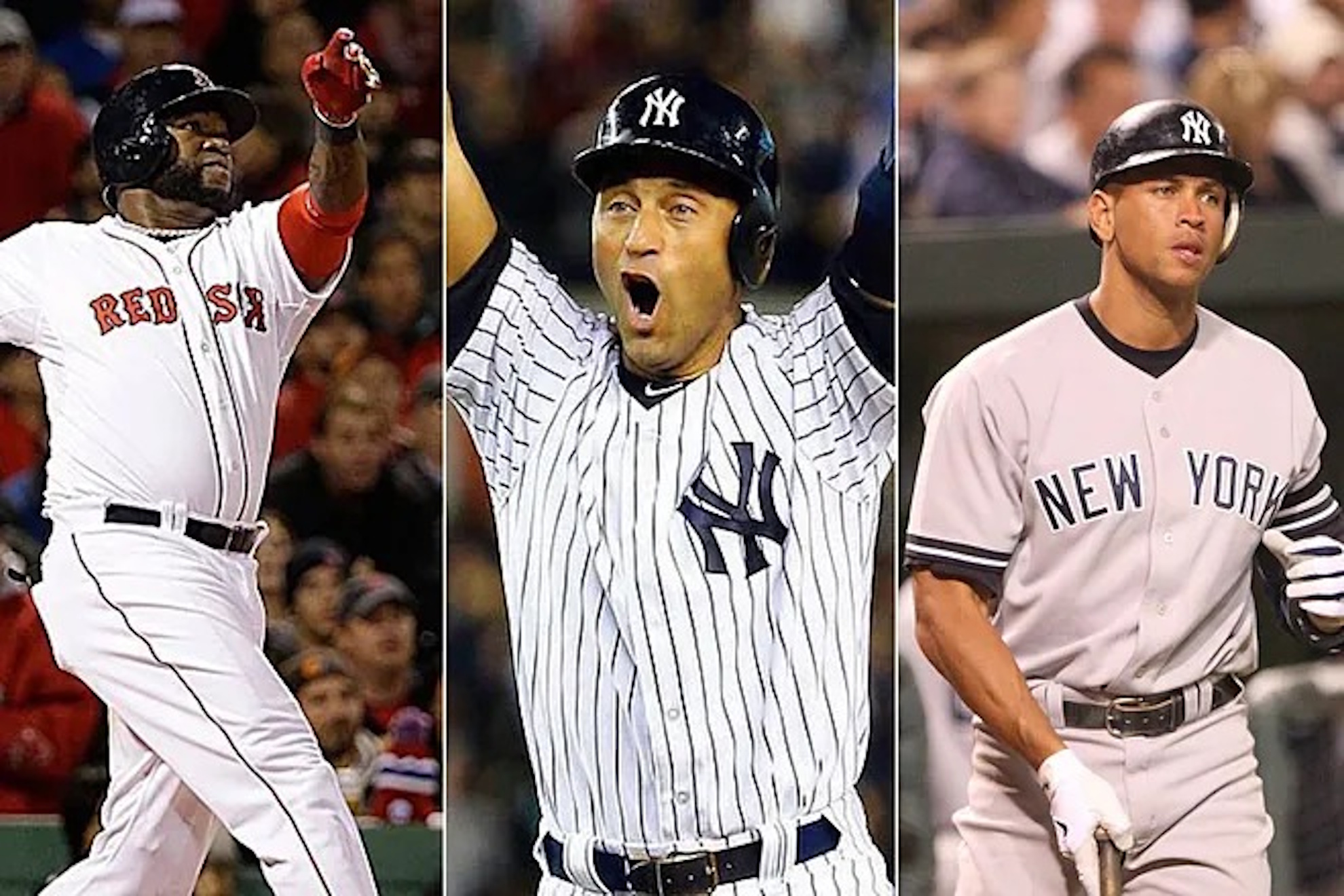
The debate between Alex Rodriguez and Derek Jeter defines a golden yet complex era of New York Yankees history. While Rodriguez possessed superior raw athletic talent, individual statistics, and three MVP awards, Jeter captured five World Series titles, earned universal reverence as team captain, and established an unmatched legacy of postseason clutch performance and leadership.
Tale of the Tape: Career Numbers and Peak Performance
When evaluating raw statistical dominance, Alex Rodriguez stands as one of the most prolific individual talents in baseball history. Across his 22-year Major League Baseball career with the Seattle Mariners, Texas Rangers, and New York Yankees, Rodriguez accumulated 696 home runs (fifth all-time), 2,086 runs batted in (RBIs), and 3,115 hits. He earned three American League Most Valuable Player (MVP) awards—two of which came during his tenure in New York (2005 and 2007)—and earned 14 All-Star selections. According to Baseball-Reference, Rodriguez compiled a career Wins Above Replacement (bWAR) of 117.6, putting him among the top elite position players to ever play the game.
Conversely, Derek Jeter constructed his legacy around remarkably durable consistency, elite contact hitting, and absolute ownership of the big stage. Playing all 20 of his MLB seasons exclusively for the New York Yankees from 1995 through 2014, Jeter amassed 3,465 hits, placing him sixth on the all-time MLB hits list and first in Yankees franchise history ahead of icons like Lou Gehrig, Babe Ruth, and Mickey Mantle. Jeter finished his career with a .310 batting average, 260 home runs, 1,311 RBIs, and 71.3 bWAR.
Individual Dominance vs. Franchise Consistency: • A-Rod: Peak power, 3x MVP, higher overall WAR (117.6 vs 71.3) • Jeter: Hit total (3,465), 5x World Series champion, .310 career batting average
While Rodriguez clearly outpaced Jeter in power metrics, slugging percentage, and advanced holistic metrics like WAR, Jeter’s offensive game was tailored to setting the table, extending innings, and performing under relentless pressure. Jeter recorded eight 200-hit seasons, whereas Rodriguez’s value stemmed from high-impact run creation, run production, and multi-category defensive and offensive superiority during his prime years.
Positional Dynamics and the 2004 Position Switch
One of the most debated managerial decisions in modern baseball history occurred in February 2004, when the New York Yankees acquired Alex Rodriguez from the Texas Rangers following an injury to third baseman Aaron Boone. At the time of the trade, Rodriguez was the reigning AL MVP and widely considered the finest defensive shortstop in the game, having won back-to-back Gold Glove Awards with Texas in 2002 and 2003.
Despite Rodriguez’s objective defensive superiority at shortstop based on metrics like Range Factor and Ultimate Zone Rating (UZR), Jeter was the entrenched captain and heart of the franchise. Rather than forcing Jeter to shift positions, Rodriguez deferentially agreed to move to third base—a position he had never played professionally.
- Defensive Reallocation: Rodriguez transitioned to third base without public complaint, subsequently winning a Silver Slugger at the position and adapting into an above-average hot-corner fielder.
- Captains Privilege: Jeter remained at shortstop, where he would go on to win five Gold Glove Awards (2004–2006, 2009–2010), despite defensive metrics long debating his range relative to elite shortstops of the era.
- Clubhouse Hierarchy: The move immediately established the internal hierarchy: regardless of contract size or personal accolades, the Yankees remained Derek Jeter’s team.
This positional sacrifice highlighted the complex tension between individual talent and organizational hierarchy. Rodriguez carried the heavier burden of adapting to an unfamiliar position, while Jeter maintained his legacy position, reinforcing the narrative of Jeter as the undisputed team leader.
Postseason Impact and Championship Pedigree
The ultimate divide between Derek Jeter and Alex Rodriguez often rests upon October performance and postseason mythology. Jeter earned nicknames like "Captain Clutch" and "Mr. November" due to his pivotal role in five World Series championships (1996, 1998, 1999, 2000, and 2009). Across 158 career postseason games—essentially a full regular season—Jeter hit .308 with 200 hits, 111 runs scored, 20 home runs, and a World Series MVP award in 2000. Iconic plays such as "The Flip" against the Oakland Athletics in the 2001 ALDS and his game-winning walk-off home run in Game 4 of the 2001 World Series cemented his standing in baseball lore.
Rodriguez’s postseason journey was far more turbulent. Early in his Yankees tenure, Rodriguez suffered well-publicized playoff slumps, notably during the 2004 ALCS collapse against the Boston Red Sox and the 2006 ALDS, where he was demoted to eighth in the batting order by manager Joe Torre. These struggles led critics to label him as a player who froze under bright lights.
However, Rodriguez completely rewritten that narrative during the 2009 postseason. In one of the most dominant individual playoff runs in franchise history, A-Rod batted .365 with six home runs, 18 RBIs, and a staggering 1.308 OPS across 15 postseason games, driving the Yankees to their 27th World Series title.
While Rodriguez delivered the single best individual postseason run between the two during 2009, Jeter’s decade-and-a-half of sustained, high-stakes excellence gave him the definitive edge in postseason reputation and championship rings.
Statistical Comparison Matrix
The table below contrasts the career achievements, regular-season output, and postseason records of Alex Rodriguez and Derek Jeter.
| Metric / Honor | Alex Rodriguez | Derek Jeter |
|---|---|---|
| Primary Yankees Position | Third Base (3B) | Shortstop (SS) |
| Yankees Tenure | 2004–2013, 2015–2016 | 1995–2014 |
| Career Hits | 3,115 | 3,465 |
| Career Home Runs | 696 | 260 |
| Career RBIs | 2,086 | 1,311 |
| Career Batting Average / OBP / SLG | .295 / .380 / .550 | .310 / .377 / .440 |
| Career bWAR | 117.6 | 71.3 |
| AL MVP Awards | 3 (2003, 2005, 2007) | 0 (Runner-up in 2006) |
| World Series Titles | 1 (2009) | 5 (1996, 1998, 1999, 2000, 2009) |
| All-Star Selections | 14 | 14 |
| Gold Glove Awards | 2 (at SS) | 5 (at SS) |
| Silver Slugger Awards | 10 | 5 |
| Career Postseason Batting Avg / OPS | .259 / .822 | .308 / .838 |
| Baseball Hall of Fame Status | On Ballot (PED Controversy) | Inducted 2020 (99.7% vote) |
Leadership, Cultural Impact, and Off-Field Controversies
The contrast between Jeter and Rodriguez extended far beyond the field, shaping public perception, media relations, and locker-room dynamics throughout their overlapping years in the Bronx.
Derek Jeter: The Stoic Corporate Leader
Derek Jeter mastered the demanding New York media environment. By offering polished, team-first answers and avoiding public controversy, Jeter protected the franchise's image. Named team captain in 2003, Jeter led by example, earning immense respect from teammates, opponents, and executives. His personal brand was defined by poise, professionalism, and operational execution under intense pressure.
Alex Rodriguez: The Polarizing Talent
Alex Rodriguez navigated a far more tempestuous career. After signing historic contracts—first a 10-year, $252 million deal with Texas in 2000, followed by a 10-year, $275 million extension with New York in 2007—Rodriguez faced immense scrutiny. His relationship with the media was often dramatic, heightened by a frosty personal relationship with Jeter that originated from a candid 2001 interview where Rodriguez questioned Jeter's ability to carry a lineup single-handedly.
Furthermore, Rodriguez's career was heavily impacted by performance-enhancing drug (PED) scandals. After admitting in 2009 to using banned substances while playing for Texas from 2001 to 2003, Rodriguez was implicated in the Biogenesis scandal in 2013, leading to an unprecedented full-season suspension for the entire 2014 MLB schedule. This contrast in public conduct ultimately shaped their enduring legacies: Jeter entered Cooperstown as a beloved hero, while Rodriguez's statistical records remain deeply tainted in Hall of Fame voting context.
Evaluating the Ultimate Legacy: Statistical Supremacy vs. Franchise Iconography
Determining a winner in the A-Rod vs. Derek Jeter debate depends entirely on the criteria chosen for evaluation.
If the metric is pure athletic capability, individual run creation, and overall positional value, Alex Rodriguez was objectively the superior baseball player. A-Rod ranks among the top five all-time in home runs and RBIs, possessed elite defensive range at his physical peak, and accumulated over 46 more WAR than Jeter. His 2005, 2007, and 2009 campaigns represent some of the highest statistical ceilings reached by any player wearing Pinstripes.
However, baseball—and specifically New York Yankees culture—is judged by championships, leadership, and iconic durability. By those standards, Derek Jeter wins the ultimate Yankees showdown. Jeter was the standard-bearer of a modern dynasty, captaining the franchise through its most successful era since the 1950s. His 3,465 hits, clean public record, postseason clutch play, and unanimous induction into Yankees lore make him the far more beloved and impactful franchise icon.
Recommended Framework for Evaluating Player Comparisons
When analyzing complex player debates featuring contrasting player profiles like Jeter and Rodriguez, sports analysts and fans should utilize a structured multi-tier evaluation method:
- Separate Peak Talent from Career Value: Distinguish between a player's absolute peak (where A-Rod dominates via MVP seasons) and long-term consistent production (where Jeter excels via hit volume and health).
- Contextualize Positional Demands: Recognize the defensive sacrifices made by players during team restructurings, evaluating metrics like UZR, Outs Above Average (OAA), and positional difficulty.
- Weight Postseason Sample Sizes: Evaluate playoff performance by looking beyond basic winning percentages to examine high-leverage context, sample sizes, and individual Win Probability Added (WPA).
- Factor Cultural and Organizational Impact: Account for leadership, team dynamics, media navigation, and how an athlete's presence influences franchise performance and public standing.
Frequently Asked Questions
Who had the higher career WAR between Derek Jeter and Alex Rodriguez?
Alex Rodriguez had a significantly higher career Wins Above Replacement (WAR) than Derek Jeter. Rodriguez generated 117.6 bWAR across his career, ranking among the highest totals in baseball history, while Derek Jeter compiled 71.3 bWAR.
Did Alex Rodriguez win a World Series with the New York Yankees?
Yes. Alex Rodriguez won his sole World Series championship with the New York Yankees in 2009. He was instrumental during that championship run, hitting six home runs and driving in 18 runs across 15 postseason games.
Why did A-Rod move to third base when he joined the Yankees in 2004?
Although Alex Rodriguez was a reigning AL MVP and two-time Gold Glove winner at shortstop, Derek Jeter was the established team captain and incumbent shortstop for the Yankees. To preserve team chemistry and respect franchise hierarchy, Rodriguez voluntarily shifted to third base.
Is Derek Jeter in the National Baseball Hall of Fame?
Yes. Derek Jeter was elected to the National Baseball Hall of Fame in 2020 in his first year of eligibility, receiving 396 out of 397 votes (99.7%), the second-highest voting percentage in Hall of Fame history behind former teammate Mariano Rivera.
Why is Alex Rodriguez not in the Baseball Hall of Fame?
Despite meeting all statistical thresholds with 696 home runs and 3,115 hits, Alex Rodriguez’s Hall of Fame candidacy has been stalled by his admitted use of performance-enhancing drugs (PEDs) and his subsequent season-long suspension in 2014 tied to the Biogenesis investigation.