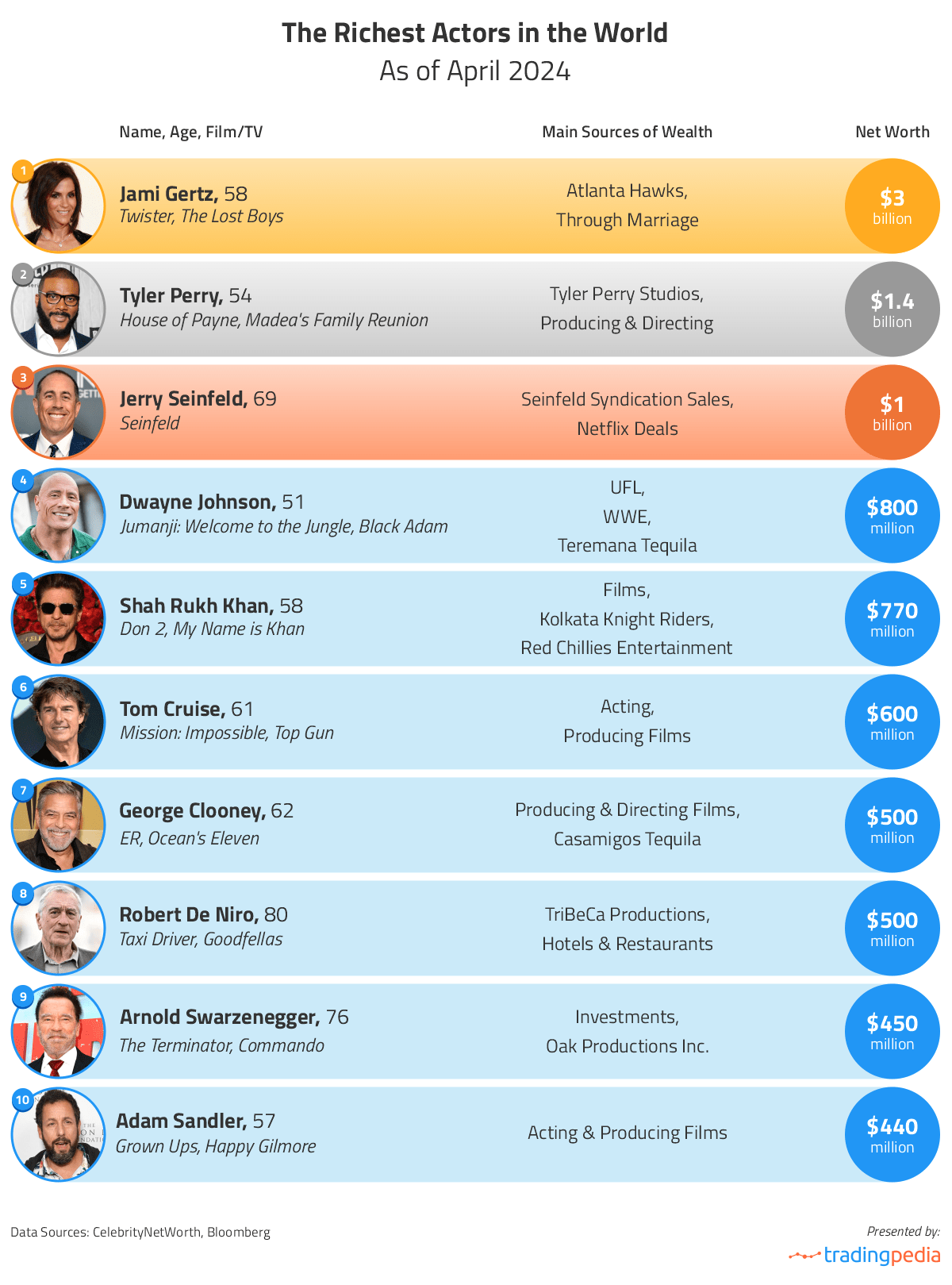
The world’s richest actors are defined not merely by their per-film salary, but by a diverse portfolio of business ventures, production houses, and strategic brand partnerships. While high-profile acting roles provide the initial capital, the vast majority of billionaire-level wealth in this sector is generated through equity stakes in major companies, alcohol brands, and global franchise ownership.
The Economic Model of Hollywood Wealth
To understand how actors reach the zenith of financial success, one must distinguish between "income" and "net worth." An actor’s salary for a blockbuster film may reach $20 million or $30 million; however, this represents only a fraction of total net worth. The wealthiest performers in the entertainment industry have shifted their focus from being "laborers for hire" to "capital owners."
The shift often begins with the transition into production. By forming their own production companies, actors move from being paid a flat fee to receiving a percentage of a film’s backend profits. This model allows them to share in the long-term success of a project, including syndication, streaming rights, and international distribution. When an actor owns the intellectual property (IP) associated with a film or series, they move from the role of a contractor to that of a media entrepreneur.
Primary Wealth Drivers Beyond Acting
The most significant accelerants for actors' wealth are equity events and brand endorsements that transcend traditional film work. In the current 2026 economic landscape, the following mechanisms are the most prevalent:
- Entrepreneurial Ventures: Many top-earning actors have invested heavily in the beverage industry, particularly tequila and spirit brands. By leveraging their personal brand, they can increase the valuation of these companies, often leading to lucrative partial or total exits through acquisition by global spirits conglomerates.
- Production and Media Houses: Creating a production company provides an actor with the leverage to develop projects they lead, thereby capturing a greater share of the profit margin. This is often the precursor to selling these production entities to larger studios or streaming platforms.
- Investment Portfolios: Successful performers often diversify their capital into technology startups, real estate, and private equity. These assets provide a hedge against the volatile nature of the film industry, where long periods of unemployment between projects are common.
- Brand Ambassadorships: Long-term, multi-year contracts with luxury fashion, automotive, or technology firms provide a steady stream of "passive" income that is not tied to the production schedule of a specific movie.
Comparative Overview of Wealth Sources
The following table summarizes the primary vehicles used by the most affluent actors to grow and sustain their wealth.
| Wealth Vehicle | Primary Benefit | Risk Profile |
|---|---|---|
| Film Production | High scalability via backend points | High; dependent on box office performance |
| Spirit/Beverage Brands | Significant exit potential (liquidity) | Moderate; requires high marketing spend |
| Real Estate | Capital appreciation and tax benefits | Low; stable long-term asset class |
| Equity Stakes | Ownership in tech/consumer goods | High; market-dependent volatility |
| Endorsement Deals | Consistent cash flow | Low; dependent on personal reputation |
The Role of Intellectual Property
Intellectual Property (IP) is perhaps the most critical component for actors looking to secure extreme wealth. In modern media, the value of a franchise—such as a superhero universe, a long-running action series, or a well-known book adaptation—far exceeds the value of an individual performance. Actors who successfully negotiate executive producer credits on these franchises gain not only a seat at the table during development but also a share in the massive revenues generated by merchandising, theme park attractions, and ancillary media.
When an actor functions as an executive producer, they effectively act as a partner to the studio. This allows them to influence the creative direction of a project, which in turn protects their long-term investment. This level of involvement turns a career based on temporary jobs into a career based on permanent asset accumulation.
Financial Management and Tax Efficiency
Managing extreme wealth requires the implementation of sophisticated financial structures. Most of the wealthiest actors in the world operate through a network of entities, including Limited Liability Companies (LLCs) and family offices. These structures serve several functions:
- Liability Protection: By housing production ventures and investments in separate legal entities, actors insulate their personal assets from potential lawsuits or business failures.
- Tax Planning: Utilizing international holding structures and specific tax jurisdictions allows for the management of tax liabilities across multiple global markets.
- Succession Planning: Family offices ensure that the wealth generated is effectively passed to the next generation, often involving complex trust structures that provide for long-term philanthropic or wealth-preservation goals.
It is important to note that financial success in the entertainment sector is not immune to economic downturns. Tax laws, specifically those related to capital gains and corporate tax rates in the United States and abroad, significantly influence the "net" take-home pay of these individuals. As of 2026, shifting global tax regulations continue to force high-net-worth individuals in the arts to adapt their investment strategies to maintain liquidity and growth.
Common Misconceptions Regarding Celebrity Wealth
There is often confusion between "gross earnings" and "net worth." Gross earnings refer to the total amount of money earned before taxes, management fees (which can be as high as 10% to 20%), and living expenses. Net worth, by contrast, is the total value of all assets—cash, real estate, stock portfolios, and company valuations—minus all liabilities.
Publicly available rankings often rely on estimates that do not account for hidden debt or fluctuating market valuations of private companies. Consequently, consumers should view these lists as approximate snapshots rather than precise audits. Furthermore, the "wealth" attributed to an actor often includes the valuation of their production companies, which are illiquid assets. An actor may be "worth" $500 million on paper, but that value is only realized if they were to successfully sell their stake in those businesses.
Frequently Asked Questions
H3: How is an actor's net worth calculated?
An actor’s net worth is calculated by aggregating the total value of their assets, including cash, real estate, investment portfolios, and the appraised value of any businesses or production companies they own, then subtracting all liabilities, such as loans, mortgages, and business debts. It is a snapshot of financial health rather than a record of annual income.
H3: Does acting in movies guarantee billionaire status?
Acting alone rarely produces billionaire-level wealth. The overwhelming majority of the world's richest actors reached their status by transitioning into business ownership, entrepreneurship, or equity-heavy production roles. Acting serves as the platform for brand building, which is then monetized through non-acting ventures.
H3: Why do so many famous actors own alcohol brands?
Alcohol brands provide a clear, scalable product that benefits from celebrity marketing. Because the spirits industry is highly competitive, companies are willing to pay massive premiums to acquire brands that have been "de-risked" by a famous partner, allowing the actor to achieve a significant "exit" through a sale.
H3: Are backend points in a movie deal still common?
Yes, backend points—which grant an actor a percentage of the film's net or gross profits—remain a standard tool for top-tier talent. However, the rise of streaming platforms has changed the structure of these deals. Many actors now negotiate "buyouts" of backend points in exchange for guaranteed upfront payments, as streaming metrics are less transparent than traditional box office returns.
H3: Can an actor lose their wealth despite success?
Yes. Like any high-net-worth individual, actors are susceptible to market volatility, poor investment decisions, and excessive personal spending. Without disciplined financial management, the lack of consistent income between film projects can lead to financial instability, even for those who have earned significant sums in the past.
Strategic Next Steps for Understanding Media Wealth
To monitor the evolution of wealth in the entertainment industry, observers should track major trade publications such as Variety or The Hollywood Reporter, which provide detailed reports on production deals and studio acquisitions. For those interested in the financial mechanics, researching the filing reports for publicly traded media conglomerates can provide insight into how production costs and talent compensation are structured. When evaluating the success of individual actors, focus on their business partnerships and the growth of their production entities, as these provide the most accurate barometer of their long-term financial trajectory.