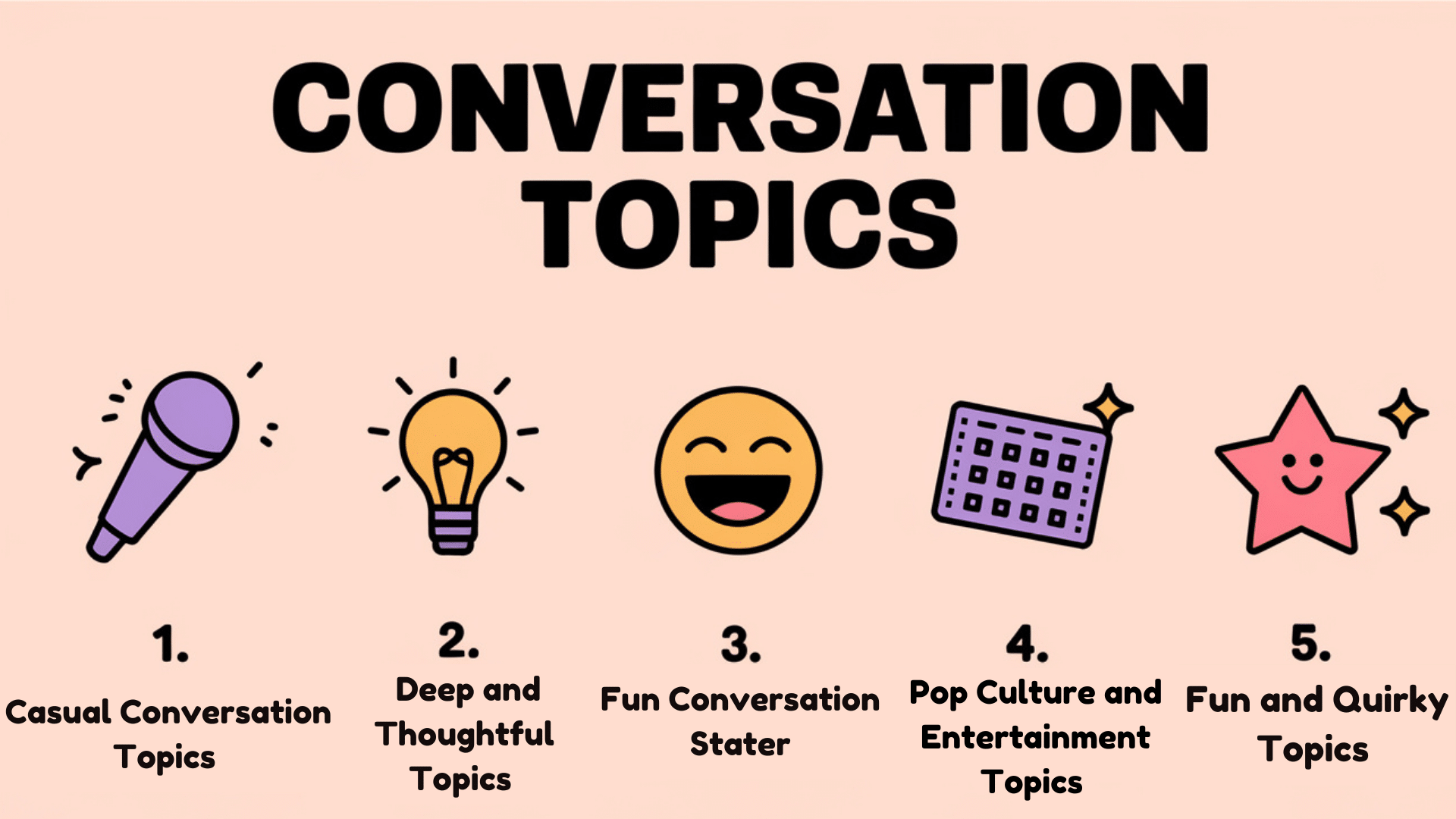
Navigating a conversation smoothly requires selecting topics that match the social setting, reading group energy, and balancing lighthearted curiosity with genuine interest. By using structured topic categories—ranging from low-risk icebreakers like food and pop culture to mid-tier hypotheticals and shared experiences—you can transform awkward silences into engaging, effortless dialogue across professional, casual, and social environments.
The Art of Topic Selection: Understanding the Conversation Risk Ladder
Every conversation operates on an implicit spectrum of social risk. Choosing the right subject depends on how well you know your conversational partners, the environment, and the collective mood of the group. Understanding this "conversation risk ladder" prevents awkward pauses and ensures that participants feel comfortable contributing without feeling put on the spot.
Social interactions generally move through three distinct stages of topic depth:
- Low-Risk Topics (Surface Level): Ideal for networking events, initial introductions, or casual elevator chats. These topics focus on immediate surroundings, universal human experiences, pop culture, and light preference questions. They require minimal vulnerability and carry virtually zero risk of disagreement or discomfort.
- Medium-Risk Topics (Personal Exploration): Best suited for casual gatherings, dinner parties, second meetings, or team lunches. These subjects touch on personal tastes, travel aspirations, hobbies, creative projects, and hypothetical scenarios. They encourage participants to share stories rather than just facts.
- High-Engagement Topics (Deep Connection): Reserved for close friends, small groups, late-night discussions, or intimate settings. These topics include childhood memories, lighthearted philosophical dilemmas, quirky pet peeves, and mild unpopular opinions.
By gauging where your interaction sits on this spectrum, you can select prompts that encourage participation while respecting appropriate social boundaries.
Low-Risk Lighthearted Topics for Icebreakers and Small Talk
When starting a conversation with new acquaintances or breaking the ice in mixed groups, the goal is to lower the barrier to entry. The best low-risk topics center on universal pleasures and everyday observations that everyone can relate to.
| Category | Sample Conversation Starter |
|---|---|
| Culinary & Food Choices | "What is your ultimate, no-questions-asked comfort food on a rainy Sunday?" |
| Pop Culture & Streaming | "What show did you binge-watch recently that actually lived up to the hype?" |
| Local Discoveries & Hidden Gems | "Have you found any amazing coffee shops or quiet spots in the city lately?" |
| Micro-Preferences & Debates | "Are you an early morning coffee person or a late-night productivity person?" |
Food, Cooking, and Culinary Adventures
Food is one of the most reliable conversation openers because virtually everyone holds strong, enjoyable opinions about it. Instead of asking generic questions like "What's your favorite food?", frame the prompt around specific experiences or light preferences.
- The Ultimate Comfort Meal: Ask people what single dish they would choose if they could only eat one meal for the rest of their life, or what food reminds them most of home.
- Culinary Dealbreakers: Inquire about strange food combinations people surprisingly enjoy, or food trends they think are completely overrated (such as truffle oil on everything or gold-leaf desserts).
- Cooking Triumphs and Disasters: Ask about the most ambitious meal someone ever attempted to cook, and whether it ended in culinary glory or a takeout order.
Entertainment, Books, and Media Consumption
Media choices offer a window into someone’s personality without demanding deep personal disclosure. Frame media questions around recommendations rather than evaluations to keep the tone positive.
- Binge-Worthy Discoveries: Ask what documentary, mini-series, or podcast completely captivated their attention recently.
- Guilty Pleasure Movies: Prompt the group to share movies they know are objectively cheesy or critically panned, but which they still watch every time they appear on television.
- Literary Escape: Inquire about books that genuinely changed how someone viewed a routine habit or inspired them to pick up a new hobby.
Local Highlights and Secret Spots
People love sharing local knowledge, making geographical or neighborhood discovery a natural bridge to easy conversation.
- The Best Kept Secret: Ask for recommendations on hidden parks, obscure bakeries, or quiet places to read in the city.
- Tourist in Your Own Town: Inquire about classic local tourist spots that people lived near for years before actually visiting.
Mid-Tier Topics for Deeper Connection and Shared Laughs
Once basic rapport is established, transitioning into mid-tier topics allows participants to reveal more of their personality, sense of humor, and personal values. These topics work exceptionally well at dinner parties, casual social gatherings, and casual team-building settings.
| Category | Sample Conversation Starter |
|---|---|
| Travel Dreams & Misadventures | "What is the most bizarre or unexpected thing that ever happened to you while traveling?" |
| Passion Projects & Quirky Hobbies | "If you had a completely free weekend with zero obligations, what would you make?" |
| Hypothetical Scenarios | "If you could instantly become an expert in any skill without training, what is it?" |
| Hidden Talents & Absurd Skills | "What is an unusually niche talent you have that never comes up on a resume?" |
Travel Stories and Vacation Misadventures
Travel stories are naturally narrative-driven, making them captivating for listeners. The key is to shift the focus away from pristine resort reviews toward funny, unexpected, or transformative experiences.
- The Unexpected Detour: Ask about trips where everything went wrong according to the itinerary, but the resulting detour became the highlight of the journey.
- Dream Itineraries: Ask where someone would fly tomorrow morning if time, work obligations, and budget were completely removed from the equation.
- Cultural Shock and Learning: Inquire about local customs or habits encountered abroad that someone wished their hometown would adopt.
Hypothetical Dilemmas and Playful "What If" Questions
Hypothetical questions unlock creative thinking and often spark humorous debates among group members. They work best when they do not involve heavy moral choices, keeping the energy light and engaging.
- The Skill Matrix: Ask: "If you could instantly wake up tomorrow morning fluent in three languages, master of one musical instrument, or top-tier at any sport, which would you pick and why?"
- Time Travel for a Day: Inquire whether someone would prefer to visit the year 1926 to experience the Roaring Twenties firsthand, or skip ahead to the year 2126 to see future technological advancements.
- Dinner Guest Selection: Ask which three historical figures or fictional characters someone would invite to a casual backyard barbecue.
Personal Passions and Niche Interests
People shine brightest when talking about things they genuinely love. Prompting others to discuss specialized passions creates an encouraging atmosphere.
- Rabbit Holes: Ask what obscure Internet topic, historical event, or hobby someone spent hours researching recently.
- Unconventional Skills: Inquire about minor, impressive skills people picked up out of pure boredom, such as juggling, rapid cup-stacking, or identifying any bird species by sound.
High-Engagement Topics for Established Friends and Small Groups
When conversing with close friends, long-term colleagues, or intimate dinner groups, you can introduce topics that require a bit more vulnerability, reflection, and humor. These prompts spark rich storytelling and unforgettable group interactions.
| Category | Sample Conversation Starter |
|---|---|
| Nostalgia & Childhood Memories | "What trend from your teenage years do you secretly wish would make a comeback?" |
| Harmless Unpopular Opinions | "What is a universally beloved food or movie that you absolute cannot stand?" |
| Life Lessons & Turning Points | "What piece of bad advice did you follow for years before realizing it was wrong?" |
| Quirky Pet Peeves | "What minor everyday inconvenience bothers you far more than it reasonably should?" |
Nostalgia and Youthful Fads
Reflecting on past eras evokes shared humor and nostalgic warmth, bridging generational gaps and highlighting shared cultural touchstones.
- Fashion and Phase Regrets: Ask about the absolute worst haircut, outfit trend, or subculture phase someone fully embraced during middle school or high school.
- Obsolete Technology: Inquire about childhood technologies—such as dial-up internet, physical road maps, or rewinding VHS tapes—that younger generations will never fully comprehend.
- First Jobs: Prompt people to share stories about their very first job, focusing on the strangest task they were ever asked to perform.
Low-Stakes Unpopular Opinions
Debating controversial political or social issues can derail a social gathering, but debating low-stakes preferences creates lively, amusing banter.
- Food Controversies: Pineapple on pizza, dipping fries in ice cream, or drinking iced coffee in sub-zero winter weather.
- Entertainment Hot Takes: Arguing that a famous award-winning movie was boring, or that a widely panned sequel was actually a masterpiece.
- Everyday Habits: Debating whether making the bed every morning actually improves productivity, or if keeping hundreds of unread emails is acceptable.
Quirky Life Philosophies and Everyday Habits
Exploring the odd routines and unwritten personal rules people create for themselves yields surprisingly insightful and entertaining conversations.
- Personal Superstitions: Ask if anyone holds a completely irrational personal rule or ritual they follow simply "just in case."
- The "Bad Advice" Audit: Inquire about well-meaning advice received early in life that turned out to be completely impractical or flat-out incorrect.
Matching Conversation Topics to Social Settings
To select the most effective topic quickly, use this comparative guide mapping conversation categories to social environments, risk levels, and natural transition techniques.
| Topic Category | Ideal Social Setting | Social Risk Level | Primary Benefit | Sample Transition Technique |
|---|---|---|---|---|
| Culinary & Food | Networking, Mixers, Lunches | Very Low | Universal appeal; low barrier to entry | "Speaking of lunch, has anyone tried that new spot down the street?" |
| Pop Culture & Media | Casual Work Breaks, Parties | Low | Identifies shared interests quickly | "I just finished watching [Show]. Has anyone else seen it?" |
| Travel & Adventure | Dinner Parties, Social Gatherings | Medium | Encourages detailed storytelling | "That photo reminds me—what’s the most unexpected trip you’ve taken?" |
| Hypotheticals & Games | Small Groups, Road Trips, Team Building | Medium | Sparks lively group debate and creativity | "Here’s a random question for the group: if you could instantly master..." |
| Nostalgia & Fashion Phases | Intimate Gatherings, Close Friends | Medium-High | Builds emotional warmth and shared laughter | "Looking at this old photo makes me wonder: what was your absolute worst haircut?" |
| Low-Stakes Unpopular Opinions | Game Nights, Casual Dinners | High | Creates fun, high-energy banter | "Okay, I have a controversial take on [Topic], and I need to know where everyone stands." |
Advanced Conversational Mechanics: How to Keep the Energy Flowing
Having a mental catalog of fun talking topics is only half the equation; knowing how to introduce, sustain, and pivot between topics ensures the conversation feels natural rather than scripted.
The FORD Method for Generating Ideas
When feeling stuck, rely on the classic FORD framework to generate relevant topics on the fly:
- F – Family & Social Circle: Asking about family traditions, pets, or how childhood friends met.
- O – Occupation & Projects: Focusing on exciting side projects, creative outlets, or favorite parts of a job rather than generic work duties.
- R – Recreation & Hobbies: Inquiring about weekend activities, upcoming events, sports, or creative passions.
- D – Dreams & Aspirations: Exploring future travel plans, skills to learn, or personal goals.
The Anchor-and-Bounce Technique
To introduce a topic without making it feel out of nowhere, use the Anchor-and-Bounce method:
- Anchor: Reference a detail from the current environment, a shared observation, or something previously mentioned ("I noticed you're drinking a cold brew...").
- Bridge: Connect that detail to a broader theme ("...which reminds me, I've been trying to find the best local roast in town.").
- Bounce: Ask an open-ended question that hands the conversation off to the other person ("Are you a coffee minimalist, or do you go for the fancy seasonal drinks?").
Active Listening and the "Follow-Up 80/20 Rule"
Great conversationalists listen more than they speak. Aim to follow the 80/20 rule: spend 80% of your focus genuinely listening to the response and 20% formulating your response.
Instead of jumping immediately to your own story when someone answers, ask at least one specific follow-up question probing deeper into their emotion or experience. For instance, if someone mentions traveling to Japan, ask "What was the most surprising moment of that trip?" before sharing your own travel stories.
Common Conversational Pitfalls and How to Avoid Them
Even with excellent topics, certain conversational habits can stall momentum or make interactions uncomfortable.
| Pitfall | How to Correct It |
|---|---|
| The Interrogation Trap | Balance open-ended questions with brief personal statements or observations. |
| Conversational Hijacking | Validate the speaker's story fully before introducing your own related experience. |
| Missing Social Cues | Shift to a lower-risk topic if responses become short, delayed, or distracted. |
| Topic Bouncing Too Quickly | Mine a single topic for stories and details before jumping to an unrelated subject. |
1. The Interrogation Trap
Asking question after question without sharing anything about yourself makes the interaction feel like an interview rather than a mutual exchange. Always balance a question with a brief observation or personal anecdote of your own.
2. Conversational Hijacking (One-Upmanship)
When someone shares a story, avoid immediately responding with a bigger, more dramatic story of your own. This turns a collaborative dialogue into a competition. Acknowledge their experience first, ask a follow-up question, and only then share a complementary memory if it naturally adds value.
3. Ignoring Energy Signals
Pay attention to non-verbal cues. If someone gives brief one-word answers, avoids eye contact, or checks their phone, the current topic may not be engaging them, or they may feel uncomfortable. Gracefully pivot to a lighter topic or give them an easy opening to wrap up the conversation.
Frequently Asked Questions
What are the best conversation topics when meeting someone for the first time?
The best initial topics are low-risk, observational, and focused on shared environments or experiences. Asking about food recommendations, recent popular media, travel preferences, or local events allows the other person to respond easily without feeling overly exposed.
How do I restart a conversation after an awkward silence?
Acknowledge the surroundings or use a lighthearted bridge topic. You can say something like, "Changing gears completely, I have a random question for you..." followed by a fun hypothetical or low-stakes question. This resets the energy without dwelling on the brief silence.
How can I make work-related small talk more interesting?
Shift the focus away from routine tasks and toward human elements. Instead of asking "What do you do?", ask "What project are you most excited about right now?" or "What’s the best piece of advice you’ve ever gotten in your career?"
What should I do if someone gives short one-word answers?
One-word answers usually signal that the topic is too dry, too private, or that the person is feeling put on the spot. Switch from factual questions to opinion- or preference-based questions, or share a brief, humorous observation of your own to take the pressure off them.
How do I politely exit a conversation that has run its course?
Exit warmly and directly by referencing a next action. Say something like, "It was so great catching up with you about [Topic]! I'm going to grab a drink / say hello to a friend, but I hope you enjoy the rest of the evening."
Mastering Everyday Conversational Agility
Becoming a great conversationalist does not require memorizing dozens of jokes or possessing an endless supply of dramatic stories. It comes down to cultivating genuine curiosity about how other people experience the world and applying simple frameworks to guide the interaction.
To put these strategies into practice immediately:
- Pick Two Prompts: Choose two low-risk prompts (such as favorite comfort foods or hidden local spots) and keep them in mind for your next social interaction.
- Practice the Follow-Up: In your next conversation, commit to asking at least one insightful follow-up question before offering your own perspective.
- Read the Room: Pay attention to the risk ladder, adjusting your topics to match the setting, familiarity level, and emotional energy of the group.
By approaching conversations with structured prompts and active listening, you can turn routine interactions into memorable exchanges.