November 14 serves as a critical date on the international calendar, primarily recognized as World Diabetes Day to honor the birth of insulin co-discoverer Frederick Banting. It also marks Children's Day in India, celebrating the legacy of Jawaharlal Nehru, and commemorates major historical milestones in space exploration and media history.
World Diabetes Day: The Global Health Focal Point of November 14
The most prominent global event occurring on November 14 is World Diabetes Day (WDD). Established in 1991 by the International Diabetes Federation (IDF) and the World Health Organization (WHO), it became an official United Nations Day in 2006. The choice of November 14 is deeply symbolic, as it marks the birthday of Sir Frederick Banting, who, along with Charles Best, discovered insulin in 1921. This discovery transformed diabetes from a certain death sentence into a manageable chronic condition.
As of 2026, the global focus on diabetes has shifted significantly toward holistic management and "well-being." The IDF’s 2024–2026 campaign theme, "Diabetes and Well-being," emphasizes that living with diabetes is about more than just managing blood glucose levels. It encompasses physical, mental, and social health. In 2026, healthcare providers and advocacy groups are increasingly highlighting the "burden of care"—the thousands of daily decisions people with diabetes must make—and advocating for technologies and policies that reduce this psychological strain.
The "Blue Circle" logo remains the universal symbol for diabetes awareness, representing the unity of the global diabetes community in response to the pandemic-level rise of the condition. Statistics in 2026 indicate that over 540 million adults worldwide are living with diabetes, a number projected to continue rising without significant policy intervention regarding food systems and preventive care. World Diabetes Day serves as the primary platform to lobby governments for better access to care, essential medicines like insulin, and diagnostic tools to prevent life-altering complications such as kidney failure, blindness, and lower-limb amputation.
Children’s Day in India: Honoring the Legacy of Jawaharlal Nehru
While much of the world observes Universal Children's Day on November 20, India celebrates its National Children’s Day on November 14. This date coincides with the birth anniversary of Pandit Jawaharlal Nehru, the first Prime Minister of independent India. Known affectionately as "Chacha Nehru" (Uncle Nehru), his devotion to the welfare, education, and development of children was a cornerstone of his political philosophy.
Nehru famously asserted that children are the "real strength of a nation and the foundation of society." Following his death in 1964, a resolution was passed in the Indian Parliament to move Children's Day from November 20 to November 14 to honor his memory. In 2026, the celebration remains a vital part of the Indian school calendar, though the focus has evolved. While traditional celebrations involve cultural programs, games, and tributes, modern observances in 2026 emphasize digital literacy, mental health awareness among youth, and bridging the educational divide in rural sectors.
The day serves as a reminder to the government and civil society of the ongoing need to protect child rights and ensure that every child has access to quality education and healthcare. For educators, it is a day to reflect on the pedagogical shifts required to prepare the next generation for a rapidly changing technological landscape while maintaining the secular and democratic values Nehru championed.
Key Historical Milestones Occurring on November 14
November 14 has been the backdrop for several transformative events in science, politics, and media. From the heights of the Space Race to the birth of modern broadcasting, the date holds a unique place in the historical record.
| Event / Entity | Category | Year | Historical Significance |
|---|---|---|---|
| Frederick Banting's Birth | Science/Medicine | 1891 | Co-discoverer of insulin; youngest Nobel Laureate in Physiology or Medicine. |
| BBC Radio Launch | Media/Tech | 1922 | The British Broadcasting Company (now Corporation) began its first daily radio service (2LO). |
| Birth of King Charles III | Monarchy | 1948 | The birth of the current British monarch at Buckingham Palace. |
| Apollo 12 Launch | Space Exploration | 1969 | The second crewed mission to land on the Moon, launched during a lightning storm. |
| Mariner 9 Arrival | Space Exploration | 1971 | Became the first spacecraft to orbit another planet (Mars), outlasting Soviet competitors. |
| Discovery of Sedna | Astronomy | 2003 | The discovery of the trans-Neptunian object 90377 Sedna, one of the most distant objects in the solar system. |
The Launch of Apollo 12 (1969)
On November 14, 1969, NASA launched Apollo 12, the second lunar landing mission. The launch was nearly derailed when the Saturn V rocket was struck by lightning twice shortly after liftoff, causing the spacecraft's electrical systems to malfunction. The mission is famous for the "EECOM" (Electrical, Environmental, and Communications) officer John Aaron's instruction to "Try SCE to Aux," a technical fix that restored the telemetry and saved the mission. This event remains a case study in aerospace engineering for crisis management and system resilience.
The Inception of the BBC (1922)
The British Broadcasting Company began its first daily radio broadcasts from the 2LO station at Marconi House in London on this day in 1922. This marked the birth of public service broadcasting in the United Kingdom, setting a global standard for news, education, and entertainment. Over a century later, the BBC remains one of the world's most influential media organizations.
Scientific and Cultural Breakthroughs
Beyond the major headlines, November 14 is associated with significant milestones in geography and astronomy. In 1963, a massive volcanic eruption beneath the sea near Iceland reached the surface, beginning the creation of the island of Surtsey. This event provided geologists and biologists with a rare opportunity to observe the birth of an island and the subsequent colonization of life on brand-new land.
In the realm of astronomy, the 2003 discovery of Sedna on November 14 challenged existing models of the solar system. Sedna’s highly elliptical orbit takes it far beyond the Kuiper Belt, leading to theories about the existence of the Oort Cloud and the potential influence of a "Planet Nine." These scientific milestones underscore November 14 as a date of discovery and the expansion of human knowledge.
Astrology and Personality Traits: The November 14 Scorpio
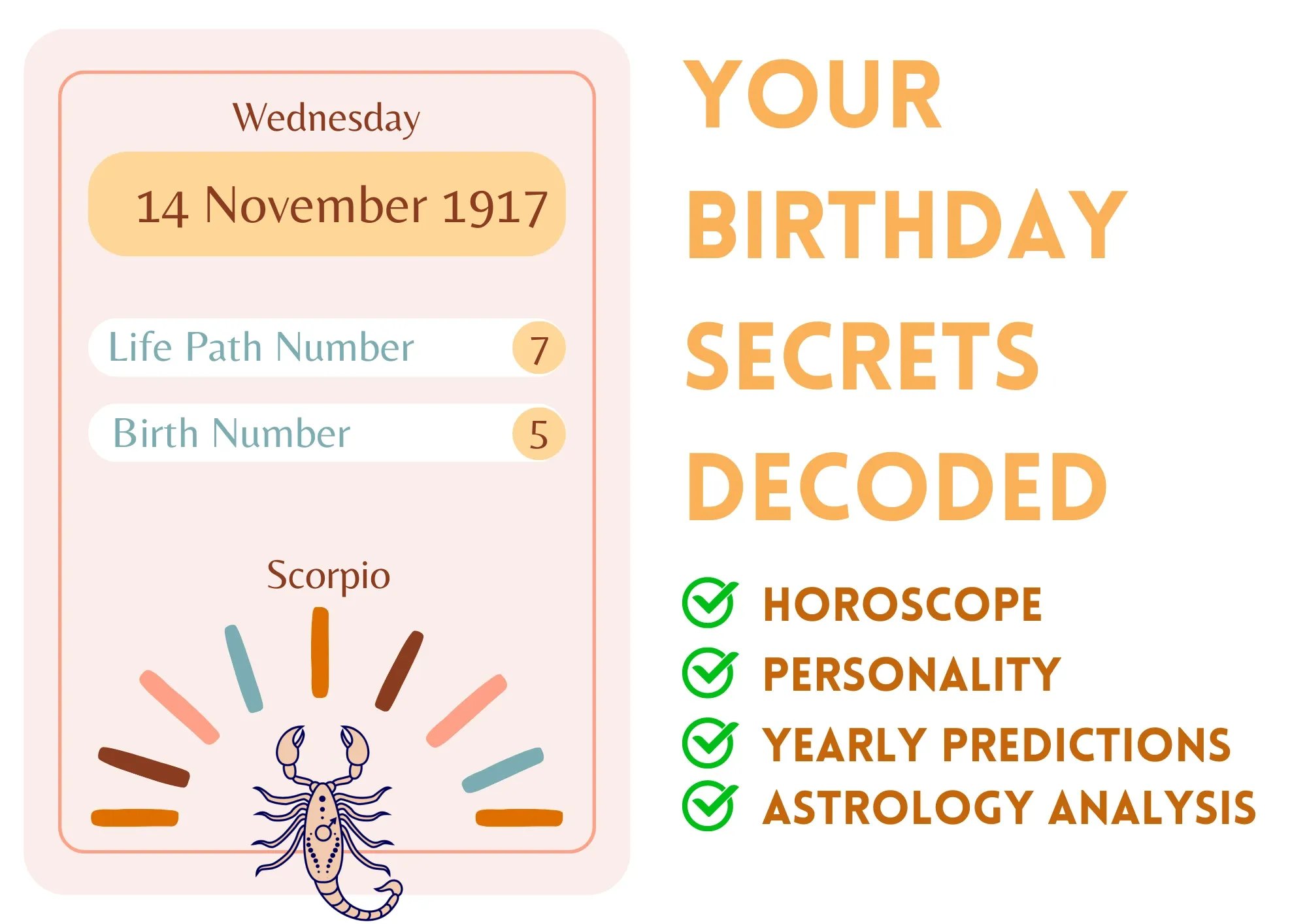
In the zodiac, those born on November 14 fall under the sign of Scorpio. Within the 2026 astrological context, November 14 individuals are often characterized by a unique blend of analytical precision and intense emotional depth. Unlike the stereotypical "mysterious" Scorpio, those born on this specific date are frequently associated with a strong sense of social responsibility and a desire for structural order.
Scorpios born on this day are said to be influenced by the planetary sub-ruler Moon (in some decanate systems), which adds a layer of sensitivity and intuition to their naturally determined personality. They are often found in professions that require deep investigation, such as research science, investigative journalism, or psychology. Their primary challenge is often balancing their high expectations of others with the need for personal flexibility.
Common Characteristics of November 14 Birthdays:
- Methodical Nature: A preference for logic and systematic approaches to problems.
- Observation Skills: An uncanny ability to notice details that others overlook.
- Loyalty: Fierce protection of family and long-term professional partners.
- Public Service: A frequent inclination toward roles that improve societal well-being, mirroring the legacies of Banting and Nehru.
Frequently Asked Questions (FAQ)
What is the main holiday on November 14?
The primary international holiday is World Diabetes Day, which is recognized by the United Nations and observed in over 160 countries. It focuses on raising awareness about diabetes prevention, care, and the need for global access to treatment. In India, the day is also a major national holiday known as Children's Day or "Bal Diwas."
Why is World Diabetes Day celebrated on November 14?
It is celebrated on this date to honor the birthday of Sir Frederick Banting. Banting, along with Charles Best and John Macleod, is credited with the discovery of insulin in the early 1920s. This medical breakthrough has saved millions of lives and remains the most significant milestone in the history of diabetes treatment.
Is November 14 a public holiday?
In most countries, November 14 is a day of observance rather than a public holiday where businesses close. However, in India, while it is not a "gazetted" public holiday (meaning government offices remain open), it is widely celebrated in schools and educational institutions across the country, often with special events that replace regular classes.
Who are some famous people born on November 14?
In addition to Frederick Banting and Jawaharlal Nehru, famous birthdays include King Charles III of the United Kingdom (born 1948), American politician Condoleezza Rice (born 1954), and French Impressionist painter Claude Monet (born 1840). The diversity of these figures highlights the historical and cultural richness of the date.
What are the "Blue Buildings" seen on November 14?
As part of the World Diabetes Day "Global Landmarks Challenge," hundreds of iconic buildings and monuments around the world—such as the Empire State Building, the London Eye, and the Burj Khalifa—are lit in blue. This initiative is designed to raise visual awareness for the condition and signify global solidarity.
Practical Actions and Participation for November 14
For those looking to engage with the significance of November 14, several practical steps can be taken depending on your interests in health, history, or community service.
If your focus is on health, 2026 guidelines recommend using World Diabetes Day as a prompt for preventive screening. Many local clinics offer free blood glucose testing on this day. Given that Type 2 diabetes can often be delayed or prevented through lifestyle changes, knowing your "numbers" is the first step in proactive health management. You can also participate in the "Global Diabetes Walk," an initiative by the World Diabetes Foundation to encourage physical activity.
If you are an educator or parent in India, the day serves as an opportunity to advocate for child-centric policies. Supporting NGOs that focus on child nutrition or digital equity can honor the spirit of Nehru’s original vision for the day. For history and science enthusiasts, November 14 is an excellent time to visit local science museums or planetariums, many of which host events commemorating the Apollo 12 mission or the history of medical discoveries.
Regardless of your location, November 14 is a day that bridges the gap between scientific achievement and social responsibility, reminding us of the progress we have made and the work that remains in global health and human welfare.