Estimating the current value of The House on the Rock in 2026 requires looking beyond traditional real estate metrics. While the physical land and structures are worth tens of millions, the total enterprise value—including its world-class collections and tourism revenue—is estimated to be between $100 million and $150 million, depending on the valuation of its unique, irreplaceable artifacts.
The House on the Rock, located in Spring Green, Wisconsin, is not merely a residence; it is a sprawling complex of architectural marvels, automated musical instruments, and massive collections that defy standard appraisal. Founded by Alex Jordan Jr. and opened to the public in 1960, it has evolved into one of the most successful and eccentric privately owned tourist attractions in the United States. To understand its worth today, one must dissect the property into its core components: real estate, the business of tourism, and the intrinsic value of its one-of-a-kind contents.
The Physical Real Estate: Land and Architecture
At its core, The House on the Rock sits on a chimney of rock known as Deer Shelter Rock. The original house, designed by Alex Jordan Jr., is a masterclass in organic architecture, though it was famously built as a "spite house" or a personal retreat rather than a functional home. In 2026, the real estate value alone is significant due to the sheer acreage and the complexity of the builds.
Acreage and Zoning
The complex spans hundreds of acres in the scenic Wyoming Valley of Wisconsin. In a 2026 market where large, contiguous tracts of land in the Driftless Area are increasingly rare, the raw land value provides a solid floor for the valuation. However, because the land is zoned for commercial tourism and features specialized infrastructure (parking lots, wastewater treatment, and gift shops), its "highest and best use" remains its current function.
Structural Integrity and Engineering
The "Infinity Room," which glass-floors 218 feet out over the valley without supports beneath it, is a marvel of engineering. Appraising such a structure is difficult because the replacement cost is astronomical. In 2026, building a similar cantilevered structure would involve modern environmental regulations and material costs that could easily exceed $20 million for that single room alone. The maintenance of these structures—fighting the Wisconsin elements and the stress of thousands of daily visitors—requires a capital expenditure budget that would intimidate most private homeowners.
The Business Value: Revenue and Enterprise Worth
Most experts in commercial real estate would value The House on the Rock using the Income Approach. This method looks at the net operating income (NOI) the property generates from ticket sales, food and beverage, and retail.
Attendance and Ticket Sales
The House on the Rock remains a "bucket list" item for travelers. With three distinct tours offered, ticket prices in 2026 typically range from $30 to $60 per person. Assuming an average attendance of 400,000 to 500,000 visitors annually, the gross revenue from admissions alone sits comfortably in the eight-figure range. When you add the high-margin revenue from the extensive gift shops and the House on the Rock Resort and Inn nearby, the business becomes a formidable financial engine.
The Multiplier Effect
In the tourism industry, businesses are often sold at a multiple of their EBITDA (Earnings Before Interest, Taxes, Depreciation, and Amortization). A stable, iconic attraction like The House on the Rock would likely command a 6x to 8x multiple. Given the steady demand for "experiential" travel in 2026, the enterprise value of the business operation likely accounts for more than half of the total $150 million valuation.
The Collections: A Treasure Trove of Curiosities
What truly separates The House on the Rock from a standard estate is its contents. Alex Jordan Jr. was a collector of collections. The property houses thousands of items, ranging from legitimate antiques to meticulously crafted replicas and "fakes" that are now valuable in their own right as part of the Jordan legacy.
- The World’s Largest Carousel: Featuring 269 animals, 20,000 lights, and 182 chandeliers, this carousel is priceless. It has never been used by riders, preserving its condition. A traditional vintage carousel might sell for $5 million to $10 million; this one, given its scale and custom nature, is worth significantly more to a specialty collector or museum.
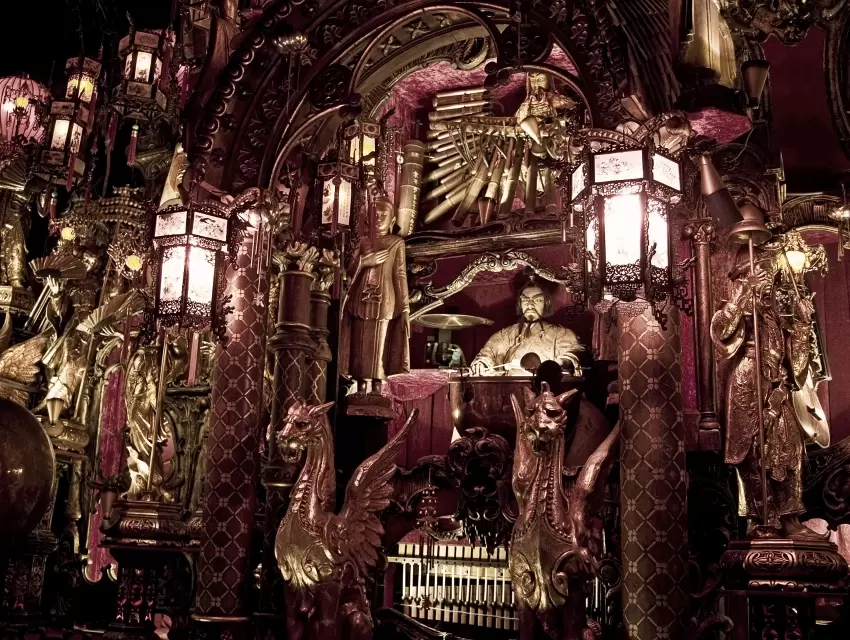
- The Mikado and Automated Music: The complex houses one of the world's most extensive collections of automated musical instruments. The "Mikado" and the "Orchestrion" rooms contain machines that, if auctioned individually, would attract global interest from mechanical music enthusiasts.
- The Sea Monster: The 200-foot-long sea monster sculpture in the "Heritage of the Sea" building is a massive asset. While it has no "utility," it is a primary draw for the facility.
Valuing these items requires a specialist's eye. While some items are kitsch, the sheer volume creates a "collection premium." If the house were to be liquidated, the auction process alone would take years and likely generate record-breaking sums for the mechanical music and nautical categories.
Comparative Valuation Factors
To put the $100M–$150M figure into perspective, it is helpful to compare the property to other unique American estates and attractions.
| Feature | The House on the Rock | Hearst Castle (CA) | Biltmore Estate (NC) |
|---|---|---|---|
| Primary Valuation Driver | Tourism Revenue & Collections | Historical Significance & Land | Architectural Scale & Hospitality |
| Ownership | Private (Donaldson Family) | State of California | Private (Cecil Family) |
| Annual Visitors (Est.) | 450,000 | 750,000 | 1,400,000 |
| Estimated Asset Value | $100M - $150M | $250M+ (State Asset) | $300M+ (Enterprise) |
| Maintenance Cost | Extreme (High Tech/Mechanical) | Extreme (Historic Preservation) | Extreme (Agricultural/Estate) |
The House on the Rock occupies a middle ground. It lacks the historic "Gilded Age" pedigree of the Biltmore, but it possesses a "pop culture" and "outsider art" appeal that ensures high visitor density. This density is the engine that drives its valuation in 2026.
Challenges to a Modern Appraisal
Any appraiser in 2026 would face significant hurdles when putting a hard number on this property. These "valuation discounts" or "risk factors" include:
- Specialized Use: The property is so unique that it has almost no alternative use. If it ceased to be a tourist attraction, the cost to convert it into a private residence or a traditional museum would be prohibitive.
- Maintenance Liability: The "Infinity Room" and the thousands of moving parts in the automated machines represent a massive ongoing liability. A buyer would need to set aside millions in a sinking fund just for structural and mechanical repairs.
- Owner-Dependent Legacy: Much of the value is tied to the mythos of Alex Jordan Jr. While the current owners (the Donaldson family, who purchased it in 1988) have successfully maintained this, a transition to a new owner would require careful brand management to ensure the "mystery" of the house remains intact.
The "Jane Donaldson" Factor and 1988 Sale
Historically, the house was sold by Alex Jordan Jr. to Jane Donaldson in 1988 for a price rumored to be around $17 million. Adjusting for inflation to 2026, that $17 million is worth approximately $48 million. However, the complex has grown significantly since 1988, adding new buildings, more sophisticated displays, and the neighboring resort. The appreciation in the "brand" of The House on the Rock has far outpaced standard inflation, leading to the current nine-figure valuation.
Frequently Asked Questions
Is The House on the Rock for sale?
As of 2026, The House on the Rock is not listed for sale. It remains under the private ownership of the Donaldson family, who have operated it since 1988. Given its status as a high-yield tourism asset, it is unlikely to hit the open market unless it is through a private equity acquisition or a generational transition.
How much does it cost to maintain the Infinity Room?
While specific figures are proprietary, engineering experts estimate that maintaining a cantilevered structure of that age and design in a climate with Wisconsin’s temperature swings costs several hundred thousand dollars annually. This includes regular structural inspections, glass replacement, and moisture control.
Are the collections inside the house insured?
Yes, the collections are insured under a specialized "inland marine" insurance policy, which is common for museums and high-value private collections. The premiums for such a policy are significant, reflecting the difficulty of replacing unique items like the massive carousel or the automated orchestrions.
Who inherited Alex Jordan’s money?
Alex Jordan Jr. sold the property before his death in 1989. The proceeds of the sale and his estate were handled through his personal dictates, though he famously had no children. The real "inheritance" was the property itself, which has flourished under the stewardship of the Donaldson family.
Does the 2026 valuation include the Resort and Inn?
Generally, yes. When discussing the "worth" of The House on the Rock, analysts treat it as a bundled asset. The House on the Rock Resort (located nearby) and the Inn are essential to the attraction's ecosystem, providing the lodging infrastructure that allows it to function as a multi-day destination.
Determining the Final Market Value
If The House on the Rock were to be appraised for a potential sale in 2026, the final number would likely settle near $125 million. This reflects a balanced view of its $50 million in physical real estate and infrastructure, $40 million in unique collectible assets, and $35 million in brand equity and capitalized earnings.
For investors or curious observers, the true "value" of the house is its resilience. Despite being an architectural anomaly in a rural corner of the Midwest, it continues to outperform traditional luxury real estate investments. Its worth is a testament to the enduring human fascination with the strange, the massive, and the mysterious.