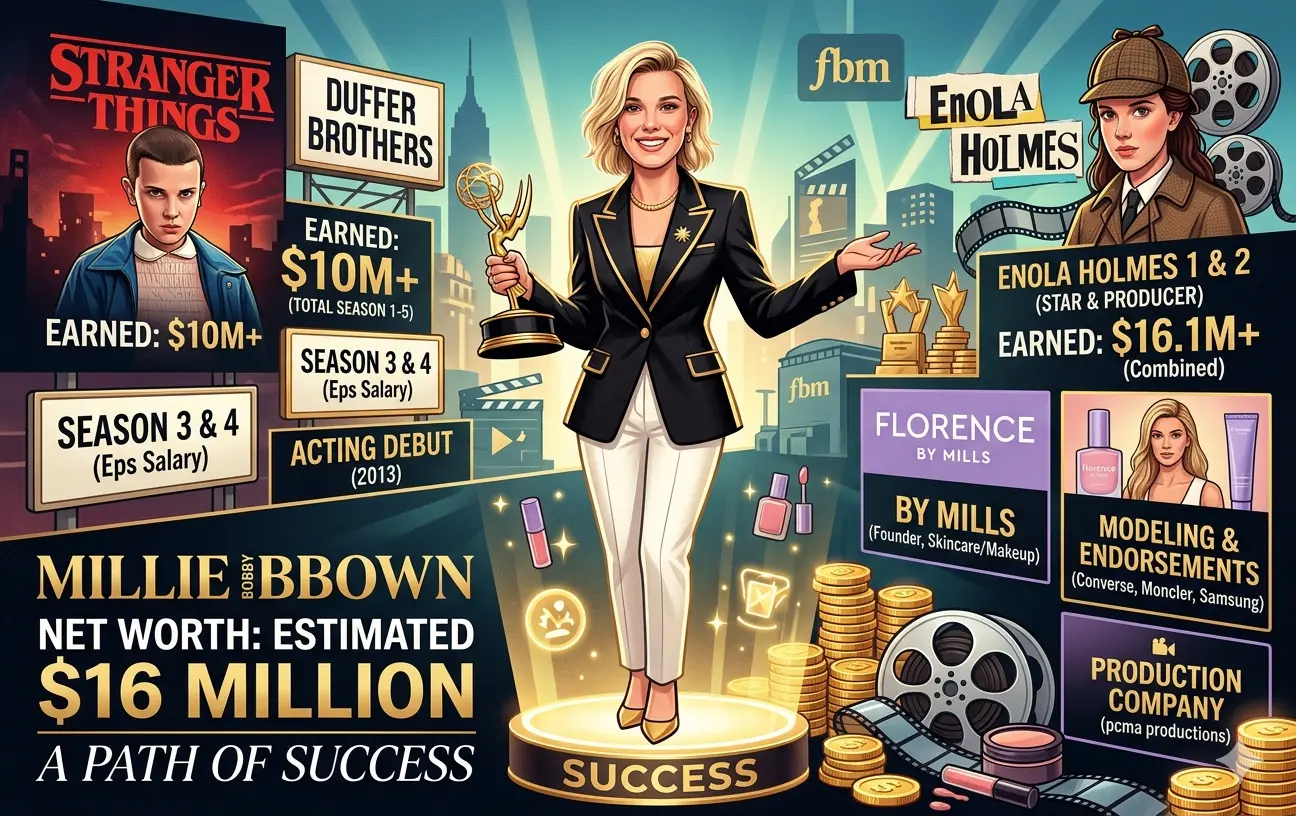
Millie Bobby Brown’s net worth is estimated between $14 million and $20 million as of 2026. Her financial profile reflects a transition from child star to Hollywood producer and entrepreneur, driven by major paychecks from Netflix’s Stranger Things, high-figure film contracts, brand equity in Florence by Mills, and executive producer fees via PCMA Productions.
Overview of Millie Bobby Brown’s Financial Trajectory
Millie Bobby Brown’s rise from a supporting television actor to one of Hollywood’s highest-paid young performers represents a modern case study in entertainment asset building. Born in Spain and raised in the United Kingdom and the United States, Brown landed her breakout role as Eleven in Netflix’s hit sci-fi series Stranger Things in 2016 at the age of 12. What began as a standard television talent contract rapidly evolved into a multi-tiered commercial empire.
Between 2016 and 2026, Brown’s financial strategy diversified beyond acting base salaries. Rather than relying solely on upfront talent fees, her management team capitalized on her cultural influence to secure producer credits, backend profit participation, global endorsement deals, and direct equity ownership in consumer product brands. This multi-pronged approach established a financial baseline that cushions against the volatility of the entertainment industry.
By acquiring majority ownership in her consumer brand, Florence by Mills, and establishing her own production company, PCMA Productions, Brown moved from being a hired performer to an equity holder. This shift significantly raised her overall net worth valuation, placing her among the most financially structured young actors of her generation.
Primary Income Streams: Television and Film Paydays
The Stranger Things Compensation Evolution
The primary driver of Brown’s early wealth accumulation was her contract with Netflix for Stranger Things. The escalation of her per-episode salary across the series highlights her rising leverage during ensemble cast renegotiations:
- Seasons 1 and 2: Early reports indicate Brown earned approximately $20,000 to $30,000 per episode for the initial seasons, translating to roughly $160,000 to $240,000 per season before taxes and agent commissions.
- Season 3: Following the global success of the show, a major cast renegotiation in 2018 elevated Brown into a top-tier pay bracket separate from the general youth ensemble. Her salary jumped to an estimated $250,000 to $350,000 per episode, yielding around $2 million to $2.8 million for the 8-episode season.
- Seasons 4 and 5: For the final seasons of the series, Brown’s per-episode earnings remained at top-tier streaming rates, supplemented by global promotional obligations and milestone bonuses tied to platform viewership metrics.
Note: Figures represent industry-reported base salaries before deductions for management teams, legal representation, tax liabilities, and corporate filings.
Film Paychecks and Netflix Partnership Deals
Outside of television episodic work, Brown carved out a lucrative relationship with Netflix feature films, securing some of the largest upfront paychecks for an actor under 20 in film history.
- Enola Holmes (2020): Brown earned a reported $6.1 million base fee for starring as the titular character, alongside additional bonuses based on streaming performance metrics. Crucially, she was also credited as a producer, opening a secondary revenue line through production fees.
- Enola Holmes 2 (2022): Brown received a reported upfront salary of $10 million for the sequel, establishing a benchmark for streaming feature film compensation for young leads.
- Damsel and The Electric State: Expanding her work with Netflix and major studio directors (such as the Russo Brothers), Brown commanded upfront payments estimated in the $5 million to $12 million range per project, backed by executive producer roles that guarantee backend participation.
Entrepreneurship and Brand Equity: Florence by Mills and PCMA Productions
Florence by Mills
In August 2019, Brown launched Florence by Mills, a clean skincare, cosmetics, and lifestyle brand specifically tailored toward Gen Z consumers. Initially developed in partnership with brand incubator Beach House Group, the venture represented a strategic push into corporate equity.
- Equity Ownership: In late 2020, Brown and her family acquired a controlling majority stake in the business from Beach House Group, with Give Back Beauty taking over as the global distributor and operational partner. Owning majority equity transformed her brand from a standard celebrity licensing deal into a primary balance-sheet asset.
- Product Expansion: Originally limited to facial cleansers, moisturizers, and basic cosmetics, Florence by Mills expanded into fragrance (Wildly Me), apparel (Florence by Mills Fashion), eyewear, and pet accessories.
- Valuation Impact: Industry estimates value the Florence by Mills brand in the tens of millions of dollars. While annual private company revenues are not publicly audited, retail placement in major chains like Ulta Beauty, Boots, and global e-commerce platforms provides continuous cash flow independent of her acting schedule.
PCMA Productions
Founded in 2018 alongside her family (with her father, Robert Brown, playing an active operational role), PCMA Productions serves as Brown’s primary vehicle for project development and intellectual property acquisition.
- Development Slate: PCMA has produced Enola Holmes, Enola Holmes 2, Damsel, and adapted literary properties such as A Time Lost.
- Financial Advantage: Operating as an active production company allows Brown to collect development fees, executive producer fees, and back-end profit shares on projects she stars in, effectively capturing revenue that would otherwise go to third-party production entities.
Commercial Endorsements and Licensing Agreements
Brown’s cross-generational appeal and massive social media following (exceeding tens of millions of followers across major platforms) have made her a high-value spokesperson for luxury brands, fashion houses, and tech corporations.
- Fashion and Luxury: At age 13, Brown became the face of Calvin Klein’s "By Appointment" campaign under creative director Raf Simons. She subsequently entered multi-year promotional partnerships with luxury brands including Louis Vuitton and Moncler.
- Jewelry and Accessories: Brown served as a global brand ambassador and product co-creator for Pandora Jewelry, launching curated collections that targeted younger demographics.
- Technology and Consumer Goods: Major global commercial campaigns include endorsements for Samsung Galaxy, EA Sports (The Sims 4), and Hyundai.
Industry benchmarks for celebrity endorsements of this scale suggest individual multi-year global campaigns command between $500,000 and $2 million annually, depending on exclusivity requirements, regional coverage, and mandatory promotional appearances.
Asset Breakdown and Financial Profile Summary
To evaluate Millie Bobby Brown's financial structure, it is useful to separate operational income streams, corporate holdings, and fixed assets.
| Income / Asset Category | Primary Source / Entity | Estimated Financial Value / Compensation Rate | Strategic Profile & Terms |
|---|---|---|---|
| Television Salaries | Stranger Things (Netflix) | $250,000 – $350,000+ per episode (Seasons 3–5) | Primary early cash flow generator; established baseline wealth. |
| Film Contracts | Enola Holmes 1 & 2, Damsel, The Electric State | $6.1M to $10M+ per major feature film project | High upfront base fees paired with producer compensation structures. |
| Consumer Brand Equity | Florence by Mills (Beauty, Apparel, Fragrance) | Controlling Majority Stake (Brand valuation estimated $25M+) | Direct corporate equity; recurring retail and e-commerce distribution revenue. |
| Production Entity | PCMA Productions | Multi-project development rights and IP catalog | Generates executive producer fees, overhead allowances, and backend profit points. |
| Brand Partnerships | Louis Vuitton, Pandora, Samsung, Moncler | $500,000 – $2,000,000+ per major contract annually | High-margin liquid income with minimal capital expenditure required. |
| Real Estate Holdings | Residential properties in Georgia (US) & London (UK) | Estimated $5M – $10M total portfolio value | Personal assets, land holdings, and equestrian/animal sanctuary property. |
Real Estate and Personal Property Investments
Brown’s real estate portfolio reflects a mix of practical living arrangements near primary production hubs and long-term land holdings.
- Georgia Real Estate: Due to the lengthy filming schedules for Stranger Things in Atlanta, Georgia, Brown purchased residential property in the region. Over time, her holdings expanded to include rural acreage that serves as a personal residence and farm sanctuary for rescue animals, managed alongside her husband, Jake Bongiovi.
- UK Properties: Maintaining roots in her home country, Brown holds real estate interests in the United Kingdom, serving as personal residences during UK-based filming schedules and European corporate engagements.
- Asset Management: Real estate investments represent a conservative cash-preservation vehicle within her broader portfolio, offering tax diversification between US and UK tax jurisdictions.
Strategic Financial Management and Industry Position
Brown’s financial trajectory differs from many historical child actors due to early structural protections and corporate diversification:
- Family-Led Operations and Professional Representation: From early in her career, Brown’s financial and legal management was structured as a family enterprise, co-managed by her father, Robert Brown, alongside top-tier Hollywood talent agencies (WME) and specialized legal counsel.
- Streaming Era Economics: Brown entered the film and television market precisely as major streaming platforms were competing aggressively for subscriber attention. This allowed her team to negotiate lucrative upfront "buyout" packages on film projects (where streaming services pay high upfront salaries in lieu of traditional theatrical backend box-office participation).
- Cross-Sector Monetization: Rather than relying exclusively on entertainment projects, Brown converted her audience engagement into an independent consumer retail ecosystem through Florence by Mills, mitigating the income fluctuations common in traditional acting careers.
Frequently Asked Questions
What is Millie Bobby Brown's estimated net worth in 2026?
Millie Bobby Brown’s net worth is estimated to be between $14 million and $20 million. This figure encompasses her acting earnings, revenues from Florence by Mills, production fees from PCMA Productions, endorsement contracts, and real estate assets.
How much was Millie Bobby Brown paid for Stranger Things?
For the first two seasons, Brown earned an estimated $20,000 to $30,000 per episode. Following a major salary renegotiation before Season 3, her compensation increased to approximately $250,000 to $350,000 per episode, earning her millions per season for the remainder of the show's run.
Does Millie Bobby Brown own Florence by Mills?
Yes, Millie Bobby Brown and her family hold a majority controlling stake in Florence by Mills. After launching the brand in partnership with Beach House Group in 2019, Brown's team acquired controlling equity in 2020, operating the company alongside distribution partner Give Back Beauty.
What is PCMA Productions and how does it make money?
PCMA Productions is a production company founded by Millie Bobby Brown and her family in 2018. It generates revenue by developing film and television properties (such as Enola Holmes and Damsel), securing producer fees, development rights, and backend profit points on major studio distributions.
How much did Millie Bobby Brown make for the Enola Holmes movies?
Brown earned a reported $6.1 million upfront for the first Enola Holmes movie in 2020, plus backend bonuses. For Enola Holmes 2 in 2022, she received a reported $10 million upfront salary, making it one of the largest paychecks for an actor under 20 in streaming history.
Strategic Financial Outlook for the Next Phase
As Stranger Things reaches its conclusion and Brown transitions fully into adult Hollywood roles, her financial strategy focuses on long-term capital preservation and scale. With a solid foundation of recurring income from Florence by Mills, her exposure to acting income volatility is lower than that of her peers.
For readers analyzing celebrity financial models, Brown’s profile illustrates the value of early equity acquisition over pure fee-for-service acting contracts. By taking controlling stakes in consumer goods and founding her own production company before age 20, she built an enterprise valuation that continues to grow independently of single box-office or streaming outcomes.
Disclaimer: Financial profiles and net worth estimates are constructed using publicly available trade reports, industry financial benchmarks, and corporate disclosures. They represent analytical estimates rather than audited private balance sheets.