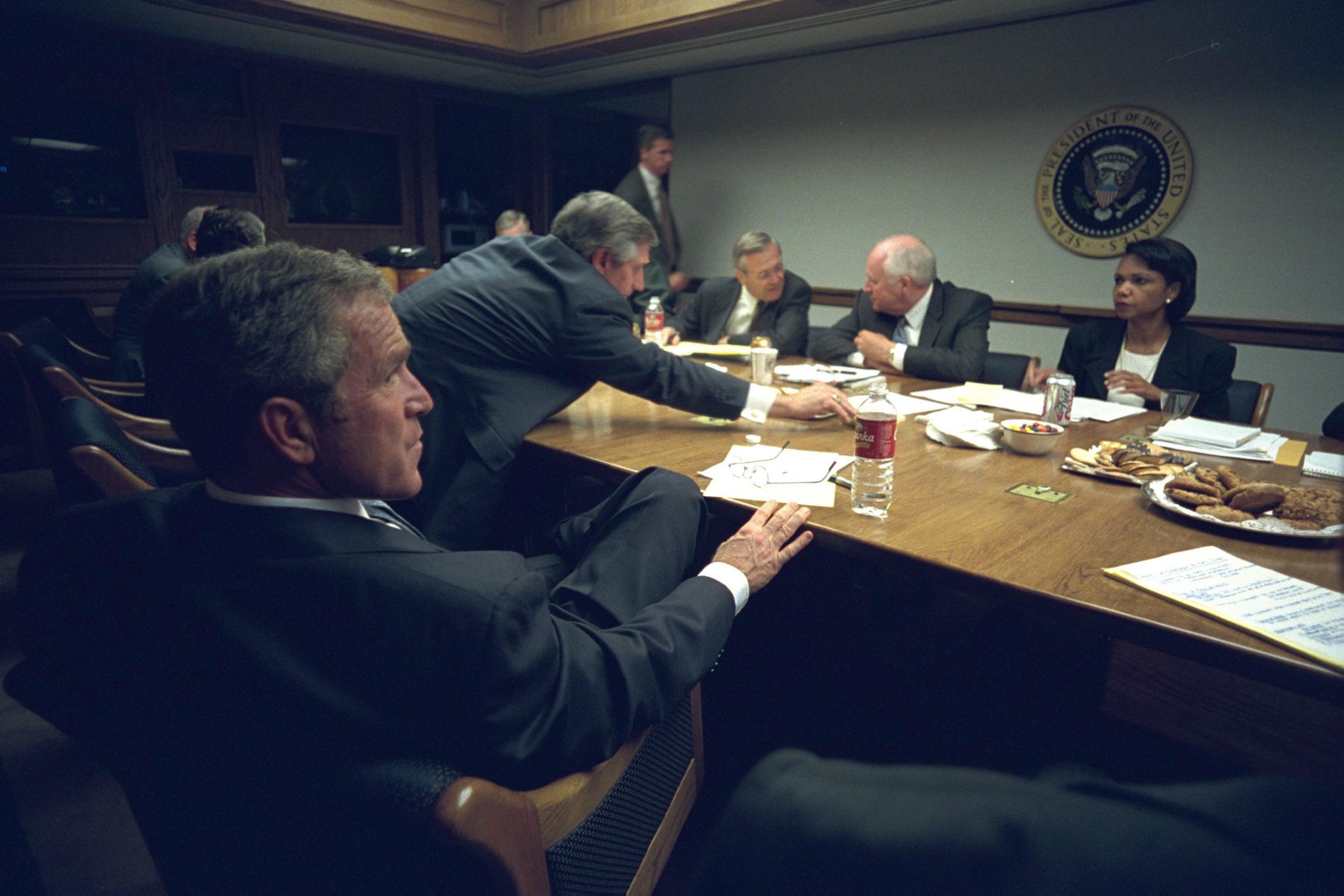
Following the attacks of September 11, 2001, President George W. Bush implemented a dual-track strategy to protect the United States: a massive structural reorganization of national security and an aggressive "financial war on terror." This included the creation of the Department of Homeland Security, the passage of the USA PATRIOT Act, and executive orders designed to freeze global terrorist assets and stabilize the domestic economy.
The Architectural Shift in National Security
The primary objective of the Bush administration in the immediate wake of 9/11 was to address the systemic intelligence failures that allowed the attacks to occur. This required a fundamental shift from a "need to know" intelligence culture to a "need to share" framework. The most visible result of this shift was the Homeland Security Act of 2002, which consolidated 22 different federal agencies into a single cabinet-level department: the Department of Homeland Security (DHS).
This reorganization was the largest overhaul of the U.S. government since the National Security Act of 1947. By bringing the Coast Guard, the Customs Service, and the newly created Transportation Security Administration (TSA) under one roof, the administration aimed to create a unified front for border protection and emergency response.
Parallel to this structural change was the legislative expansion of surveillance and investigative powers. The Uniting and Strengthening America by Providing Appropriate Tools Required to Intercept and Obstruct Terrorism (USA PATRIOT) Act was signed into law on October 26, 2001. It significantly expanded the authority of law enforcement to use "roving wiretaps," access business records, and monitor electronic communications. While controversial due to privacy concerns, the administration argued these tools were essential to "connect the dots" before another attack could materialize.
Financial Warfare: Disrupting the Mechanics of Terror
While the military and intelligence responses were highly visible, the Bush administration simultaneously launched a less public but equally significant campaign: the financial war on terror. President Bush famously stated that the U.S. would starve terrorists of their resources, moving beyond physical warfare to target the global banking systems that facilitated extremist activities.
Executive Order 13224
On September 24, 2001, President Bush signed Executive Order 13224. This order gave the U.S. government the power to freeze the assets of individuals and organizations identified as having ties to terrorism. More importantly, it authorized the Treasury Department to "name and shame" foreign banks that refused to cooperate. If a foreign financial institution continued to do business with a designated terrorist entity, that institution risked being cut off from the U.S. financial system—a "financial death sentence" for any global bank.
The Office of Terrorism and Financial Intelligence (TFI)
To manage these efforts, the Department of the Treasury underwent its own evolution, leading to the creation of the Office of Terrorism and Financial Intelligence (TFI). This office integrated intelligence gathering with the Treasury's regulatory and enforcement powers. By 2026, the TFI model remains the gold standard for how nations use economic sanctions to influence geopolitical outcomes and disrupt non-state actors.
Aviation and Infrastructure Protection
The 9/11 attacks exploited vulnerabilities in civil aviation, prompting immediate and drastic changes to how Americans traveled. On November 19, 2001, President Bush signed the Aviation and Transportation Security Act. This law fundamentally changed the nature of airport security by federalizing the workforce.
Prior to this act, airport screening was largely handled by private security firms contracted by individual airlines, often with varying standards and high turnover rates. The creation of the TSA ensured that all screeners were federal employees under rigorous training and background check requirements. Additionally, the act mandated that 100% of checked baggage be screened for explosives and required the reinforcement of cockpit doors on commercial aircraft to prevent unauthorized entry.
Beyond aviation, the administration focused on "Critical Infrastructure Protection." This involved identifying vulnerable points in the nation’s power grid, water supplies, and digital networks. The Bush administration’s "National Strategy for the Physical Protection of Critical Infrastructures and Key Assets" laid the groundwork for the public-private partnerships that characterize modern American cybersecurity and infrastructure resilience.
Economic Stabilization and Industry Bailouts
The financial impact of 9/11 was not limited to the destruction in Lower Manhattan. The U.S. stock markets closed for four days—the longest closure since the Great Depression. When they reopened, the Dow Jones Industrial Average suffered its largest one-week point drop in history. To prevent a total systemic collapse, the Bush administration moved quickly to stabilize specific sectors.
The Air Transportation Safety and System Stabilization Act
The grounding of all flights for several days, followed by a sharp decline in travel demand, pushed several major airlines to the brink of bankruptcy. President Bush signed a $15 billion relief package, which included $5 billion in direct grants and $10 billion in loan guarantees. This was not a move of corporate favoritism but a strategic necessity to ensure the nation's transportation infrastructure remained functional.
The September 11th Victim Compensation Fund (VCF)
A critical component of the stabilization act was the creation of the VCF. This was designed to provide financial compensation to victims and their families in exchange for their agreement not to sue the airlines. The administration feared that massive, multi-year litigation against the airlines and security companies would bankrupt the industry and cause a cascading failure throughout the broader economy.
Terrorism Risk Insurance Act (TRIA)
By 2002, another crisis emerged: insurance companies were removing "terrorism coverage" from their policies, making it impossible for developers to secure financing for large construction projects in major cities. In response, Bush signed TRIA, which created a federal "backstop." Under TRIA, the federal government agreed to share the losses with insurers in the event of a certified act of terrorism, ensuring that the real estate and construction industries could continue to operate.
Summary of Key Legislative and Executive Actions
The following table summarizes the primary mechanisms through which the Bush administration reshaped the security and financial landscape of the United States.
| Action / Legislation | Primary Focus | Key Result / Impact |
|---|---|---|
| EO 13224 | Financial | Enabled the freezing of assets for any entity linked to terrorism. |
| USA PATRIOT Act | Security/Legal | Expanded surveillance powers and information sharing between agencies. |
| Aviation & Transportation Security Act | Infrastructure | Created the TSA and federalized airport security screening. |
| Homeland Security Act of 2002 | Structural | Established the DHS by consolidating 22 federal agencies. |
| Stabilization Act ($15B) | Economic | Provided emergency grants and loans to prevent airline bankruptcy. |
| Terrorism Risk Insurance Act (TRIA) | Economic/Insurance | Created a federal backstop for terrorism-related insurance claims. |
| 9/11 Victim Compensation Fund | Legal/Relief | Provided compensation to families to prevent industry-collapsing litigation. |
International Cooperation and Diplomatic Pressure
President Bush recognized that neither security nor financial disruption could be achieved by the United States alone. The response included a massive diplomatic effort to align international standards through organizations like the Financial Action Task Force (FATF).
Under U.S. pressure, the FATF expanded its mandate from money laundering to include terrorist financing. This led to a global tightening of "Know Your Customer" (KYC) and "Anti-Money Laundering" (AML) regulations. Foreign nations were encouraged—and sometimes coerced—into adopting similar reporting standards for large wire transfers and suspicious financial activities. This international coordination was essential because terrorist networks like Al-Qaeda functioned as decentralized, globalized entities that could easily move funds through jurisdictions with weak regulatory oversight.
Long-term Legal and Ethical Evolutions
As we look back from 2026, the long-term impacts of these actions remain central to American legal and political discourse. The "Security vs. Liberty" debate was defined by the Bush administration's response to 9/11.
On the security front, the measures were largely successful in preventing another large-scale foreign-directed attack on U.S. soil. However, the legal precedents established by the Patriot Act and the use of the Foreign Intelligence Surveillance Act (FISA) courts led to decades of litigation regarding the Fourth Amendment. The Bush administration’s assertion of executive power—specifically the "unitary executive theory"—reshaped the balance of power between the presidency and Congress, a legacy that has persisted through every subsequent administration.
Economically, the 9/11 response proved that the federal government could and would act as the "insurer of last resort." The precedents set by the airline bailout and TRIA influenced how the U.S. government handled later crises, including the 2008 financial collapse and the economic disruptions of the early 2020s.
Frequently Asked Questions
What was the main purpose of the USA PATRIOT Act?
The USA PATRIOT Act was designed to remove the "wall" that existed between domestic law enforcement and foreign intelligence agencies. Prior to 9/11, agencies like the FBI and CIA were restricted from sharing certain types of information. The Act facilitated better communication and provided new tools, such as roving wiretaps and expanded access to business records, to help investigators identify and disrupt terrorist cells before they could act.
How did the Bush administration target terrorist financing?
The administration used a combination of executive orders and international diplomacy. Executive Order 13224 allowed the U.S. to freeze the assets of anyone suspected of supporting terrorism. Additionally, the Department of the Treasury worked with the global community to implement stricter banking regulations, making it much harder for terrorist groups to use the traditional banking system to move money across borders.
Why was the Department of Homeland Security (DHS) created?
DHS was created to solve the problem of fragmented national security. Before its creation, dozens of agencies with overlapping responsibilities operated independently. By consolidating these agencies—including the Coast Guard, FEMA, and Customs—the government aimed to create a single point of accountability for protecting the "homeland" from both man-made and natural disasters.
Did the airline bailout work as intended?
The $15 billion Air Transportation Safety and System Stabilization Act successfully prevented the immediate collapse of the U.S. aviation industry. By providing direct cash assistance and loan guarantees, the government ensured that airlines could cover their immediate costs and continue operations during a period when travel demand had plummeted. It also helped stabilize the broader economy by maintaining a critical piece of infrastructure.
What is the Terrorism Risk Insurance Act (TRIA)?
TRIA is a federal law that ensures insurance companies continue to provide coverage for acts of terrorism. After 9/11, many insurers stopped offering this coverage because the risk was too high to calculate. TRIA provides a government "backstop," where the U.S. Treasury shares the cost of claims with private insurers if a massive terrorist attack occurs. This allows commercial real estate and construction projects to remain insured and financed.
Navigating Historical Policy Records
For researchers and students looking to explore the primary documents associated with these events, the George W. Bush Presidential Library and Museum serves as the definitive archive. Detailed records of the National Commission on Terrorist Attacks Upon the United States (the 9/11 Commission) are also available via the National Archives.
Understanding the financial and security responses of the early 2000s requires a deep dive into the legislative language of the time. Those interested in the specific mechanics of terrorist asset freezing should consult the U.S. Department of the Treasury’s Office of Foreign Assets Control (OFAC). These resources provide the factual basis for analyzing how a singular event transformed the modern American state.