Ice hockey is a fast-paced team sport played on an ice rink where two teams of six players—five skaters and a goaltender—use wooden or composite sticks to maneuver a vulcanized rubber puck into the opposing goal. Games consist of three 20-minute periods, governed by core rules including offside, icing, and strictly regulated physical contact.
Rink Layout and Core Equipment Mechanics
To understand hockey, one must first understand the surface on which it is played. A standard National Hockey League (NHL) rink measures 200 feet (61 meters) long by 85 feet (26 meters) wide, enclosed by rigid wooden or fiberglass walls known as the boards, topped with protective plexiglass. International rinks used in Olympic competition historically measured slightly wider at 98.4 feet (30 meters), though modern international standards increasingly align with standard North American dimensions.
The ice surface is divided into three distinct zones by thick colored lines drawn across the width of the rink:
- Defensive Zone: The area closest to a team's own goal cage, where the primary objective is preventing the opponent from scoring.
- Neutral Zone: The central area between the two blue lines, containing the center red line and four outer face-off spots surrounding the center ice circle.
- Offensive Zone: The area beyond the opponent's blue line, where attacking plays are built and shots on goal are executed.
The center red line divides the rink in half lengthwise and is primarily used to judge icing violations and line passes under traditional rules. The blue lines mark the boundaries of the offensive and defensive zones and dictate the application of the offside rule.
At each end of the rink sits a goal net measuring 6 feet (1.8 meters) wide by 4 feet (1.2 meters) high. Surrounding the net is a blue-painted semi-circular area known as the goal crease. The crease protects the goaltender from physical interference; opposing players cannot intentionally impede the goaltender inside this area without incurring a penalty or having a goal disallowed.
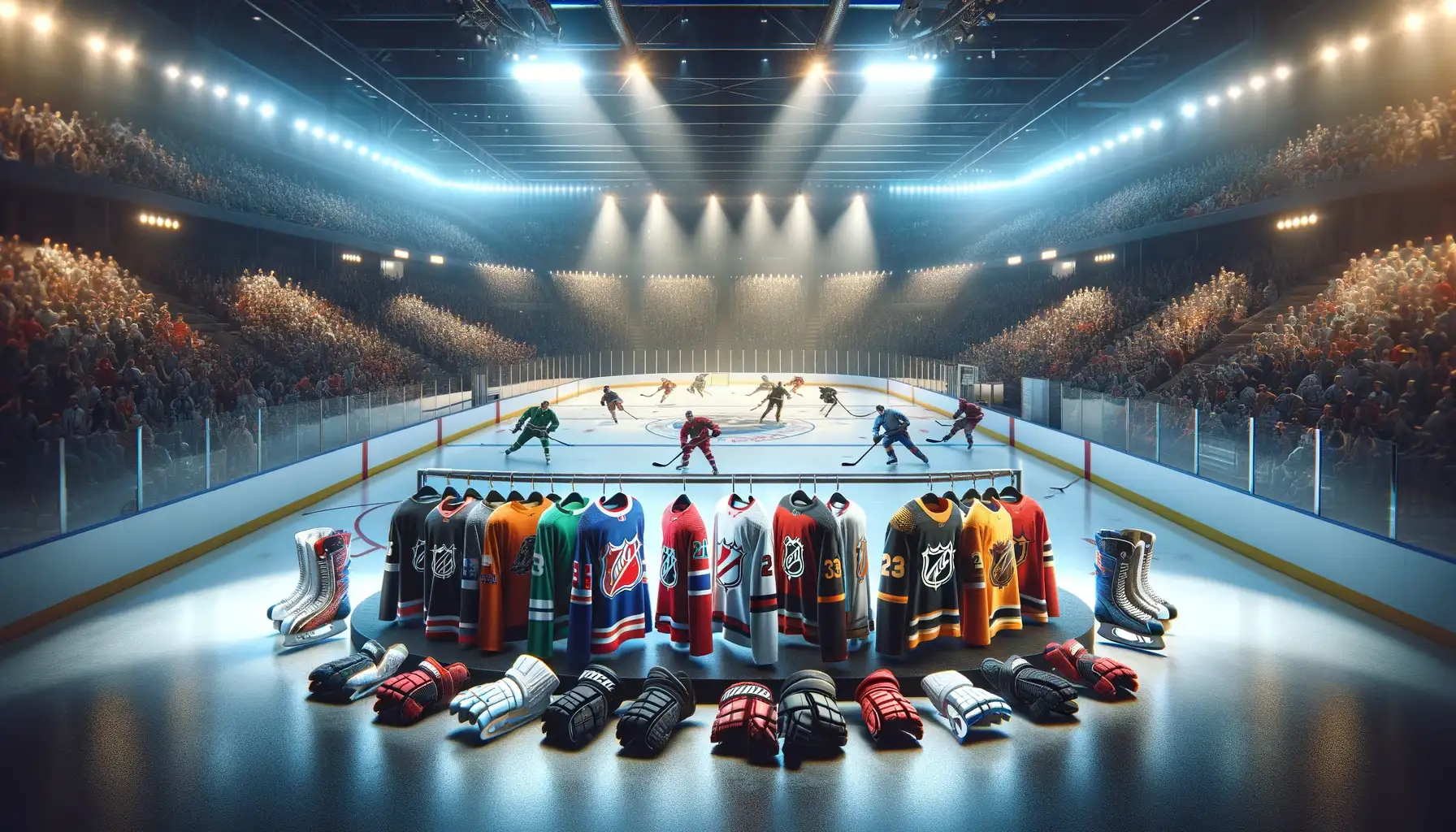
The game is played with a disk of vulcanized rubber known as the puck. Measuring 1 inch (2.54 cm) thick and 3 inches (7.62 cm) in diameter, the puck weighs between 5.5 and 6 ounces (156 to 170 grams). Before games, pucks are frozen in coolers to minimize bouncing on the ice surface during play. Players utilize specialized carbon-fiber or composite sticks with curved blades to handle, pass, and shoot the puck.
Player Roles and Team Structure
A full hockey roster consists of 20 players (18 skaters and 2 goaltenders), but only six players from each team are on the ice simultaneously under standard conditions. Substituting players is continuous and fluid, taking place either during stoppages in play or live during action—a process called changing "on the fly." Because hockey requires maximum physical exertion, individual shifts typically last only 45 to 60 seconds.
- Goaltender (G)
- Defensemen: Left Defenseman (LD), Right Defenseman (RD)
- Forwards: Left Wing (LW), Center (C), Right Wing (RW)
The Forwards (Offensive Unit)
The forward unit comprises three positions responsible for generating offensive momentum, maintaining puck possession, and executing scoring plays:
- Center: The tactical hub of the forward line. Centers take face-offs, cover vast distances across the full length of the ice, and serve as the link between defensemen and wingers. They must possess superior passing vision and defensive responsibility.
- Left Wing and Right Wing: Wingers operate primarily along the side boards. Their main responsibilities include establishing the forecheck (pressuring opposing defenders), driving toward the net to capture passes or rebounds, and covering opposing defensemen when defending in their own zone.
The Defensemen (Defensive Unit)
Two defensemen—typically organized as a left and right pairing—play behind the forwards. Their primary duty is stopping opposing attacks by intercepting passes, blocking shots, rubbing out ball-carriers along the boards, and retrieving pucks from the defensive corners. In modern hockey, defensemen also play a vital role in offense, joining the attack as "puck-movers" or shooting from the "point" (the area near the opponent's blue line).
The Goaltender (Goalie)
The goaltender is the final line of defense, tasked with preventing the puck from crossing the goal line. Goalies wear heavily padded gear, including a specialized mask, catch glove, blocker pad, and oversized leg pads. Unlike skaters, goaltenders remain on the ice for the entire game unless pulled late in a contest for an extra skater when trailing.
Essential Rules: Offside, Icing, and Game Stoppages
Hockey operates on a continuous play clock that stops only when a referee or linesman blows the whistle. Game stoppages occur due to out-of-bounds pucks, goaltender freezes, penalties, or critical structural infractions: Offside and Icing.
- Defensive Zone: [Goal] (Blue Line)
- Neutral Zone: (Center Red)
- Offensive Zone: (Blue Line) [Goal] (Attacking player must NOT cross BEFORE the puck!)
The Offside Rule
Offside regulates how teams transition the puck into the offensive zone. The rule dictates that the puck must completely cross the opponent’s blue line before any attacking player enters the offensive zone.
If an attacking player's skates fully cross the outer edge of the blue line into the offensive zone before the puck itself crosses the line, the play is blown dead for an offside violation. Play resumes with a face-off in the neutral zone near the blue line. Modern rules include a delayed offside provision: if a player enters early but does not touch the puck, play continues if all offensive players clear the zone back across the blue line without touching the puck.
The Icing Rule
Icing prevents teams from simply slamming the puck down the entire length of the ice to relieve defensive pressure. An icing violation occurs when a player shoots or passes the puck from their own half of the center red line all the way across the opponent's goal line without the puck being touched by any player along the way.
Under modern professional rules, leagues enforce hybrid icing to protect player safety. A linesman stops play if the defending player reaches the end-zone face-off dots first while chasing the iced puck. If the attacking player gets to the dot first, icing is negated ("washed out"), and play continues.
When icing is called, the face-off returns to the defensive zone of the team that committed the infraction. Crucially, the team that committed the icing is not permitted to substitute its players on the ice before the resumption of play, penalizing tired defensive units.
Face-offs
Every play in hockey begins or resumes with a face-off. An official drops the puck between two opposing players at one of nine designated face-off spots marked on the ice. The choice of face-off location depends on where the previous play ended or why play was stopped.
Penalties, Power Plays, and Special Teams
When a player violates safety rules or engages in illegal tactics to disrupt an opponent, officials assess a penalty. The offending player is sent to the penalty box, forcing their team to play with fewer skaters for a designated duration.
- Power Play (5 Skaters):
- [LW], [C], [RW]
- [LD], [RD]
- Penalty Kill (4 Skaters):
- [D], [D]
- [F], [F]
Types of Penalties
- Minor Penalties (2 Minutes): Assessed for common physical or stick-related infractions such as tripping, hooking, slashing, holding, high-sticking, or interference. The penalized player sits in the penalty box for two minutes. If the opposing team scores a goal during this time, the penalty instantly ends, and the player returns to the ice.
- Major Penalties (5 Minutes): Called for dangerous actions, such as fighting, severe boarding, or hits to the head. Major penalties must be served in full; even if the opposing team scores one or more goals during the five minutes, the penalized player remains in the box.
- Double Minor Penalties (4 Minutes): Called when a minor infraction causes physical injury (such as high-sticking that draws blood). The offender serves two consecutive two-minute penalties. If a goal is scored during the first two minutes, that segment expires, but the second two-minute segment must still be served.
- Misconduct Penalties (10 Minutes): Handed down for unsportsmanlike behavior or verbal abuse of officials. The player serves 10 minutes, but the team does not play short-handed unless accompanied by an additional minor or major penalty.
- Match Penalties: Result in an immediate ejection from the game when a player deliberate attempts to injure an opponent. A teammate serves a 5-minute major penalty in their place.
Power Plays and Penalty Kills
When a team has an advantage in manpower due to an opponent's penalty, that team is on the Power Play. The short-handed team is on the Penalty Kill.
Specialized tactical formations are used during these situations. Power play units deploy skilled playmakers to maintain perimeter possession, looking for defensive lapses to shoot through passing lanes. Penalty killers operate in compact defensive boxes or diamonds, prioritizing shot blocks, clearing the puck down ice (which is legally permitted during penalty kills without triggering icing), and frustrating the power play's setup.
Overview of Standard Hockey Penalties
The table below outlines common infractions, their default time penalties, and their immediate impact on on-ice strength.
| Penalty Type | Ineligibility Duration | On-Ice Strength Impact | Early Termination on Goal? | Common Examples |
|---|---|---|---|---|
| Minor Penalty | 2 Minutes | 5 vs 4 (Short-handed) | Yes (Ends immediately when opponent scores) | Tripping, Hooking, Slashing, Holding |
| Double Minor | 4 Minutes | 5 vs 4 (Short-handed) | Partial (First 2 min ends on goal; second 2 min remains) | High-sticking drawing blood, Spearing attempt |
| Bench Minor | 2 Minutes | 5 vs 4 (Short-handed) | Yes (Served by any designated skater) | Too Many Men on the Ice, Delay of Game |
| Major Penalty | 5 Minutes | 5 vs 4 (Short-handed) | No (Must be served in full regardless of goals) | Fighting, Boarding, Charging, Checking from behind |
| Misconduct | 10 Minutes | Full strength (5 vs 5)* | No (Player stays in box; team plays full strength) | Abusing officials, Unsportsmanlike conduct |
| Match Penalty | Ejection + 5 Min | 5 vs 4 (Short-handed) | No (Offender ejected; teammate serves 5-minute major) | Deliberate intent to injure an opponent |
*Note: Misconduct penalties are frequently assessed alongside a minor penalty, requiring a teammate to serve the 2-minute minor short-handed simultaneously.
Game Duration, Overtime, and Scoring Mechanics
A standard hockey game is split into three 20-minute periods, separated by two 18-minute intermissions. The clock stops on every whistle, meaning a regulation game typically takes about 2.5 hours of real time to complete.
How Goals Are Scored
A goal is officially awarded when the puck completely crosses the goal line between the posts and under the crossbar, provided it was propelled legally by a stick. Goals are disallowed under the following conditions:
- The puck was intentionally kicked into the net using a foot or skate.
- The puck was struck above the height of the crossbar with a high stick.
- An attacking player committed goaltender interference prior to the puck entering the net.
- The puck was thrown or directed into the net by an attacking player's hand.
Resolving Ties: Overtime and Shootouts
If the score remains tied at the end of 60 regulation minutes, the game moves to overtime. Overtime rules depend on whether the match is a regular-season or playoff contest:
- Regular Season (NHL Standard): Teams play one 5-minute sudden-death overtime period featuring a 3-on-3 open-ice format. The first team to score wins instantly. If neither team scores during overtime, the game proceeds to a three-round shootout, where individual skaters take penalty shots against the opposing goaltender.
- Playoffs: Shootouts are eliminated. Playoff ties are resolved through continuous 20-minute 5-on-5 sudden-death overtime periods until one team scores.
Key Tactical Concepts for New Viewers
To follow a live broadcast effectively, viewers should watch how teams manage territorial space rather than staring exclusively at the puck.
The Forecheck and Backcheck
- Forechecking: The aggressive pressuring of opposing defensemen by attacking forwards in the offensive zone. A heavy forecheck forces turnovers, leading to high-danger scoring chances.
- Backchecking: The defensive effort by forwards sprinting back toward their own zone to assist defensemen in neutralizing counterattacks.
Zone Entries and Puck Cycling
- Controlled Zone Entry: Carried out by a skilled forward skating the puck across the blue line under control, maintaining possession to set up organized attacks.
- Dump and Chase: A tactical play where a team shoots the puck deep into the offensive corner and sprints after it, relying on heavy physical forechecking to win battles along the boards.
- Cycling: A continuous movement pattern where two or three forwards pass the puck along the boards in the offensive zone, wearing down defenders until a scoring opening appears.
Practical Action Plan: Following Your First Hockey Games
For new viewers wanting to build an intuitive grasp of the sport, implementation is best approached systematically:
- Track the Flow, Not the Puck: Avoid straining to watch the 3-inch disk continuously on television. Instead, observe the body language and directional movement of all five skaters; their positioning instantly reveals where the puck is located.
- Learn the Referee Hand Signals: Pay attention to the officials. A linesman raising a hand horizontally indicates a potential offside or icing; a referee raising an arm straight up signals a delayed penalty.
- Review Official Rulebooks for Nuance: To deepen technical knowledge, review published standards directly from governing bodies such as the National Hockey League Official Rules or the International Ice Hockey Federation Regulations.
- Attend a Live Game: Watching hockey in person offers an irreplaceable perspective on player speed, physical contact, line change execution, and spatial awareness that television cameras often miss.
What is the difference between offside and icing in hockey?
Offside occurs when an attacking player crosses the opponent's blue line into the offensive zone before the puck does. Icing occurs when a player shoots the puck from their own side of the center red line all the way past the opponent's goal line without anyone touching it. Offside is an offensive positioning rule, while icing prevents teams from simply dumping the puck out of panic to clear their zone.
How many players are on the ice during a hockey game?
Under standard play, each team has 6 players on the ice: 3 forwards (Center, Left Wing, Right Wing), 2 defensemen, and 1 goaltender, totaling 12 players across both teams. If a team receives a minor or major penalty, they must play short-handed with fewer players (such as 5 against 4) until the penalty expires.
What happens during a power play in hockey?
A power play occurs when one team has a numerical skater advantage because an opposing player was sent to the penalty box for an infraction. The team with the advantage plays with 5 skaters while the penalized team plays with 4 (or 3 if serving multiple penalties). If the team on the power play scores during a minor penalty, the penalty ends immediately and the penalized player returns to the ice.
Can a team change players while the game is actively being played?
Yes. Hockey allows continuous substitutions during active play, known as changing "on the fly." Because of the extreme physical intensity of skating, players take short shifts lasting between 45 and 60 seconds before vaulting over the boards to substitute with a teammate while play continues without interruption.
Why do hockey players fight, and what is the penalty for it?
Fighting in hockey has historically functioned as an informal self-policing mechanism to deter dirty plays, protect skilled players, and shift momentum. When two players engage in a fight, officials assess both with a 5-minute major penalty. In many leagues outside the NHL—such as international IIHF play or college hockey—fighting results in an automatic match penalty and game ejection.