Buying fine jewelry online offers unparalleled access to extensive inventories, competitive pricing, and transparent specifications. Success requires understanding precious metal purities, verifying gemological certifications, evaluating retailer policies on shipping and returns, and ensuring proper post-purchase protection. Following systematic verification steps protects your investment when purchasing high-value rings, necklaces, bracelets, and gemstones remotely.
Understanding Fine Jewelry Materials and Industry Standards
Fine jewelry is defined by its composition of precious metals and high-quality natural or lab-grown gemstones, distinguishing it from fashion or costume jewelry made from base metals and synthetic glass. Navigating online listings requires a firm understanding of material purities, alloy compositions, and official stamping standards.
Precious Metals and Stamped Hallmarks
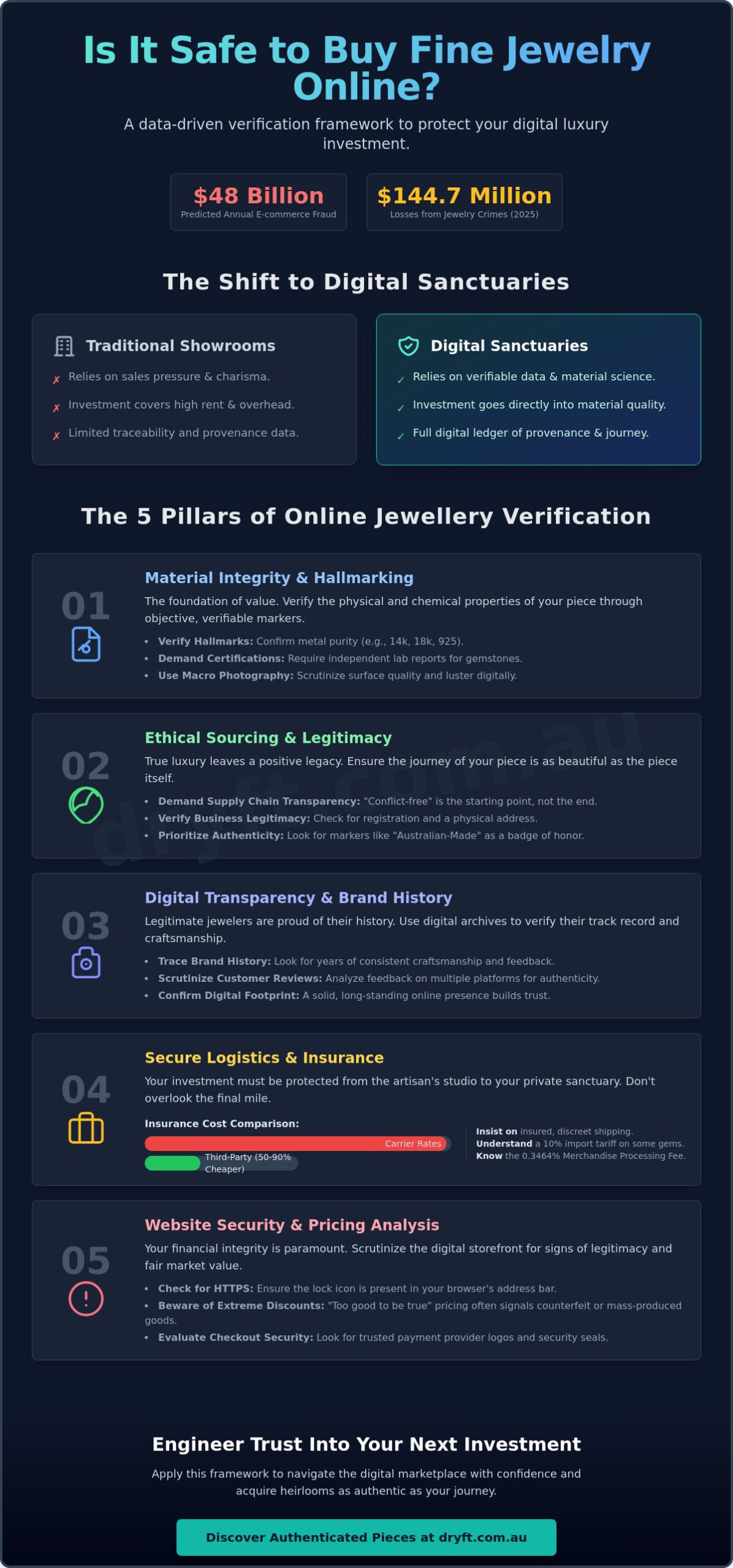
Precious metals are alloyed with other elements to enhance durability, alter color, or adjust malleability. When purchasing online, always look for high-resolution images or explicit written specifications confirming official hallmark stamps:
- Gold (Au): Gold purity is measured in karats (K), representing 24ths of pure gold content.
- 24K Gold: 99.9% pure gold. Very soft and prone to bending, rarely used for structural fine jewelry settings.
- 18K Gold: 75% pure gold alloyed with copper, silver, or nickel. Offers rich color and solid durability for fine engagement rings and fine jewelry. Stamped as
18K,18Kt, or750. - 14K Gold: 58.3% pure gold. The most popular balance of hardness, scratch resistance, and affordability in North America. Stamped as
14K,14Kt, or585. - 10K Gold: 41.7% pure gold. The minimum legal standard for gold in the United States. Stamped as
10Kor417. - Gold Alloys: White gold is created by alloying pure gold with palladium, nickel, or silver, often plated with rhodium for a bright silver finish. Rose gold blends gold with copper to achieve its warm reddish hue.
- Platinum (Pt): A naturally white, dense, and hypoallergenic heavy metal. Platinum jewelry retains its mass over time, developing a soft satin patina rather than wearing away. Standard fine platinum is alloyed at 90% to 95% purity and stamped as
PLAT,PT950, orPT900. - Sterling Silver (Ag): Composed of 92.5% pure silver and 7.5% copper for structural strength. Fine silver pieces are stamped as
925orSterling.
Diamonds and Colored Gemstones
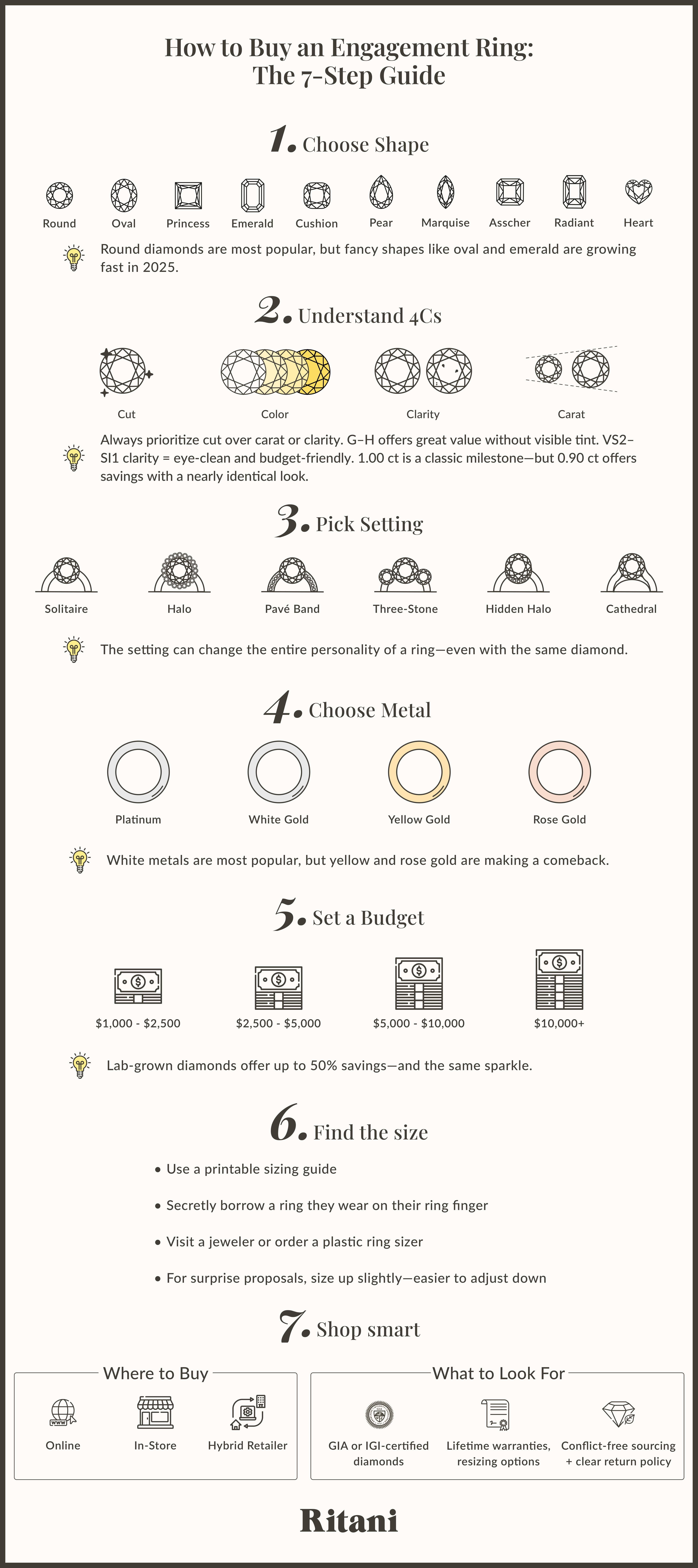
Online diamond inventories allow buyers to filter through hundreds of thousands of loose stones based on standardized grading scales. Understanding the 4 Cs established by the Gemological Institute of America (GIA) is vital:
- Cut: Refers to how well a diamond's facets interact with light, determining brightness, fire, and scintillation. Cut is widely considered the most critical factor in a diamond's visual appeal.
- Color: Graded on a scale from D (colorless) to Z (light yellow or brown). Grades D–F represent colorless stones, while G–J represent near-colorless stones that offer strong visual value.
- Clarity: Evaluates internal characteristics (inclusions) and surface defects (blemishes). Grades range from Flawless (FL) to Included (I1–I3). Grades like Very Slightly Included (VS1/VS2) and Slightly Included (SI1) often provide "eye-clean" appearance at lower price points.
- Carat Weight: Measures physical weight, where one carat equals 0.20 grams. Weight does not scale linearly with price; a 1.00-carat diamond costs significantly more than two 0.50-carat diamonds of equal quality due to rarity.
For colored stones such as sapphires, rubies, and emeralds, color hue, tone, and saturation dominate value over clarity. Be aware of common gem treatments, such as heat treatment (standard for sapphires and rubies) or oiling (standard for emeralds), which must be disclosed by reputable online vendors under guidelines from enforcement agencies like the Federal Trade Commission.
Deciphering Gemological Certification and Documentation
Never rely solely on a retailer's internal description when buying high-value diamond or gemstone jewelry online. Independent gemological laboratory reports provide an unbiased third-party evaluation of a stone's characteristics.
Major Grading Laboratories
- GIA (Gemological Institute of America): The international benchmark for diamond and gemstone grading. GIA reports are universally recognized for strict, consistent standards.
- IGI (International Gemological Institute): A major global grading laboratory widely utilized for both natural diamonds and lab-grown diamonds.
- AGS (American Gem Society): Historically renowned for its scientific numeric scale evaluating diamond cut quality (now integrated into GIA's analytical frameworks).
How to Verify a Certificate Online
Online jewelers should display the unique certificate number for any loose stone or center diamond listed on their website. Before submitting payment:
- Locate the grading laboratory name and report number on the product page.
- Navigate directly to the official laboratory website (such as GIA's Report Check tool).
- Enter the report number and carat weight to confirm that the physical details, dimensions, clarity plot diagram, and color grade match the seller's claims exactly.
- Confirm if the stone possesses a micro-laser inscription on its girdle matching the certificate number, which can be verified by a local jeweler upon delivery using a loupe or microscope.
Evaluating Online Jewelry Retailers and Security Protocols
Purchasing high-value items online requires verifying both the commercial reputation of the vendor and the technical security of their checkout platform.
| ONLINE JEWELRY BUYING CHECKLIST |
|---|
| [ ] Verify Metal Hallmark (750, 585, PT950, 925) |
| [ ] Cross-Check Independent Grading Report (GIA / IGI Database) |
| [ ] Confirm Return Window (30-day minimum, zero restocking fee) |
| [ ] Ensure Shipping is Fully Insured with Adult Signature Req. |
| [ ] Validate Payment Security (SSL, Credit Card Buyer Protection) |
| [ ] Schedule Post-Delivery Third-Party Independent Appraisal |
Merchant Types and Business Models
- Direct-to-Consumer (DTC) E-Commerce Specialists: Platforms operating exclusively online maintain lower overhead costs, allowing them to offer extensive virtual diamond feeds and lower margins compared to traditional brick-and-mortar storefronts.
- Heritage Luxury Houses: Brands with historic storefronts offering online portals provide high brand prestige, proprietary designs, and high-end packaging, though generally at higher profit margins per carat or gram.
- Online Marketplaces and Auctions: Platforms hosting third-party sellers offer access to antique, vintage, or estate jewelry. Buying on these platforms requires strict reliance on third-party escrow services, buyer protection guarantees, and verified seller feedback history.
Crucial Sales Policies to Review
Before finalizing an online transaction, audit the fine print of the merchant's customer service agreements:
- Return Policy: Reputable fine jewelry e-commerce sites provide a minimum of 30 days for returns or exchanges. Check whether custom-designed settings, engraved rings, or resized bands void the return policy. Confirm whether return shipping fees and insurance are covered by the merchant.
- Restocking Fees: Avoid retailers charging percentage-based restocking fees on fine jewelry or certified diamonds.
- Warranty and Maintenance Services: Check if the seller offers complimentary routine maintenance, such as annual prong inspection, tightening, cleaning, or rhodium re-plating for white gold settings.
- Resizing Guidelines: Determine whether the initial ring resizing is free of charge and whether returning a resized ring alters your right to a full refund.
Technical Comparison of Fine Jewelry Metals and Stone Options
Choosing the right material combination depends on durability needs, maintenance expectations, and budget parameters. The following table compares common fine jewelry options:
| Material / Option | Composition / Purity Standard | Durability Level | Maintenance Requirements | Typical Pricing Tier | Best Suited For |
|---|---|---|---|---|---|
| Platinum (PT950) | 95% Pure Platinum, 5% Iridium or Ruthenium | High structural density; scratches form patina without metal loss | Periodic professional buffing to restore high polish | Premium | Daily-wear engagement rings and wedding bands |
| 18K Yellow Gold | 75% Pure Gold, 15% Copper, 10% Silver | Moderate-High; warm yellow hue, softer than 14K | Occasional cleaning; resists tarnish completely | Upper-Mid | High-end fine fashion rings, pendants, and earrings |
| 14K White Gold | 58.3% Gold alloyed with Nickel/Palladium | High structural hardness; strong scratch resistance | Rhodium re-plating every 12–24 months to maintain white finish | Mid-Range | Versatile daily jewelry, heavy-wear ring settings |
| Sterling Silver (925) | 92.5% Silver, 7.5% Copper | Moderate; softer metal subject to denting | Frequent polishing to remove natural tarnish/oxidation | Budget-Friendly | Statement fashion pieces, seasonal accessories |
| Natural Diamond | Carbon lattice formed via geological process | Extreme (10 on Mohs scale); highest scratch resistance | Routine ultrasonic or soapy water cleaning | Premium to Investment | Classic heirloom pieces, traditional engagement rings |
| Lab-Grown Diamond | Optically & chemically identical carbon lattice | Extreme (10 on Mohs scale); highest scratch resistance | Routine ultrasonic or soapy water cleaning | Value-Oriented (Lower price per carat) | Modern fine jewelry, maximizing carat size on a budget |
Essential Step-by-Step Purchase and Delivery Workflow
To ensure a seamless transaction, execute your online purchase using a structured verification process.
Step 1: Establish Sizing and Ergonomic Dimensions
Confirming accurate measurements prior to ordering eliminates post-delivery delays and alterational costs.
- Rings: Utilize a metal ring sizer kit sent by the retailer rather than paper printouts, which are prone to scaling errors during printing. Consider finger swelling due to temperature changes and band width; wider bands (over 6mm) typically require a half-size larger than thin bands.
- Bracelets: Measure wrist circumference just above the wrist bone using a flexible measuring tape, adding 0.5 to 1 inch depending on whether a snug, comfort, or loose fit is desired.
- Necklaces: Pay attention to chain length standards (e.g., 16-inch choker, 18-inch princess, 20-inch matinee) and chain style durability. Cable, wheat, and box chains offer high structural integrity for holding heavy pendants compared to delicate snake or herring-bone styles.
Step 2: Perform HD Visual and Data Inspections
Online jewelers should provide high-definition 360-degree video captures of exact inventory items under neutral lighting. Inspect loose diamonds for inclusions located directly beneath the table facet, which are more visible to the naked eye. Verify light performance, symmetry, and bow-tie effects in fancy shapes (such as oval, marquise, or pear cuts).
Step 3: Secure Payment and Logistics Insurance
- Payment Security: Pay using a major credit card or secure payment service that provides consumer dispute rights in case of shipping loss, damage, or non-delivery. Avoid direct wire transfers unless dealing with established auction houses offering explicit wire discounts alongside verified escrow services.
- Insured Logistics: Ensure the retailer ships via a secure carrier (such as FedEx or UPS) using fully insured overnight or two-day transit services. The package must require an adult signature upon delivery. Verify that the shipping label uses an abbreviated sender name rather than terms like "Fine Diamonds" or "Jewelers" to prevent transit theft.
Common Mistakes to Avoid When Buying Online
- Purchasing Uncertified Center Stones: Buying diamonds labeled with vague "in-house grades" or unverified store certificates risks receiving stones with artificially inflated clarity or color marks.
- Confusing Carat Weight with Visual Surface Area: Carat refers to weight, not visual spread. A poorly cut deep diamond can weigh 1.00 carat while appearing visually smaller than a properly proportioned 0.90-carat stone.
- Ignoring Recourse and Return Shipping Terms: Assuming an online store covers return shipping costs can lead to unexpected out-of-pocket expenses, as fully insured return shipping for high-value items can be costly without a prepaid merchant label.
- Overlooking Secondary Maintenance Costs: White gold requires periodic rhodium replating to maintain its bright white sheen. Factor long-term care into your overall metal selection.
Frequently Asked Questions
How can I verify that a delivered diamond matches its GIA grading report?
You can confirm a diamond's identity by taking it to an independent certified gemologist or local jeweler to inspect the girdle inscription using a loupe or microscope. The micro-laser inscription on the diamond's edge should match the unique certificate number listed on the GIA report. Additionally, the gemologist can cross-reference the physical measurements and inclusion plot diagram against the digital report on GIA's official database.
What is the safest payment method when buying fine jewelry online?
Using a credit card offers the strongest consumer protection when purchasing fine jewelry online. Credit cards provide purchase protection, chargeback mechanisms, and fraud protection under Federal Reserve regulations if the merchant fails to deliver the specified item or if the shipment is lost. Avoid direct bank transfers or untraceable payment methods unless working with verified escrow services.
How do lab-grown diamond guarantees and certifications compare to natural diamonds?
Lab-grown diamonds undergo identical gemological testing procedures and are graded on the same 4 Cs scale as natural diamonds by major independent laboratories like IGI and GIA. Lab-grown certificates explicitly state that the diamond was created via Chemical Vapor Deposition (CVD) or High Pressure High Temperature (HPHT) methods. While optically and chemically identical to natural diamonds, lab-grown diamonds sell at significantly lower price points per carat and have different long-term resale value profiles.
What steps should I take immediately after receiving fine jewelry shipped online?
Upon receiving your shipment, inspect the outer packaging for signs of tampering before signing for delivery. Open the package on camera to document the unboxing process, verify that all hallmarks and certificates match your order specifications, and check the setting for loose stones by gently shaking the piece near your ear. Finally, schedule an independent appraisal within your return window to confirm value and obtain detailed documentation for insurance coverage.
How do I insure fine jewelry purchased online?
You can insure fine jewelry by adding a personal jewelry scheduled rider to your existing homeowners or renters insurance policy, or by purchasing a specialized policy from a dedicated jewelry insurer. To activate coverage, insurers typically require the itemized sales receipt, the independent grading report (for center diamonds or major gems), and a detailed appraisal confirming replacement value.
Next Steps for Securing and Maintaining Your Purchase
Once your fine jewelry arrives, take the following immediate steps to safeguard your investment:
- Schedule an Independent Appraisal: Visit a Certified Senior Member of an recognized organization, such as the American Society of Appraisers (ASA) or the National Association of Jewelry Appraisers (NAJA), who does not sell jewelry directly. This ensures an unbiased evaluation of the item's market value.
- Bind Specialized Insurance Coverage: Secure a standalone policy or policy endorsement covering accidental loss, theft, and damage globally. Specialized jewelry insurance typically provides repair-or-replace coverage without impacting your standard property insurance premiums.
- Establish Correct Storage and Care: Store precious metal pieces and gemstone jewelry in separate soft-lined pouches or compartmented boxes to prevent harder stones (like diamonds) from scratching softer metals or gems. Schedule routine annual inspections with a local bench jeweler to check prong integrity, clasp security, and stone stability.