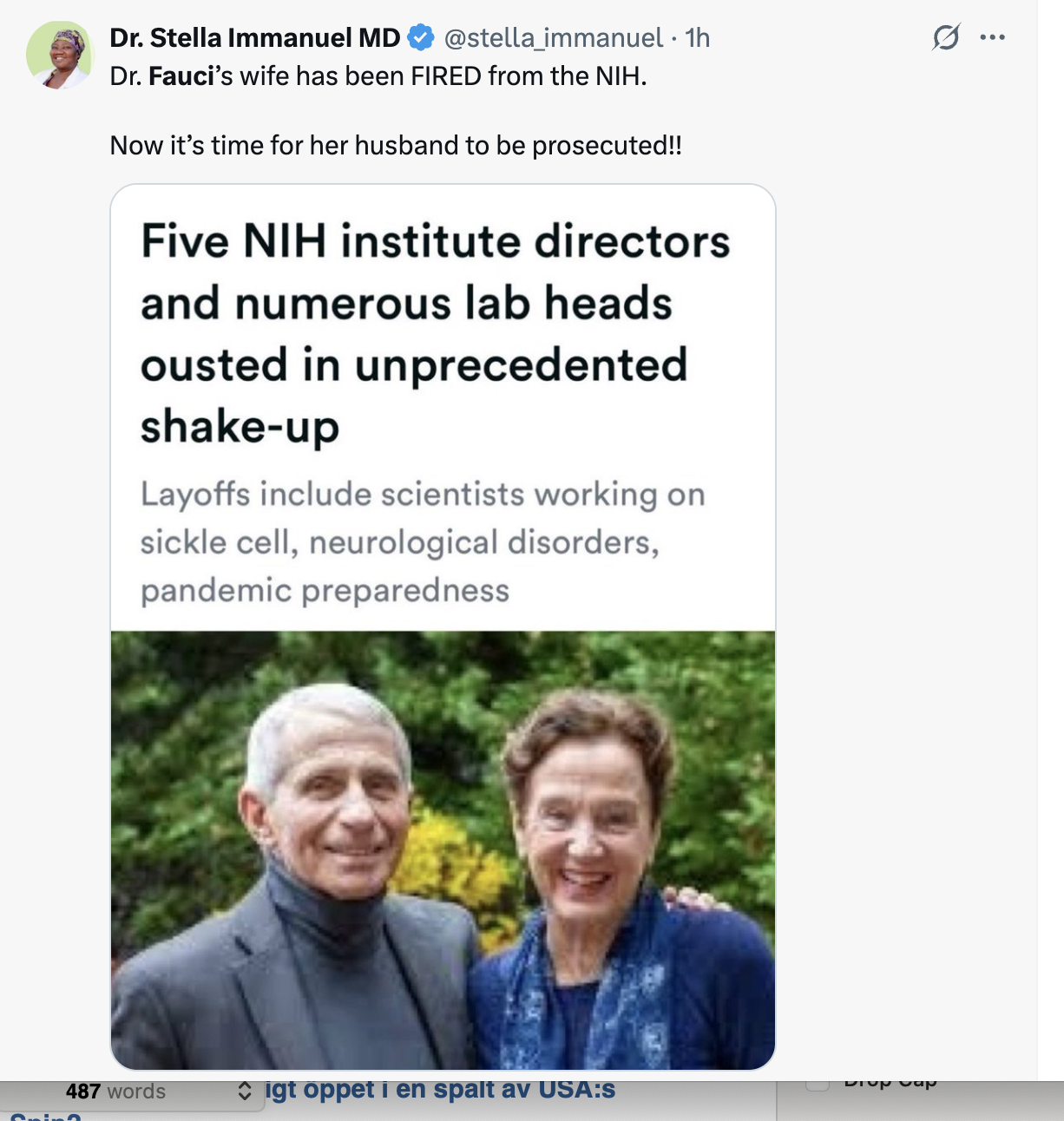
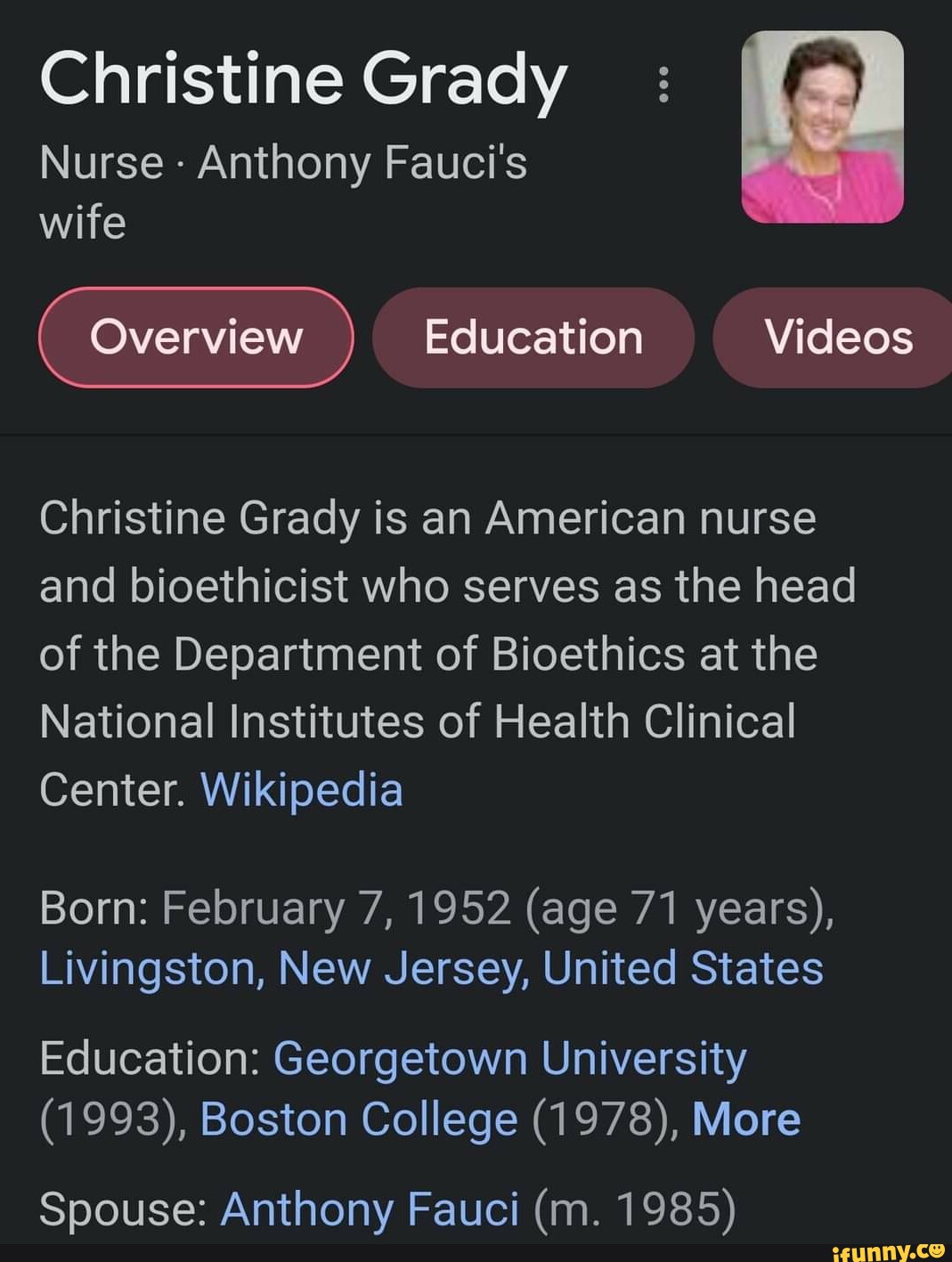
Dr. Christine Grady is a distinguished bioethicist and nurse scientist who serves as the Chief of the Department of Bioethics at the National Institutes of Health (NIH) Clinical Center. While she is widely recognized in public life as the wife of Dr. Anthony Fauci, the former director of the National Institute of Allergy and Infectious Diseases (NIAID), her individual career in clinical research, medical ethics, and nursing has established her as a prominent figure in her own right within the American medical establishment.
Academic Foundation and Early Career
Dr. Grady’s professional trajectory began with a commitment to both nursing and biological sciences. She earned her Bachelor of Science in Nursing and Biology from Georgetown University, followed by a Master of Science in Nursing from Boston College and a Ph.D. in Philosophy from Georgetown University. This interdisciplinary background allowed her to bridge the gap between bedside nursing care and the complex theoretical framework of medical ethics.
Throughout her early career, Dr. Grady focused on the ethical dimensions of clinical research. Her work was particularly instrumental during the height of the HIV/AIDS epidemic in the 1980s and 1990s. During this period, she served on the Presidential Commission for the Study of Bioethical Issues, where she gained national recognition for her contributions to developing ethical guidelines for human subjects research. Her tenure at the NIH has been defined by her efforts to ensure that clinical trials are designed to protect participants while advancing scientific knowledge.
Leadership at the NIH Department of Bioethics
As the Chief of the Department of Bioethics at the NIH Clinical Center, Dr. Grady leads a department dedicated to studying the ethical issues that arise in clinical care and biomedical research. Her leadership involves advising researchers, clinicians, and hospital administrators on complex cases, such as those involving life-sustaining treatment, informed consent, and the allocation of scarce medical resources.
Under her guidance, the department has become a hub for international scholarship. Dr. Grady is widely published in academic journals, focusing on topics such as the ethics of clinical research, the nurse-patient relationship, and the role of bioethics in public health emergencies. Her work often addresses the tension between the pursuit of medical breakthroughs and the moral obligation to safeguard the rights and welfare of volunteers who participate in clinical trials.
The Intersection of Professional Life and Public Exposure
The marriage between Dr. Christine Grady and Dr. Anthony Fauci has often placed her in the public eye, particularly following the global health crisis that began in 2020. Despite the intense media scrutiny directed at her husband, Dr. Grady has maintained a focused career trajectory, balancing her administrative responsibilities at the NIH with her scholarly output.
The nature of their professional roles—both being senior officials at the NIH—has provided them with a shared understanding of the burdens of public service. While Dr. Fauci often represented the operational and infectious disease-specific responses of the government, Dr. Grady’s influence was felt in the deliberative space of bioethics, where the moral arguments for various public health strategies were rigorously vetted. This partnership has been a focal point for many observers interested in how domestic life interfaces with high-level federal health policy.
Key Aspects of Dr. Christine Grady’s Professional Scope
The following table summarizes the primary areas of influence and professional responsibility associated with Dr. Grady’s current and past work within the health sector.
| Area of Focus | Description | Impact |
|---|---|---|
| Clinical Ethics | Addressing dilemmas at the patient-care level | Improves end-of-life care and informed consent |
| Research Ethics | Developing standards for human trials | Ensures safety and trust in medical innovation |
| Public Health Policy | Providing ethical guidance for government responses | Influences equitable resource allocation |
| Nursing Leadership | Bridging clinical practice with academic research | Elevates the role of nursing in bioethical policy |
The Evolution of Bioethics in Modern Medicine
Dr. Grady’s contributions have been vital in the evolution of bioethics from a niche academic discipline into a fundamental component of institutional health policy. In 2026, the field of bioethics continues to grapple with the rapid advancement of biotechnology, artificial intelligence in diagnostics, and genomic editing. Dr. Grady’s work remains anchored in the principle that human rights must remain the priority, regardless of how quickly technological capabilities expand.
Her approach to bioethics is noted for being highly practical. Rather than confining her work to abstract theory, she advocates for embedded ethics, where bioethicists are present at the table during the planning stages of research protocols. This proactive stance is designed to prevent ethical compromises before they occur, rather than simply analyzing them after the fact.
FAQ: Common Questions Regarding Dr. Christine Grady
What is Dr. Christine Grady’s current role?
Dr. Christine Grady serves as the Chief of the Department of Bioethics at the National Institutes of Health (NIH) Clinical Center. In this capacity, she oversees research, clinical consultation, and education on ethical issues in medicine.
How did Dr. Grady and Dr. Anthony Fauci meet?
The couple met while working at the NIH. They were married in 1985 and have supported each other through their respective careers in public health, infectious diseases, and medical ethics, often cited as a dual-career couple in federal service.
Does Dr. Grady work on medical research directly?
Dr. Grady is a researcher in her own right, primarily focusing on the ethics of clinical trials. While she is not a principal investigator for drug development in the same manner as an infectious disease scientist, her work is essential to the design and implementation of every trial conducted at the NIH Clinical Center.
What are the main ethical issues Dr. Grady addresses?
Her work covers a broad spectrum, including informed consent, the ethics of global health research, the rights of patients, and how to conduct clinical trials during public health crises when standard protocols may need adjustment to meet urgent needs.
How has her background in nursing shaped her bioethical view?
Her nursing background provides a unique perspective that prioritizes the patient’s lived experience. Many bioethicists come from legal or purely philosophical backgrounds, but Dr. Grady’s experience as a nurse allows her to understand the practicalities and human elements of medical care that must be protected.
Engaging with Bioethical Standards for Research
For those interested in the protocols and ethical standards that Dr. Grady advocates, the NIH Clinical Center remains the primary repository for her published work and the institutional guidelines developed under her leadership. Engaging with these materials requires an understanding that bioethics is a dynamic field that evolves as new medical challenges arise. Whether one is a patient, a healthcare professional, or an academic, the resources provided by the NIH Department of Bioethics serve as a benchmark for integrity in American medical research.
The most effective way to stay updated on her contributions is to review peer-reviewed literature and public statements released via official NIH channels. As we progress through 2026, the guidance emerging from the department continues to set the standard for how large research institutions balance the duty to innovate with the absolute necessity of respecting individual autonomy and human dignity.