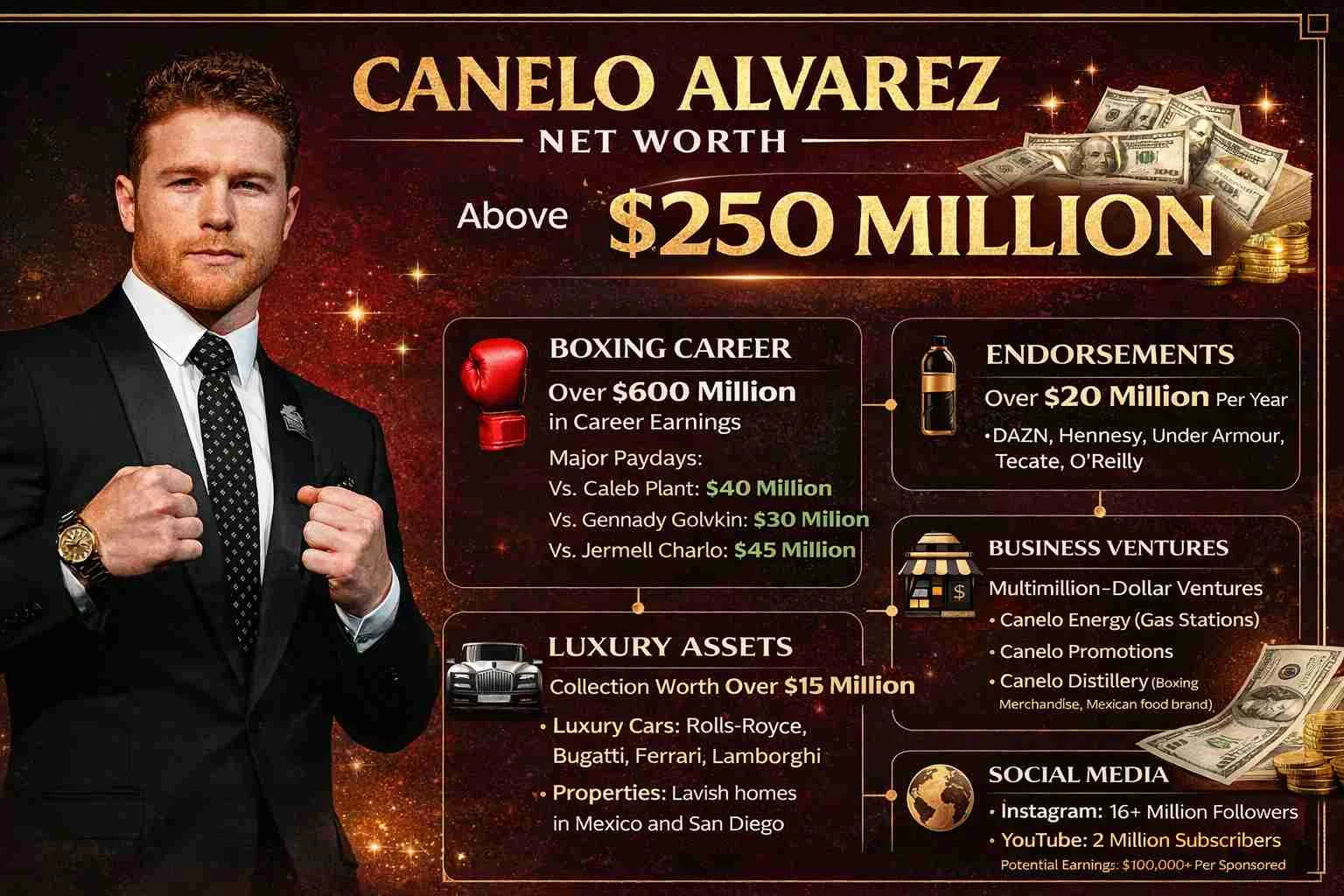
As of 2026, Canelo Álvarez’s net worth is estimated at approximately $350 million to $400 million. This staggering figure is the result of his position as boxing’s undisputed biggest attraction, bolstered by record-breaking fight purses, a sprawling diversified business empire in Mexico, and a strategic portfolio of global brand endorsements.
The Financial Evolution of a Boxing Kingpin
Santos Saúl "Canelo" Álvarez Barragán has successfully transitioned from a teenage phenom to a global sporting conglomerate. His financial trajectory is unique in the world of combat sports because it relies equally on his prowess in the ring and his acumen as a venture capitalist. Unlike many athletes who diversify late in their careers, Canelo began building his corporate infrastructure while still in his physical prime.
The foundation of his wealth was built on massive guaranteed purses. Early in his career, fights against legends like Floyd Mayweather Jr. and Miguel Cotto established his marketability. However, it was the landmark $365 million deal with DAZN in 2018—at the time the richest contract in sports history—that fundamentally shifted his net worth into the stratosphere. Although that specific contract ended prematurely due to litigation, it set a new "floor" for his earnings, ensuring that every time he stepped into the ring, he would earn a minimum of $35 million to $50 million.
By 2026, Canelo has maintained this earning power. Even as he moves into the later stages of his career, his ability to command massive gates in Las Vegas and high pay-per-view (PPV) buy rates remains unparalleled. His recent bouts against top-tier challengers have continued to yield high eight-figure payouts, solidifying his status as the highest-paid active boxer in the world.
Breakdown of Career Earnings and Purses
Canelo’s income is primarily driven by three factors: guaranteed fight purses, PPV upside, and site fees. Because he is a "free agent" who works with various promoters like Matchroom Boxing and PBC (Premier Boxing Champions), he retains significant leverage in negotiations, often taking the lion's share of the revenue.
Major Fight Payouts
The revenue generated from a single Canelo Álvarez fight night is comparable to a mid-sized corporation's annual earnings. For example, his fights against Caleb Plant, Gennady Golovkin (the trilogy), and Dmitry Bivol each generated total revenues exceeding $100 million when accounting for ticket sales, international TV rights, and sponsorships. Canelo typically receives 50% to 70% of the total profit from these events.
In 2024 and 2025, his fights against opponents such as Jaime Munguía and Edgar Berlanga continued this trend. By 2026, even if his frequency of fighting slows to once per year, his brand equity ensures that the "Canelo premium" remains intact for broadcasters and sponsors alike.
Revenue from Canelo Promotions
A significant portion of his wealth is retained through Canelo Promotions. By acting as his own co-promoter, he avoids the traditional 20-30% "promoter's cut" that most fighters pay to companies like Top Rank or Golden Boy. This vertical integration allows him to control the production, the undercard, and the commercial partnerships associated with his events, effectively doubling his net profit per fight compared to other elite boxers.
The "Canelo" Business Empire: Beyond the Ring
What distinguishes Canelo from other high-earning athletes is his aggressive expansion into the Mexican retail and energy sectors. He has often stated in interviews that he wants to be a billionaire, and his non-boxing ventures are designed to achieve that goal through recurring revenue.
Canelo Energy and Upper
Canelo Energy is perhaps his most ambitious project. Launched with the goal of opening up to 100 gas stations across Mexico, the brand competes directly with established players like Pemex and BP. These stations are not merely branding exercises; they are full-service fuel and convenience hubs.
Complementing the energy business is Upper, a chain of convenience stores located within or near his gas stations. Upper utilizes advanced technology, such as automated checkouts and high-end branding, to differentiate itself in a crowded market. By 2026, these two entities have grown into a significant portion of his net worth, providing a steady cash flow that is independent of his physical health or boxing schedule.
VMC and Yaoca
In the lifestyle and health sector, Canelo has launched VMC (Viva Mexico Cabrones), a line of ready-to-drink tequila-based cocktails. The brand has seen explosive growth in both Mexico and the United States, tapping into the booming RTD (Ready-to-Drink) alcohol market.
Additionally, his sports nutrition brand, Yaoca, provides supplements and hydration drinks. By leveraging his image as one of the most disciplined athletes in the world, Canelo has successfully marketed these products to a global audience, further diversifying his income away from the volatility of the sports world.
Estimated Earnings Comparison (2021–2026)
The following table outlines the estimated annual earnings for Canelo Álvarez, illustrating the balance between his boxing purses and his growing business revenue.
| Year | Boxing Earnings (Est.) | Business/Endorsement Income | Total Annual Income |
|---|---|---|---|
| 2021 | $85 Million | $5 Million | $90 Million |
| 2022 | $90 Million | $10 Million | $100 Million |
| 2023 | $60 Million | $15 Million | $75 Million |
| 2024 | $70 Million | $20 Million | $90 Million |
| 2025 | $50 Million | $25 Million | $75 Million |
| 2026 (Projected) | $45 Million | $35 Million | $80 Million |
Note: Figures are estimates based on reported fight purses, PPV estimates, and corporate growth projections. Final net worth accounts for taxes, management fees (Eddy Reynoso), and reinvestment.
Real Estate and Luxury Assets
A substantial part of Canelo's $350M+ net worth is tied up in high-value tangible assets. He is known for his "no-expense-spared" approach to his lifestyle, which doubled as a series of wise long-term investments.
- Real Estate Portfolio: Canelo owns several luxury properties, including a massive estate in Guadalajara, Mexico, and a mansion in San Diego, California. His Guadalajara property is legendary for its size, featuring a private museum for his belts and a stable for his prize-winning horses.
- The Car Collection: His garage is valued at over $20 million. It includes rare specimens such as the Bugatti Chiron (the "Blue Ghost"), several Ferrari models (including a LaFerrari), Lamborghinis, and vintage Rolls-Royces. These vehicles often appreciate in value due to their rarity and their association with his celebrity status.
- Equestrian Interests: Canelo is a passionate horseman. He owns several world-class Shire and Friesian horses. While often viewed as a hobby, high-end horse breeding and competition is a legitimate niche asset class in Mexico and the US.
Professional Advice and Financial Management
For individuals looking to understand the financial mechanics of an athlete at this level, it is important to note that net worth is not the same as liquid cash. Canelo’s wealth is managed by a sophisticated team of advisors who prioritize tax efficiency and asset protection.
Financial Considerations for High-Net-Worth Profiles:
- Tax Jurisdiction: As a dual resident of Mexico and the US, Canelo must navigate complex international tax treaties to avoid double taxation on his fight purses.
- Management Fees: Standard industry rates for trainers and managers (like Eddy Reynoso) typically range from 10% to 33%. Canelo's long-standing loyalty to his team suggests a stable, though significant, cost of doing business.
- Inflation and Reinvestment: By moving money into "hard assets" like gas stations and convenience stores, Canelo protects his wealth against the inflation of fiat currency.
Disclaimer: This analysis is for informational purposes only and does not constitute professional financial, legal, or investment advice. Net worth estimates are based on public records, reported earnings, and market valuation of private businesses.
Frequently Asked Questions
How much does Canelo make per fight in 2026?
In 2026, Canelo typically earns a base guarantee of $30 million to $35 million per fight. When factoring in his share of pay-per-view revenue and international broadcast rights, his total take-home pay for a single night of boxing often exceeds $50 million.
Who is Canelo Álvarez's manager and how does it affect his wealth?
Eddy Reynoso serves as Canelo’s manager and head trainer. Their relationship is one of the most successful in boxing history. Because they operate as a tight-knit unit under the "No Boxing No Life" brand, they are able to keep much of their promotional infrastructure in-house, significantly increasing Canelo’s net profit margins.
Does Canelo Álvarez own gas stations?
Yes, Canelo owns a brand called Canelo Energy. Launched in Mexico, the goal was to establish 100 stations. This business is a key pillar of his long-term financial strategy, providing recurring retail revenue that does not depend on his boxing career.
How does Canelo’s net worth compare to Floyd Mayweather’s?
While Floyd "Money" Mayweather has a higher career total earnings (estimated over $1 billion), Canelo is on a trajectory to potentially match or exceed Mayweather’s net worth later in life. This is because Canelo has focused more heavily on scalable retail businesses (Energy, RTD cocktails) earlier in his career compared to Mayweather’s focus on promotion and real estate.
Is Canelo Álvarez a billionaire?
As of 2026, Canelo Álvarez is not yet a billionaire. His net worth is between $350 million and $400 million. However, he has publicly stated that his goal is to reach billionaire status through his various business ventures and real estate holdings.
Tracking the Future of the Canelo Brand
To truly understand the trajectory of Canelo Álvarez’s wealth, one must look beyond the boxing ring. The next stage of his financial journey will likely involve the expansion of Canelo Energy into international markets or the potential sale of his stake in VMC to a major global beverage conglomerate.
For fans and financial analysts alike, monitoring his business filings and promotional partnerships provides a blueprint for how modern athletes can transform short-term physical dominance into a multi-generational financial legacy. Whether he fights until 2028 or retires sooner, his status as a titan of industry in Mexico is already secure.