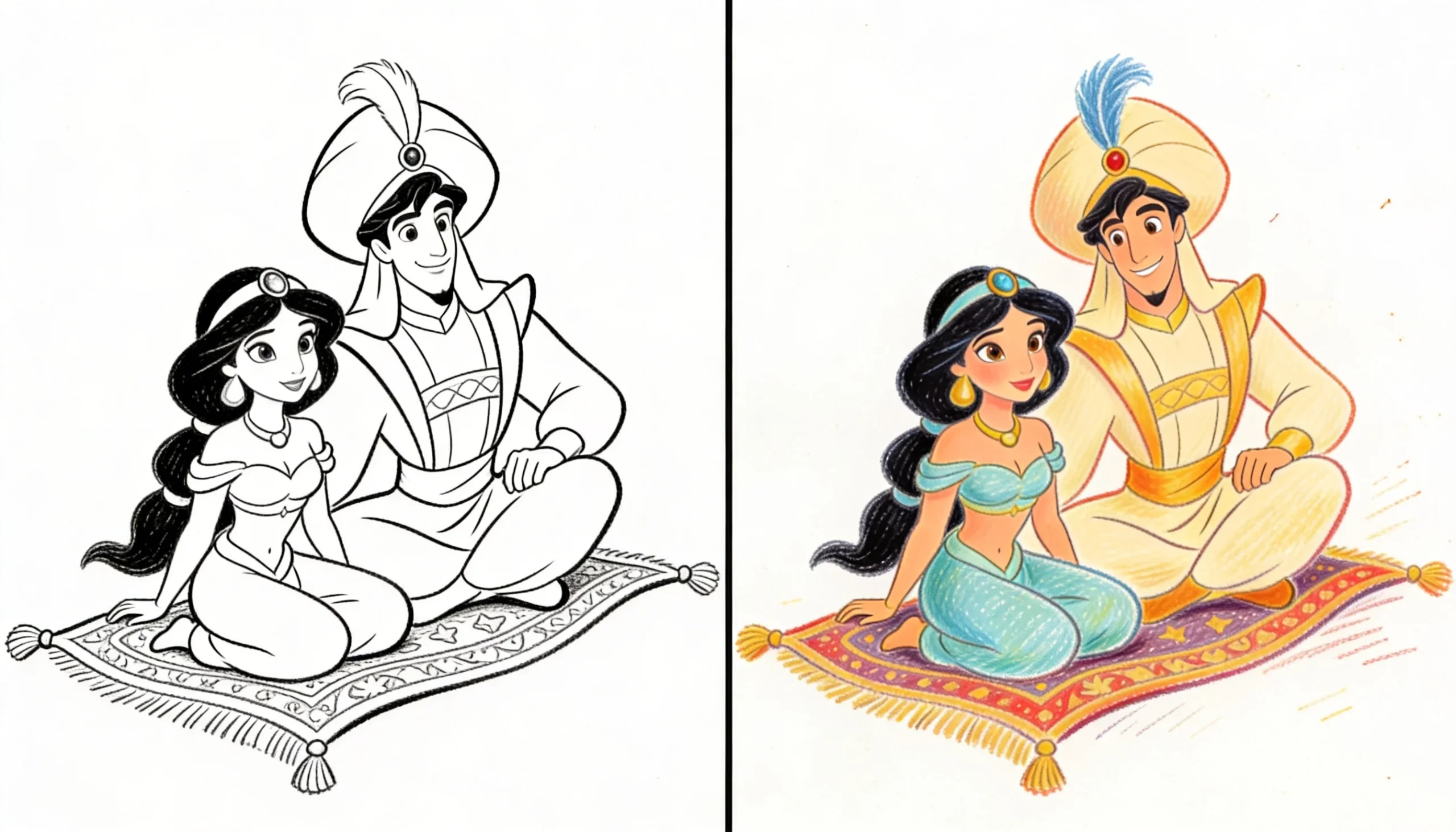
The romance between Aladdin and Princess Jasmine serves as a foundational narrative on cross-class partnership, balancing personal agency with duty, and emotional authenticity within classic animation. Their dynamic during the iconic magic carpet sequence marks a turning point where romantic fantasy intersects with genuine psychological breakthrough and mutual liberation.
Examining this relationship requires looking past the surface spectacle of animated musical numbers and evaluating how character motivations, socio-economic divides, and spatial dynamics shape their bond. Within the scope of character relationship profiles, the pairing offers a fascinating study in breaking through social stratification, overcoming systemic isolation, and navigating the tension between royal obligation and personal freedom.
The Socio-Economic Divide and Initial Motivations
Understanding the trajectory of Aladdin and Jasmine requires analyzing the vast chasm between their respective worlds in Agrabah. Princess Jasmine exists inside the rigid confines of the Sultan's palace, enduring isolation enforced by archaic laws dictating that she must marry a visiting prince. Her primary motivation is autonomy—the fundamental right to make her own choices and experience life outside palace walls.
Aladdin, conversely, operates at the opposite end of Agrabah's social hierarchy. Surviving as a street urchin through petty theft and deception, his daily motivation is mere subsistence coupled with a deep-seated desire for validation. He wears a persona of confidence, but internally struggles with profound inadequacy, believing his true self is fundamentally unworthy of respect or love.
When these two worlds collide in the marketplace, the interaction is catalyzed by shared empathy rather than mere physical attraction. Jasmine steps outside her comfort zone and demonstrates a fundamental misunderstanding of public survival, which Aladdin gently corrects. This initial encounter establishes a dynamic of mutual instruction: Jasmine learns about the harsh realities of her subjects, while Aladdin encounters someone who values him before any magical transformation occurs.
The Catalyst of the Magic Carpet Sequence
The magic carpet sequence set to "A Whole New World" functions as the narrative engine that transforms a tentative mutual attraction into a deep emotional alliance. Far from being a simple romantic montage, this sequence serves as a psychological crucible where both characters shed their defensive facades.
From a spatial perspective, the magic carpet acts as a neutral equalizer. Hovering high above Agrabah, away from the laws of the Sultan and the criminal perils of the streets, Aladdin and Jasmine occupy a shared vacuum. Neither is constrained by palace guards or market authorities. This spatial liberation enables psychological vulnerability.
During this flight, Aladdin momentarily drops the deception of his "Prince Ali" persona, though he still harbors the core secret of his true identity. Jasmine, meanwhile, experiences the literal breadth of the world she has yearned to explore. The shared experience of wonder bridges their ideological gaps, allowing them to communicate as equals rather than as a royal heir and a street rat.
Balancing Personal Agency and Palace Expectations
A critical element of any relationship profile is how partners navigate external pressures. For Jasmine, agency is an ongoing battle against institutional patriarchy and traditionalism. She refuses to be treated as a political prize to be awarded to the winning suitor. Her alignment with Aladdin—even the fabricated Prince Ali—is an act of rebellion against her expected matrimonial timeline.
| Relationship Dimension | Princess Jasmine | Aladdin |
|---|---|---|
| Core Motivation | Autonomy, agency, and empathy | Validation, survival, and worth |
| Primary Obstacle | Rigid royal laws and isolation | Imposter syndrome and deception |
| Role on the Carpet | Explorer seeking authentic truth | Provider of wonder and freedom |
| Resolution Arc | Changing the law to choose freely | Embracing honesty over facades |
Aladdin’s struggle with agency is internal. While Jasmine fights external restrictions, Aladdin constructs his own psychological prison through the Genie's magic. His reliance on a fabricated identity creates an ethical barrier in the relationship. The magic carpet ride amplifies this conflict: the more genuine his connection with Jasmine becomes, the heavier the burden of his deception weighs upon him.
Emotional Vulnerability Versus Deception
The central conflict of their romance hinges on trust and authenticity. Jasmine explicitly states her exhaustion with people hiding behind titles and facades, a sentiment that directly implicates Aladdin's ongoing deception. The intimacy built on the magic carpet is therefore paradoxical: it is emotionally real, yet built upon a foundational falsehood.
This tension demonstrates that a relationship profile cannot rely on romantic milestones alone; it must account for systemic hurdles. Aladdin’s fear of inadequacy drives him to maintain the "Prince Ali" charade, fearing that revealing his true background will cause Jasmine to reject him. However, Jasmine’s attraction is repeatedly shown to anchor to Aladdin's courage, wit, and kindness—qualities independent of royal garments or magical wealth.
The eventual shattering of this illusion forces both characters to confront the reality of their partnership outside of magical enhancements. It proves that the foundation laid upon the magic carpet—one of shared discovery and mutual respect—is robust enough to survive the stripping away of artifice.
Frequently Asked Questions
What makes the magic carpet scene pivotal to their relationship?
The magic carpet scene provides a neutral space free from societal constraints, allowing both characters to experience vulnerability and genuine connection as equals rather than representatives of opposing social classes.
How does Jasmine maintain her agency throughout the romance?
Jasmine actively rejects suitors who view her as a possession, demands to be treated as an equal partner, and ultimately influences the amendment of Agrabah's ancient laws to choose her own future.
Why does Aladdin struggle with maintaining the relationship?
Aladdin battles severe imposter syndrome, fearing that his true identity as a street urchin is insufficient for a princess, which leads him to rely on magical deception rather than honesty.
Does the social class difference permanently affect their dynamic?
While initial class disparities create hurdles and prompt deception, the narrative resolves by dismantling those systemic barriers, establishing a partnership based on mutual respect and shared governance.
How do external antagonists impact their bond?
External pressures, such as Jafar's political maneuvers and attempts to force marriage, test the resilience of their bond, forcing them to coordinate strategies and rely on each other's resourcefulness.
Cultivating Authentic Partnerships in Complex Environments
Navigating profound social or circumstantial divides requires prioritizing transparency over protective artifice. Much like the progression seen during the iconic aerial journey, building a lasting connection demands stepping outside familiar environments to establish shared ground. For individuals and narrative analysts alike, the takeaway is clear: sustainable bonds are forged through mutual exploration, the dismantling of artificial barriers, and an unwavering commitment to honesty even when vulnerability feels risky.