Navigating Alabama records requires understanding which state agency, county office, or archival repository holds the specific vital statistic, historical document, or public file you need. Whether you are conducting genealogical research, verifying legal properties, or requesting official certificates, Alabama distributes its information across distinct departmental jurisdictions governed by state statutes.
Understanding the Scope of Alabama Public Records
Public records in Alabama encompass a wide array of documents generated, used, or maintained by state and local government agencies. Under the state's open records laws, commonly referred to as the Alabama Open Records Act, citizens generally have the right to inspect and copy public writings. However, access provisions vary significantly depending on whether the record is classified as a vital statistic, a court filing, a property deed, or a historical archive.
Unlike some states with centralized online repositories for all government data, Alabama operates a decentralized system. This means that requesting a document often requires contacting the specific county office, municipal clerk, or state department responsible for that record type. For example, local probate courts handle marriage licenses and property deeds, whereas the Alabama Department of Public Health handles statewide vital statistics like birth and death certificates. Understanding this jurisdictional split prevents administrative delays and ensures that requests are submitted to the correct authority with the proper fee and documentation.
Requesting Vital Statistics: Birth, Death, Marriage, and Divorce Certificates
Vital records—specifically birth, death, marriage, and divorce certificates—are managed primarily through the Alabama Department of Public Health (ADPH) Center for Health Statistics, though marriage and divorce records have distinct historical storage paths through local county offices.
Birth and death records are restricted data. Statewide birth records are available from 1908 forward, while death records are available from 1908 forward. Access to birth certificates is strictly limited to the person named on the certificate, their legal spouse, parents, children, or legal representatives. Death certificates are available to family members and individuals with a direct legal or financial interest.
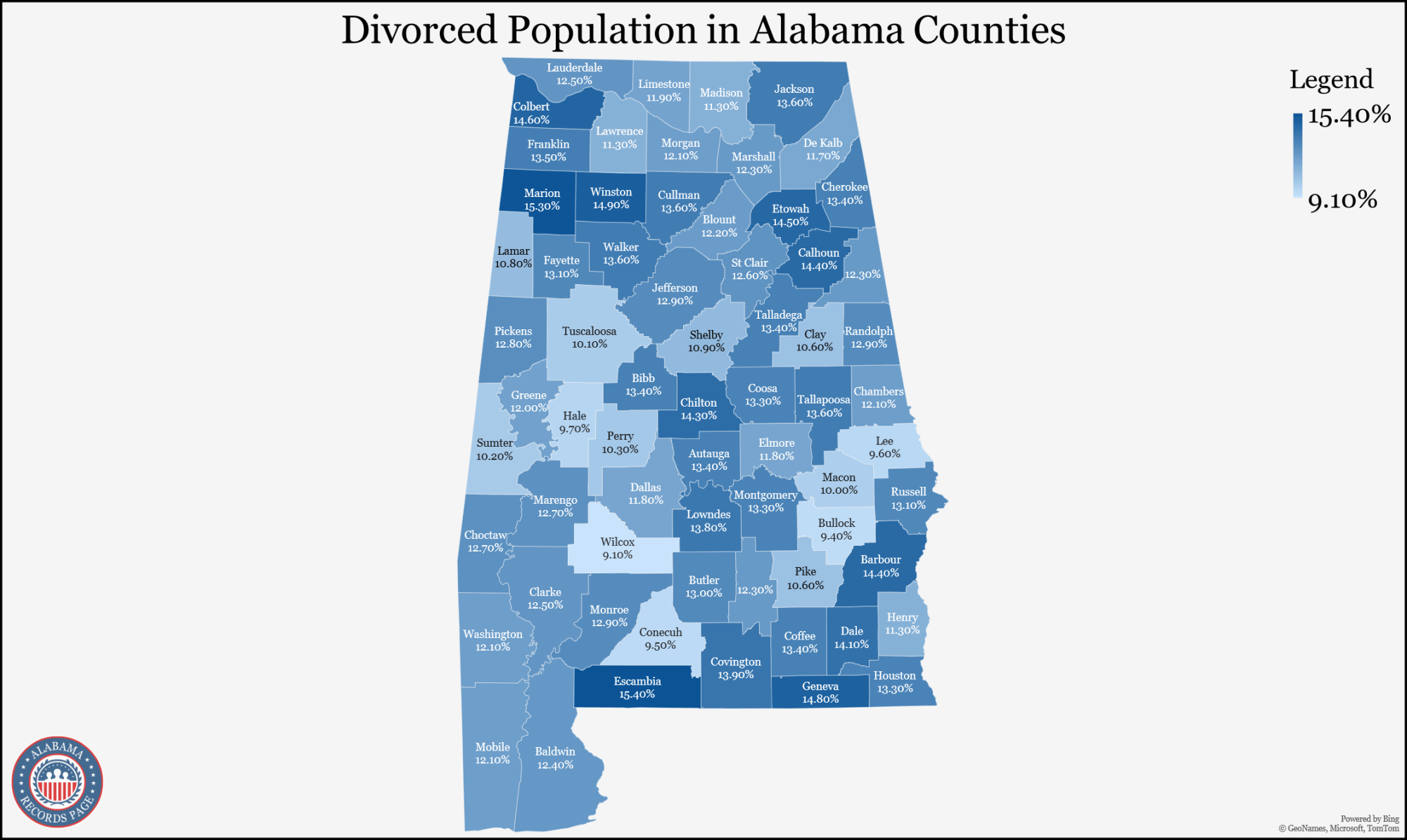
Marriage and divorce certificates involve a dual-tier system. The ADPH maintains marriage records from August 1936 to the present, and divorce records from January 1950 to the present. For marriages or divorces occurring outside those date ranges, or for obtaining certified copies of the original decrees, applicants must contact the office of the Circuit Court Clerk or the Probate Judge in the specific county where the license was issued or the divorce was granted.
The standard procedure for requesting vital records from the state health department requires completing an application form, providing valid government-issued photo identification, and paying the statutory non-refundable search fee. Requests can be submitted by mail, online through authorized third-party vendors, or in person at the state vital records office in Montgomery or designated county health departments.
Navigating Property Deeds, Mortgages, and Land Records
Property records in Alabama offer a clear window into real estate history, land ownership chains, and encumbrances. These records are decentralized and maintained at the county level by the Office of the Judge of Probate in each of Alabama’s 67 counties.
The probate office records and preserves deeds, mortgages, liens, plats, and subdivision maps. Anyone can access these records for title searches, genealogical investigation, or property boundary verification. In recent decades, many Alabama counties have modernized their recording systems, allowing researchers to search indexes online through subscription or free county-specific portals. However, older records—particularly those predating the digital era—often require visiting the county courthouse in person to inspect physical books, microfilm, or historical tract books.
When conducting a property record search, you will typically encounter several key document types:
- Warranty Deeds: Legal instruments used to transfer real estate ownership with guarantees of clear title.
- Quitclaim Deeds: Documents transferring interest in a property without warranties or guarantees regarding the validity of the title.
- Mortgages and Deeds of Trust: Financial instruments securing a loan against real property, which must be satisfied and released upon full loan repayment.
- Mechanic's Liens: Claims filed by contractors or material suppliers against a property for unpaid work or supplies.
Accessing Court Records and Judicial Filings
Court records in Alabama are divided into municipal, district, circuit, and appellate levels, with each court tier maintaining distinct administrative responsibilities and case files.
Circuit courts handle major civil lawsuits, felonies, and domestic relations cases, while district courts manage misdemeanors, minor civil claims, and juvenile matters. Municipal courts handle local ordinance violations and traffic infractions. Administrative access to electronic court records is governed by the Alabama Administrative Office of Courts (AOC).
While attorneys and registered legal professionals utilize the AlaFile system for electronic filing and case management, members of the public can access active case information through Alabama Court Judiciary public portals or by visiting the Circuit Court Clerk's office in the county where the action was filed. Criminal history background checks are processed separately through the Alabama Law Enforcement Agency (ALEA), which maintains state criminal identification records based on fingerprint submissions and arrests.
Utilizing the Alabama Department of Archives and History
For historical research, genealogical projects, and state government archives, the Alabama Department of Archives and History (ADAH), located in Montgomery, serves as the central state repository. Established in 1901 as the first independently state-funded archival agency in the United States, the ADAH holds extensive collections documenting Alabama history from the territorial period to the modern era.
Researchers visiting or contacting the ADAH can access territorial and state census records, military service records for Alabamians who served in various conflicts, early tax rolls, state agency records, and manuscript collections from prominent families and organizations. While many genealogical resources are available on-site or through digitized partnerships, archival staff assist with complex historical inquiries and specialized document retrieval.
| Record Type | Primary Custodian | Access Restriction Level | Typical Delivery Method |
|---|---|---|---|
| Birth Certificates | Alabama Department of Public Health | Confidential / Restricted | Mail, In-Person, Authorized Online Vendor |
| Death Certificates | Alabama Department of Public Health | Restricted (First 25 years) | Mail, In-Person, Authorized Online Vendor |
| Property Deeds | County Office of the Judge of Probate | Public | In-Person, County Online Portal |
| Court Case Files | Local Circuit / District Court Clerk | Varies (Public / Sealed) | In-Person, AlaCourt Portal |
| Criminal Histories | Alabama Law Enforcement Agency (ALEA) | Restricted (Requires Consent/Fingerprints) | Mail, Electronic Submission |
| Historical Archives | Alabama Department of Archives and History | Public (Historical Collections) | On-Site Research, Digital Collections |
Resolving Common Record Requests and Troubleshooting Delays
Navigating government bureaucracy in Alabama can occasionally result in delayed applications or rejected requests. Understanding the common pitfalls ensures a smoother document retrieval process.
The most frequent cause of delay in vital statistics requests is insufficient identification or incorrect applicant eligibility. Submitting an application for a birth certificate without proving a direct familial relationship will result in an automatic rejection by the ADPH. Similarly, failing to include the correct non-refundable fee or using outdated application forms causes processing bottlenecks.
For property and court records, spelling variations in historical names frequently disrupt searches. Surnames often underwent phonetic spelling changes in early 20th-century census and land records. When searching probate or court indexes, researchers should utilize wildcard searches or check alternative phonetic spellings to locate elusive files. If an online portal is down or historical books are missing from digital indices, contacting the local county archivist or deputy clerk directly is the most effective troubleshooting step.
Next Actions for Record Retrieval
To initiate your record search successfully, first identify the exact category of document required and pinpoint the correct government level—state department, county probate office, or municipal court—that holds jurisdiction. Verify fee schedules and identification requirements on the official agency website before submitting mail-in or online forms. For complex genealogical or legal investigations involving multiple counties, establish a structured research log to track application dates, receipt numbers, and jurisdictional contacts.