Al Pacino’s portrayal of Michael Corleone across The Godfather trilogy stands as one of the most celebrated masterclasses in cinematic acting. By detailing a war hero’s tragic descent into moral corruption, Pacino redefined screen acting and established the modern cinematic antihero through an extraordinary, decade-spanning performance.
The Casting Battle: How an Unknown Theater Actor Secured the Role
The journey to cast Al Pacino as Michael Corleone in Francis Ford Coppola’s 1972 adaptation of Mario Puzo’s novel was marked by extreme studio resistance. Executives at Paramount Pictures, led by head of production Robert Evans, strongly favored established Hollywood leading men for the role. Names frequently discussed included Warren Beatty, Robert Redford, Ryan O’Neal, and Jack Nicholson. Paramount sought a bankable star who matched the traditional Hollywood ideal of a tall, charismatic protagonist.
Coppola, however, envisioned an authentic Italian-American aesthetic and saw in Pacino an elusive, internal intensity. At the time, Pacino was primarily a New York stage actor with only one major film lead—playing a young man struggling with addiction in Jerry Schatzberg’s The Panic in Needle Park (1971). Coppola had observed Pacino’s Broadway work in Does a Tiger Wear a Necktie?, for which Pacino won a Tony Award in 1969, and felt the young actor possessed the quiet, brooding gaze necessary to convey Michael’s internal shifts.
- Paramount Executives (Favored Established Stars)
- Warren Beatty / Robert Redford / Ryan O'Neal
- Sought: Traditional Hollywood leading man
- Francis Ford Coppola (Favored Authenticity & Intensity)
- Al Pacino (Off-Broadway/Broadway Theater Actor)
- Sought: Internal intensity & authentic Italian-American presence
Pacino underwent numerous screen tests, many of which Paramount executives initially dismissed, considering his early auditions muted and underwhelming. The studio referred to him dismissively as "that little Pacino." The breakthrough came when Coppola shot test scenes focused on Michael’s turn toward violence.
A further hurdle arose regarding Pacino’s contract with Metro-Goldwyn-Mayer (MGM) for the comedy The Gang That Couldn't Shoot Straight. To resolve the legal deadlock, producer Robert Evans pulled industry strings to release Pacino from his MGM contract, allowing Robert De Niro—who had originally auditioned for Sonny Corleone—to take Pacino’s place in the MGM production. This maneuver cleared the way for Pacino to join The Godfather, setting the stage for film history.
The Evolution of Michael Corleone: Deciphering Pacino’s Acting Methodology
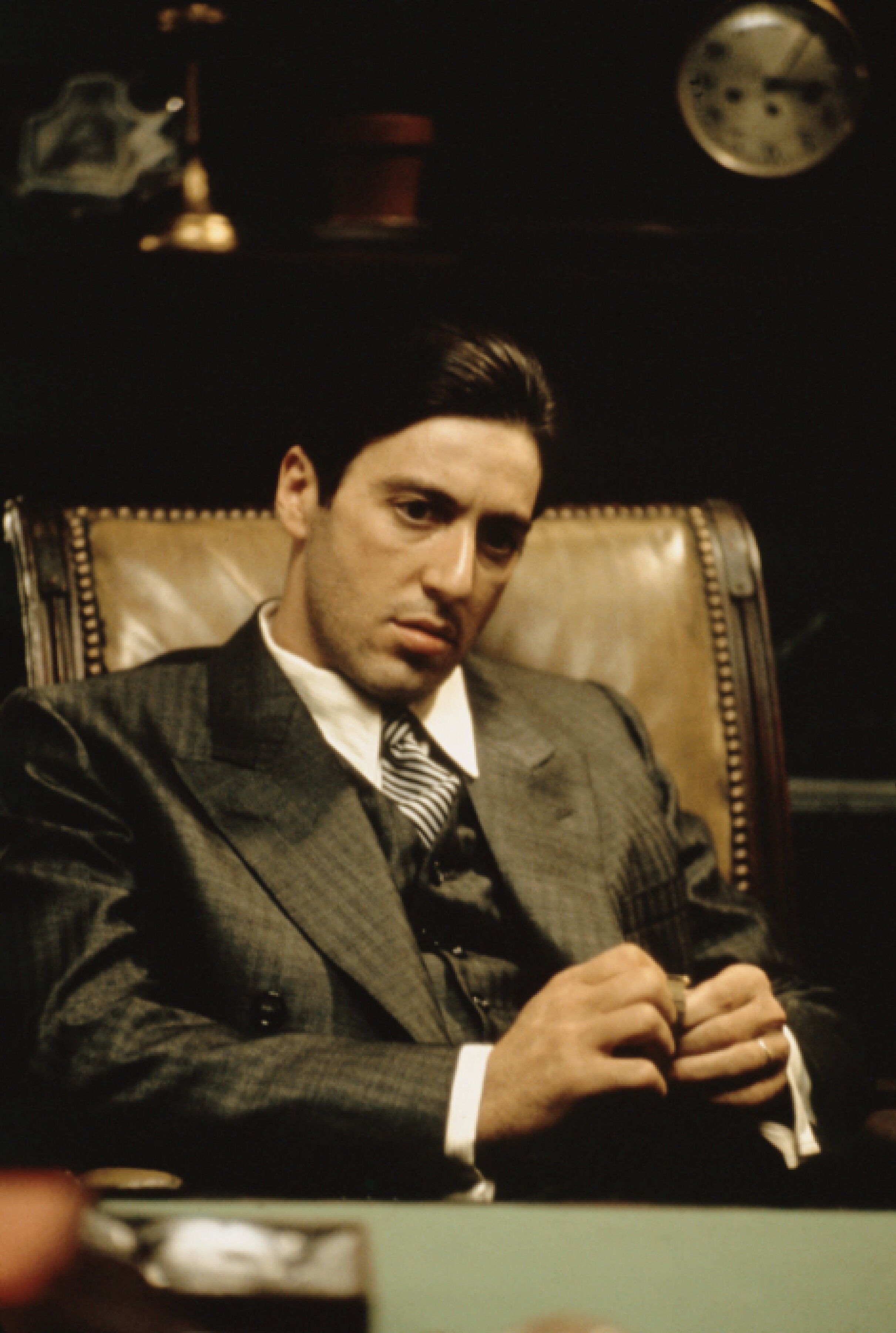
Pacino’s approach to Michael Corleone relies on extreme psychological minimalism. Rather than employing expressive gestures or high-energy vocal delivery, Pacino anchors his performance in still posturing, deliberate breathing, and sharp, observation-focused eye movements. This methodology allows the audience to track Michael's transition from an idealistic outsider to a cold, autocratic boss.
Phase 1: The Reluctant Outsider
In the opening act of The Godfather, Michael Corleone appears in his United States Marine Corps Captain uniform at his sister Connie’s 1945 wedding. He is physically removed from the illegal activities of the family, leaning back in chairs, smiling warmly, and assuring his girlfriend, Kay Adams (played by Diane Keaton), with the famous declaration: "That's my family, Kay. It's not me." Pacino plays this initial version of Michael with a light vocal cadence, mobile facial expressions, and relaxed posture, representing an Americanized young man determined to choose his own destiny.
Phase 2: The Catalyst and Internal Awakening
Michael’s turn toward the family business occurs gradually, triggered by the failed assassination attempt on his father, Vito Corleone (Marlon Brando). Pacino signals this shift not through explosive emotion, but through a hardening of his posture and a drop in vocal pitch. During his bedside visit to his recovering father at the hospital, Michael realizes the family is vulnerable. Standing guard on the hospital steps alongside the nervous baker Enzo, Michael lights Enzo’s cigarette; Pacino notices his own hands are completely steady while Enzo’s are shaking. That subtle physical realization marks Michael's acceptance of his capacity for cold-blooded resolve.
Phase 3: The Cold Autocrat
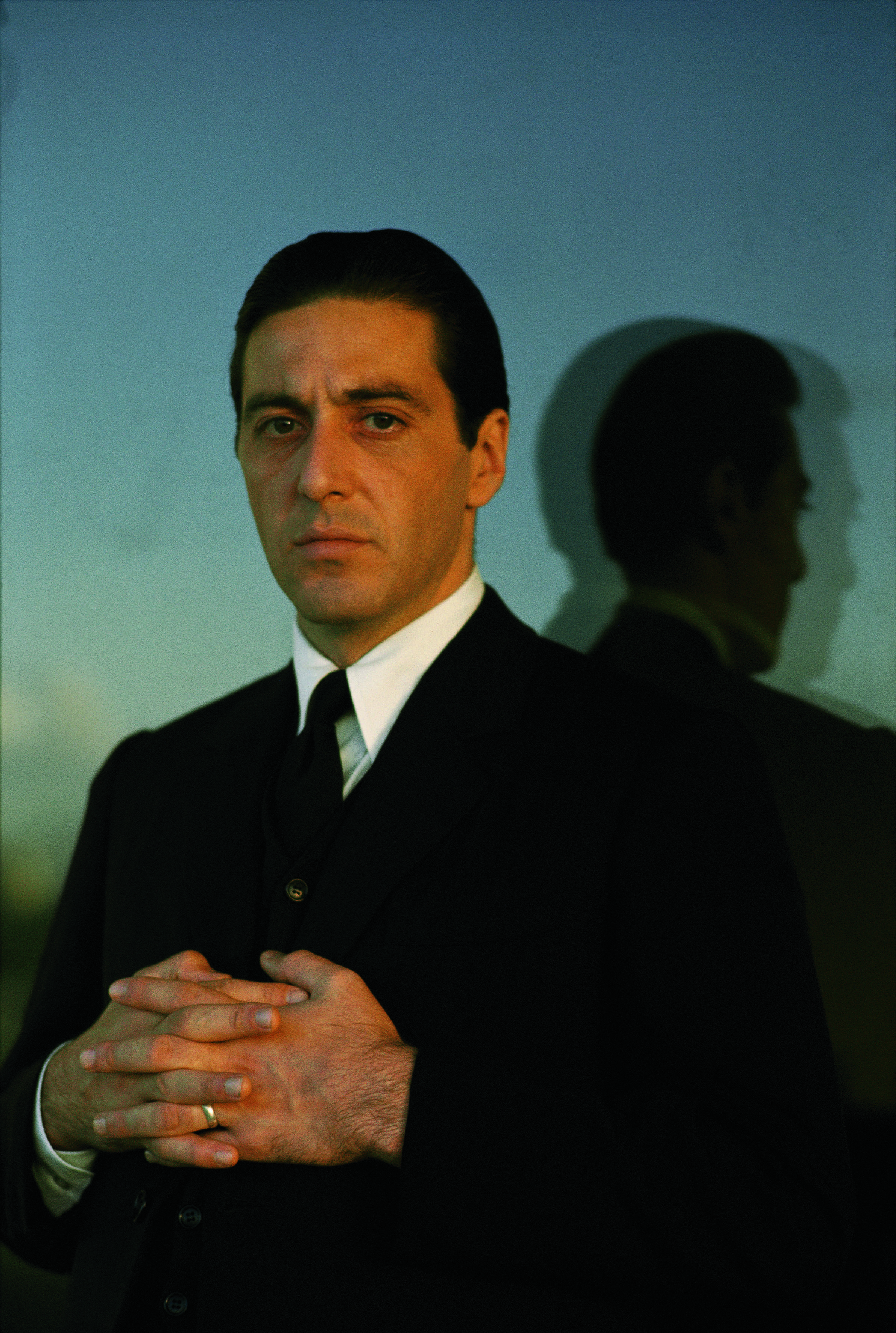
Following his exile to Sicily and the murders of his first wife Apollonia and brother Sonny, Michael returns to New York to assume command of the Corleone empire. Pacino strips the character of all youthful animation. His eyes become glassy and unblinking, his speech grows quiet and clipped, and his body language becomes rigid. In The Godfather Part II (1974), Pacino deepens this physical restraint, turning Michael into an isolated monarch whose power is defined by silence, immobility, and terrifying emotional distance.
Part I vs. Part II vs. Part III: Tracking the Character’s Tragic Arc
The narrative structure of The Godfather trilogy provides a rare canvas for an actor, allowing Pacino to develop a single character across three distinct eras of cinematic storytelling.
- Part I (1972): Reluctant Outsider to Ruthless Leader
- Part II (1974): Absolute Power, Paranoia, Fratricide, and Isolation
- Part III / Coda (1990): Physical Decay, Guilt, and Vain Search for Redemption
The Godfather (1972)
In the original film, Michael’s arc represents a classic downward moral curve masked as an upward trajectory of power. Pacino balances the character's early innocence against his growing mastery of strategic violence. The arc concludes with the famous baptism scene, where Pacino’s stone-faced calm is cross-cut with the brutal murders of rival dons, solidifying his transition into the new Godfather.
The Godfather Part II (1974)
Widely considered Pacino’s finest technical performance, Part II explores the psychological weight of absolute power. Set in the late 1950s against the backdrop of Lake Tahoe, Las Vegas, and pre-revolutionary Cuba, Michael’s arc is defined by intense paranoia and emotional detachment. Pacino plays Michael as a man haunted by betrayal from within his inner circle, culminating in his decision to order the execution of his own brother, Fredo (John Cazale). By the film's conclusion, Pacino sits alone in the snow at Lake Tahoe, physically motionless, his eyes staring into an empty void—a visual image of absolute power paired with complete spiritual bankruptcy.
The Godfather Part III / The Godfather Coda (1990 / 2020)
Set in 1979, the third installment presents an aging Michael seeking legitimacy and spiritual redemption through the Vatican. Pacino alters his performance to reflect physical decay, diabetes, and intense remorse over Fredo’s murder. While some critics noted that Pacino brought more of his later, high-energy stage persona to this film compared to the quiet stillness of the 1970s entries, the director's 2020 recut, The Godfather Coda: The Death of Michael Corleone, reframed Pacino's performance around the tragic impossibility of undoing past sins.
Key Performance Milestones Across The Godfather Trilogy
The table below outlines the evolution of Al Pacino’s performance, technical methodologies, key scenes, and industry awards across the trilogy:
| Film Title & Year | Michael's Stage of Life | Pacino's Acting Technique & Physicality | Signature Scene | Major Academy Recognition |
|---|---|---|---|---|
| The Godfather (1972) | Decorated WWII Hero to New Godfather | Soft vocal tone expanding into rigid posture, unblinking focus, minimalist hand movements | Louis Restaurant assassination of Sollozzo & McCluskey | Nominated: Best Supporting Actor (Boycotted ceremony) |
| The Godfather Part II (1974) | Entrenched Mob Empire Leader / Don | Extreme physical restraint, low pitch, deadened gaze, stillness conveying absolute fear | Lake Tahoe confrontation with Fredo ("I know it was you") | Nominated: Best Actor (Won BAFTA Best Actor) |
| The Godfather Part III / Coda (1990 / 2020) | Aging Tycoon seeking spiritual redemption | Gravelly vocal tone, expressive emotional outbursts, visible physical frailty | Devastating silent scream on the steps of the Teatro Massimo | Nominated: Golden Globe for Best Actor (Drama) |
Masterclass in Subtlety: Analyzing Critical Scenes
To understand the genius of Pacino’s performance, one must analyze specific sequences where small physical choices communicate dense narrative meaning.
The Louis Restaurant Scene (Bronx, New York)
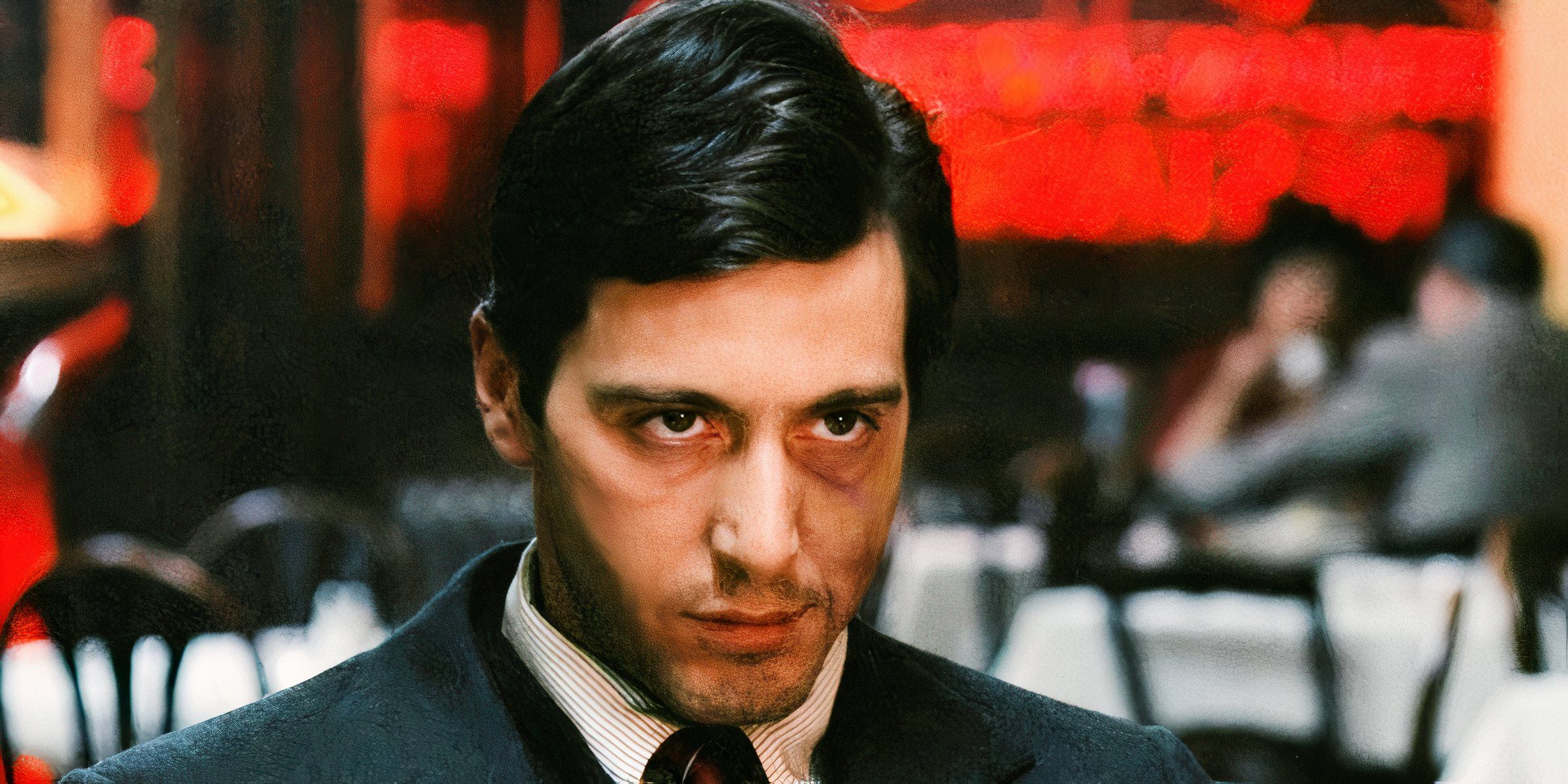
The assassination of Virgil Sollozzo and Captain Mark McCluskey in a Bronx diner is often studied in film schools as a masterclass in subjective acting. As Sollozzo speaks to Michael in rapid Italian, Coppola keeps the camera tightly framed on Pacino's face.
Pacino does not respond with anger; instead, his eyes dart back and forth, conveying a mind processing an imminent life-altering choice. The sound design amplifies the screeching of an elevated train outside, mimicking the roaring tension inside Michael's head. When Michael returns from the bathroom with the hidden revolver, Pacino delays the shooting by sitting back down, allowing a heavy beat of silence to build before standing up and executing both men. Pacino's panicked, awkward movement as he drops the gun and leaves the restaurant highlights the terrifying weight of his first murders.
The Baptism Sequence
The climax of The Godfather juxtaposes Michael standing as godfather to his nephew in a Catholic church with the simultaneous mass execution of his rivals. Pacino’s performance here relies on absolute calm. As he clearly speaks the sacred vows—renouncing Satan and all his works—Pacino’s eyes remain totally vacant. The stark contrast between his holy promises and his cold execution orders highlights Michael's total moral detachment.
- Church Altar (Sacred Vows)
- Michael: "I do renounce him."
- Pacino's unblinking, calm visage
- New York Streets (Violent Cleansing)
- Rival Dons eliminated simultaneously
The Havana Betrayal Kiss
In The Godfather Part II, during a New Year’s Eve celebration in pre-revolutionary Havana, Michael confirms that his older brother Fredo has betrayed him to rival mobster Hyman Roth. Pacino grabs Fredo (John Cazale) by the head and forcibly kisses him, whispering, "I know it was you, Fredo. You broke my heart." Pacino infuses the moment with a blend of tragic heartbreak and terrifying resolve, turning a traditional Judas kiss into one of the most memorable betrayals in cinema.
Oscar Controversies and Critical Legacy
Al Pacino’s history with the Academy Awards regarding The Godfather remains one of the most famous chapters in awards ceremony history.
The 1973 Academy Awards Boycott
For the 45th Academy Awards honoring films released in 1972, The Godfather earned 11 nominations. Marlon Brando was nominated for (and won) Best Actor for his role as Don Vito Corleone, while Al Pacino, Robert Duvall, and James Caan were all nominated in the Best Supporting Actor category.
Pacino boycotted the ceremony, taking issue with his placement in the Supporting category. He argued that his character had significantly more screen time and dialogue than Brando’s, making Michael Corleone the clear narrative lead of the film. While Brando famously sent Native American activist Sacheen Littlefeather to decline his Best Actor award in protest of Hollywood's treatment of Native Americans, Pacino simply refused to attend. The Best Supporting Actor Oscar that year was awarded to Joel Grey for Cabaret.
The 1975 Best Actor Snub
At the 47th Academy Awards in 1975, Pacino was nominated for Best Actor for The Godfather Part II. His performance was universally acclaimed, yet the Oscar ultimately went to veteran actor Art Carney for his role in the gentle comedy-drama Harry and Tonto. Film historians, critics, and scholars frequently cite Pacino’s loss to Carney as one of the most significant oversights in the history of the Academy Awards.
Despite missing out on the Oscar, Pacino won the BAFTA Award for Best Actor for his combined work in The Godfather Part II and Dog Day Afternoon (1975).
- 1973 Oscars (Part I): Nominated Best Supporting Actor (Boycotted over category placement)
- 1975 Oscars (Part II): Nominated Best Actor (Lost to Art Carney in a classic Academy oversight)
- 1993 Oscars (Scent...): Won Best Actor (Acknowledged partly as lifetime recognition for 1970s work)
Enduring Impact on Cinematic Acting
Pacino’s work as Michael Corleone permanently shifted the landscape of modern acting. Prior to the early 1970s, cinematic leading men were often expected to project grand heroism or overt theatrical charisma. Pacino, alongside peers like Robert De Niro, Dustin Hoffman, and Gene Hackman, popularized an internal, quiet style rooted in the Method technique.
Michael Corleone demonstrated that quiet stillness could be more threatening than loud displays of anger. This performance laid the foundation for future complex television and film antiheroes, directly influencing performances such as James Gandolfini’s Tony Soprano in The Sopranos and Bryan Cranston’s Walter White in Breaking Bad.
Key Lessons for Film Enthusiasts and Performance Analysts
To fully appreciate Al Pacino’s performance in The Godfather saga, viewers and scholars should approach the trilogy with a focused analytical eye:
- Observe the Eyes Over Speech: In The Godfather Part II, track how rarely Pacino blinks during high-stakes dialogues. The intensity of his gaze often conveys more information than his scripted lines.
- Track Physical Space and Posture: Note how Michael commands physical spaces. In early Part I scenes, he adapts to the posture of those around him. By the midpoint of Part II, characters enter his office while he remains seated, immobile behind a heavy wooden desk, forcing others to navigate his personal space.
- Compare Vocal Pitch Across the Trilogy: Pay attention to Pacino’s voice modulation. He raises his pitch in early scenes with Kay, drops it to an even, low tone throughout Part II, and uses a raspy, emotionally exhausted tone in Part III / Coda.
- Study the Reactivity in Ensemble Scenes: Focus on Pacino when other actors are speaking. In scenes with Marlon Brando, John Cazale, or Robert Duvall, Pacino’s listening choices drive the scene's tension, showing a character who processes information long before taking action.
Frequently Asked Questions
Why did Paramount executives initially oppose casting Al Pacino?
Paramount executives viewed Pacino as an unproven stage actor who lacked traditional Hollywood leading-man charisma. They wanted an established film star like Warren Beatty, Robert Redford, or Ryan O'Neal to guarantee box office success. Director Francis Ford Coppola fought for Pacino because he wanted an authentic Italian-American actor who could project a quiet, internal intensity.
Why did Al Pacino boycott the 45th Academy Awards ceremony in 1973?
Pacino boycotted the ceremony because he was nominated in the Best Supporting Actor category despite having more screen time and lines than Marlon Brando, who was nominated for Best Actor. Pacino believed the category placement was an unfair decision by the studio to maximize the film's chances of winning multiple acting awards.
How did Pacino alter his physical acting between Part I and Part II?
In Part I, Pacino portrays Michael with expressive body language, animated facial movement, and a lighter vocal tone, reflecting his initial detachment from the crime family. In Part II, Pacino strips away almost all expressive movement, using rigid posture, quiet monotone speech, and an unblinking gaze to show Michael's complete loss of humanity and total isolation.
What is the significance of the restaurant scene with Sollozzo and McCluskey?
The restaurant scene represents Michael’s point of no return. Pacino relies heavily on internal acting—using intense eye movements and subtle changes in facial expression—to convey Michael's decision to cross the line from civilian war hero to cold-blooded killer. It is widely regarded as one of the most brilliantly executed dramatic turns in film history.
Is The Godfather Coda considered part of Pacino's canonical performance arc?
Yes. Released by Francis Ford Coppola in 2020 to mark the 30th anniversary of The Godfather Part III, The Godfather Coda: The Death of Michael Corleone restructures the opening and closing acts of the 1990 film. This recut streamlines Pacino's performance, focusing the narrative more tightly on Michael's internal grief, guilt over Fredo's murder, and hopeless search for spiritual redemption.
Recommended Next Steps for Students of Film
To gain a complete technical understanding of Al Pacino’s work in The Godfather, explore high-definition physical media releases or official archival collections. The 50th Anniversary 4K UHD restoration of The Godfather trilogy provides pristine visual clarity, allowing viewers to analyze subtle details in lighting, shadow, and micro-expressions in Pacino’s acting.
Additionally, pair your viewing of The Godfather with Pacino’s subsequent 1970s performances—such as Serpico (1973), Dog Day Afternoon (1975), and ...And Justice for All (1979)—to see how he balanced high-energy, explosive stage techniques against the subdued stillness of Michael Corleone. Film scholars can access detailed screenplays and shooting scripts through the Writers Guild Foundation Archive to compare Pacino's scripted dialogue against his improvised non-verbal choices on screen.