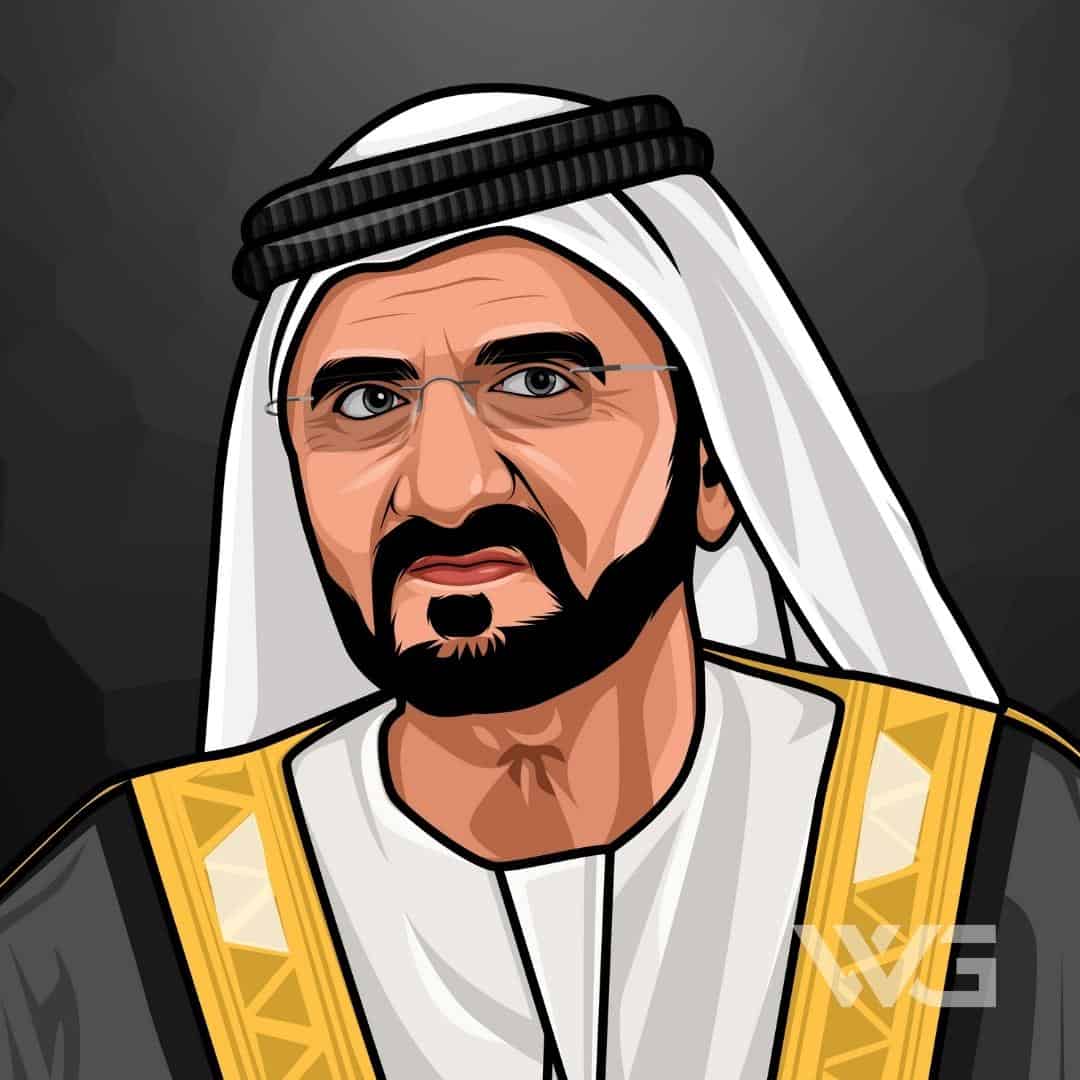
Sheikh Mohammed bin Rashid Al Maktoum, the Ruler of Dubai and Vice President and Prime Minister of the United Arab Emirates (UAE), possesses an estimated personal net worth between $14 billion and $18 billion. However, evaluating the total financial power of the Al Maktoum family requires distinguishing private wealth from state-backed sovereign investment vehicles that manage several hundred billion dollars in global assets.
Understanding the financial standing of Dubai’s ruling family involves analyzing complex corporate holdings, sovereign wealth funds, vast international real estate portfolios, and world-renowned equine operations. Because royal asset structures in the Gulf region blur the line between personal equity and national infrastructure, tracking the net worth of the Al Maktoum dynasty demands a detailed look into both private wealth and institutional state capital.
State Capital vs. Private Holdings: The Royal Asset Framework
Evaluating the net worth of prominent Middle Eastern royals requires separating public governance assets from private family equity. In Dubai, sovereign development and commercial expansion have historically operated under the direct leadership of the ruling family, creating overlap between national development projects and private holdings.
The wealth attributed to Sheikh Mohammed bin Rashid Al Maktoum and the broader Al Maktoum family generally falls into three distinct financial classifications:
- Sovereign Wealth Funds: Institutional investment arms owned directly by the Government of Dubai, such as the Investment Corporation of Dubai (ICD). While managed under royal decree and executive oversight, these assets represent public sovereign wealth rather than personal cash reserves.
- Semi-Governmental Holding Companies: Entities such as Dubai Holding, which operate commercially across real estate, hospitality, media, and technology. These firms are closely linked to the ruling family’s vision and strategic investment interests.
- Private Personal Assets: Directly owned personal real estate, equine investments under the Godolphin brand, luxury maritime vessels, and private international equity holdings.
Financial publications such as Forbes and Bloomberg typically focus their wealth estimations on verified personal assets and commercial stakes, deliberately excluding broad state-owned infrastructure like public airports or government administrative assets.
Core Pillars of the Al Maktoum Financial Portfolio
The commercial footprint of the Al Maktoum family spans key global industries, anchored by strategic domestic development and high-value international acquisitions.
- Al Maktoum Asset Framework
- Private Holdings
- Equine Empire (Godolphin)
- Luxury Real Estate
- Maritime Assets (Yachts)
- Corporate Entities
- Dubai Holding
- Jumeirah Group
- Dubai Properties Group
- Sovereign Funds
- Investment Corp of Dubai (ICD) (Emirates, Emaar, Emirates NBD)
- Private Holdings
1. Corporate Development and Dubai Holding
Established in 2004, Dubai Holding serves as a primary vehicle for managing a global portfolio of assets valued in the tens of billions of dollars. Operating across 13 countries, the group controls key subsidiaries that drive Dubai’s economic diversification:
- Jumeirah Group: The flagship luxury hospitality brand operating premier properties worldwide, including the iconic Burj Al Arab.
- Dubai Properties: A major urban real estate developer responsible for massive residential and commercial districts across Dubai.
- Tecom Group: Operator of specialized commercial hubs, including Dubai Media City, Dubai Internet City, and Dubai Design District.
2. The Equine Empire: Godolphin and Darley
Sheikh Mohammed bin Rashid Al Maktoum is one of the world's most influential figures in thoroughbred horse racing and breeding.
- Godolphin: The ruler’s private racing stable operates across the United Arab Emirates, the United Kingdom, Ireland, France, Australia, Japan, and the United States. Godolphin horses have won thousands of prestigious races internationally.
- Darley Stud: The global breeding arm of the operation, holding some of the most valuable bloodlines and stallion operations in thoroughbred racing history. The land holdings, breeding stock, and commercial stud fees associated with Darley represent several billion dollars in agricultural and equine real estate value.
3. Sovereign Oversight: Investment Corporation of Dubai (ICD)
While the Investment Corporation of Dubai (ICD) is the principal investment arm of the Government of Dubai rather than a purely private account, its leadership under Sheikh Hamdan bin Mohammed Al Maktoum (Crown Prince of Dubai) and other senior royals connects it directly to the family's broader economic stewardship.
According to official audited financial reports, ICD manages over $300 billion in total assets. Its key holdings include:
- The Emirates Group: Owning Emirates Airline and dnata.
- Emirates NBD: One of the largest banking groups in the Middle East by assets.
- Emaar Properties: The master developer behind landmark developments such as the Burj Khalifa and The Dubai Mall (in which ICD maintains a major controlling stake).
Asset Valuation Matrix: Private vs. Institutional Holdings
To understand how financial analysts calculate the Al Maktoum net worth, it is necessary to compare the structure, estimated valuations, and governance of their primary asset categories.
| Asset Category | Key Entities / Holdings | Primary Focus / Sectors | Estimated Portfolio Reach | Governance / Ownership Type |
|---|---|---|---|---|
| Sovereign Wealth | Investment Corporation of Dubai (ICD) | Aviation, Financial Services, Commercial Real Estate | $300B+ Total Assets | Public Sovereign Fund (State-owned) |
| Development Holdings | Dubai Holding | Hospitality, Business Parks, Urban Development | Multi-Billion Dollar Enterprise | Commercial Group (Ruling Family control) |
| Equine & Breeding | Godolphin Stables, Darley Stud | Thoroughbred Racing, Global Stud Operations | Estimated $1B - $3B+ | Private Personal Asset |
| Private Real Estate | Global Estates (UK, Europe, UAE), Luxury Residences | Agricultural Land, Urban Palaces, Manor Estates | Estimated $1B - $2B+ | Private Personal Asset |
| Maritime & Aviation | M/Y Dubai, Private Fleet Vehicles | Superyachts, Executive Transport | Estimated $400M - $600M | Private Personal Asset |
International Real Estate and Private Assets
Outside the Gulf region, the Al Maktoum family holds an extensive portfolio of high-value real estate assets, with a notable concentration in the United Kingdom.
European Estates and Agricultural Land
- Longcross Estate (Surrey, UK): A premier private estate acquired for personal family use.
- Inverinate Estate (Highlands, Scotland): A extensive highland estate spanning tens of thousands of acres, used primarily as a private retreat and wildlife management zone.
- Newmarket Holdings (Suffolk, UK): Vast tracts of land dedicated to horse training facilities, stud farms, and historic equine infrastructure around the center of British horse racing.
Luxury Maritime Assets
Sheikh Mohammed owns one of the world's largest superyachts, the Dubai. Measuring over 160 meters (524 feet), the vessel features accommodations for dozens of guests, a helipad, swimming pools, and specialized security systems. The yacht's estimated replacement value exceeds $400 million, representing a substantial personal passion asset.
Methodological Challenges in Valuing Royal Net Worth
Determining an exact net worth figure for Middle Eastern monarchs presents unique analytical challenges that differ significantly from valuing corporate executives or public-company founders.
Transparency vs. Private Royal Status
Unlike publicly listed corporations, sovereign families are not subject to standard individual wealth reporting rules. While entities like ICD publish audited financial summaries due to their debt issuances on international bond markets, private royal trusts, equine assets, and personal land registries operate under private offshore or non-public structures.
Commingling of National and Personal Development
In monarchical financial systems, state revenue growth directly enhances the financial security and capital access of the ruling dynasty. Projects funded through public-private partnerships often carry implicit guarantees backed by the strength of the royal family’s commercial holdings. Consequently, financial rating agencies evaluate Dubai's sovereign creditworthiness separately from the ruler's personal balance sheet, even though political and economic leadership overlap.
Strategic Financial Lessons from Dubai’s Sovereign Model
The management of the Al Maktoum asset footprint offers key lessons on sovereign wealth diversification, asset management, and urban economic development:
- Asset Diversification Beyond Oil: Unlike neighboring Gulf states historically reliant on oil reserves, Dubai built its economic model on logistics, tourism, financial services, and real estate. This strategic pivot protected the family's assets and state revenues from long-term oil price volatility.
- Reinvestment in Brand and Infrastructure: Strategic investments in international sports (such as racing and equine breeding) and global luxury hospitality (Jumeirah) served to elevate Dubai's international standing, driving foreign direct investment and tourism back to the emirate.
- Separation of Sovereign and Commercial Assets: Maintaining distinct operational structures—such as ICD for public sovereign investments and Dubai Holding for commercial development—allows the leadership to balance national economic objectives with high-performing commercial returns.
Frequently Asked Questions
What is the estimated net worth of Sheikh Mohammed bin Rashid Al Maktoum?
Financial analyses estimate Sheikh Mohammed’s personal net worth at approximately $14 billion to $18 billion. This estimate covers verified private holdings, real estate, equine investments, and personal equity, while excluding broader state-owned sovereign funds.
Does Sheikh Mohammed personally own Emirates Airline?
No. Emirates Airline is owned by The Emirates Group, which is a subsidiary of the Investment Corporation of Dubai (ICD), the state-owned sovereign wealth fund of the Dubai government. While Sheikh Mohammed oversees the governance of Dubai as ruler, the airline is a public sovereign asset rather than his personal property.
What is Godolphin, and how does it contribute to the Al Maktoum net worth?
Godolphin is Sheikh Mohammed’s private thoroughbred horseracing and breeding operation. Spanning top facilities in the UK, Ireland, the US, Australia, and the UAE, Godolphin owns valuable bloodlines, stud facilities, and racing stock valued at several billion dollars.
How does Dubai Holding differ from the Investment Corporation of Dubai (ICD)?
ICD is the sovereign wealth fund of the Dubai government, managing public state assets like Emirates Airline, Emirates NBD, and major stakes in Emaar Properties. Dubai Holding is a major global investment company operating across real estate, media, technology, and hospitality (including the Jumeirah Group), closely linked to the commercial vision of the ruling family.
Why do net worth estimates for Gulf rulers vary significantly between financial sources?
Estimates vary because sovereign family wealth is distributed across private family trusts, personal property, and public state funds. Because monarchs do not publish unified personal tax returns or public wealth disclosures, financial publications use differing methodologies regarding which state assets to include or exclude.
Contextualizing Sovereign Wealth and Royalty
When evaluating the net worth of prominent leaders like Sheikh Mohammed bin Rashid Al Maktoum, financial analysts must look beyond simple personal cash reserves. The true economic standing of the Al Maktoum family lies in their dual role as stewards of multi-hundred-billion-dollar sovereign institutions and owners of premier international assets across equine sports, real estate, and global commercial holdings. For investors, economists, and researchers, understanding this balance between state sovereign capital and personal enterprise provides the clearest picture of Dubai's broader economic stability.