The Akademik Shokalskiy is a world-renowned ice-strengthened research vessel primarily utilized for expedition cruising in the Polar Regions. Built in 1982 and significantly refurbished for passenger comfort, it serves as a rugged, small-scale alternative to modern luxury cruise ships, offering intimate access to the Arctic and Antarctica for researchers and adventure travelers alike.
The Architectural Heritage and Technical Profile of the Akademik Shokalskiy
To understand the enduring relevance of the Akademik Shokalskiy in 2026, one must look at its origins in the twilight of the Soviet era. Constructed at the Laivateollisuus shipyard in Turku, Finland, the vessel was part of the Akademik Shuleykin class. This series of ships was specifically designed for oceanographic and hydrometeorological research, prioritizing stability and ice-breaking capabilities over aesthetic luxury.
The ship is named after Yuly Shokalskiy, a prominent Russian oceanographer and geographer who served as the president of the Soviet Geographical Society. This naming convention underscores the vessel's primary mission: scientific discovery. In its current 2026 configuration, the ship maintains its robust steel hull, which is rated as Ice Class 1A. This classification is critical for polar navigation, as it allows the vessel to operate in difficult ice conditions, including transit through broken grey-white ice and some multi-year ice floes that would pose a significant risk to standard hulls.
Technically, the vessel is a masterpiece of functional engineering. It measures approximately 71 meters (233 feet) in length and 12.8 meters in width. While small by modern cruise standards, this size is its greatest asset. In the 2026 expedition market, "small-ship" cruising is highly sought after because it allows for more frequent landings and access to narrow fjords and shallow bays in places like the Ross Sea or the Russian Far East.
Operational History: From Scientific Research to Polar Tourism
For the first decade of its life, the Akademik Shokalskiy was a dedicated research platform for the USSR’s Academy of Sciences. Following the geopolitical shifts of the 1990s, the ship transitioned into a dual-purpose role. While it remains a registered research vessel under the Russian flag, it has spent much of the last 30 years under charter by specialized expedition companies, such as Heritage Expeditions.
This transition from pure science to "expedition tourism" reflects a broader trend in maritime history where rugged polar vessels are repurposed to fund their own maintenance. In 2026, the ship continues to fulfill this niche. It doesn't offer the spas or theaters found on "mega-expedition" ships; instead, it provides a functional "base camp" at sea.
The onboard environment is designed for those who value education and exploration. The vessel carries a fleet of Zodiacs (inflatable motorized boats) that are deployed rapidly for shore excursions. In the 2026 operating season, the ship typically carries between 48 and 54 passengers, ensuring a high staff-to-guest ratio that is essential for safety and educational depth in remote wilderness areas.
The 2013 Antarctic Ice Incident: Lessons in Polar Safety
Perhaps the most famous chapter in the history of the Akademik Shokalskiy is the "Spirit of Mawson" incident that occurred between December 2013 and January 2014. While following the historical route of explorer Douglas Mawson, the ship became trapped in thick pack ice in Commonwealth Bay, East Antarctica.
The entrapment was caused by a sudden shift in weather conditions that pushed massive amounts of ice against the coast, pinning the vessel. This event triggered a massive international rescue operation involving the Chinese icebreaker Xue Long, the French vessel L'Astrolabe, and the Australian icebreaker Aurora Australis. Eventually, the passengers were evacuated via helicopter to the Australian ship.
For modern maritime operators in 2026, the 2013 incident remains a case study in polar risk management. It highlighted several critical factors:
- The Unpredictability of Fast Ice: Even with modern satellite imagery, ice conditions in Antarctica can change faster than a ship can retreat.
- International Cooperation: The rescue demonstrated the effectiveness of the Antarctic Treaty System’s protocols for mutual assistance.
- Hull Durability: Despite being trapped for weeks and subjected to immense pressure from the surrounding ice, the Akademik Shokalskiy suffered no structural breaches, proving the integrity of its original Finnish construction.
Technical Specifications and Vessel Comparison
When choosing an expedition vessel in 2026, travelers and researchers often compare the Akademik Shokalskiy against newer "X-Bow" designs or larger luxury icebreakers. The following table highlights the ship's core specifications and how they translate to the passenger experience.
| Feature | Specification | Practical Benefit |
|---|---|---|
| Length / Beam | 71.6m / 12.8m | High maneuverability in narrow ice leads and fjords. |
| Ice Class | UL / 1A (Finnish-Swedish) | Capability to navigate through moderate pack ice safely. |
| Passenger Capacity | 48 - 54 Guests | Rapid boarding for Zodiacs; intimate learning environment. |
| Propulsion | 2 x 1,147 kW Diesel Engines | Redundancy and power for navigating challenging currents. |
| Stability | Internal Stabilizers | Reduced rolling in the Drake Passage or Southern Ocean. |
| Zodiac Fleet | 5 - 6 Heavy-duty Mark V | Allows all passengers to be off-ship simultaneously. |
| Navigation Gear | Dual Radar, GPS, Satellite Ice Imaging | Enhanced safety and real-time ice field monitoring in 2026. |
The Onboard Experience: Life on a Working Research Ship
In 2026, the Akademik Shokalskiy appeals to a specific demographic: the "purist" explorer. Unlike modern luxury vessels that insulate passengers from the environment, the Shokalskiy is designed to keep guests connected to the sea.
Accommodations and Public Spaces
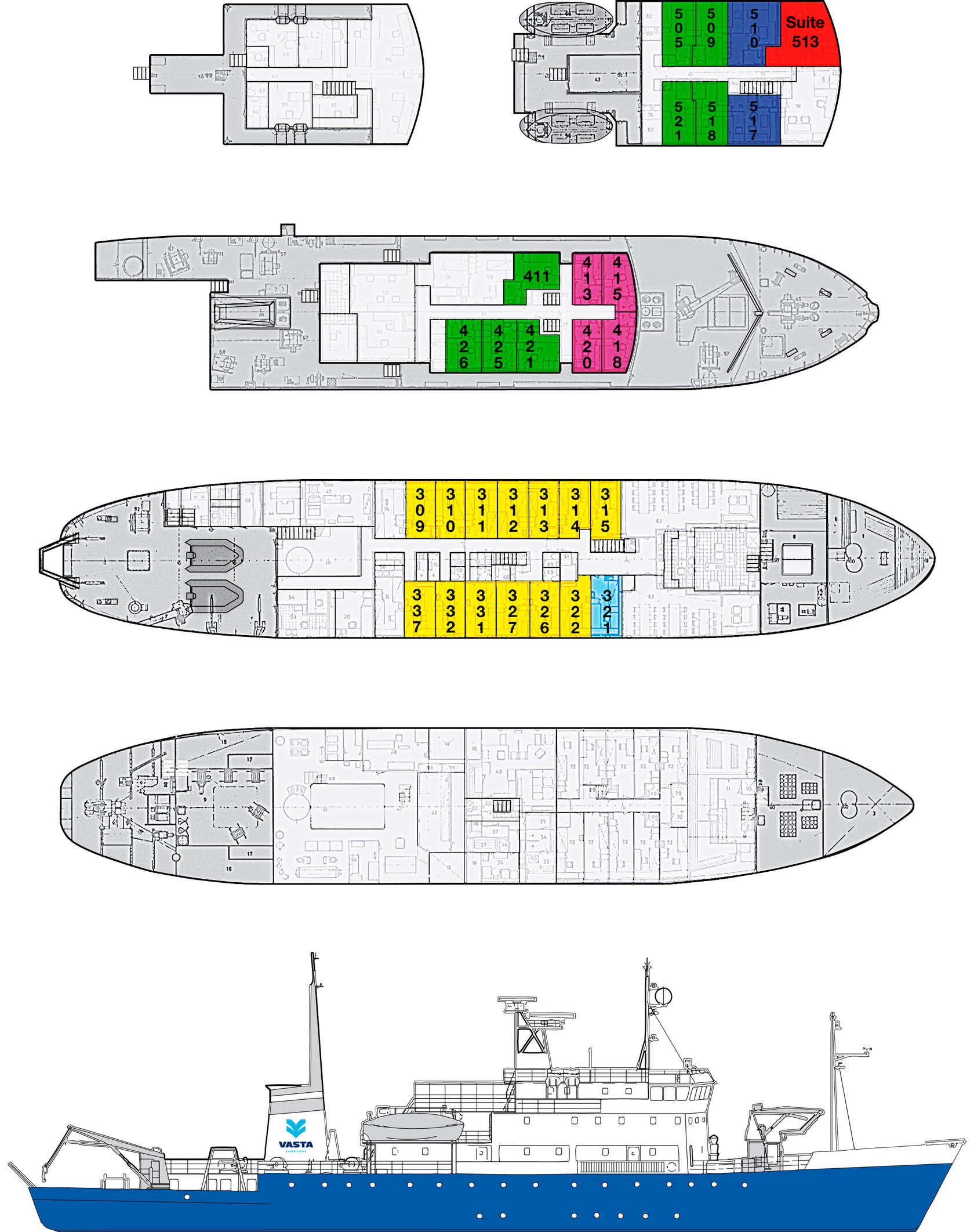
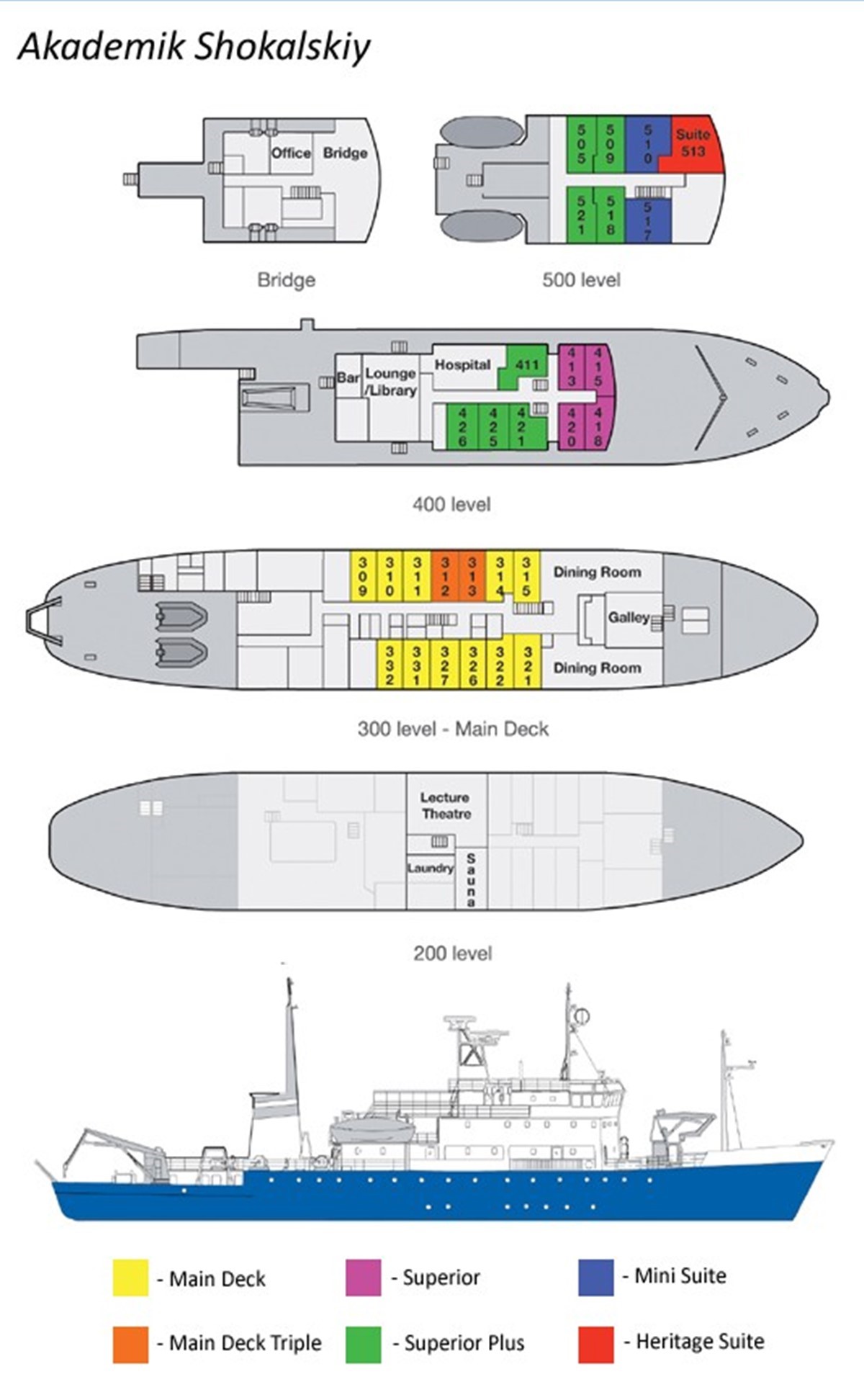
The cabins are divided into several grades, ranging from Heritage Suites to twin-share cabins with shared facilities. While the 2026 updates have introduced better bedding, improved climate control, and modern communication arrays, the aesthetic remains functional. The "Bridge" is often open to passengers, a rarity on larger ships, allowing guests to watch the officers navigate through ice fields in real-time.
The Educational Component
The heart of any voyage on the Shokalskiy is the lecture room. In 2026, expeditions are typically staffed by a team of biologists, geologists, and historians. Because the ship is small, these experts dine with the passengers, fostering a continuous dialogue about the environment being explored. This "expedition style" of travel prioritizes the destination over the ship's amenities.
Zodiac Operations and Landings
The efficiency of the Akademik Shokalskiy lies in its "swing-and-dip" crane system for launching Zodiacs. In the Antarctic or the Russian Far East, weather windows are often narrow. The ability to deploy the entire passenger complement into the boats within 20 minutes is a significant advantage over larger ships that may take over an hour to clear their decks.
Environmental Compliance and Future Outlook in 2026
As environmental regulations for polar waters become more stringent, the Akademik Shokalskiy has undergone several retrofits to remain compliant with the IMO Polar Code. These regulations, which are strictly enforced in 2026, govern everything from fuel types to sewage treatment and hull integrity.
The vessel now operates on Marine Gas Oil (MGO) or low-sulfur fuels to minimize its carbon footprint and eliminate the risk of heavy fuel oil spills in sensitive ecosystems. Furthermore, the ship utilizes advanced waste management systems to ensure a "zero-discharge" policy during shore operations in protected areas like the Ross Sea Dependency or the various Arctic National Parks.
Looking ahead, the Akademik Shokalskiy represents a disappearing breed of vessels. As newer, more expensive ships enter the market, the Shokalskiy offers a more accessible price point for serious researchers and wildlife photographers. Its longevity is a testament to the quality of late-20th-century marine engineering and the enduring appeal of traditional seafaring.
FAQ: Common Questions About the Akademik Shokalskiy
Is the Akademik Shokalskiy a luxury cruise ship?
No, it is an ice-strengthened expedition vessel. While it provides comfortable cabins, high-quality food, and modern safety features, it lacks luxury amenities like swimming pools, casinos, or large-scale entertainment. It is designed for travelers who prioritize wildlife, science, and remote landings over shipboard pampering.
How does the ship handle the rough waters of the Drake Passage?
Due to its relatively small size and "expedition" hull design, the ship can experience more movement than a massive 5,000-passenger cruise ship. However, it is equipped with internal stabilizers and a heavy-duty hull that provides a stable, if lively, ride. Many polar travelers consider this "authentic" experience part of the journey's appeal.
Is the ship safe given the 2013 ice incident?
Yes. The 2013 incident was caused by extreme weather and sea-ice movements rather than a failure of the vessel itself. In fact, the ship’s ability to withstand the ice pressure without leaking or hull failure proved its superior construction. Navigation protocols and satellite ice-monitoring technology have improved significantly by 2026, further reducing such risks.
What regions does the vessel typically visit?
The Akademik Shokalskiy generally follows a seasonal schedule. During the Austral Summer (November–March), it operates in the Southern Ocean, visiting the Ross Sea, Commonwealth Bay, and the Sub-Antarctic Islands. During the Boreal Summer (June–September), it often moves to the Northern Hemisphere to explore the Russian Far East, including Wrangel Island and the Kamchatka Peninsula.
Selecting the Right Voyage on the Shokalskiy
For those planning a journey in 2026, the Akademik Shokalskiy is best suited for travelers who want to maximize their time on land and in the water. When booking, consider the specific itinerary rather than just the destination. Because of its ice class, this ship can often reach locations—such as the historic huts of Scott and Shackleton in the Ross Sea—that are inaccessible to larger, less-reinforced vessels.
Prospective passengers should ensure they are physically mobile enough to navigate steep gangways and board Zodiacs in choppy water. If your goal is to stand on the remote shores of Antarctica or observe polar bears in the Russian Arctic without the crowds of a larger ship, the Akademik Shokalskiy remains one of the most reliable and storied platforms available in the 2026 expedition market.