The history of commercial aviation spans more than a century of rapid technological advancement, intense economic deregulation, and profound geopolitical shifts, transforming air travel from an experimental luxury for the wealthy into a globally integrated mass transportation network.
The Potted Dawn: From Kitty Hawk to the First Scheduled Flights
The trajectory of airline history began well before the first commercial ticket was ever sold. Following the Wright brothers' successful powered flight at Kitty Hawk, North Carolina, in 1903, aviation enthusiasts and engineers recognized the potential of heavier-than-air craft for cargo and passenger transport. However, early aeroplanes were fragile, wood-and-fabric contraptions heavily dependent on weather conditions and lacking the payload capacity necessary for economic viability.
The immediate catalyst for structured commercial aviation arrived in the aftermath of World War I. Governments found themselves in possession of surplus military aircraft—such as the Handley Page Type O and various modified bombers—alongside a large cadre of newly trained pilots. This surplus created the initial physical and human infrastructure required to launch the world's first scheduled international air services.
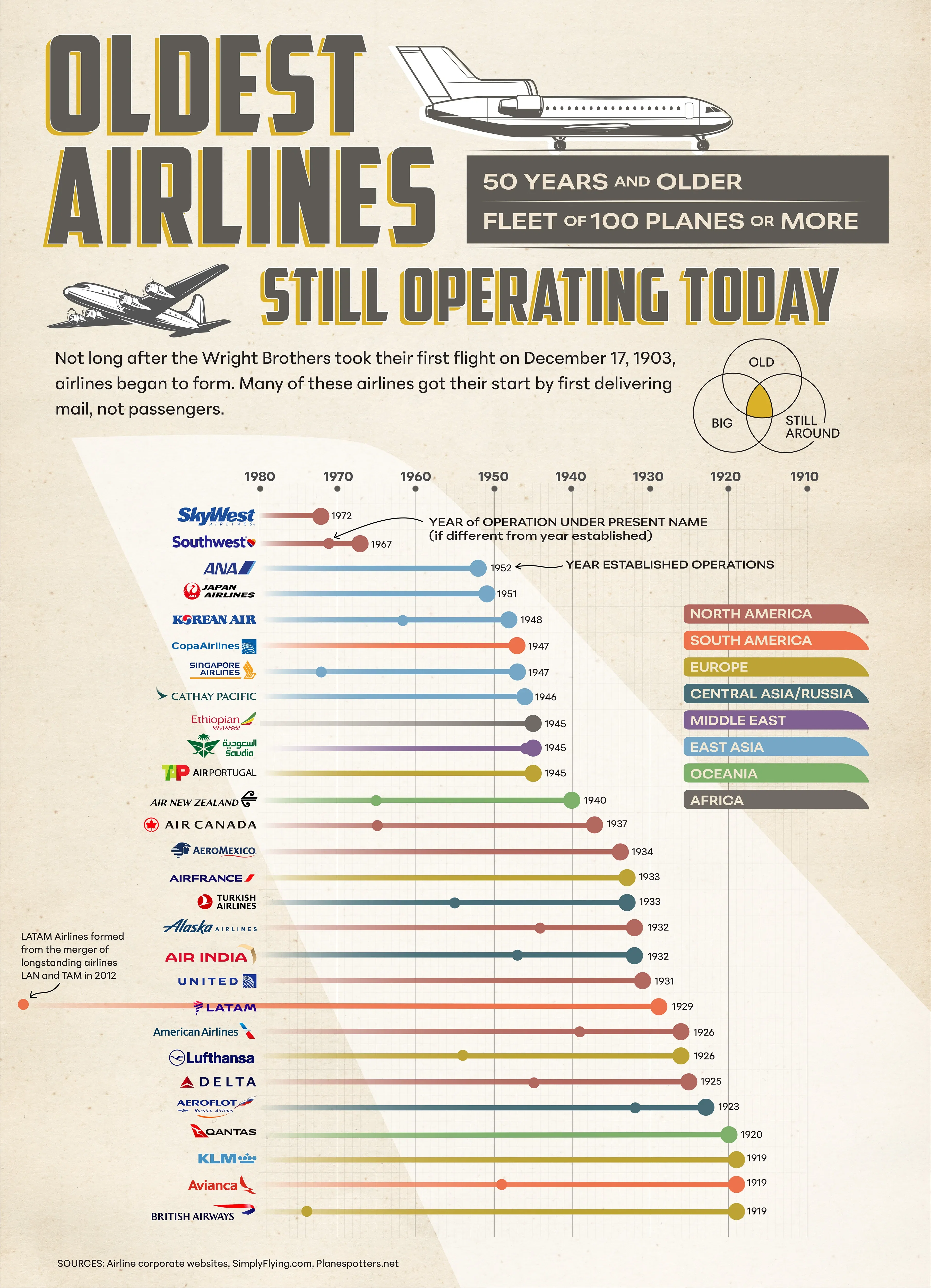
On August 25, 1919, Aircraft Transport and Travel Limited inaugurated the world's first daily international scheduled flight service between London (Hounslow Heath Aerodrome) and Paris (Le Bourget Airport). Utilizing a modified Airco DH.4A biplane, the flight carried a single passenger, newspapers, and leather goods. Simultaneously, continental European nations established their own state-sponsored or heavily subsidized carriers. Germany founded Deutsche Luft Reederei in 1919, while the Royal Dutch Airlines (KLM) began operations in 1919, securing its status as the world's oldest airline still operating under its original name. These early operations proved that air transport was technically feasible, though they relied entirely on government subsidies to offset high operating costs and low passenger capacities.
The Interwar Years: Metal Monoplanes, Flying Boats, and Route Expansion
Throughout the 1920s and 1930s, airline history shifted from makeshift military conversions to purpose-built commercial aircraft. The introduction of all-metal construction marked a major engineering turning point. Pioneers like Hugo Junkers in Germany championed the shift away from wooden frames and fabric coverings toward corrugated duralumin airframes, significantly increasing structural integrity and safety.
Simultaneously, the quest to connect vast colonial empires led to the development of long-range flying boats. British Imperial Airways and Pan American World Airways (Pan Am) utilized majestic flying boats—such as the Short Empire and the Boeing 314 Clipper—to pioneer transoceanic routes. Because land-based airports with adequate runways were scarce globally, flying boats could utilize natural water bodies for takeoff and landing, making them ideal for spanning the Atlantic and Pacific oceans, as well as reaching remote outposts across Africa and Asia.
Domestic aviation experienced a parallel revolution, particularly in the United States. The passage of the Air Mail Act of 1925 (the Kelly Act) authorized the U.S. Post Office to contract private carriers to fly mail, providing a reliable revenue stream that allowed fledgling airlines to stabilize financially. This policy directly enabled the consolidation of smaller operators into major legacy carriers, many of which would later dominate the global landscape.
The technical capstone of the interwar era was the introduction of the Douglas DC-3 in 1935. Featuring twin piston engines, variable-pitch propellers, and an aerodynamic all-metal monoplane design, the DC-3 revolutionized airline economics. For the first time, an aircraft could carry 21 passengers and operate profitably purely on passenger revenue without relying on mail contracts or government subsidies. It set the global standard for commercial transport and served as the backbone of airline fleets worldwide through World War II.
The Jet Age and Widebody Revolution
Following a hiatus imposed by World War II, during which global aviation capacity was diverted to military transport, the industry entered its most transformative technological epoch: the Jet Age. Piston-engine airliners like the Lockheed Constellation and Douglas DC-7 had pushed propeller technology to its absolute physical limits, constrained by high vibration, noise, and diminishing speed returns.
The transition to gas-turbine propulsion began with military applications, but civilian adaptation quickly followed. The British de Havilland Comet debuted in 1952 as the world's first commercial jetliner, dramatically cutting travel times. Although early operational challenges—specifically structural fatigue issues resulting from square cabin windows—temporarily grounded the type, it paved the way for more resilient designs.
The definitive breakthrough arrived in October 1958 when Pan Am inaugurated transatlantic jet service with the Boeing 707. Shortly thereafter, the Douglas DC-8 entered service. The Boeing 707 effectively halved travel times between continents, making intercontinental mass travel a reality and shifting the primary mode of long-distance international transit from ocean liners to aeroplanes. Airports had to be radically redesigned with longer runways, and air traffic control systems underwent rapid modernization to manage higher speeds and increasing flight volumes.
| Era / Aircraft | Key Innovation | Propulsion Type | Typical Passenger Capacity | Primary Impact on Aviation |
|---|---|---|---|---|
| Interwar (Douglas DC-3) | All-metal monoplane, profitable passenger transport | Twin Piston | 21–32 | Enabled airlines to operate without government mail subsidies. |
| Jet Age (Boeing 707) | High-speed intercontinental travel, swept-wing design | Four Turbojet / Turbofan | 140–189 | Halved intercontinental travel times; ended the dominance of ocean liners. |
| Widebody Era (Boeing 747) | Twin-aisle cabin, high-bypass turbofan efficiency | Four Turbofan | 350–500+ | Democratized long-haul travel by drastically lowering seat-mile costs. |
| Modern Era (Boeing 787 / Airbus A350) | Composite materials, ultra-long-range point-to-point routing | Twin Turbofan | 250–400 | Reduced fuel consumption and bypassed traditional hub airports. |
As passenger numbers surged through the 1960s, airspace and airport congestion became critical bottlenecks. The industry's response was the invention of the widebody airliner, featuring a twin-aisle cabin. The Boeing 747, which made its maiden commercial flight in January 1970, redefined capacity. Its massive scale lowered the cost per seat-mile, making international air travel accessible to a broader socioeconomic demographic. Concurrently, European manufacturers united to form Airbus, introducing the twin-engine A300, which established the dominance of widebody, twin-engine efficiency on medium-to-long haul routes.
Deregulation, Globalization, and the Rise of Low-Cost Carriers
For much of mid-20th-century airline history, commercial aviation operated as a heavily regulated, quasi-public utility in many parts of the world. In the United States, the Civil Aeronautics Board (CAB) strictly controlled route awards, scheduling, and passenger fares, virtually eliminating price competition among carriers. Similar protectionist regimes governed international routes through bilateral agreements and state-owned flag carriers.
This regulatory framework shifted dramatically with the passage of the U.S. Airline Deregulation Act of 1978. Spearheaded by economic deregulation advocates, the law stripped federal authorities of the power to control routes and pricing for domestic carriers. While initial years saw intense market turbulence, bankruptcies, and corporate consolidations, deregulation ultimately catalyzed a consumer-driven marketplace. Airlines introduced hub-and-spoke networks to maximize aircraft utilization and passenger feed into central airports.
Deregulation also laid the groundwork for the low-cost carrier (LCC) business model. Pioneered earlier by carriers like Southwest Airlines in the U.S. and later adopted globally by airlines such as Ryanair and EasyJet in Europe, the LCC model dismantled traditional frills. By utilizing a single aircraft family (typically the Boeing 737 or Airbus A320) to reduce maintenance and training costs, flying out of secondary, lower-cost airports, maximizing daily aircraft utilization, and stripping out complimentary meals and assigned seating, low-cost carriers offered radically lower fares. This forced legacy carriers to restructure their cost bases, unbundle ancillary fees, and adopt point-to-point routing where feasible.
Modern Fleet Innovations and Environmental Realities
Entering the 21st century, airline history has been increasingly defined by ecological imperatives, advanced digital distribution systems, and material science breakthroughs. The focus of aircraft manufacturing has shifted from raw speed to extreme fuel efficiency and reduced acoustic and carbon footprints.
The introduction of composite-intensive airframes—most notably the Boeing 787 Dreamliner and the Airbus A350—marked a departure from traditional aluminum alloys. Utilizing carbon-fiber-reinforced polymers allowed engineers to build lighter, stronger airframes capable of operating at higher cabin pressure altitudes with increased humidity, enhancing passenger comfort on ultra-long-haul routes exceeding 15 hours. Furthermore, advanced high-bypass turbofan engines, aerodynamic sharklets, and optimized wing designs have collectively reduced fuel consumption and carbon emissions per passenger-kilometer compared to previous generations of aircraft.
Concurrently, the distribution and operational backbones of airlines underwent a complete digital transformation. The transition from paper tickets to electronic ticketing (e-ticketing) in the mid-2000s, followed by the proliferation of Global Distribution Systems (GDS) and internet-based direct booking platforms, fundamentally altered how consumers interact with carriers. Today, airlines operate as complex logistics and data enterprises, utilizing dynamic pricing algorithms, sophisticated revenue management systems, and advanced yield optimization tools to navigate fluctuating fuel prices, geopolitical disruptions, and shifting global demand.
Frequently Asked Questions
What was the first commercial airline in the world?
The world's first scheduled commercial airline service using fixed-wing aircraft was inaugurated by Aircraft Transport and Travel Limited on August 25, 1919, operating between London and Paris. However, Royal Dutch Airlines (KLM), founded on October 7, 1919, holds the distinction of being the oldest airline in continuous operation under its original name.
When did the Jet Age begin in commercial aviation?
The Jet Age in commercial aviation began in October 1958 when Pan American World Airways introduced the Boeing 707 into scheduled service across the Atlantic Ocean. This milestone followed earlier pioneering efforts by the British de Havilland Comet in 1952, which faced temporary groundings due to structural engineering challenges.
How did the Airline Deregulation Act of 1978 change the industry?
The U.S. Airline Deregulation Act of 1978 abolished federal control over domestic airline routes, scheduling, and ticket pricing. This legislative shift introduced open market competition, led to the consolidation of major carriers, facilitated the development of hub-and-spoke networks, and ultimately enabled the rise of low-cost carriers that lowered fares for the general public.
Why was the introduction of the Boeing 747 significant?
The Boeing 747, introduced in 1970, was significant because it was the world's first widebody, twin-aisle commercial airliner. Its massive passenger capacity dramatically lowered the cost per seat-mile, effectively democratizing international travel and making long-haul flights financially accessible to millions of travelers.
What are the main characteristics of low-cost carriers?
Low-cost carriers operate with a simplified business model focused on minimizing operating expenses. Key characteristics include utilizing a single aircraft type to reduce training and maintenance costs, flying out of secondary airports with lower landing fees, maximizing daily aircraft turnaround times, and unbundling services by charging separately for baggage, seat selection, and onboard food.
Strategic Navigation of Aviation Heritage and Industry Analysis
To fully comprehend the mechanics of modern global mobility, industry analysts, aviation professionals, and researchers must examine how past regulatory frameworks and engineering breakthroughs continue to dictate contemporary route economics. When evaluating airline operational strategies or historical market trends, prioritize primary documents from regulatory bodies such as the International Civil Aviation Organization (ICAO) or national transport archives to ensure factual precision regarding aircraft certifications, route authorizations, and economic policy shifts.