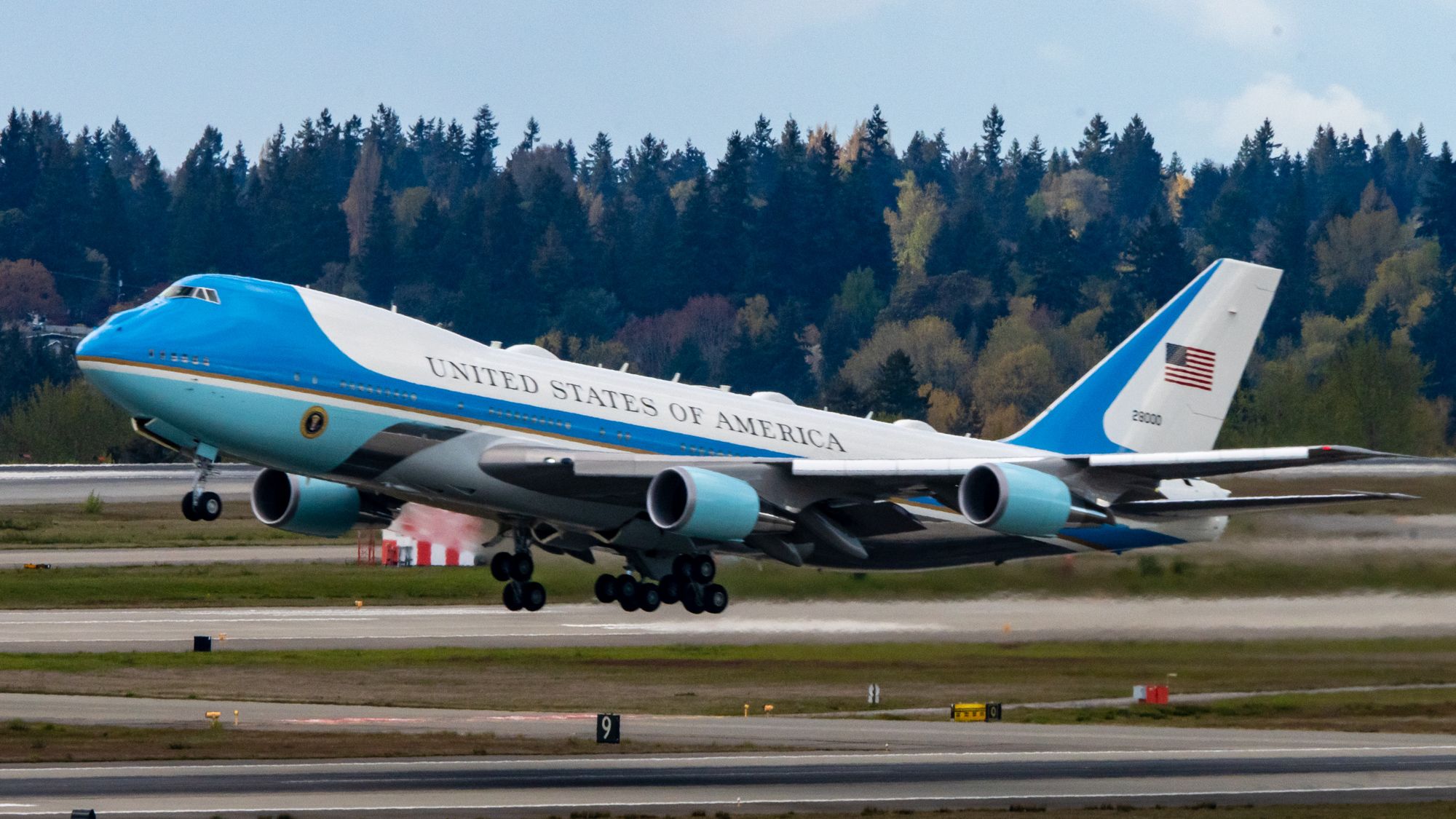
Air Force One is the official air traffic control call sign for any United States Air Force aircraft carrying the President of the United States. While the term technically applies to any USAF plane the President boards, it is most commonly associated with the two highly modified Boeing 747-200B series aircraft, designated as VC-25A, that serve as the primary long-haul presidential transport.
The Dual Identity: Call Sign vs. Airframe
To understand Air Force One, one must first distinguish between a specific physical aircraft and a military call sign. The "Air Force One" designation exists to ensure clear communication between pilots and air traffic controllers, prioritizing the safety and security of the Commander-in-Chief. If the President travels on a Marine Corps helicopter, the call sign changes to Marine One; on a civilian aircraft, it becomes Executive One.
Since the early 1990s, the primary aircraft serving this role have been two Boeing 747-200B airframes, tail numbers 28000 and 29000. These are not standard commercial jets. They are "flying oval offices," equipped with advanced defensive systems, secure communications, and the ability to function as a mobile command center during a national emergency. As of 2026, these iconic VC-25A models are nearing the end of their operational lifespan, with the transition to the new VC-25B (based on the Boeing 747-8) representing the most significant fleet modernization in three decades.
Engineering the VC-25A: The Flying White House
The current VC-25A fleet was commissioned during the Reagan administration and delivered during the George H.W. Bush administration. These aircraft are massive, three-level structures with 4,000 square feet of floor space. They are designed to withstand the electromagnetic pulse (EMP) generated by a nuclear blast, a feat achieved through miles of shielded wiring and specialized hardening of the onboard electronics.
Performance and Refueling
One of the most critical features of the VC-25A is its range. While its unrefueled range is approximately 7,800 miles, it is equipped for mid-air refueling, which theoretically allows it to stay airborne indefinitely. This capability is vital during a protracted crisis where landing might be unsafe. The aircraft is powered by four General Electric CF6-80C2B1 engines, which provide a top speed of Mach 0.92—nearly the speed of sound—making it one of the fastest passenger aircraft in the sky.
Security and Defensive Systems
The defensive suites of Air Force One are largely classified, but several components are publicly acknowledged by the U.S. Air Force. The aircraft is equipped with electronic countermeasure (ECM) suites to jam enemy radar. It also carries flares to divert heat-seeking missiles and chaff to confuse radar-guided projectiles. Every window on the aircraft is armored, and the hull is reinforced to handle pressure differentials beyond those of a standard commercial 747.
Inside the Aircraft: Layout and Capabilities
The interior of the VC-25A is meticulously organized to support both the President’s personal needs and the functional requirements of the U.S. government. The aircraft is divided into distinct zones to ensure that the President can work, sleep, and govern without interruption.
- The Presidential Suite: Located in the nose of the plane, this area includes a private office (the "Airborne Oval Office"), a lavatory, a shower, and a dressing room. It provides the President with total privacy and a space for sensitive meetings.
- The Medical Suite: Air Force One functions as a mobile hospital. It features a fully equipped medical room with a pharmacy, a surgical table, and a dedicated physician who travels on every flight. This ensures that the President can receive emergency care even while over the Atlantic or Pacific.
- The Communication Center: The upper deck houses the "nerve center" of the plane. It contains the most advanced secure and non-secure communication equipment in the world, including 85 onboard telephones, multi-frequency radios, and satellite links. This allows the President to address the nation or coordinate with military leaders from 45,000 feet.
- Staff and Press Areas: Behind the presidential suite, there is seating for senior advisors, Secret Service agents, and a small pool of journalists. The two galleys can serve up to 100 people at a time, with enough food storage to provide 2,000 meals during extended deployments.
The VC-25B Modernization Program (2026 Status)
As of 2026, the transition to the VC-25B program is the primary focus of presidential airlift logistics. This program replaces the aging VC-25A fleet with two modified Boeing 747-8 aircraft. The 747-8 is larger, faster, and more efficient than its predecessor, offering a longer range and significantly lower carbon emissions.
The VC-25B project, managed by Boeing, has faced several years of technical and budgetary challenges. According to the Government Accountability Office (GAO), the aircraft required extensive structural modifications to accommodate the presidential interior and defensive hardware. In 2026, these aircraft are in the final stages of flight testing and certification. The new fleet features an updated livery and even more robust communication systems designed to handle modern cybersecurity threats and data-heavy satellite transmissions.
| Feature | VC-25A (Current) | VC-25B (Incoming) |
|---|---|---|
| Base Model | Boeing 747-200B | Boeing 747-8 |
| Engines | 4x GE CF6-80C2B1 | 4x GE GEnx-2B67 |
| Length | 231 feet, 10 inches | 250 feet, 2 inches |
| Wingspan | 195 feet, 8 inches | 224 feet, 7 inches |
| Range (Unrefueled) | ~7,800 miles | ~8,900 miles |
| Passenger Capacity | 70 + Crew | ~71 + Crew |
| Floor Space | 4,000 sq. ft. | ~4,700 sq. ft. |
Logistics and the 89th Airlift Wing
The operation of Air Force One is the responsibility of the Presidential Airlift Group, part of the 89th Airlift Wing at Joint Base Andrews, Maryland. This wing is renowned for its "SAM" (Special Air Mission) flights. Maintaining Air Force One is a 24/7 operation; the aircraft are kept in a constant state of readiness in a high-security hangar.
Before every flight, the Air Force sends an advance team with C-17 Globemaster III transport planes. These planes carry the Presidential motorcade—including "The Beast," the President's armored limousine—as well as specialized equipment and personnel. The coordination between the White House Military Office, the Secret Service, and the 89th Airlift Wing ensures that the President has a seamless transition from the ground to the air, regardless of the destination.
Historical Evolution of Presidential Flight
The concept of a dedicated presidential aircraft began in the 1940s. Before the current Boeing era, several historic aircraft served as the flagship for U.S. presidents:
- The Sacred Cow (C-54 Skymaster): Used by Franklin D. Roosevelt and Harry S. Truman, this aircraft featured the first presidential elevator to accommodate FDR’s wheelchair.
- The Independence (C-118 Liftmaster): Named after President Truman’s hometown, it featured a distinctive eagle paint scheme.
- The Columbine II and III (Lockheed Constellations): Used by Dwight D. Eisenhower, these were the first to officially use the "Air Force One" call sign after a near-collision with a commercial flight using the same tail number.
- SAM 26000 and 27000 (Boeing 707): These jets ushered in the jet age for presidential travel. SAM 26000 is perhaps the most famous, as it was the plane that carried John F. Kennedy to Dallas and returned his body to Washington, D.C., with Lyndon B. Johnson taking the oath of office on board.
What happens when the President is on board?
The moment the President steps onto the aircraft, the crew’s priority shifts to "Special Air Mission 1." The aircraft is always accompanied by a backup plane and often escorted by fighter jets during high-risk international travel. Ground crews at the destination airport are vetted, and the runway is swept for debris to ensure a perfect landing.
Why is the call sign changed?
The call sign is a functional safety tool. If the President is not on board, the aircraft uses its tail number (e.g., "SAM 28000"). If the Vice President is the highest-ranking official on board, the call sign becomes Air Force Two. This system ensures that all ground controllers and nearby aircraft are aware of the VIP status of the flight, allowing for prioritized routing and enhanced security cordons.
How much does it cost to operate Air Force One?
Operating the VC-25A is an expensive endeavor. Estimates from the Department of Defense suggest the cost is approximately $200,000 per flight hour. This figure includes fuel, maintenance, flight crew salaries, and the immense overhead of the specialized communication and security systems. While the cost is high, the aircraft is viewed as a necessary tool for national security and global diplomacy.
Can the public visit an Air Force One aircraft?
Yes, several retired presidential aircraft are on public display. SAM 26000, the Boeing 707 used by JFK and LBJ, is a centerpiece at the National Museum of the U.S. Air Force in Dayton, Ohio. Another retired 707 (SAM 27000) is housed at the Ronald Reagan Presidential Library in Simi Valley, California. These exhibits allow the public to see the transition from mid-century executive travel to the modern era of the "Flying White House."
What is the significance of the livery?
The iconic blue-and-white paint scheme was designed by industrial designer Raymond Loewy at the request of President John F. Kennedy. Loewy wanted a look that was both modern and representative of the American spirit, moving away from the military-standard silver or orange designs of the time. The 2026 VC-25B fleet maintains a variation of this classic aesthetic, preserving a visual symbol that is recognized worldwide as a sign of American presence.
Looking Ahead: Ensuring Seamless Continuity
As the VC-25B enters full service in the latter half of the 2020s, the focus shifts to ensuring that the technology on board remains resilient against evolving threats. In an era of increased cyber warfare and satellite-jamming capabilities, the next generation of Air Force One is more than just a luxurious transport; it is a hardened node in the nation's defense network.
For those interested in the future of aviation or the logistics of the executive branch, monitoring the final delivery phases of the VC-25B provides a window into the intersection of aerospace engineering and geopolitical strategy. The aircraft remains the ultimate symbol of the American presidency—a mobile fortress that ensures the continuity of government, no matter where in the world the President may be.