The internal layout of Air Force One is designed to function as a mobile White House, providing the President of the United States with 4,000 square feet of floor space across three distinct levels. This specialized configuration includes a presidential suite, a medical operating room, a secure communications center, and specialized defensive equipment.
Technically referred to as the VC-25A—a heavily modified Boeing 747-200B—Air Force One is perhaps the most recognizable aircraft in the world. As of 2026, while the transition to the newer VC-25B (based on the Boeing 747-8i) continues, the classic VC-25A remains the benchmark for airborne command and control. Understanding the layout requires a vertical analysis of its three decks, each serving a specific logistical, administrative, or defensive purpose.
The Three-Level Vertical Architecture
Unlike a commercial Boeing 747, which typically uses the lower lobe for luggage and the upper decks for passengers, Air Force One utilizes every cubic inch of its interior for mission-critical operations. The aircraft is divided into the Lower Deck (the "basement" for logistics), the Middle Deck (the primary passenger and office space), and the Upper Deck (the flight deck and communications hub).
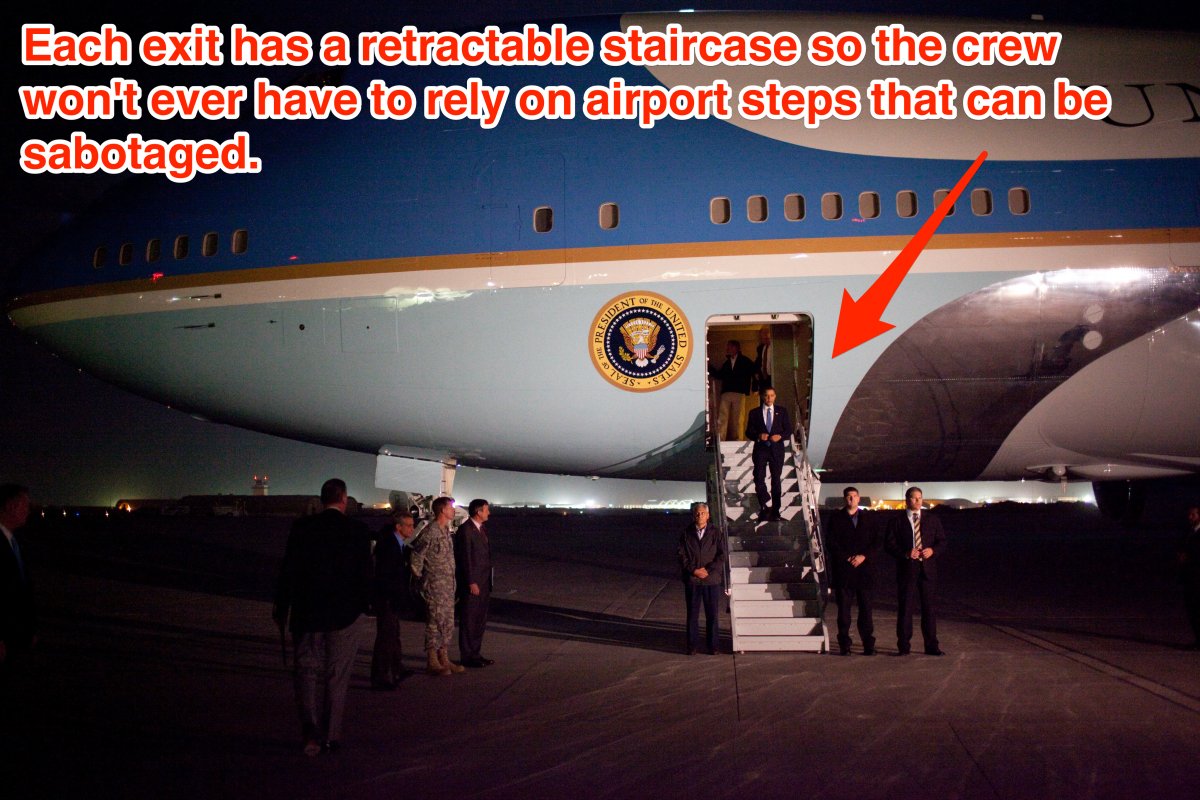
This vertical separation ensures that high-traffic areas, such as the press cabin and staff seating, do not interfere with the confidential operations occurring in the forward sections of the plane. The plane is equipped with its own retractable stairways, both at the front and rear, allowing it to remain independent of airport ground equipment, which is a vital security feature when landing in volatile or under-developed regions.
The Lower Deck: Logistics, Galleys, and Survival
The lowest level of the aircraft serves as the foundation for the plane’s self-sufficiency. In a standard commercial flight, this area would be filled with cargo containers. On Air Force One, it houses the machinery and supplies necessary for the aircraft to operate as a standalone fortress for extended periods.
Specialized Galleys and Food Preparation
One of the most impressive features of the lower deck is the pair of massive galleys. These are capable of providing up to 2,000 meals during a single mission. Because the President may be in the air for days during a national emergency, the plane must carry a vast amount of food. The galleys are staffed by military personnel who follow strict security protocols to prevent tampering.
The Cargo Lobe and Self-Sufficiency
The lower deck also contains the aircraft’s specialized baggage-loading system. To ensure security, the crew does not rely on local airport baggage handlers. Instead, the plane carries its own loaders. Additionally, this level houses the internal stairs that lead up to the middle deck, providing a secondary point of entry and exit for the President and staff.
The Middle Deck: The "White House in the Sky"
The middle deck is the heart of the aircraft. This is where the President, senior advisors, guests, and the press corps spend the majority of their time. The layout is arranged from front to back, moving from the most private areas to the more public seating.
The Presidential Suite (The Forward Cabin)
Located in the very nose of the plane—directly under the cockpit—is the Presidential Suite. This area is remarkably quiet because it is located forward of the engines. It includes:
- The Stateroom: A private cabin featuring two twin beds that can be converted into a couch, providing the President with a place to rest.
- The Private Lavatory: Equipped with a shower and a vanity, a luxury rarely found on aircraft of this vintage.
- The Presidential Office: Often referred to as the "Oval Office of the Air," this room is where the President conducts business and addresses the nation via secure video link.
The Conference and Dining Room
Moving toward the rear from the President's office, you find the large conference room. This space features a massive table and leather seating, serving as the primary meeting spot for the National Security Council and senior staff. It also doubles as the President’s dining room. The walls are often adorned with screens displaying real-time flight data and secure news feeds.
The Medical Suite
Situated mid-ship, the medical suite is a fully functional mini-hospital. It is staffed by a dedicated physician and nurse on every flight. The suite contains a fold-down operating table, a pharmacy, and a wide array of emergency medical supplies. It is designed to handle everything from minor illnesses to emergency surgery, ensuring the President has immediate access to life-saving care without needing to land.
Staff and Guest Seating
The aft (rear) portion of the middle deck contains seating for various groups. There is a dedicated section for the Secret Service, senior staff members, and a separate cabin for the traveling press corps. While the press cabin resembles a high-end first-class section of a commercial airline, the staff areas are designed more like functional office cubicles to facilitate work during long-haul flights.
The Upper Deck: The Brain of the Aircraft
The upper deck is the most restricted area of the plane. While the middle deck handles the people, the upper deck handles the flight and the data.
The Flight Deck (Cockpit)
The cockpit is located at the front of the upper deck. It is operated by a highly trained Air Force crew, usually consisting of a pilot, co-pilot, flight engineer, and navigator. The controls have been upgraded significantly over the years to include modern avionics, despite the airframe's age.
The Communications Center
Behind the cockpit lies the communications hub. Air Force One is equipped with 85 onboard telephones, multi-frequency radios, and secure satellite links. This area allows the President to command the U.S. military, including the nuclear arsenal, from anywhere in the sky. The wiring on this deck is specially shielded to protect against the Electromagnetic Pulse (EMP) generated by a nuclear blast, a feature that differentiates it from almost any other aircraft in existence.
Specialized Pods and Defensive Systems
While the interior layout focuses on comfort and command, the exterior and the "skin" of the aircraft house specialized pods and defensive arrays. These systems are largely classified, but several key components are known to exist.
- Electronic Countermeasures (ECM) Pods: Located on the wingtips and the tail, these pods house sensors that can jam enemy radar and misdirect incoming surface-to-air missiles.
- Infrared Countermeasures: These systems use pulsed light to "blind" heat-seeking missiles.
- Chaff and Flare Dispensers: Hidden in the fuselage, these can be deployed to create a cloud of metal (chaff) to confuse radar or high-heat flares to lure away heat-seeking projectiles.
- In-Flight Refueling Probe: A prominent "bump" on the nose of the VC-25A allows the plane to take on fuel from a tanker while in flight, theoretically allowing it to stay airborne indefinitely during a crisis.
Technical Specifications: VC-25A vs. Standard 747-200
| Feature | VC-25A (Air Force One) | Standard Boeing 747-200 |
|---|---|---|
| Floor Space | 4,000 sq. ft. | ~3,500 sq. ft. (variable) |
| Passenger Capacity | 70 (plus 26 crew) | Up to 400+ |
| Communications | Secure Satellite, EMP Shielded | Standard VHF/UHF |
| Refueling | Aerial Refueling Capable | Ground Refueling Only |
| Defensive Systems | Jamming, Flares, Chaff | None |
| Medical Facilities | Full Surgical Suite | First Aid Only |
| Wiring | 238 miles (Shielded) | ~150 miles (Standard) |
Operational Realities: Security and Maintenance
Maintaining the complex layout of Air Force One is a monumental task. The aircraft are housed at Joint Base Andrews in Maryland and are maintained by the 89th Airlift Wing. Every piece of equipment, from the engines to the coffee makers in the galley, is subjected to rigorous security sweeps.
The layout is not static; it undergoes regular "depot-level" maintenance where the interior is often stripped and inspected for structural integrity and security breaches. Because the plane is a military asset, its layout is optimized for "survivability." This means the pods and decks are arranged so that critical systems have redundancies. For example, the communications center can be powered by multiple independent generators, ensuring that the President never loses contact with the Pentagon.
Why is the layout designed this way?
The primary driver behind the layout is continuity of government. In the event of an attack on Washington D.C., the layout allows the President to function with the same efficiency as if they were in the West Wing. The pods provide the defense, the lower deck provides the sustenance, the middle deck provides the office space, and the upper deck provides the control.
FAQ
Where does the President sleep on Air Force One?
The President sleeps in the stateroom located in the forward-most section of the middle deck, directly under the cockpit. This area includes twin beds, a private bathroom, and a shower, providing maximum privacy and quiet, as it is far from the engines and other passenger cabins.
Is there a "Situation Room" on the plane?
While there isn't a room officially named the "Situation Room," the large conference room on the middle deck serves this purpose. It is equipped with secure video conferencing technology and data links that allow the President to receive classified briefings and coordinate with military leaders in real-time.
Can Air Force One really survive a nuclear blast?
The plane is designed to survive the secondary effects of a nuclear explosion, specifically the Electromagnetic Pulse (EMP). The 238 miles of onboard wiring are heavily shielded to ensure the electronics do not fry. However, the plane's ability to survive the physical blast depends on its distance from the detonation, much like any other aircraft.
How many galleys are on the plane?
There are two main galleys located on the lower deck. These are high-capacity kitchens staffed by military personnel who can prepare up to 2,000 meals. This allows the plane to be fully self-sufficient for long-duration missions without needing to restock at every stop.
Experience the Layout: Public Access and Education
For those interested in seeing the layout firsthand, the most practical step is visiting the National Museum of the United States Air Force in Dayton, Ohio. While the current VC-25A models (SAM 28000 and 29000) are still in service as of 2026, the museum houses several predecessor "Air Force One" aircraft, including the SAM 26000 (a Boeing 707 used by Kennedy and Johnson).
Walking through these retired aircraft provides an excellent sense of how the "pod and deck" philosophy evolved. To stay updated on the transition to the newer VC-25B layout, monitor official U.S. Air Force Fact Sheets, which provide the most accurate, declassified data regarding the fleet’s configuration and defensive capabilities.