Aerial firefighting is a specialized branch of wildland fire suppression that utilizes aircraft to deliver suppressants and retardants, transport crews, and provide reconnaissance. It serves as a critical support mechanism for ground forces, aiming to slow fire progression and protect high-value assets through coordinated air-to-ground tactical maneuvers.
The Strategic Role of Aerial Firefighting in Wildfire Management
Aerial firefighting is often misunderstood as a standalone solution for extinguishing massive wildfires. In reality, it functions as a strategic support tool designed to assist ground-based firefighters. The primary objective of an air attack is not necessarily to "put the fire out" from the sky, but to reduce the fire’s intensity and rate of spread, allowing ground crews to move in and establish containment lines safely.
As of 2026, the integration of aerial assets follows a strict "Initial Attack" philosophy. When a fire is small, the rapid deployment of aircraft can prevent a localized spark from becoming a mega-fire. If the fire escapes initial containment, aerial assets transition to "Extended Attack," where they focus on protecting structures (the Wildland-Urban Interface), creating secondary fuel breaks, and cooling "hot spots" that threaten to jump established lines.
The effectiveness of these operations depends on the "drop." Pilots must account for wind drift, terrain slope, and the "canopy effect," where thick foliage prevents liquids from reaching the forest floor. By 2026, the use of advanced telemetry and real-time atmospheric sensing has improved drop accuracy, yet the fundamental principle remains: air assets win battles, but ground crews win the war against the fire.
Classification and Capabilities of Firefighting Aircraft
The aerial firefighting fleet is diverse, ranging from small, agile planes to converted commercial airliners. The National Interagency Fire Center (NIFC) and international bodies categorize these assets based on their tank capacity and operational role.
Single Engine Air Tankers (SEATs)
SEATs, such as the Air Tractor AT-802F, are the "first responders" of the sky. These aircraft are capable of operating from small, remote airstrips and even dirt roads. They typically carry around 800 gallons of retardant. Their primary advantage is maneuverability in tight canyons and the ability to provide rapid turnaround times in rural areas where larger tankers cannot land.
Large Air Tankers (LATs) and Very Large Air Tankers (VLATs)
LATs, including the RJ85 and C-130 Hercules, carry between 2,000 and 4,000 gallons. These are the workhorses of the mid-range fire front. VLATs, such as the McDonnell Douglas DC-10, carry upwards of 9,000 to 11,000 gallons. These massive aircraft are used to lay long "lines" of retardant ahead of the fire’s path. While they are highly effective for large-scale containment, they require massive turning radii and are restricted to major airports with specialized loading pits.
Water Scoopers
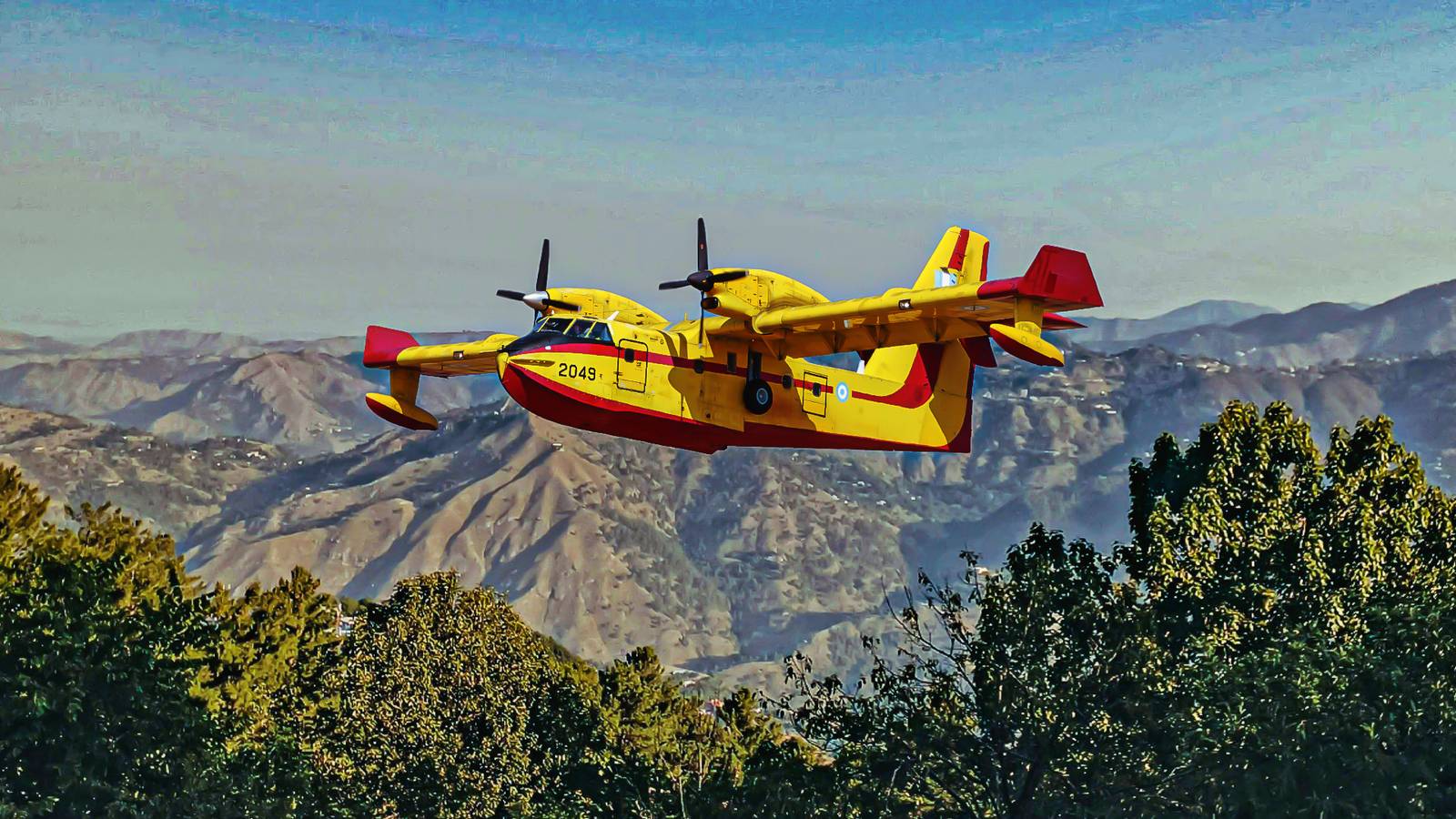
Aircraft like the Canadair CL-415 are unique because they do not need to return to a base to refill. They skim the surface of lakes or reservoirs, scooping up to 1,600 gallons of water in seconds. This allows for a high "drop frequency" if a suitable body of water is located near the fire.
Rotorcraft: Helitankers and Buckets
Helicopters offer precision that fixed-wing aircraft cannot match. Type 1 helicopters (Heavy), such as the Sikorsky S-64 Skycrane, can carry up to 2,600 gallons via a snorkel or a suspended bucket. They are essential for precision drops on specific structures or localized flare-ups.
| Aircraft Type | Typical Model | Payload Capacity (Gallons) | Primary Strength |
|---|---|---|---|
| SEAT | Air Tractor AT-802F | 800 | Maneuverability; remote access |
| LAT | BAE 146 / RJ85 | 2,000 – 4,000 | Versatility; speed to incident |
| VLAT | McDonnell Douglas DC-10 | 9,400+ | Long-range containment lines |
| Scooper | Canadair CL-415 | 1,600 | High-frequency drops near water |
| Type 1 Heli | Sikorsky S-64 (Skycrane) | 2,600 | Precision; hovering capability |
Suppressant Agents: Retardants, Water, and Enhancers
The substances dropped from aircraft are specifically engineered for different fire behaviors. Understanding the distinction between a "suppressant" and a "retardant" is vital for operational efficiency.
Long-Term Fire Retardants are typically ammonium polyphosphate-based chemicals, often colored with a red iron oxide dye. This dye allows pilots to see where previous drops were made, ensuring a continuous line of protection. Unlike water, retardants are effective even after the moisture has evaporated. They work by altering the combustion process of the fuel (trees and brush), making it chemically resistant to ignition. In 2026, newer "clear" retardants are increasingly used in sensitive urban areas to prevent staining, though the red "Phos-Chek" remains the industry standard for wildland use.
Water and Foams are considered short-term suppressants. Water cools the fire and smothers the flame, but its effect is lost once it evaporates. To increase efficiency, "Class A Foam" or "Water Enhancers" (gels) are added. These additives break the surface tension of the water, allowing it to penetrate deep into the fuel bed rather than just running off. Gels are particularly useful because they create a thick thermal barrier that stays "wet" significantly longer than plain water.
Operational Dynamics: The Hierarchy of Airspace Control
The airspace above a wildfire is one of the most complex and dangerous environments in aviation. To prevent mid-air collisions and ensure effective drops, a strict command hierarchy is established, known as the Incident Command System (ICS).
- Air Attack (ATGS): The Air Tactical Group Supervisor flies in a high-orbit "Bird Dog" or reconnaissance aircraft. They are the "air traffic controller" for the fire, coordinating which tankers drop where and when.
- Lead Planes and ASMs: For LATs and VLATs, a Lead Plane (or Aerial Supervision Module) often flies directly in front of the tanker. The Lead Plane pilot "marks" the start and end of the drop with smoke or by physical positioning, guiding the heavy tanker through difficult terrain and turbulence.
- The Drop Sequence: A typical drop involves the tanker descending to a "drop height" (usually 150 to 300 feet above the vegetation). The pilot or flight engineer operates the tank doors to control the "coverage level"—the thickness of the retardant coating on the ground.
By 2026, many of these coordination tasks are augmented by ADS-B (Automatic Dependent Surveillance-Broadcast) technology, allowing all pilots to see the exact position and altitude of other assets on their cockpit displays, even in heavy smoke.
Technological Integration: UAS and Night Operations in 2026
The year 2026 marks a significant turning point in the use of Unmanned Aircraft Systems (UAS), commonly known as drones. Historically, aerial firefighting was limited to daylight hours because of the extreme risk of flying low-altitude missions in mountainous terrain with zero visibility.
Drones have revolutionized this by enabling 24/7 monitoring. Equipped with Long-Wave Infrared (LWIR) sensors, drones can peer through thick smoke that would blind a human pilot. They map the fire’s perimeter in real-time, sending data to ground commanders who can then reposition crews overnight. Furthermore, 2026 has seen the rollout of "Cargo UAS" capable of delivering supplies to trapped crews or performing small-scale chemical drops in areas too dangerous for manned flight.
Night flying for manned helicopters has also expanded. Using Night Vision Goggles (NVG) and high-definition thermal imaging, specialized "Night Attack" programs (like those pioneered by CAL FIRE) allow helicopters to drop water on fires when temperatures are lower and humidity is higher, which is often the most effective time to stop a fire's momentum.
The Economic and Logistical Realities of Aerial Assets
Aerial firefighting is an expensive endeavor. The cost is divided into two main categories: Availability (the "standby" cost of having the aircraft and crew ready) and Flight Hours (the cost of fuel, retardant, and maintenance while in the air).
As of 2026, the daily availability rate for a Large Air Tanker can range from $30,000 to $50,000, while the hourly flight rate can exceed $10,000. A single "load" of retardant for a VLAT can cost upwards of $60,000. These high costs necessitate a "value-based" deployment strategy. Incident Commanders must constantly evaluate whether the "probability of success" justifies the massive expenditure.
Logistically, the "Air Tanker Base" serves as the hub. These bases must be equipped with high-capacity pumps, massive storage tanks for retardant concentrate, and specialized crews that can "hot-load" an aircraft (refilling the tanks while the engines are still running) to minimize turnaround time.
Frequently Asked Questions
Can airplanes put out a wildfire completely without ground crews?
No. Aerial assets are rarely capable of fully extinguishing a wildland fire. Their role is to support ground crews by cooling the fire and creating retardant lines. Without ground crews to "mop up" (extinguish embers and dig mineral soil lines), the fire will eventually burn through or jump over the aerial drops once the moisture evaporates or the wind shifts.
Why do firefighting planes sometimes drop red liquid?
The red liquid is a long-term fire retardant, typically a mixture of water and ammonium phosphate. The red color comes from iron oxide (clay) or food-grade dye, which is added so that pilots and ground crews can see exactly where the retardant has landed. This visibility is crucial for building a continuous "line" of protection without leaving gaps.
What happens to the aircraft during the winter or off-season?
During the "off-season," many firefighting aircraft undergo heavy maintenance and inspections. Some aircraft are "multi-role" and return to cargo hauling or military duties. However, with the emergence of year-round fire seasons in 2026, many agencies now utilize "Exclusive Use" contracts that keep a core fleet ready for deployment regardless of the month.
Are drones a threat to firefighting aircraft?
Yes. Unauthorized civilian drones are a major safety hazard. When a "rogue" drone is spotted near a fire, all firefighting aircraft must be grounded immediately to avoid a collision. This can lead to a fire growing out of control. However, "authorized" agency drones are fully integrated into the communication system and are used safely for reconnaissance and mapping.
How do pilots deal with the heavy smoke and turbulence?
Firefighting pilots are some of the most skilled in the aviation world. They utilize a combination of Lead Plane guidance, specialized cockpit instruments, and extensive training in low-level maneuvering. Turbulence is a constant factor caused by the heat of the fire (updrafts) and the surrounding terrain, requiring aircraft with high structural integrity and powerful engines.
Future Recommendations for Fire Management Stakeholders
To maximize the efficacy of aerial firefighting in 2026 and beyond, stakeholders should prioritize Interoperability. This means ensuring that local, state, and federal agencies use the same radio frequencies, retardant specifications, and digital mapping platforms.
For property owners in high-risk areas, the best "next action" is to focus on Defensible Space. Aerial firefighting is most effective when it is defending a property that has already been prepared by removing excess brush and flammable materials. Aircraft can provide a "shield" of retardant, but if the fire is fueled by thick vegetation touching the home, even the most precise drop may fail to save the structure. Investing in automated rooftop sprinkler systems that use fire-blocking gels is another proactive step that complements regional aerial suppression efforts.