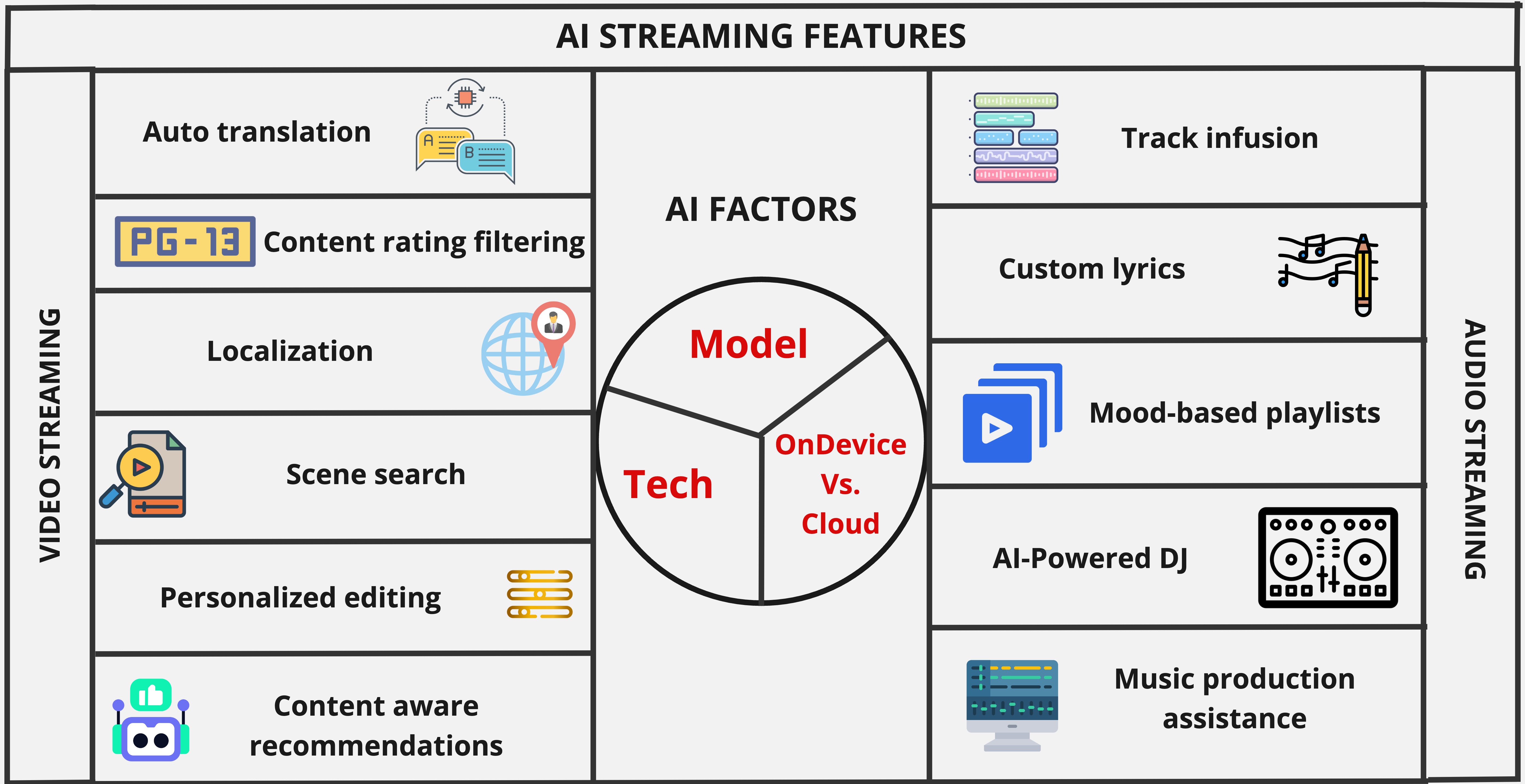
Artificial intelligence powers music streaming by analyzing vast libraries of audio data, user listening histories, and contextual signals to deliver hyper-personalized recommendations, dynamic playlist generation, and advanced audio processing. Platforms leverage machine learning models to predict user preferences, manage rights management workflows, and optimize streaming delivery at scale.
The Architectural Foundation of AI-Driven Audio Platforms
Modern music streaming platforms process petabytes of unstructured audio data and billions of user interaction events daily. To handle this computational load, streaming infrastructure relies on a blend of collaborative filtering, content-based filtering, and deep neural networks. These models do not merely categorize music by genre or artist; they deconstruct songs into thousands of distinct acoustic dimensions, including tempo, key, timbre, vocal presence, and harmonic structure.
Collaborative filtering examines patterns across millions of user accounts to identify behavioral similarities. If User A and User B share heavy overlap in their listening histories, the recommendation engine predicts that User A will likely enjoy tracks already saved or played by User B.
However, collaborative filtering suffers from the cold-start problem: newly uploaded tracks have no historical interaction data. To bridge this gap, platforms deploy content-based filtering and deep audio embeddings.
Convolutional neural networks (CNNs) analyze raw spectrograms or compressed audio files directly, mapping sonic characteristics into high-dimensional vector spaces. A newly released indie track with atmospheric reverb and a slow tempo is positioned close to established ambient tracks in the vector space, allowing the recommendation engine to surface it immediately to receptive listeners.
Personalization Algorithms and Dynamic Discovery
Personalization forms the core of user retention in contemporary streaming services. Recommendation engines synthesize explicit signals, such as user-generated playlists, likes, and follows, with implicit signals, including skip rates, completion rates, time of day, and repeat listens.
When a listener hits play on a daily mix or algorithmic discovery station, the system executes real-time inference. It evaluates the user's current session context against historical preferences to sequence tracks that balance familiarity with novelty.
Dynamic discovery relies heavily on reinforcement learning. The algorithm treats track selection as an ongoing experiment: it occasionally introduces a track outside the user's established comfort zone to measure engagement. If the user listens through to completion, the system updates its policy to favor similar recommendations. If the user skips immediately, the penalty discourages similar pairings for that user profile.
This feedback loop underpins features like personalized daily mixes, automated weekly discovery feeds, and infinite playback radio stations. Behind these interfaces, vector databases perform approximate nearest neighbor (ANN) searches across billions of embeddings in milliseconds, ensuring zero perceptible latency during playback transitions.
Audio Processing and Quality Optimization
Beyond recommendations, artificial intelligence transforms how audio is encoded, transmitted, and rendered on consumer devices. Streaming services must deliver consistent audio quality across diverse network conditions and hardware setups, ranging from high-end studio headphones to budget smartphone speakers.
Machine learning models assist in perceptual audio coding by optimizing compression ratios without sacrificing perceived fidelity. By simulating human auditory masking—where loud sounds obscure quieter simultaneous frequencies—AI-driven codecs allocate bitrate dynamically to the most critical psychoacoustic elements of a track.
Furthermore, generative AI and deep learning models facilitate audio separation and remastering. Source separation algorithms can isolate vocals, basslines, percussion, and melodic instruments from a fully mixed stereo track.
This capability powers features such as real-time instrumental extraction for karaoke modes, dynamic spatial audio upmixing, and automated master quality verification that flags clipping, phase issues, or frequency imbalances before a track goes live on the platform.
| AI Application | Core Technology | Primary Function | Business & User Impact |
|---|---|---|---|
| Collaborative Filtering | Matrix Factorization / KNN | Behavioral pattern matching across user bases | Drives core playlist generation and peer recommendations |
| Content-Based Analysis | Convolutional Neural Networks | Direct audio feature extraction from waveforms | Solves the cold-start problem for newly released tracks |
| Contextual Delivery | Reinforcement Learning | Real-time session adaptation and pacing | Balances musical discovery with familiar listening habits |
| Audio Compression | Perceptual ML Codecs | Dynamic bitrate allocation and bandwidth optimization | Ensures seamless streaming under poor network conditions |
| Source Separation | Deep Neural Networks | Isolating stems (vocals, drums, bass) from mixes | Powers karaoke modes, spatial audio, and remastering |
Copyright, Licensing, and Synthetic Audio Challenges
The rapid advancement of generative AI introduces complex regulatory, legal, and operational challenges for music streaming platforms. Generative models trained on copyrighted catalogs can produce stylistically identical sound-alikes or incorporate unauthorized vocal models, triggering intense disputes over intellectual property rights and royalty distribution.
Streaming platforms face the dual task of protecting rightsholders while integrating legitimate AI tools. Automated fingerprinting and content recognition systems now scan incoming uploads not only for exact audio matches but also for stylistic signatures and synthetic voice cloning markers.
When synthetic tracks or AI-generated covers slip past initial filters, rights organizations and major labels demand rapid takedown protocols and revenue-sharing frameworks.
Simultaneously, royalty calculation engines use machine learning to detect fraudulent streaming activity, such as bot-driven artificial stream inflation. By analyzing listening velocity, user session continuity, and device fingerprint clustering, platforms identify and filter out fraudulent plays before calculating payouts, ensuring legitimate artists receive accurate compensation.
Optimizing Your Experience with AI Music Discovery
Navigating AI-driven music platforms effectively requires understanding how user actions shape algorithmic behavior. Listeners can deliberately train and refine their recommendation models by applying specific practices to their daily listening habits.
- Explicit Feedback Utilization: Consistently use the like, dislike, and hide buttons. Negative signals carry significant weight in retraining recommendation weights.
- Contextual Session Management: Use private listening sessions or dedicated profile features when playing background noise, sleep tracks, or music intended for a different demographic to prevent polluting your primary recommendation vector.
- Curated Playlist Seeding: Add discovered tracks to personal playlists rather than just saving albums. This signals strong affinity to the model, reinforcing related artist suggestions.
- Regular Profile Auditing: Periodically review listening history summaries provided by streaming apps to identify and remove algorithmic drift caused by passive listening sessions.
Frequently Asked Questions
How do music streaming services use AI for recommendations?
Streaming services combine collaborative filtering, which analyzes behavioral overlaps between millions of users, with content-based deep learning models that evaluate the acoustic properties of audio files. These systems evaluate your listening history, skip rates, and contextual signals like time of day to predict and serve tracks tailored to your immediate preferences.
Can AI generate entire songs for streaming platforms?
Yes, generative AI models can produce fully structured musical compositions, including instrumentation, vocals, and lyrics, from text prompts or reference inputs. While some platforms host AI-generated tracks, major distributors and streaming services enforce strict guidelines regarding copyright infringement, metadata labeling, and synthetic voice cloning.
Why do my daily music recommendations sometimes get stuck in a loop?
Recommendation loops occur when reinforcement learning models overfit to recent listening behavior. If you repeat a small cluster of tracks or artists over several days, the algorithm interprets this as a strong preference and narrows its discovery parameters, temporarily starving out exploratory recommendations until your listening habits diversify.
How does AI prevent fraudulent streaming and bot inflation?
Platforms deploy anomaly detection algorithms that monitor listening velocity, user account characteristics, and device fingerprints in real time. When automated scripts or bot networks artificially inflate play counts for specific tracks, the system flags and removes those plays from royalty calculation models.
Will AI replace human curators on streaming platforms?
AI will not entirely replace human curators, as editorial playlists curated by industry experts provide vital cultural context, trend forecasting, and human storytelling that purely mathematical models cannot replicate. Instead, human curation and AI recommendations operate in a hybrid model, where algorithms handle personalization at scale while human editors drive cultural moments.
Next Actions for Creators and Industry Professionals
Music creators, publishers, and rights administrators operating within the AI-driven streaming ecosystem must proactively adapt their distribution strategies. Ensure all audio assets are registered with comprehensive metadata, proper International Standard Recording Code (ISRC) tagging, and authorized digital fingerprinting registries.
Monitor platform updates regarding synthetic audio policies and maintain direct communication channels with digital service providers (DSPs) to audit and verify algorithmic distribution performance across global territories.