AI infrastructure encompasses the specialized hardware, software frameworks, networking fabrics, and data storage systems required to train, deploy, and scale machine learning models. Successfully scaling artificial intelligence workloads demands a cohesive architecture that bridges raw compute power with high-throughput data pipelines.
Defining the Core Components of Modern AI Infrastructure
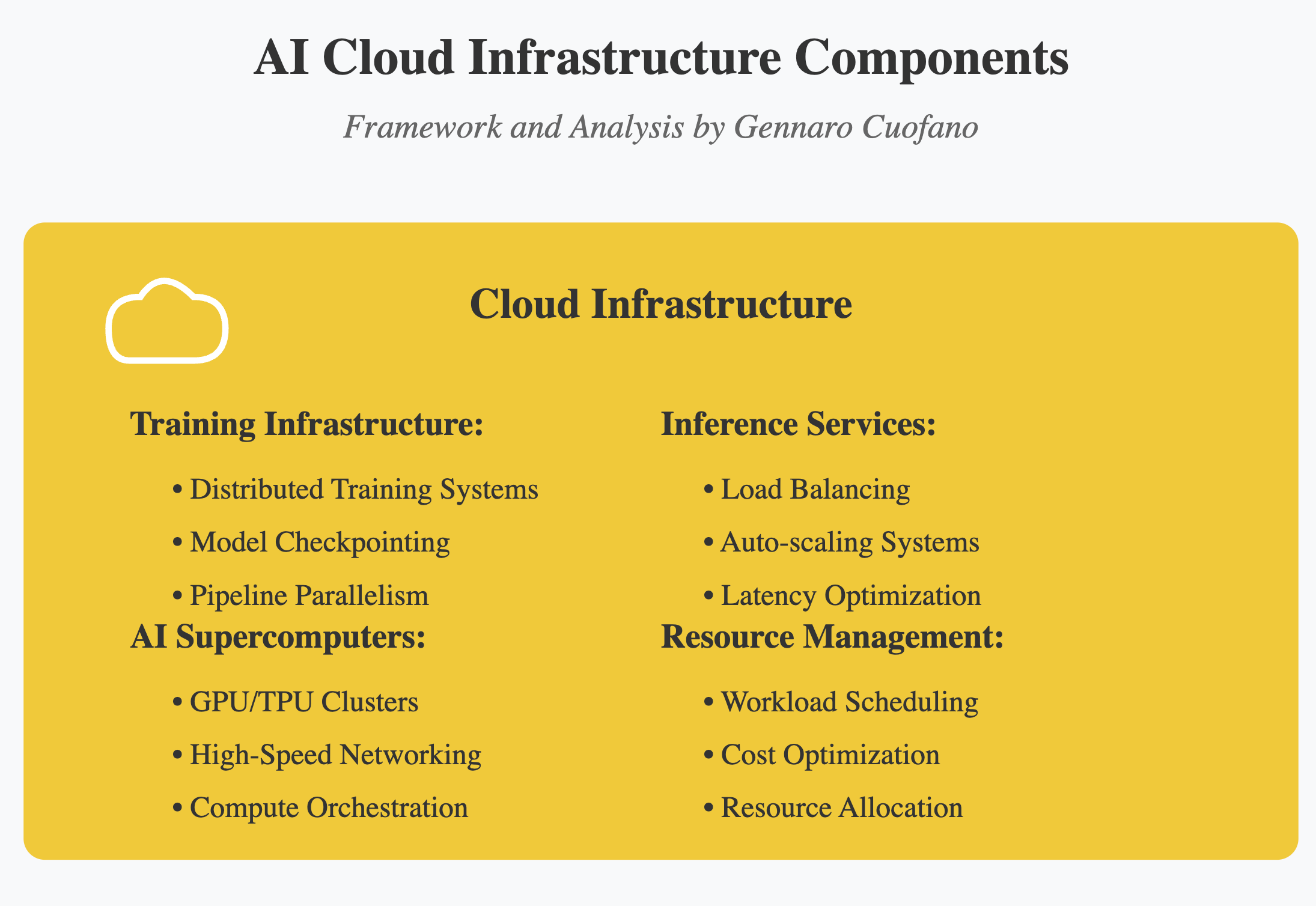
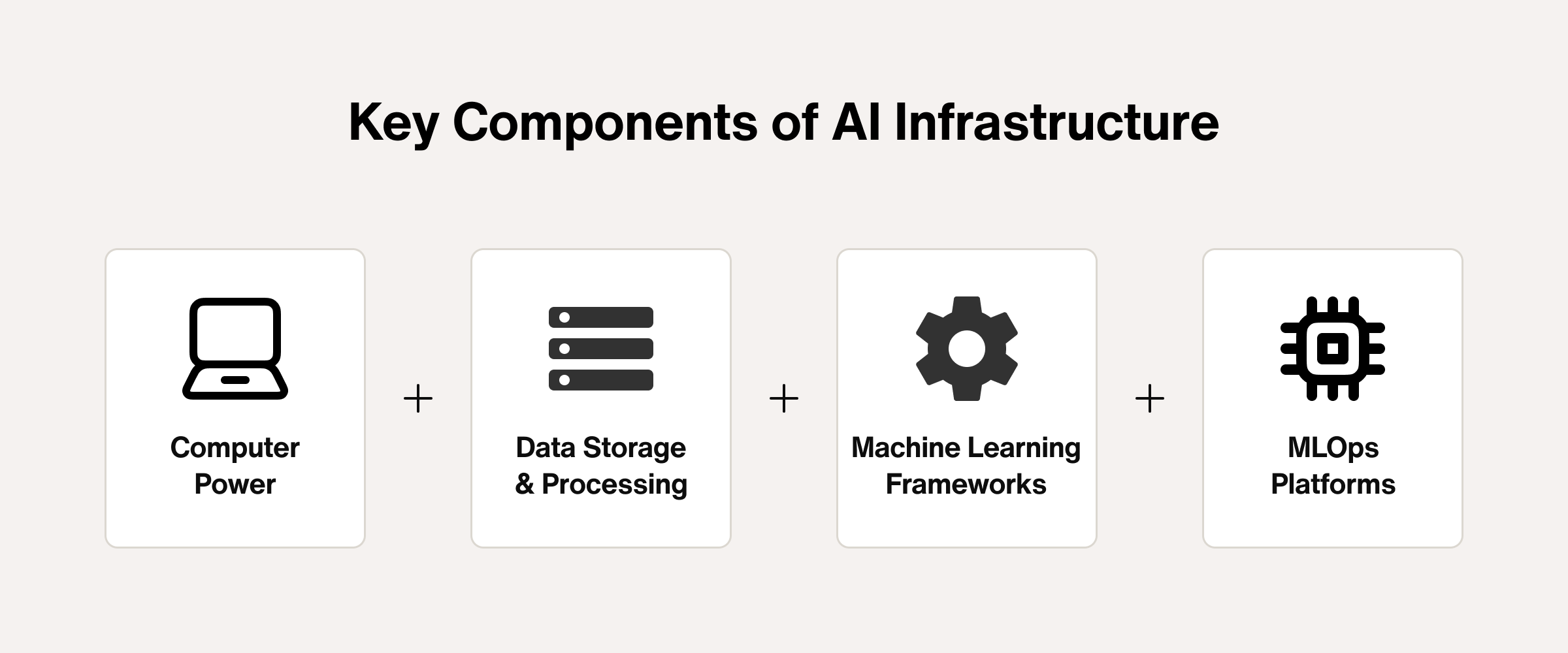
The architecture powering artificial intelligence initiatives extends far beyond conventional cloud computing setups. At its foundation, AI infrastructure is a specialized technological stack engineered to manage massive parallelism, unprecedented data ingestion rates, and ultra-low latency communications. Traditional data centers, optimized for transactional databases and web applications, frequently bottleneck when forced to process intensive matrix multiplications and deep learning gradients. Consequently, modern deployments require a complete paradigm shift across four primary pillars: compute engines, networking fabrics, storage systems, and orchestration layers.
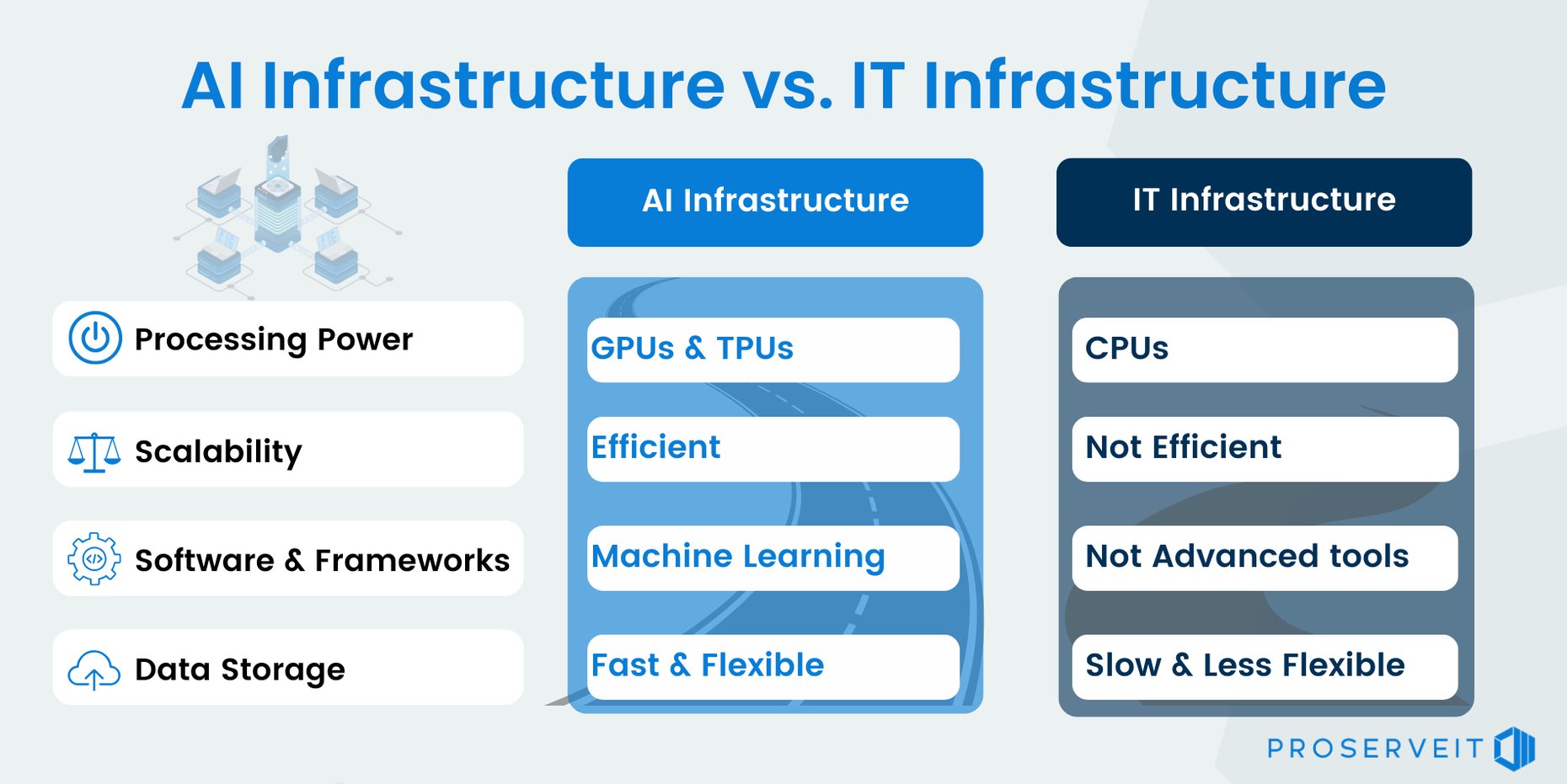
Hardware acceleration serves as the primary engine for this ecosystem. Graphics Processing Units (GPUs), Tensor Processing Units (TPUs), and application-specific integrated circuits (ASICs) execute parallelized floating-point operations at speeds unattainable by traditional central processing units. However, raw compute potential remains restricted without a corresponding networking layer. Distributed training jobs across thousands of nodes rely on high-performance fabrics—such as InfiniBand or RoCE (RDMA over Converged Ethernet)—to minimize synchronization lag during weight updates.
Furthermore, feeding these high-throughput compute units demands high-performance storage architectures. NVMe-based storage arrays and parallel file systems ensure that datasets stream continuously to GPUs without triggering I/O starvation. Finally, containerization and orchestration platforms manage resource allocation, ensuring that machine learning models scale efficiently across hybrid cloud environments.
Hardware Foundations: Compute, Acceleration, and Specialized Processors
Selecting the appropriate hardware tier is the most critical decision in designing an AI infrastructure strategy. Training large language models (LLMs) and complex computer vision architectures requires specialized processors capable of handling FP16, BF16, and FP8 precision arithmetic with minimal thermal throttling and maximum energy efficiency.
GPUs and Accelerators
Graphics processing units remain the gold standard for both model training and high-throughput inference. Modern enterprise accelerators feature high-bandwidth memory (HBM) integrated directly onto the processor package, drastically accelerating data transfer speeds between memory and compute cores.
TPUs and Custom ASICs
Application-specific integrated circuits, such as Tensor Processing Units, are custom-built by hyperscale cloud providers to optimize specific neural network operations. While GPUs offer general-purpose flexibility across diverse machine learning frameworks, custom ASICs often deliver superior performance-per-watt ratios for specific tensor math workloads.
CPUs in the AI Pipeline
While accelerators handle the heavy lifting of deep learning, CPUs remain vital for data preprocessing, feature engineering, pipeline orchestration, and handling inference requests that require complex logical branching or sequential execution.
Networking and Interconnects for Distributed Training
As neural network parameter counts scale into the hundreds of billions, single-node training becomes physically impossible due to memory capacity limitations. Distributed training across cluster networks becomes mandatory, turning the interconnect fabric into a critical performance determinant.
When distributed across multiple nodes, training jobs require GPUs to constantly exchange gradients. If the network latency is high or bandwidth is constrained, expensive compute clusters sit idle waiting for synchronization—a phenomenon known as the communication bottleneck. To mitigate this, enterprise architectures rely on Remote Direct Memory Access (RDMA) over Converged Ethernet or InfiniBand topologies. These technologies bypass the operating system kernel, enabling direct memory-to-memory data transfers between GPUs across different servers with microsecond-level latencies. Network interface cards (NICs) equipped with hardware-offloaded collective operations further accelerate multi-node scaling efficiency.
Storage and Data Pipelines for High-Throughput Workloads
Machine learning models are data-hungry entities. A robust AI infrastructure must ingest, transform, and serve petabytes of training data without creating pipeline bottlenecks that leave expensive GPUs underutilized.
Conventional Network-Attached Storage (NAS) solutions often fail under the random read patterns and massive concurrency demands of modern deep learning frameworks. Instead, modern AI data layers utilize parallel file systems (such as Lustre, GPFS, or DAOS) and distributed object stores that distribute data across multiple storage nodes simultaneously.
| Storage Tier | Primary Use Case | Performance Profile | Typical Latency |
|---|---|---|---|
| Local NVMe SSD | Active training cache & checkpointing | Ultra-high IOPS, massive throughput | Sub-millisecond |
| Parallel File Systems | Shared multi-node training datasets | High aggregate bandwidth | Low single-digit milliseconds |
| Object Storage (S3-compatible) | Raw data ingestion, archiving, versioning | High scalability, cost-effective | Variable (tens of milliseconds) |
| Enterprise NAS | Metadata management, code repositories | Balanced read/write performance | Moderate |
Caching layers situated close to the compute nodes further optimize this architecture by pre-fetching training epochs into high-speed memory pools, ensuring that storage I/O never restricts model iteration speed.
Software Frameworks and Orchestration Layers
Hardware and networking form the physical skeleton of AI infrastructure, but software orchestration breathes life into the system. Managing complex workflows—from exploratory data science notebooks to automated CI/CD pipelines for production models—requires mature MLflow, Kubeflow, and Kubernetes-native toolchains.
Containerization via Docker and container orchestration through Kubernetes provide the necessary abstraction layer to run workloads seamlessly across on-premises bare-metal servers and multi-cloud environments. Kubernetes operators designed specifically for AI workloads automatically manage GPU sharing, node autoscaling, and driver compatibility.
Furthermore, MLOps platforms integrate model registries, feature stores, and experiment tracking tools directly into the infrastructure. This automation ensures reproducibility, tracks data lineage, and simplifies the transition of models from experimental sandbox environments to high-availability production endpoints.
Cost Optimization and Sustainability in Enterprise AI Deployments
Operating large-scale AI infrastructure incurs substantial financial and environmental costs. Power consumption for high-density GPU racks frequently pushes rack power densities beyond 40 kilowatts, requiring advanced liquid cooling solutions rather than traditional air conditioning.
To maintain economic viability, organizations implement sophisticated cost-management strategies. These include utilizing spot instances for fault-tolerant batch training jobs, implementing dynamic auto-scaling policies for inference clusters, and optimizing model weights through quantization and pruning to reduce compute requirements. Balancing computational throughput with energy efficiency remains a defining engineering challenge for modern enterprise architecture teams.
Frequently Asked Questions
What is the difference between AI training and inference infrastructure?
AI training infrastructure requires massive parallel compute, high-bandwidth interconnects, and large memory pools to iteratively compute gradients and update model parameters. Inference infrastructure focuses on low latency, high throughput, and cost efficiency, often utilizing optimized quantized models running on smaller, specialized hardware profiles tailored for rapid predictions.
Why is specialized networking necessary for large language model training?
Large language models are too large to fit into the memory of a single accelerator, requiring model parallelism across thousands of interconnected nodes. Specialized networking protocols like InfiniBand eliminate communication bottlenecks by enabling direct memory transfers between GPUs, drastically reducing the time spent synchronizing model weights.
How does cloud-native infrastructure compare to on-premises deployments for AI?
Cloud-native infrastructure offers elastic scalability, immediate access to the latest GPU architectures, and reduced capital expenditure. On-premises deployments provide greater data sovereignty, predictable long-term costs for continuous high-utilization workloads, and deep customization control over physical networking and cooling systems.
What role do feature stores play in AI architecture?
Feature stores serve as centralized repositories that standardize the definition, storage, and retrieval of machine learning features. They eliminate data duplication between training and inference pipelines, ensuring model consistency and accelerating the deployment of new predictive capabilities.
How are enterprises managing the high energy consumption of AI data centers?
Organizations are adopting advanced liquid cooling technologies, locating data centers near renewable energy sources, and optimizing model architectures through quantization, distillation, and sparsity techniques to reduce the total computational energy footprint.
Strategic Implementation and Next Actions
Deploying an effective AI infrastructure strategy requires a methodical, phased approach aligned with organizational maturity. Begin by auditing current data engineering pipelines to identify potential storage bottlenecks before procuring expensive hardware accelerators. Establish clear workload profiling metrics to determine whether training demands justify on-premises capital investments or if cloud-based burst capacity provides a more agile economic model. Finally, prioritize MLOps automation early in the architecture design phase to ensure seamless transitions from exploratory model development to secure, scalable enterprise production environments.