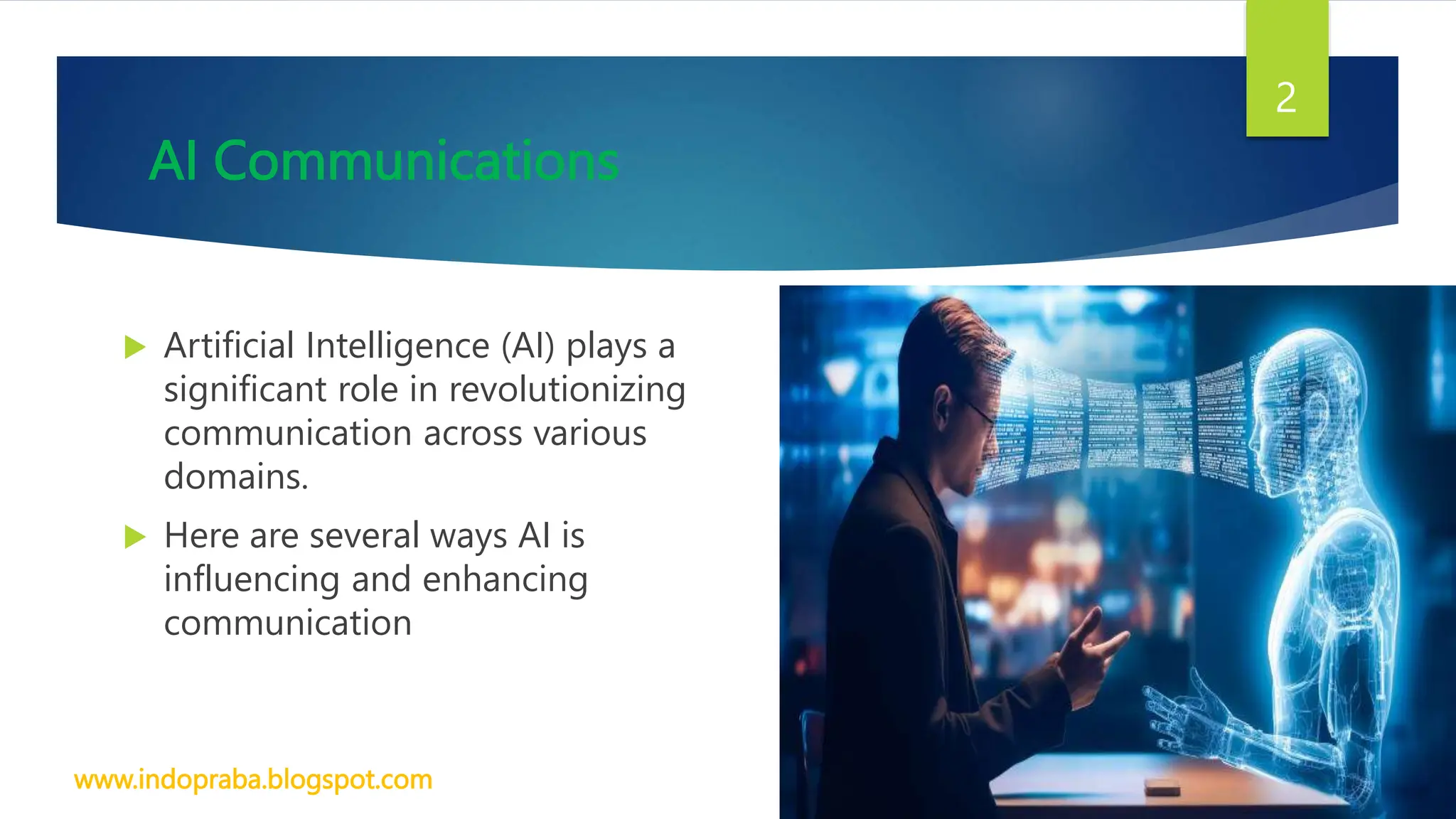
AI communication transforms how organizations interact internally and externally by combining natural language processing, machine learning, and automated data pipelines to generate, interpret, and optimize information exchange. This technology moves beyond simple chatbots to handle complex, context-aware dialogues, semantic analysis, and real-time translation across multiple channels.
Organizations increasingly rely on AI communication systems to manage high volumes of correspondence, parse unstructured customer feedback, and automate routine operational workflows. By integrating these systems into existing communication stacks, businesses can reduce response times, maintain consistent messaging across global markets, and extract actionable insights from everyday data streams. However, successful deployment requires careful attention to technical architecture, data privacy regulations, and human oversight.
Core Technologies and Architectural Foundations of AI Communication
Modern AI communication relies on a layered technological stack designed to process human language with high fidelity. At the foundational level, Large Language Models (LLMs) and transformer architectures serve as the primary engines for understanding and generating text. These models are trained on vast corpora of text, allowing them to grasp nuances, context, and syntax across multiple human languages.
Complementing these core models are Natural Language Processing (NLP) pipelines that handle text tokenization, part-of-speech tagging, and sentiment analysis. When an incoming message arrives—whether through an email client, a chat interface, or a voice-to-text transcription service—the NLP pipeline cleans and structures the input. The LLM then evaluates the semantic intent, retrieves relevant contextual data from vector databases using Retrieval-Augmented Generation (RAG), and formulates a contextually appropriate response.
Furthermore, Application Programming Interfaces (APIs) and middleware connect these intelligence layers to enterprise communication channels, such as Customer Relationship Management (CRM) platforms, enterprise resource planning systems, and unified communications-as-a-service (UCaaS) providers. This integration ensures that automated responses reflect up-to-date inventory levels, customer histories, and organizational policies without requiring manual data lookup.
Operational Benefits and Efficiency Gains
Implementing structured AI communication frameworks offers quantifiable advantages for enterprise efficiency and resource allocation. By automating repetitive informational exchanges, organizations free human personnel to focus on high-touch, complex problem-solving and strategic planning.
- Scalability: Automated systems handle simultaneous interactions across thousands of customer touchpoints without degrading response quality or increasing wait times.
- Consistency: Enterprise communication tools apply uniform tone, style guidelines, and compliance rules across every outbound message, minimizing human error and brand misalignment.
- Multilingual Agility: Real-time neural machine translation allows organizations to support international markets natively, removing language barriers in support and sales operations.
- Data Synthesis: Continuous processing of communication channels turns unstructured conversations into structured analytics, highlighting emerging customer pain points and operational bottlenecks.
These gains translate directly into reduced operational costs and improved customer satisfaction metrics. Organizations no longer need to scale support teams linearly with user growth, as intelligent routing and automated resolution manage a substantial percentage of Tier-1 inquiries.
Technical Requirements and Integration Challenges
Deploying AI communication systems involves navigating significant technical, architectural, and governance hurdles. Organizations must evaluate their existing infrastructure to ensure compatibility with modern API-driven machine learning models.
- Enterprise Communication Channels (Email, Chat Widgets, Voice Transcripts, APIs)
- API & Middleware Layer (Authentication, Rate Limiting, Routing)
- AI & NLP Processing Engine (LLMs, Sentiment Analysis, RAG Pipelines)
- Enterprise Data Sources (CRMs, Vector DBs, Knowledge Bases)
Data privacy and security represent primary constraints. Because AI communication tools process sensitive internal communications and personally identifiable information (PII), organizations must implement strict data governance policies. This includes encrypting data in transit and at rest, anonymizing training datasets, and ensuring that third-party model providers do not use proprietary enterprise communications to train public models.
Another technical challenge is hallucination and factual drift. Unlike deterministic software, generative models can occasionally produce plausible-sounding but incorrect information. Enterprises mitigate this risk by enforcing RAG architectures that tether model outputs strictly to verified internal knowledge bases, combined with deterministic validation rules before a message reaches an end user.
Comparing Traditional Channels and AI-Driven Communication Platforms
Organizations evaluating infrastructure upgrades must weigh the operational capabilities of legacy communication channels against modern AI-augmented environments.
| Feature | Traditional Communication | AI-Driven Communication |
|---|---|---|
| Availability | Restricted by staffing hours and shift schedules | 24/7/365 instant response capability |
| Processing Speed | Dependent on manual reading, routing, and drafting | Millisecond semantic parsing and automated generation |
| Language Support | Requires fluent human speakers for every target language | Real-time multilingual translation and generation |
| Data Utilization | Siloed transcripts requiring manual audit and tagging | Automated sentiment tracking and continuous insight extraction |
| Consistency | Variable based on individual employee fatigue and training | Uniform adherence to brand guidelines and compliance rules |
This comparison highlights that AI communication does not entirely replace human touchpoints, but rather optimizes the baseline layer of interaction, elevating human agents to handle exceptions and high-value strategic discussions.
Governance, Compliance, and Risk Management
As regulatory bodies globally increase scrutiny on automated systems, organizations must establish robust governance frameworks for their AI communication deployments. Compliance requirements vary significantly by jurisdiction and industry sector. In financial services, communications must adhere to strict archiving and auditing standards set by regulators such as the Financial Industry Regulatory Authority (FINRA) or the Securities and Exchange Commission (SEC). In healthcare, patient communications must comply with privacy regulations like the Health Insurance Portability and Accountability Act (HIPAA).
Organizations must maintain human-in-the-loop (HITL) checkpoints for high-stakes communications, such as financial transactions, medical advice, or legal notifications. These checkpoints ensure that automated drafts are reviewed and approved by authorized personnel before dissemination. Furthermore, organizations should maintain comprehensive audit logs tracking every AI-generated interaction, including the model version used, the retrieved prompt context, and any human modifications applied.
Frequently Asked Questions
What is AI communication?
AI communication refers to the use of artificial intelligence technologies, including natural language processing and machine learning, to automate, analyze, and optimize information exchange between humans and digital systems or other humans across various enterprise channels.
How do AI communication tools ensure data privacy?
Enterprise-grade AI communication platforms ensure privacy by deploying on-premise models, utilizing isolated cloud instances, enforcing strict data encryption, and prohibiting third-party model providers from using proprietary enterprise data for public model training.
Can AI communication systems handle multiple languages simultaneously?
Yes. Modern neural machine translation and multilingual large language models allow AI communication platforms to detect, comprehend, and generate responses in dozens of languages in real time without requiring separate localized teams.
What is a human-in-the-loop workflow in AI communication?
A human-in-the-loop workflow requires a human supervisor to review, edit, or approve AI-generated messages before they are sent to users, ensuring accuracy and accountability in sensitive operational contexts.
How do organizations prevent AI models from providing incorrect information?
Organizations prevent incorrect outputs by implementing Retrieval-Augmented Generation (RAG) architectures that anchor model responses to verified internal documents, alongside deterministic validation filters that catch anomalies before publication.
Strategic Implementation and Next Actions
To successfully integrate AI communication into existing enterprise operations, leadership teams should begin with a comprehensive audit of current communication bottlenecks and customer touchpoints. Identify repetitive, high-volume workflows that consume significant staff hours but require low creative input. Next, establish a cross-functional task force comprising IT, legal, security, and operations representatives to draft governance guidelines and select vendors that meet stringent enterprise compliance standards. Pilot the chosen solution within a controlled environment—such as internal IT help desks or Tier-1 customer support queues—before scaling the technology enterprise-wide. Continuously monitor performance metrics, audit interaction logs, and refine prompt libraries to ensure long-term alignment with organizational objectives.