Authorised Gas Tester (AGT) safety encompasses the standardized procedures, equipment calibration protocols, and testing methodologies used to verify safe atmospheric conditions prior to and during high-hazard industrial activities. It protects workers against oxygen deficiency, toxic gas exposure, and explosive atmospheres in confined spaces and hot work operations across energy, chemical, and manufacturing facilities worldwide.
The Strategic Role of AGT Safety in High-Hazard Environments
In energy production, petrochemical refining, marine operations, and heavy manufacturing, atmospheric hazards represent some of the most dangerous invisible risks to worker health and facility integrity. Toxic gas leaks, oxygen displacement, and volatile organic hydrocarbon vapors can cause fatal asphyxiation or catastrophic explosions within seconds. Authorised Gas Tester (AGT) safety protocols serve as the frontline defense against these risks by establishing rigorous, standardized atmospheric testing prior to granting work access.
An Authorised Gas Tester is a trained and certified professional responsible for sampling, analyzing, and monitoring the atmosphere inside hazardous environments. Before any maintenance crew enters a storage tank, pressure vessel, process pipe, or sewer—or before any welder performs spark-producing "hot work"—the AGT must conduct precise physical gas tests to confirm the area is safe for human entry and thermal operations.
- OXYGEN TESTING (19.5% - 23.5% Vol)
- Must precede explosive gas detection
- FLAMMABLE GAS TESTING (< 10% LEL Entry)
- Requires adequate O2 for catalytic sensors
- TOXIC GAS TESTING (H2S, CO, VOCs)
- Compared against STEL and TWA exposure limits
The AGT role bridges operational task planning and occupational health. Testing is not merely a formality; it directly informs the issuance of Safe Work Permits, specifies required Personal Protective Equipment (PPE), and dictates mechanical ventilation requirements. Without strict AGT oversight, routine operational tasks can escalate into fatal multi-casualty incidents, particularly in confined space scenarios where rescuers often succumb to identical atmospheric hazards.
Standard AGT Certification Levels and Frameworks
To maintain international standardization and operational integrity, safety governance organizations such as OPITO (the global offshore energy safety body) and national regulators like the US Occupational Safety and Health Administration (OSHA 29 CFR 1910.146) establish structured certification pathways for AGT personnel. The OPITO AGT framework, widely adopted globally, categorizes gas testing roles into three distinct operational levels based on the specific risk profile of the task:
- AGT Level 1 (Testing for Hot Work): Focuses on measuring flammable gas concentrations prior to and during hot work operations (e.g., welding, grinding, torch cutting) in open or enclosed hazardous areas. Level 1 testers verify that the atmosphere remains well below lower explosive limits to prevent ignition.
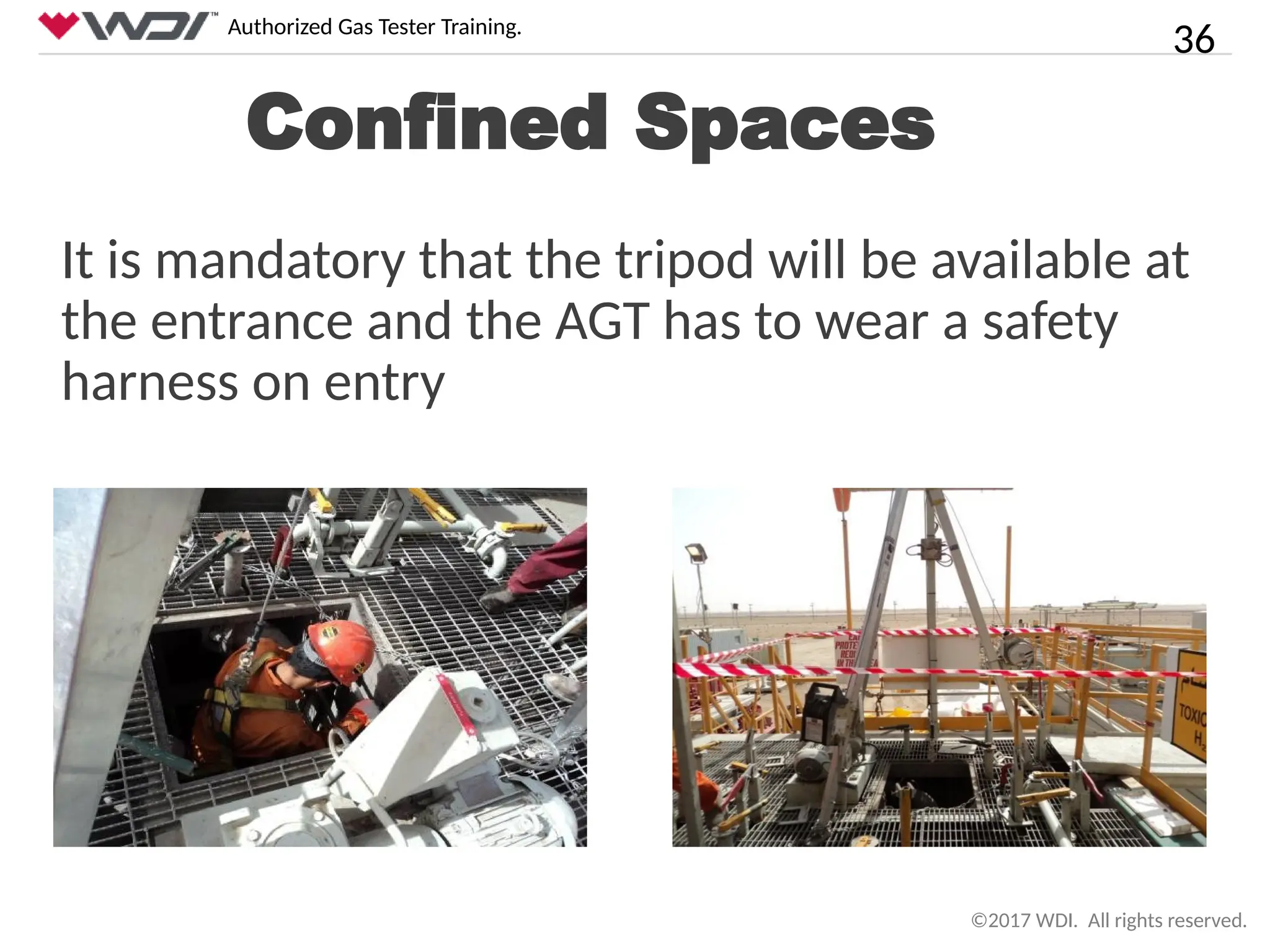
- AGT Level 2 (Testing for Confined Space Entry): Qualifies individuals to conduct physical pre-entry atmospheric testing of confined or enclosed spaces. This includes assessing multi-level stratified atmospheres for oxygen balance, flammable vapors, and toxic contaminants before personnel step inside.
- AGT Level 3 (Continuous Gas Monitoring): Covers the duties of designated safety watch personnel who continuously monitor atmospheres using portable direct-reading instruments while work is actively underway. Level 3 monitors ensure conditions do not deteriorate during the shift.
Personnel holding AGT qualifications must demonstrate technical knowledge of gas behavior, sensor physics, sample draw dynamics, and permit-to-work systems. Recertification is typically required every two to three years to ensure testers remain sharp on evolving equipment technologies, regulatory exposure limits, and emergency shutdown procedures.
Key Atmospheric Hazards and Safety Action Thresholds
Atmospheric testing must always evaluate three distinct categories of hazard in a precise, non-negotiable sequence: Oxygen content, Flammable/Explosive gases, and Toxic vapors. Testing out of order can produce false instrument readings and introduce lethal risk.
1. Oxygen Balance ($O_2$)
Normal ambient air contains 20.9% oxygen by volume. Oxygen levels must be tested first because catalytic bead sensors (commonly used for flammable gas detection) require at least 10% oxygen to function correctly.
- Oxygen Deficiency (< 19.5%): Impairs cognitive function, muscle coordination, and respiration. Caused by microbial activity, rust formation, displacement by inert purge gases (such as nitrogen or argon), or chemical reaction oxidation.
- Oxygen Enrichment (> 23.5%): Dramatically increases the combustibility of materials. Clothing, oil-soaked rags, and structural elements can ignite spontaneously or burn violently in enriched environments.
2. Flammable and Combustible Gases (LEL Monitoring)
Flammable vapors are measured as a percentage of the Lower Explosive Limit (LEL)—the lowest concentration of a gas in air capable of producing a flash fire in the presence of an ignition source.
- Hot Work Limit: For hot work operations, the acceptable LEL reading is typically 0%. Any detectable flammable gas indicates a active hydrocarbon leak or un-purged residue.
- Confined Space Entry Limit: Safe entry typically requires levels below 10% LEL (with continuous ventilation), though many corporate safety management systems enforce stricter internal action thresholds of 1% to 5% LEL.
3. Toxic Gases and Vapors
Toxic hazards are assessed against published occupational exposure limits, such as Time-Weighted Averages (TWA) and Short-Term Exposure Limits (STEL), set by organizations like the UK Health and Safety Executive (HSE L101 Guidelines). Common industrial gases include:
- Hydrogen Sulfide ($H_2S$): Extremely toxic gas common in oil refining and sewer infrastructure. Characterized by a rotten-egg odor at low levels, but rapidly causes olfactory fatigue (loss of smell) at concentrations above 100 ppm, leading to instant collapse and death at higher levels. Alarm thresholds are often set at 5 ppm TWA.
- Carbon Monoxide ($CO$): Odorless, colorless byproduct of incomplete combustion. Binds to hemoglobin in the bloodstream 200 times more aggressively than oxygen, causing tissue hypoxia. Standard action limits are set at 20–25 ppm TWA.
- Volatile Organic Compounds (VOCs): Benzene, toluene, and xylene vapors present acute toxic risks and long-term carcinogenic hazards, requiring photoionization detectors (PID) for low-parts-per-million detection.
Comparison of AGT Roles, Testing Protocols, and Critical Thresholds
The following matrix outlines the functional differences across AGT roles, primary target hazards, instrumentation requirements, and non-negotiable safety limits enforced across industrial sectors:
| AGT Level / Target Application | Primary Atmospheric Hazards Monitored | Mandatory Instrumentation Technology | Standard Safety Action Thresholds | Regulatory / Industry Reference Standard |
|---|---|---|---|---|
| AGT Level 1(Hot Work Operations) | Flammable hydrocarbon vapors, dissolved gases, oxygen levels | Multi-gas detector with catalytic bead or Non-Dispersive Infrared (NDIR) | 0% LEL for hot work start; $O_2$ between 19.5% and 22.0% | OPITO AGT Standard 1; OSHA 1910.252 |
| AGT Level 2(Confined Space Entry) | Oxygen deficiency/enrichment, $H_2S$, $CO$, benzene, volatile hydrocarbons | Multi-gas pump unit with extendsible sample lines, Electrochemical sensors, PID | $O_2$: 19.5%–23.5%;< 10% LEL (entry);$H_2S$: < 5 ppm; $CO$: < 20 ppm | OPITO AGT Standard 2; OSHA 1910.146; HSE L101 |
| AGT Level 3(Continuous Safety Watch) | Real-time drift of oxygen, explosive mixtures, and toxic gas buildup | Personal wearable multi-gas monitor; diffusion-based spatial monitors | Immediate evacuation on Low Alarm ($O_2$ < 19.5%, LEL > 5%, toxic TWA breach) | OPITO AGT Standard 3; Safe Work Permit System |
Atmospheric Testing Procedures: Step-by-Step Execution
Conducting accurate atmospheric tests requires systematic execution. A accurate reading on an instrument display is useless if sample collection technique is flawed or drawn from an unrepresentative area.
- EQUIPMENT VISUAL INSPECTION
- Check housing, filter & battery
- FRESH AIR ZERO CALIBRATION
- Establish clean-air baseline
- FIELD BUMP TESTING
- Verify sensor/alarm response
- STRATIFIED MULTI-LEVEL TEST
- Top, middle & bottom sampling
- DOCUMENTATION & PERMITTING
- Record values & issue clearance
Step 1: Pre-Operational Equipment Checks
Before approaching the testing site, the AGT must visually inspect the detector for physical housing damage, clean sensor ports, verify battery charge, and confirm pump operation. The instrument must be zeroed in known clean air to establish an accurate baseline.
Step 2: Bump Testing Verification
The AGT must perform a field challenge test ("bump test") by exposing the sensors to a certified target gas mixture of known concentration. A bump test confirms that the gas pathways are clear, sensors respond within manufacturer tolerance windows (typically within 10-15 seconds), and audio/visual alarms function properly. A device that fails a bump test must be removed from service immediately.
Step 3: Stratified Vertical Sampling
Gases possess varying vapor densities relative to air (air = 1.0). Therefore, tests inside enclosed structures must be conducted at multiple elevations (top, middle, and bottom) using a motorized sample pump and non-reactive extension hose:
- Lighter-than-air gases (e.g., Methane, Hydrogen, Ammonia) rise and accumulate at the top of spaces.
- Gases equal to air density (e.g., Carbon Monoxide, Nitrogen) mix throughout the mid-section.
- Heavier-than-air gases (e.g., Hydrogen Sulfide, Propane, Benzene) sink and settle into low spots, sumps, and beneath floor grating.
Step 4: Accounting for Sample Travel Time
When utilizing a sample draw hose, the AGT must allow sufficient residence time for the gas to travel from the probe tip to the internal sensors. The standard rule of thumb is 2 seconds per foot of sample hose, plus sensor response time ($T_{90}$ values), before recording the final stability value.
Step 5: Recording and Permit Authorization
The AGT logs the exact numerical values for $O_2$, LEL, $H_2S$, and $CO$, along with the time, exact physical location, instrument serial number, and calibration expiration date directly on the Safe Work Permit. If values sit within authorized parameters, the AGT signs the permit authorizing entry or hot work.
Gas Detection Sensor Technologies and Maintenance Standards
Understanding the underlying physics of gas sensors helps AGTs interpret unexpected readings, recognize potential cross-sensitivities, and prevent sensor poisonings in industrial environments.
| CATALYTIC BEAD (LEL) | INFRARED / NDIR (LEL) | PHOTOIONIZATION (PID/VOCs) |
|---|---|---|
| Requires >10% Oxygen | Functions in inert gases | Uses UV light for ionization |
| Vulnerable to Silicones | Immune to silicone poison | Measures aromatic organic compounds in PPM/PPB levels |
| Measures combustible gas | Measures Hydrocarbons |
Catalytic Bead (Pellistor) Sensors
Catalytic bead sensors detect combustible gases by burning sample gas on a coated platinum coil, causing a temperature change proportional to gas concentration.
- Advantage: Cost-effective, reliable measure for general hydrocarbons.
- Limitation: Requires at least 10% ambient oxygen to operate. Exposure to silicone vapors, tetraethyl lead, sulfur compounds, or high concentrations of halogenated hydrocarbons can permanently poison the catalyst.
Non-Dispersive Infrared (NDIR) Sensors
NDIR sensors pass an infrared beam through target gas, measuring light absorption at specific wavelengths characteristic of hydrocarbon bonds.
- Advantage: Does not require oxygen (ideal for testing inerted, nitrogen-purged tanks); immune to chemical poisons.
- Limitation: Cannot detect non-hydrocarbon combustible gases such as Hydrogen ($H_2$).
Electrochemical Sensors
Used exclusively for oxygen and toxic gases ($H_2S$, $CO$, $Cl_2$, $SO_2$). Target gas reacts chemically with an internal electrolyte, generating a electrical current proportional to concentration.
- Advantage: High specificity and sensitivity in parts-per-million (ppm) ranges.
- Limitation: Finite operational lifespan (typically 12 to 24 months); susceptible to cross-sensitivity from interfering gases (e.g., Hydrogen gas cross-reacting on Carbon Monoxide sensors).
Photoionization Detectors (PID)
PID sensors utilize high-energy Ultraviolet (UV) light to ionize Volatile Organic Compounds (VOCs), releasing electrons that produce a measurable electrical current.
- Advantage: Essential for detecting toxic carcinogenic compounds (such as Benzene) at extremely low parts-per-million or parts-per-billion levels long before they reach LEL thresholds.
Safe Work Permits, Hot Work Isolation, and Continuous Monitoring
Initial gas testing only provides a snapshot of atmospheric conditions at the exact moment of measurement. Atmospheric conditions inside process plants are dynamic; changing ambient temperatures, solar heating of vessels, chemical residue off-gassing, or nearby process upsets can rapidly alter safety parameters.
- Initial AGT Gas Testing
- Is Atmosphere Safe?
- NO: Ventilate / Purge / Re-isolate
- YES: Issue Safe Work Permit
- Initiate Work Activities
- Continuous Monitoring (AGT Level 3)
- Alarm Triggered?: STOP WORK & Evacuate
- No Alarms: Complete Work & Close Permit
To manage dynamic risk, AGT safety protocols mandate clear integration with organizational Permit-to-Work (PTW) systems:
- Isolation Verification: Prior to initial AGT testing, mechanical, process, and electrical isolations (Lockout/Tagout, double-block-and-bleed, pipe spading/blinding) must be physically verified to prevent fresh contaminants from entering the test zone.
- Forced Mechanical Ventilation: Enclosed spaces must be continuously ventilated using positive-pressure air movers. When ventilation is temporarily turned off to take an static gas sample, the AGT must allow atmospheric stratification to settle before recording values.
- Continuous Real-Time Monitoring: During active hot work or extended entry operations, an AGT Level 3 monitor must maintain continuous observation using portable spatial alarms or personal wear monitors.
- Re-Testing Triggers: Work must immediately cease, permits must be suspended, and a complete re-test must be executed by an AGT if:
- Work is suspended for more than 30–60 minutes (such as lunch breaks or shift changes).
- Ventilation systems fail or undergo maintenance.
- A process upset or unannounced release occurs elsewhere in the facility.
- Physical conditions inside the space change (e.g., sludge disturbance, coating application).
Frequently Asked Questions
What is the primary objective of AGT safety training?
The primary objective of AGT safety training is to qualify personnel to correctly sample, test, evaluate, and monitor workplace atmospheres for flammable gases, toxic vapors, and oxygen imbalance. This ensures compliance with safe work permits, prevents explosions during hot work, and eliminates asphyxiation or toxic poisoning risks during confined space entries.
Why must oxygen be tested before measuring flammable gas levels?
Oxygen must be tested first because conventional catalytic bead LEL sensors require a minimum of 10% oxygen by volume to burn the gas sample internally and register an accurate reading. If an atmosphere is oxygen-deficient (e.g., inerted with nitrogen), a catalytic bead sensor will read falsely low or zero even in the presence of explosive hydrocarbon gas levels, creating a false sense of security.
How often should gas detection equipment undergo bump testing and calibration?
A functional bump test must be performed prior to each day's use (or before every shift) using a known target gas concentration to verify sensor and alarm responsiveness. Full multi-point span calibrations should be performed periodically according to manufacturer specifications—typically every 30 to 180 days—or immediately if a unit fails a field bump test.
What is the difference between AGT Level 1 and AGT Level 2 certifications?
OPITO AGT Level 1 certification focuses specifically on testing atmospheres in preparation for hot work operations, evaluating flammable gas risks in open or enclosed plant areas. AGT Level 2 certification specifically covers pre-entry atmospheric testing for confined space entry, requiring advanced knowledge of vertical atmospheric stratification, extended sampling techniques, and complex toxic hazard evaluations.
What immediate actions must an AGT take if gas levels breach safety thresholds?
If atmospheric testing reveals values outside acceptable safety limits (e.g., $O_2$ < 19.5%, LEL > 0% for hot work, or toxic gas exceeding TWA limits), the AGT must immediately stop work, refuse to sign or immediately revoke the Safe Work Permit, order all personnel out of the hazard zone, notify the Area Supervisor/Safety Department, and verify isolation and ventilation measures.
Implementation Roadmap for Industrial AGT Safety Compliance
To establish and maintain a high-integrity AGT safety framework across industrial sites, health, safety, and environmental (HSE) managers should implement the following operational steps:
- Audit Site Gas Hazards: Inventory all process streams, storage vessels, sumps, and confined spaces to map potential atmospheric hazards ($H_2S$, $CO$, aromatic hydrocarbons, asphyxiants).
- Standardize Instrumentation Fleets: Standardize on multi-gas detector models featuring automated bump/calibration docking stations. This reduces human error in maintenance logging and ensures clear audit trails.
- Formalize Role-Based Training: Ensure all safety watch personnel, entry supervisors, and maintenance technicians possess current, verifiable AGT certifications appropriate to their exact duties (Level 1, Level 2, or Level 3).
- Integrate Permit-to-Work Workflows: Mandate that no Permit for Hot Work or Confined Space Entry can be activated without gas test signatures recorded by a certified AGT within 30 minutes of task start.
- Enforce Mandatory Equipment Logs: Implement digital docking stations that automatically capture bump test results, sensor calibration health, alarm events, and peak concentration exposures across all deployed devices.