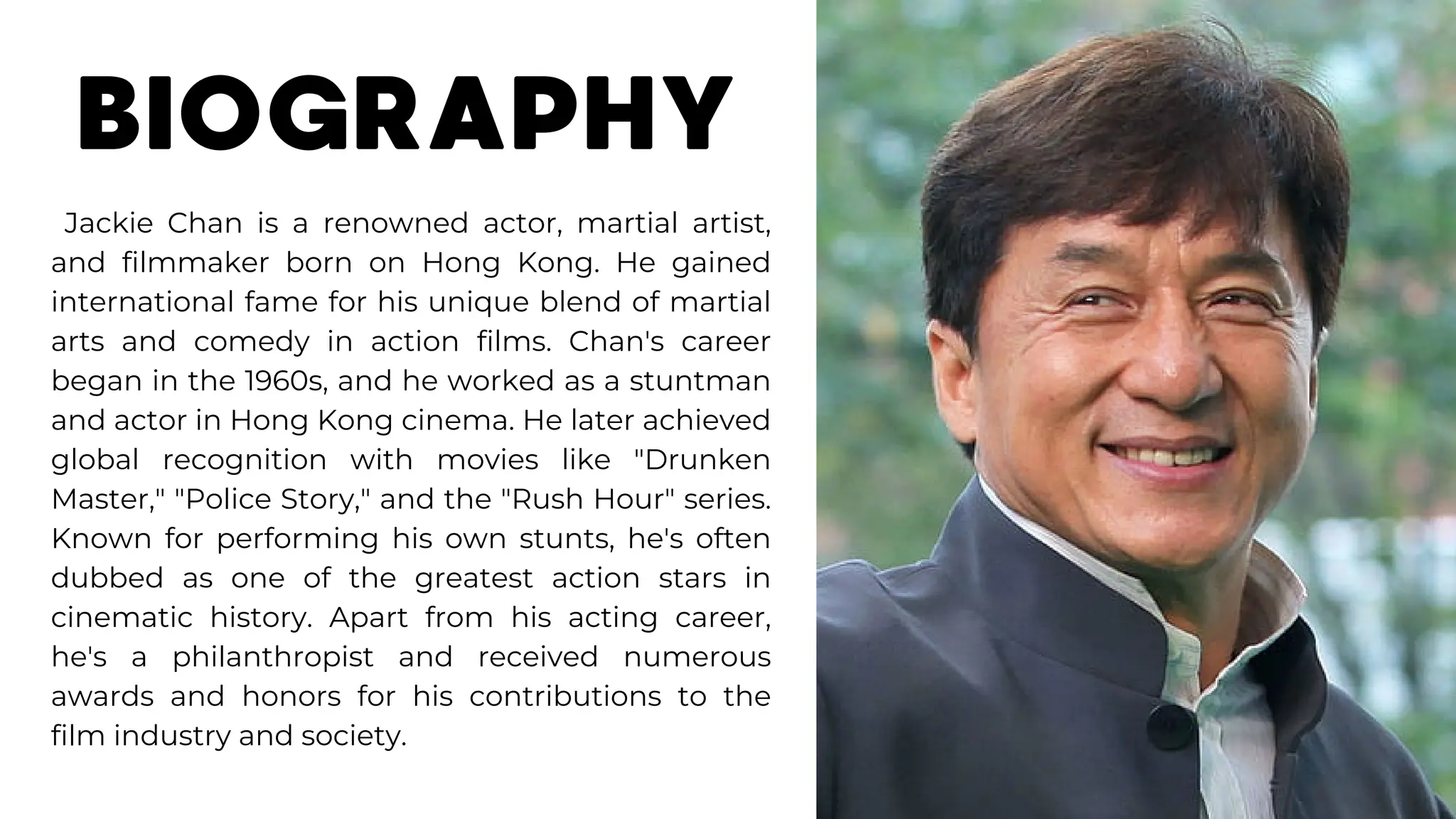
As of 2026, Jackie Chan remains a global icon of resilience and creativity, having celebrated his 72nd birthday on April 7. His journey from a grueling childhood at the Peking Opera school to becoming a multi-generational cinematic legend is defined by a unique fusion of acrobatic precision, comedic timing, and a philosophy that emphasizes perseverance over perfection.
The Chronology of a Living Legend: From Stuntman to Global Icon
Born Chan Kong-sang in Hong Kong in 1954, Jackie Chan’s career spans over six decades. His early training at the China Drama Academy under Master Yu Jim-yuen provided the foundation for his "ageless wisdom." The academy was a rigorous environment where students trained from dawn until midnight, mastering martial arts, acrobatics, singing, and acting. This discipline became the bedrock of his professional ethos.
In the early 1970s, Chan worked as a stuntman in Bruce Lee’s films, notably Fist of Fury and Enter the Dragon. Following Lee’s untimely death, the industry attempted to mold Chan into a "second Bruce Lee." However, Chan’s wisdom lay in his realization that he could never be Lee. Instead of the stoic, invincible warrior, Chan developed a persona that was vulnerable, expressive, and frequently forced to use his environment to survive. This pivot toward action-comedy, cemented by the 1978 hits Snake in the Eagle’s Shadow and Drunken Master, changed the trajectory of Hong Kong cinema forever.
By the 1980s and 90s, Chan had established the Jackie Chan Stunt Team (Sing Ga Ban), a group of highly trained professionals who helped him execute some of the most dangerous sequences in film history. Projects like Project A, Police Story, and Armour of God showcased his willingness to risk life and limb, resulting in a legendary list of injuries that has become a testament to his dedication.
The Philosophy of Ageless Wisdom: Mindset and Longevity
Jackie Chan’s longevity in the industry—often referred to by fans as his "ageless wisdom"—is not merely about physical fitness; it is about psychological adaptability. As he transitioned into his 60s and now his 70s, Chan shifted his focus from high-risk stunts to nuanced storytelling and character-driven roles.
One of the core tenets of Chan’s wisdom is the concept of "Wu De" or martial virtue. This involves humility, respect for one’s craft, and the understanding that martial arts is a tool for self-improvement rather than aggression. Chan has often stated that "the best fight is the one we avoid," a sentiment reflected in his characters who usually fight only as a last resort.
Furthermore, his approach to aging involves a realistic assessment of physical limits. In recent years, Chan has embraced technology, such as CGI and wirework, more than he did in his youth. While he once looked down on these tools, his wisdom evolved to recognize that they allow him to continue entertaining audiences without the life-threatening risks that characterized his earlier career. This transition was notably visible in films like The Foreigner (2017), where he played a grounded, grief-stricken father, proving his dramatic range surpassed his physical acrobatics.
Defining the "Legendary Moves": The Mechanics of Action-Comedy
Jackie Chan’s "legendary moves" are categorized not just by their difficulty, but by their "rhythm." Unlike the quick-cut editing often found in Western action films, Chan’s cinematography typically utilizes wide shots and long takes. This allows the audience to see the full movement and the physical consequences of every strike and fall.
The Use of Props and Environment
Chan is the master of "environmental fighting." A chair, a ladder, a jacket, or even a refrigerator becomes a weapon or a shield in his hands. This style requires immense spatial awareness and creativity. In First Strike, the ladder sequence is frequently cited by film historians as a masterpiece of choreography, blending weaponized utility with slapstick humor.
The "Ouch" Factor and Comedic Timing
A hallmark of a Jackie Chan move is the reaction to pain. When Chan hits a wall or gets kicked, he doesn't just keep moving; he stops to shake his hand or grimace in pain. This humanizes him, making the audience root for him more intensely. His comedic timing is often compared to silent film stars like Buster Keaton and Charlie Chaplin, where the humor is derived from the physicality of the situation rather than dialogue.
Drunken Boxing and Fluidity
His portrayal of "Drunken Boxing" in the Drunken Master series remains the definitive cinematic representation of the style. It requires a paradoxical combination of extreme muscular control and the appearance of total relaxation. This fluidity has influenced countless modern fight choreographers in both live-action and animated media.
The Evolution of the Jackie Chan Stunt Team
The Sing Ga Ban (Jackie Chan Stunt Team) is integral to understanding his moves. Founded in 1976, the team became a laboratory for action innovation. Chan’s wisdom led him to create a system where stuntmen were not just bodies for hire, but collaborators who understood his specific rhythm and safety protocols.
In the current era of 2026, the team continues to operate as a training ground for the next generation. Chan has invested heavily in stunt schools and training facilities in China, ensuring that the "Jackie Chan style"—characterized by practical effects and rigorous physical training—does not disappear in an era of digital dominance. His insistence on performing multiple takes until a move is "perfectly imperfect" remains a standard for the team.
Comparing the Eras of Jackie Chan’s Career
To understand how Chan’s age and wisdom have shaped his moves, it is helpful to look at the different phases of his career.
| Era | Focus | Key Films | Physicality Style |
|---|---|---|---|
| Early (1971–1980) | Establishing Identity | Drunken Master, The Young Master | High-energy acrobatics, traditional kung fu, heavy comedic influence. |
| Peak (1981–1997) | Extreme Stunts | Police Story, Armour of God, Supercop | Life-threatening stunts, urban settings, innovative prop usage. |
| Hollywood (1998–2010) | Global Accessibility | Rush Hour, Shanghai Noon, The Forbidden Kingdom | Balanced action-comedy, chemistry-focused, simplified choreography. |
| Elder Statesman (2011–Present) | Legacy & Drama | The Foreigner, Ride On, Hidden Strike | Grounded fighting, dramatic depth, strategic use of technology/doubles. |
The Impact of Philanthropy and Cultural Ambassadorship
Beyond the screen, Jackie Chan’s "ageless wisdom" manifests in his role as a cultural ambassador and philanthropist. He has used his platform to promote Chinese culture globally while contributing millions to disaster relief, education, and health initiatives through the Jackie Chan Charitable Foundation and the Dragon's Heart Foundation.
His wisdom is also reflected in his commitment to environmentalism. Chan is known for being extremely frugal on set, famously instructing crew members to finish their water bottles and avoid waste. This "ageless" pragmatism is a result of his humble beginnings, reminding his peers and fans that success should not lead to excess. In 2026, these efforts are seen as part of his holistic legacy, where the man is as respected as the movie star.
Frequently Asked Questions
How old is Jackie Chan and is he still doing his own stunts?
As of 2026, Jackie Chan is 72 years old. While he still performs many of his own stunts, he has publicly acknowledged the use of stunt doubles and visual effects for high-risk sequences that would have been physically impossible or irresponsible at his current age. His wisdom lies in prioritizing his health to continue working in the industry.
What is Jackie Chan’s most famous move?
While subjective, his most famous "move" is likely the "Clock Tower Fall" from Project A (1983) or his various "Drunken Boxing" sequences. However, his most enduring contribution is the "prop-based fighting" style, where he utilizes everyday objects with surgical precision and comedic flair.
Has Jackie Chan ever won an Academy Award?
Yes, Jackie Chan received an Honorary Academy Award (Oscar) in 2016 for his extraordinary achievements in film. The award recognized his decades of work as an actor, writer, director, and stunt coordinator, acknowledging the global impact of his unique brand of action-comedy.
What is the "Jackie Chan Stunt Team"?
The Jackie Chan Stunt Team (Sing Ga Ban) is a group of stunt performers and choreographers hand-picked and trained by Jackie Chan. Established in the 1970s, the team is responsible for the intricate and dangerous choreography seen in his films. They are widely regarded as one of the most elite stunt teams in cinematic history.
How has Jackie Chan’s style changed with age?
In his later years, Chan has shifted from purely physical roles to those with more emotional depth. His fighting style has become more "grounded," focusing on efficient movements and defensive maneuvers rather than high-flying kicks. He also incorporates more dramatic acting, as seen in films like The Foreigner.
Embracing the Jackie Chan Mindset
For fans and practitioners of martial arts, the greatest takeaway from Jackie Chan’s career is the value of consistent adaptation. Whether you are an athlete, a professional, or a student, the "ageless wisdom" of Jackie Chan suggests that success comes from a willingness to fail, the courage to reinvent oneself, and the discipline to remain humble regardless of one's achievements.
To honor his legacy, one should focus on "finding the rhythm" in their own work. Just as Chan found music in the movement of a fight, individuals can find flow in their daily tasks by applying his principles of hard work and creative problem-solving. As he continues his journey into his 70s, Jackie Chan remains the ultimate proof that while the body may age, a spirit fueled by passion and wisdom remains truly ageless.