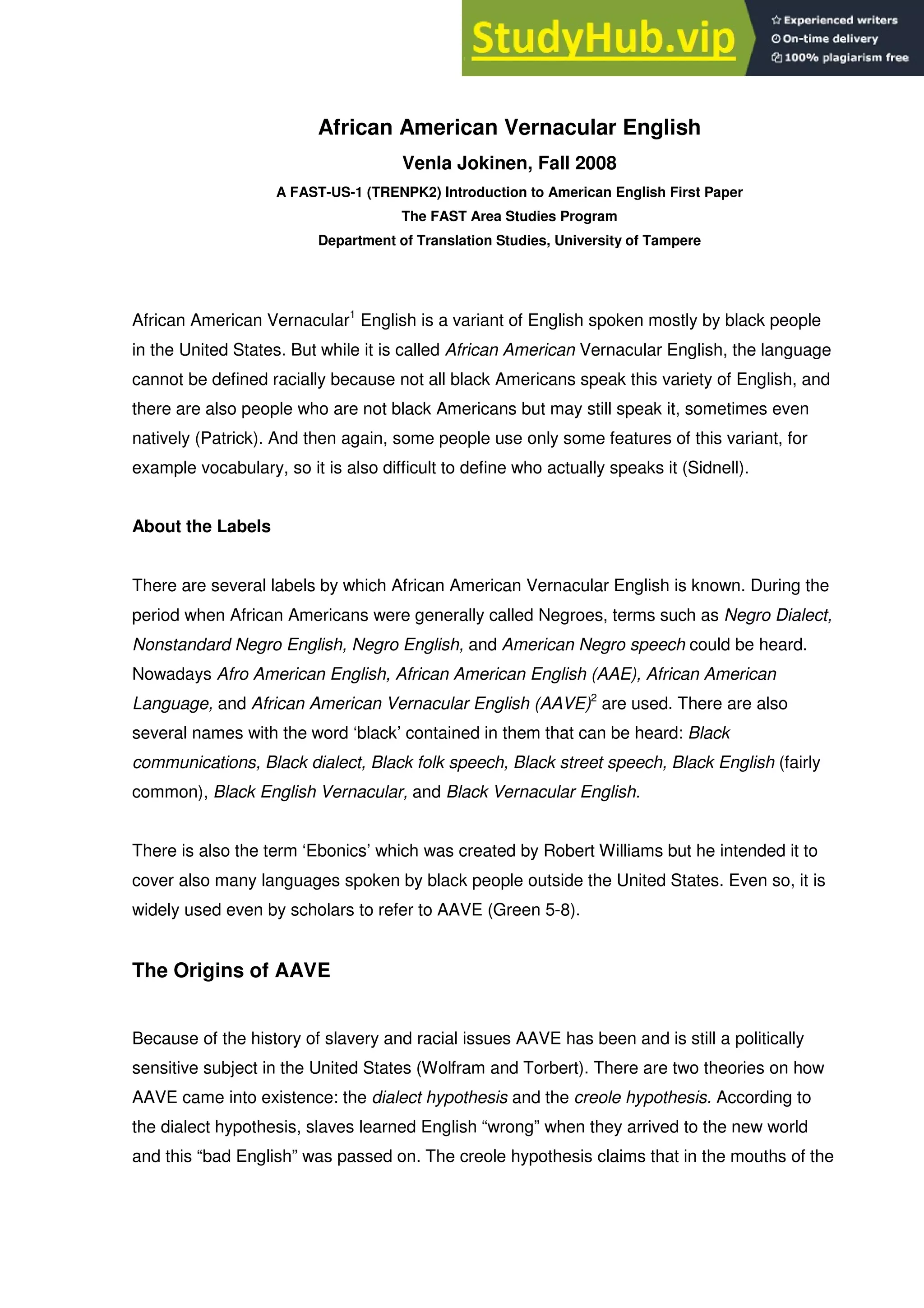
African American English (AAE) is a systematic, rule-governed variety of American English spoken by many African Americans. It is characterized by distinct grammatical, phonological, and lexical patterns that are consistent across regions. Rather than being "incorrect" English, AAE follows complex linguistic rules rooted in African languages and early American history.
African American English, often referred to by linguists as African American Vernacular English (AAVE), is one of the most studied and misunderstood dialects in the United States. In 2026, its influence on global culture, digital communication, and linguistic research remains profound, yet it continues to be a subject of intense sociological and educational debate. To understand AAE, one must look beyond the surface level of vocabulary and examine the sophisticated syntactic structures and the historical resilience of the people who developed it.
The Historical Foundations of African American English
The origins of AAE are the subject of two primary linguistic theories: the Creolist hypothesis and the Substratist (or Anglicist) hypothesis. Understanding these roots is essential for recognizing AAE not as a "broken" version of Standard American English (SAE), but as a linguistic evolution born of necessity and cultural preservation.
The Creolist hypothesis suggests that AAE developed from a creole language that arose during the Transatlantic Slave Trade. In this scenario, enslaved people from various West African linguistic backgrounds developed a pidgin—a simplified contact language—to communicate with each other and with European enslavers. Over generations, this pidgin evolved into a full-fledged creole, blending African syntax with English vocabulary.
Conversely, the Substratist and Anglicist theories argue that AAE's roots lie more heavily in the British and Irish dialects spoken by indentured servants and settlers in the American South. Proponents of this view suggest that African slaves adopted these regional British features, which were later modified by the unique "substrate" of West African languages. By 2026, most linguists favor a hybrid view, acknowledging that while AAE shares features with Southern white dialects, its unique aspect markers and phonology are undeniably influenced by West African grammatical logic.
Throughout the Great Migration of the 20th century, these linguistic patterns traveled from the rural South to urban centers in the North and West. This geographic spread led to the development of regional variations within AAE, though the core grammatical "backbone" of the dialect remained remarkably consistent across the United States.
Core Grammatical Structures and Verb Tense
One of the most complex aspects of AAE is its verb system, which utilizes aspectual markers to convey the timing and nature of an action with greater precision than Standard American English. These markers are often misinterpreted by non-speakers as "errors," when in fact they follow rigid internal logic.
The Habitual 'Be'
The use of "be" to indicate a recurring or habitual action is perhaps the most famous feature of AAE. For example, "He be working" does not mean "He is working right now." Instead, it means "He is habitually employed" or "He is usually working at this time." In SAE, one would have to use an adverb like "usually" or "regularly" to convey the same meaning. In AAE, this meaning is baked into the verb form itself.
Zero Copula (Copula Absence)
AAE allows for the omission of the verb "to be" in the present tense under specific conditions. For example, "She at home" instead of "She is at home." This is not a random deletion; it typically occurs in the same places where SAE speakers use contractions (e.g., "She's at home"). If the verb cannot be contracted in SAE (such as at the end of a sentence), it generally cannot be deleted in AAE. This demonstrates that AAE speakers are following a structured linguistic template.
Remote Past 'BEEN'
The stressed "BEEN" (phonetically /bɪn/) is used to indicate an action that happened a long time ago or a state that has existed for a significant duration. "I BEEN finished that" implies the task was completed long ago, whereas "I finished that" refers to a more recent completion. The emphasis on the syllable is a crucial phonological marker that changes the grammatical meaning.
Phonological and Sound Patterns
Beyond grammar, AAE is defined by specific phonological rules. These sounds are not "slurred" speech; they are consistent phonetic shifts that occur in many languages and dialects worldwide.
- Consonant Cluster Reduction: AAE often simplifies clusters of consonants at the end of words, especially if they are followed by a word starting with a consonant. For example, "desk" might be pronounced "des," or "test" as "tes." This rule is particularly active when the final consonant is a 't' or 'd'.
- Th-Fronting and Stopping: The "th" sound (/θ/ or /ð/) is often replaced with /f/, /v/, /t/, or /d/. "Birthday" may become "birfday," and "them" may become "dem." This feature is also found in several British and Caribbean dialects.
- Monophthongization: This involves the "flattening" of diphthongs (double vowel sounds). In SAE, the word "my" has a gliding vowel sound (/maɪ/). In AAE, it is often pronounced as a long, single vowel (/maː/), sounding like "mah."
- Liquid Vocalization: The "l" and "r" sounds at the end of words or before consonants may be weakened or turned into a vowel sound. This is similar to "non-rhotic" accents found in Boston or New York City.
Comparing AAE with General American English
The following table highlights the systematic differences between common AAE features and their equivalents in General American English (GAE).
| Feature | AAE Example | GAE Equivalent | Functional Purpose |
|---|---|---|---|
| Habitual Aspect | "They be laughing." | "They are usually laughing." | Denotes a recurring state or habit. |
| Completed Aspect | "He done ate." | "He has already eaten." | Emphasizes that an action is finished. |
| Remote Past | "I BEEN knew her." | "I have known her for a long time." | Indicates a state established long ago. |
| Negative Concord | "I don't want nothing." | "I don't want anything." | Provides emphasis through multiple negatives. |
| Copula Absence | "You the man." | "You are the man." | Matches contexts where SAE uses contractions. |
| Existential 'It' | "It's a fly in here." | "There is a fly in here." | Replaces "there is" with "it is." |
Social Context, Code-Switching, and Digital Evolution
In 2026, the social dynamics surrounding AAE are more visible than ever due to the ubiquity of social media. However, this visibility brings both celebration and "linguistic appropriation."
Code-switching is a survival and professional strategy used by many AAE speakers. It involves shifting between AAE and SAE depending on the social context. For example, a professional might use SAE in a corporate boardroom to avoid systemic bias (linguistic profiling) but switch to AAE at home or in social settings to build rapport and express cultural identity. Research by sociolinguists like John Baugh has shown that linguistic profiling—discriminating against a person based on their accent or dialect—remains a significant barrier in housing and employment.
Digital platforms have accelerated the spread of AAE vocabulary into the mainstream. Terms and grammatical structures originating in Black communities often become "internet slang" overnight. While this reflects the creative power of AAE, it also leads to "digital blackface" or the misuse of the dialect by non-speakers who do not understand the underlying grammatical rules. In 2026, the distinction between authentic AAE and "Internet African American English" (IAAE) is a major area of study, as the latter often lacks the systematic syntax of the former.
Educational and Legal Implications
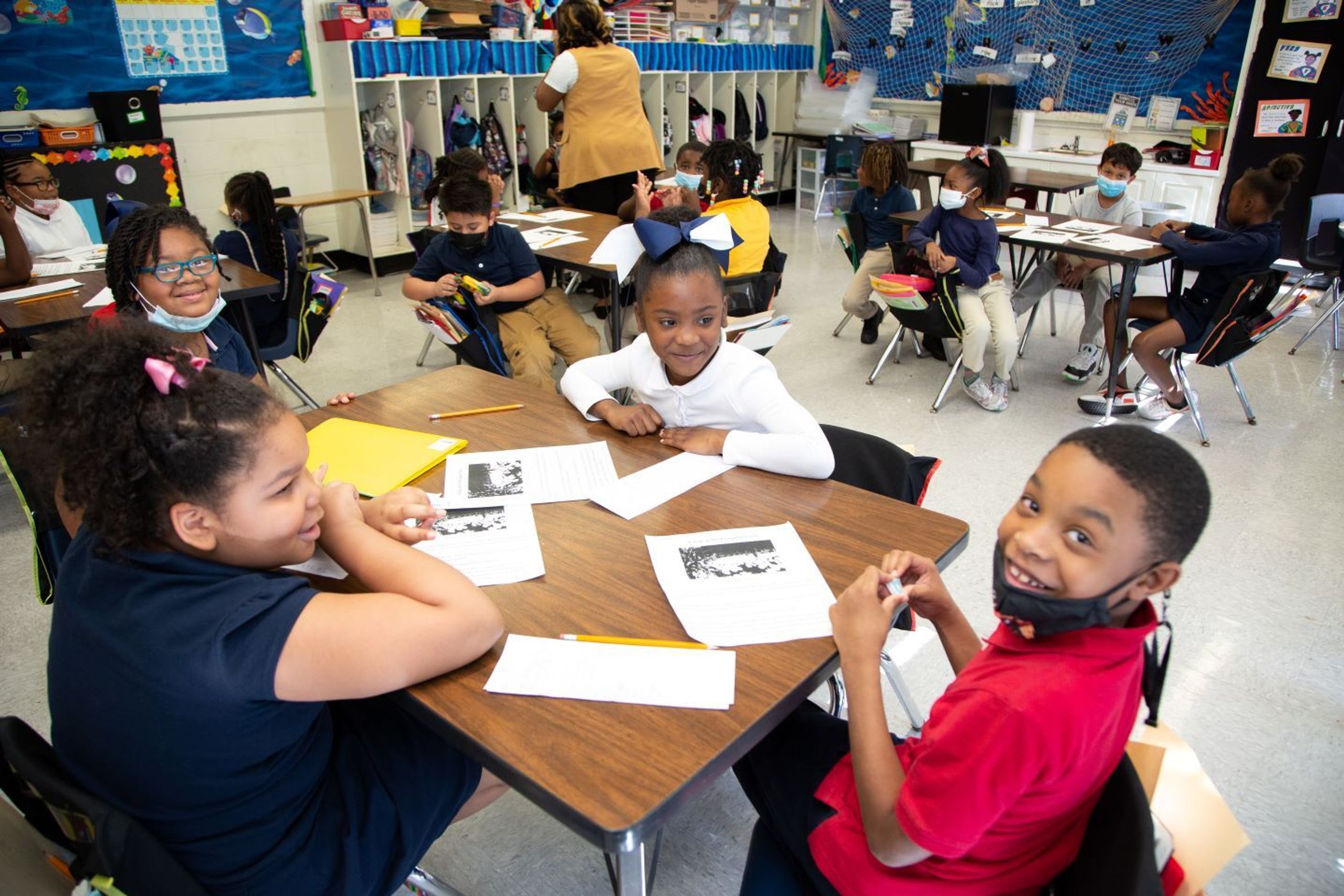
The recognition of AAE as a legitimate language system has had significant legal and educational milestones. The 1979 Ann Arbor Decision (King v. Ann Arbor School District) was a landmark case where a federal court ruled that teachers must take into account a student's home language (AAE) when teaching them to read Standard English.
Later, the 1996 Oakland Ebonics controversy sparked a national debate over whether AAE should be recognized as a primary language for Black students. While the media often misrepresented the resolution as "teaching Ebonics instead of English," the actual goal was to use AAE as a bridge to help students master SAE—a method known as contrastive analysis.
By 2026, many progressive school districts have adopted curricula that validate AAE while providing students with the "power code" of Standard English. This approach acknowledges that a student’s home dialect is not a "deficit" but a linguistic asset. Validating AAE in the classroom has been shown to improve literacy outcomes and student engagement by reducing the stigma associated with the way students and their families speak.
FAQ
Is African American English just "slang"?
No, AAE is a complete linguistic system with its own rules for grammar, syntax, and pronunciation. While it has its own slang (like any other dialect), its core features—such as the habitual "be"—are stable grammatical structures that have existed for centuries. Slang is temporary vocabulary; AAE is a permanent dialect.
Can anyone speak African American English?
While anyone can learn the vocabulary, AAE is a cultural dialect deeply tied to the history and experience of the African American community. Non-speakers who attempt to use it often miss the complex grammatical nuances, which can lead to it sounding performative or disrespectful. Understanding the social context is as important as understanding the grammar.
Is AAE the same as Southern American English?
AAE and Southern American English share many features due to their shared geographic history in the American South. However, they are distinct. AAE contains unique West African-influenced aspect markers (like "done" and "BEEN") and specific phonological patterns that are not typically found in white Southern dialects.
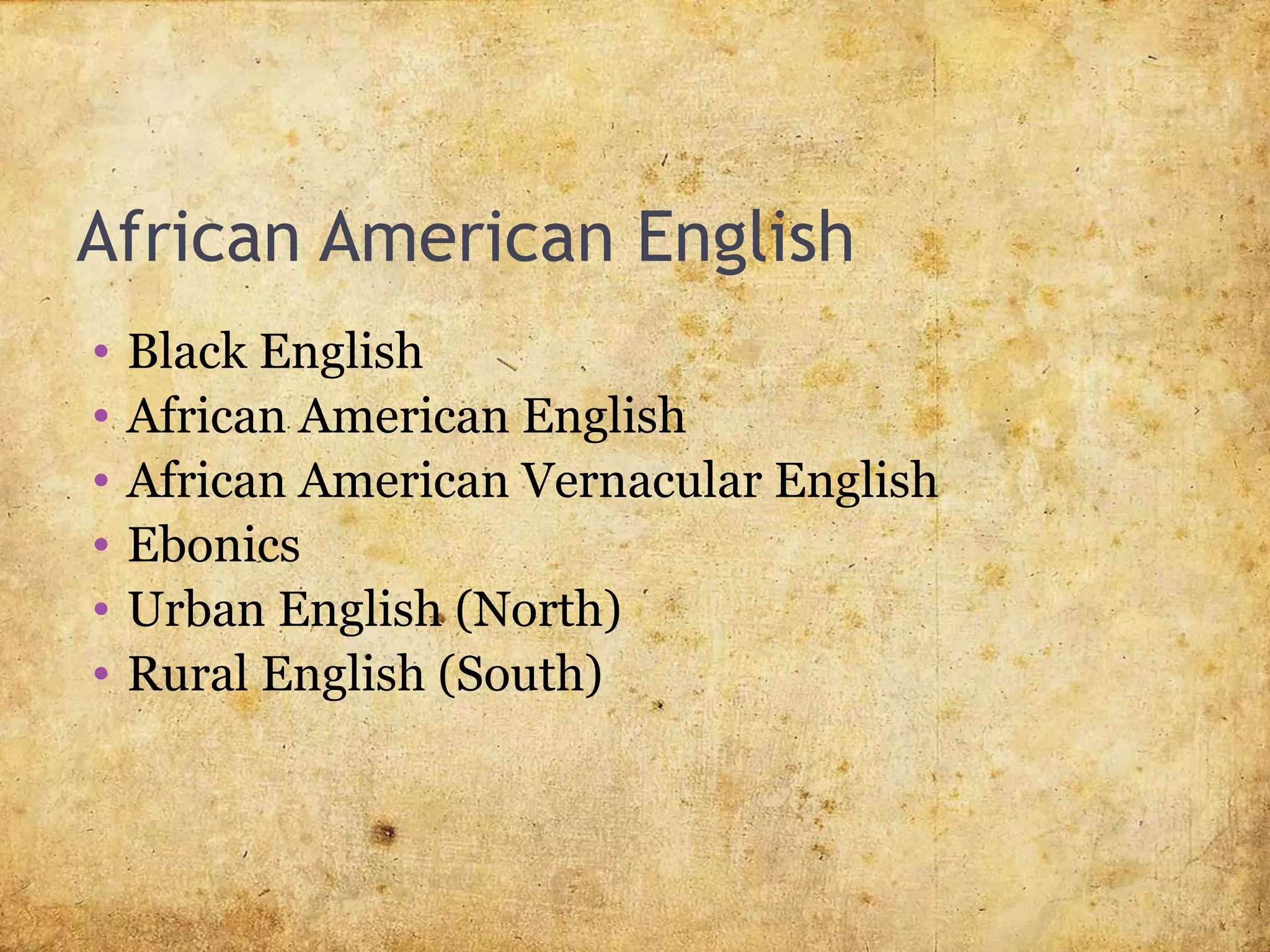
Why do some people call it AAVE or Ebonics?
"African American Vernacular English" (AAVE) is a term used by linguists to specify the non-standard, urban variety of the dialect. "Ebonics" is a portmanteau of "ebony" and "phonics" coined in 1973 by psychologist Robert Williams. While "Ebonics" became a household name in the 1990s, most scholars and the public today use the more comprehensive term "African American English."
Does speaking AAE affect intelligence or learning ability?
Absolutely not. There is no correlation between a person's native dialect and their cognitive ability. The challenges AAE speakers face in school or the workplace are typically the result of societal bias and a lack of instructional methods that bridge the gap between AAE and Standard English, rather than any inherent linguistic deficiency.
Recommendations for Professional and Social Engagement
For educators, employers, and the general public in 2026, navigating the complexities of AAE requires a commitment to linguistic justice.
- Educators: Implement Contrastive Analysis in the classroom. Instead of telling students their speech is "wrong," show them the differences between "Home Speech" and "School Speech." This helps students become bi-dialectal without devaluing their identity.
- Employers: Recognize that Linguistic Profiling is a form of discrimination. Diversity, Equity, and Inclusion (DEI) initiatives should include training on linguistic diversity to ensure that qualified candidates are not screened out because of their dialect.
- General Public: Be mindful of Linguistic Appropriation. Using AAE features for "coolness" or "humor" without understanding the culture or the rules of the dialect can be offensive. Respect AAE as a legitimate form of communication that carries the history and resilience of a community.
By treating African American English with the same respect afforded to any other global language or dialect, we move toward a more inclusive society that values the diverse ways humans express themselves.