Adoption barriers are the psychological, technical, economic, and organizational hurdles that prevent users or businesses from integrating new technologies or processes. These obstacles range from high upfront costs and lack of technical skills to cultural resistance and perceived complexity, ultimately stalling the return on investment for innovative solutions and modern operational workflows.
The Multi-Layered Nature of Adoption Barriers
In 2026, the landscape of innovation is moving faster than ever, yet the fundamental reasons why people and organizations resist change remain remarkably consistent. An adoption barrier is not merely a "no" from a customer or an employee; it is a complex intersection of friction points that can occur at any stage of the implementation lifecycle. To effectively manage these barriers, one must first recognize that they are rarely isolated. A technical limitation often triggers a psychological fear, which in turn creates a financial justification for maintaining the status quo.
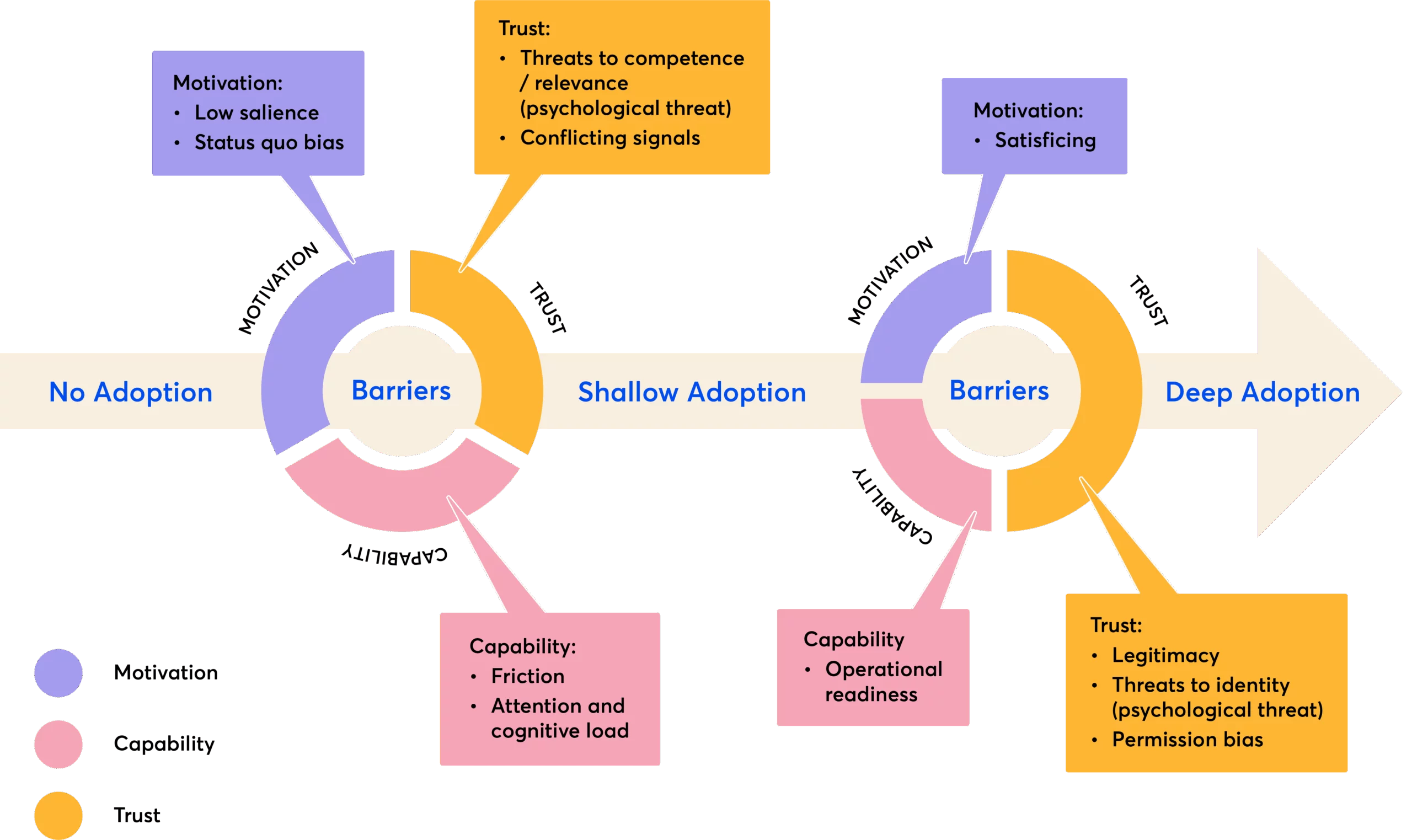
The "Status Quo Bias" remains the most significant psychological anchor. Humans are evolutionarily wired to prefer the familiar because it carries predictable risks. When a new system—be it an AI-driven project management tool or a new sustainable manufacturing process—is introduced, the perceived "cost of switching" often outweighs the perceived benefit in the short term. Understanding this helps leadership move away from viewing resistance as "stubbornness" and instead treats it as a structural problem that requires a strategic solution.
Economic and Financial Inhibitors to Change
Financial barriers are often the most visible hurdles to adoption. Even when a new technology promises long-term savings, the immediate capital expenditure (CAPEX) can be prohibitive. In the current 2026 economic climate, businesses are increasingly scrutinized on their liquidity and immediate cash flow, making "wait-and-see" a default defensive strategy.
Beyond the initial purchase price, several hidden costs contribute to adoption barriers:
- Training and Onboarding Expenses: The time employees spend learning a new system is time they are not performing their core duties. This "productivity dip" is a real financial cost that many organizations fail to budget for accurately.
- Legacy Integration Costs: Replacing a single component of a tech stack often requires expensive middleware or custom API development to ensure the new tool communicates with older, existing databases.
- Opportunity Cost of Failure: If a high-stakes adoption fails, the loss isn't just the money spent; it is the lost time that could have been used to pursue a different, more successful innovation.
To mitigate these, many providers have shifted toward "Success-Based Pricing" or highly modular deployment models. This allows organizations to verify the value of an innovation in a low-stakes environment before committing to a full-scale rollout.
Technical Debt and Infrastructure Complexity
Technical adoption barriers occur when the existing environment is fundamentally incompatible with the new solution. This is frequently seen in "Technical Debt," where years of quick-fix patches and outdated software architectures make it impossible to plug in modern, data-intensive tools.
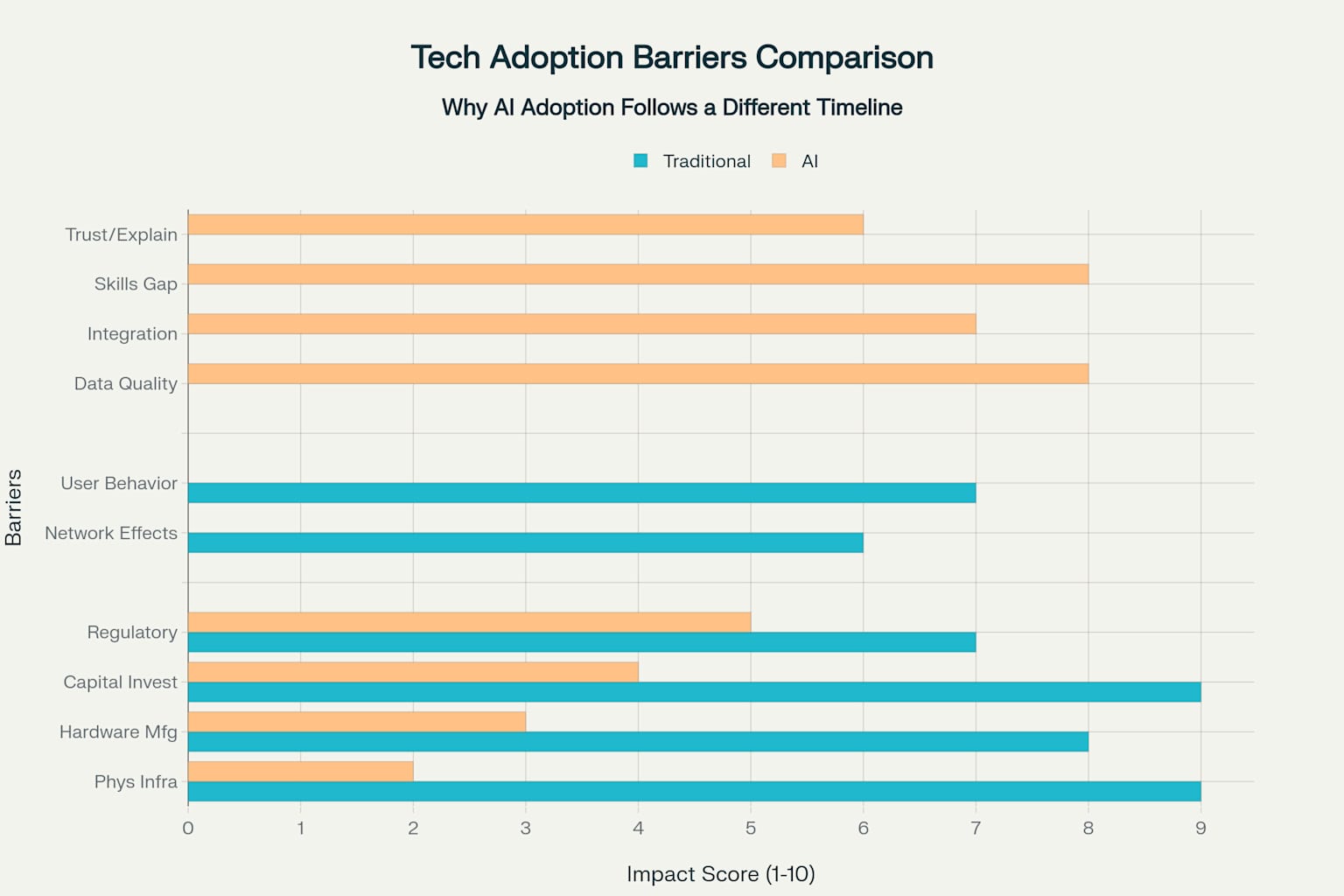
In 2026, a primary technical barrier involves data interoperability. As organizations move toward more autonomous systems, the requirement for clean, structured, and accessible data has become a massive roadblock. If a company’s data is siloed across different departments or stored in incompatible formats, the adoption of advanced analytics or AI agents becomes technically unfeasible without a massive, multi-year data-cleaning project.
Furthermore, infrastructure requirements such as high-speed connectivity, specific hardware specifications, or cloud-native environments can exclude certain regions or smaller enterprises from adopting the latest advancements. When the prerequisite for a solution is a complete overhaul of the underlying infrastructure, the barrier to entry often becomes insurmountable for all but the most well-funded entities.
Human Psychology and the Learning Curve
The "Learning Curve" is a term often used lightly, but in change management, it represents a significant barrier to adoption. Every new interface or process requires cognitive load. When employees feel overwhelmed by their existing workload, the addition of a new tool—no matter how helpful it claims to be—is often viewed as an additional burden rather than a relief.
Psychological barriers often manifest as:
- Fear of Obsolescence: Employees may resist a tool if they believe it will eventually automate them out of a job.
- Lack of Self-Efficacy: If a user feels they lack the technical literacy to master a new system, they will avoid using it to prevent looking incompetent.
- Complexity Perception: If the "Time to Value" (the time it takes for a user to see a benefit) is too long, they will abandon the tool and revert to their old ways.
To combat this, successful organizations prioritize User Experience (UX) and "Micro-Learning" modules that provide immediate, small wins for the user. By reducing the initial cognitive load, the psychological barrier is lowered, allowing the user to build confidence incrementally.
Comparing Types of Adoption Barriers
The following table categorizes the most common adoption barriers and identifies their primary impact and mitigation strategies.
| Barrier Category | Primary Characteristic | Common Example | Mitigation Strategy |
|---|---|---|---|
| Financial | High upfront or hidden costs | Expensive licensing or hardware | Phased rollouts; ROI-based pilot programs |
| Technical | Systems incompatibility | Data silos or legacy software | Middleware integration; API-first architecture |
| Psychological | Fear of change or complexity | Employees fearing job loss to AI | Transparent communication; reskilling programs |
| Organizational | Lack of structural support | No "champion" in leadership | Executive sponsorship; clear KPIs |
| Regulatory | Legal or compliance risks | Data privacy laws (GDPR/CCPA) | Compliance-by-design; legal audits |
| Usability | Poor interface design | "Over-featured" software | Simplified UX; targeted training |
Strategic Frameworks for Removing Barriers
Overcoming adoption barriers requires a move away from "forcing" technology on users and toward "enabling" them. Two primary frameworks are widely utilized in 2026 to manage this transition:
The Technology Acceptance Model (TAM)
TAM suggests that two specific factors determine whether a person will use a new system: Perceived Usefulness and Perceived Ease of Use. If the tool is useful but impossible to use, adoption fails. If it is easy to use but provides no value, adoption also fails. Leaders must market the "usefulness" internally while designers ensure "ease of use."
The Diffusion of Innovations (Rogers)
This theory categorizes adopters into five groups: Innovators, Early Adopters, Early Majority, Late Majority, and Laggards. The biggest barrier occurs at "The Chasm" between early adopters (who like tech for tech's sake) and the early majority (who want practical solutions). To cross this chasm, organizations must provide social proof, case studies, and reliable support structures that reassure the more risk-averse majority.
Industry-Specific Barriers: A 2026 Perspective
While the core principles are universal, different sectors face unique challenges. In Healthcare, the primary barrier is often regulatory and safety-related. The "cost of an error" is so high that adoption of new diagnostic tools is intentionally slowed by rigorous validation processes. This is a "protective barrier" that serves a public good but can delay the deployment of life-saving innovations.
In Manufacturing, the barrier is often physical. Integrating robotics into a 20-year-old assembly line requires more than a software update; it requires physical reconfiguration, downtime, and significant safety testing. Conversely, in the SaaS (Software as a Service) world, the primary barrier is often "subscription fatigue." Businesses are increasingly reluctant to add another monthly line item to their budget, leading to a "consolidation barrier" where only all-in-one platforms are being considered for adoption.
Frequently Asked Questions
What is the single biggest barrier to technology adoption?
Resistance to change, often rooted in the status quo bias, is generally considered the most significant barrier. While financial and technical issues are tangible, the human element—specifically the fear that a new system will be harder to use or threaten job security—is the most difficult to overcome because it cannot be solved simply by throwing money at the problem.
How do you measure the impact of adoption barriers?
The impact is usually measured through "Usage Rates," "Time to Proficiency," and "Churn." If an organization buys 500 licenses but only 50 people log in regularly after three months, that gap represents the cost of adoption barriers. Low engagement typically indicates that the perceived value does not exceed the effort required to use the system.
Can adoption barriers ever be beneficial?
Yes, in high-risk environments like aerospace or nuclear energy, adoption barriers act as a "filter" for unproven technologies. These barriers ensure that new systems are subjected to extreme scrutiny, stress-testing, and validation before they are allowed to manage critical infrastructure. In these cases, friction is a feature of safety, not a bug of the system.
How can small businesses overcome financial adoption barriers?
Small businesses often utilize "Modular Adoption." Instead of implementing a massive Enterprise Resource Planning (ERP) system all at once, they might adopt a single module (like inventory management) first. This lowers the initial investment and allows the business to fund future modules using the savings or revenue generated by the first one.
What role does leadership play in breaking down barriers?
Leadership is responsible for "Executive Sponsorship." When the C-suite actively uses and advocates for a new tool, it signals to the rest of the organization that the change is permanent and supported. Without this "top-down" validation, employees often view new initiatives as "flavor of the month" projects that can be ignored until they go away.
Navigating the 2026 Landscape: Your Implementation Roadmap
To successfully navigate and dismantle adoption barriers in the current year, organizations should adopt a "User-Centric" deployment strategy. The days of the top-down "mandatory rollout" are fading, replaced by internal marketing and iterative feedback loops. Start by identifying your "Internal Champions"—those early adopters who are naturally inclined toward innovation—and empower them to train their peers.
Next, conduct a "Friction Audit" before any major launch. This involves identifying exactly where a user might get stuck, whether it's a confusing login process, a lack of data access, or a fear of being replaced. By addressing these specific friction points before the launch, you significantly increase the likelihood of a smooth transition and a high return on investment. The ultimate goal is to make the new path easier than the old one; once the "benefit of change" clearly outweighs the "comfort of the status quo," adoption becomes an organic process rather than a forced one.