Adjective usage governs how descriptive words modify nouns and pronouns to clarify, quantify, or add specific qualities to sentences. Proper application requires understanding attributive and predicative placement, coordinate versus cumulative ordering rules, and the avoidance of redundancy or excessive modification to maintain clear, effective prose.
Understanding the Core Function of Adjectives in Grammar
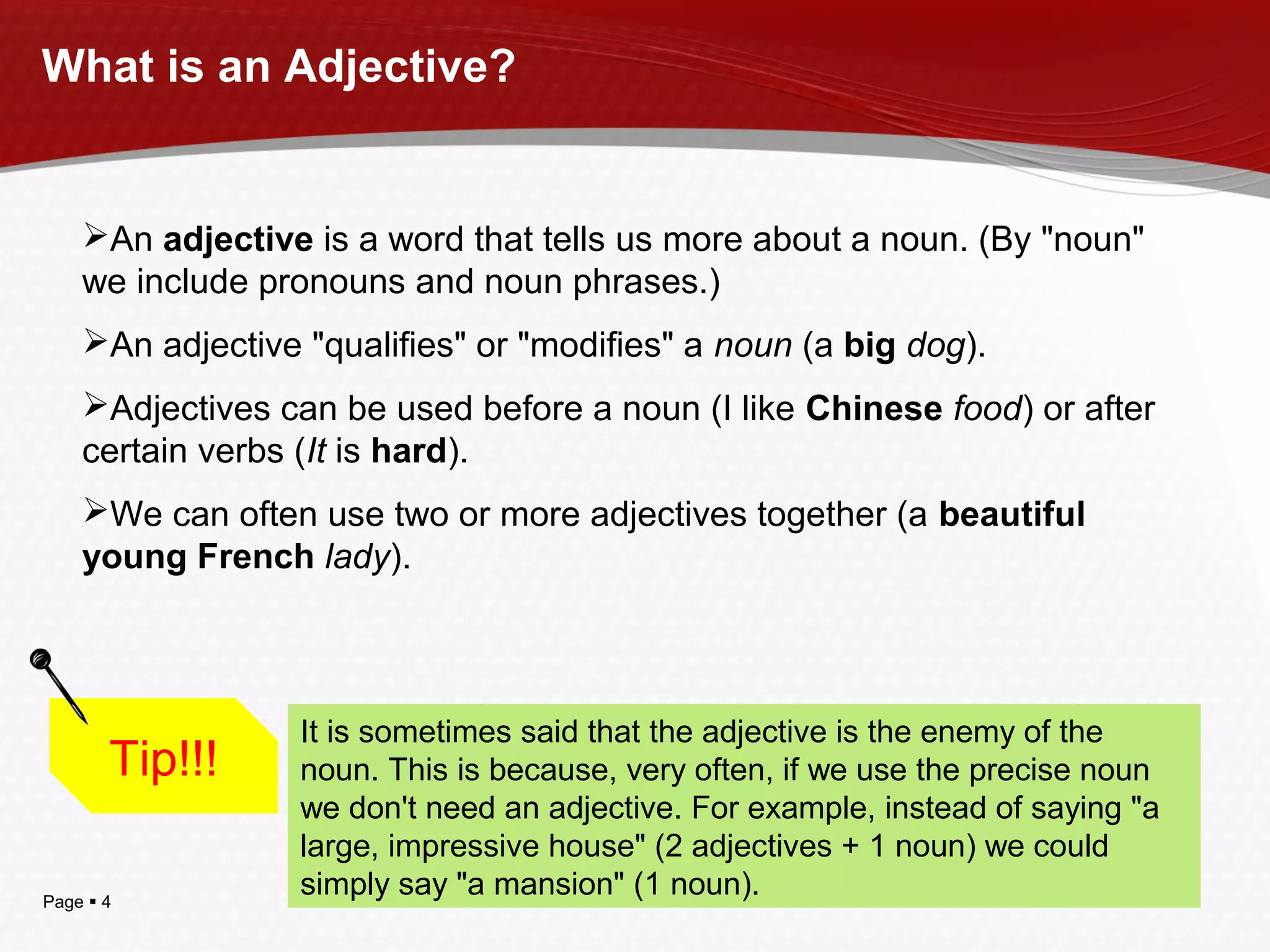
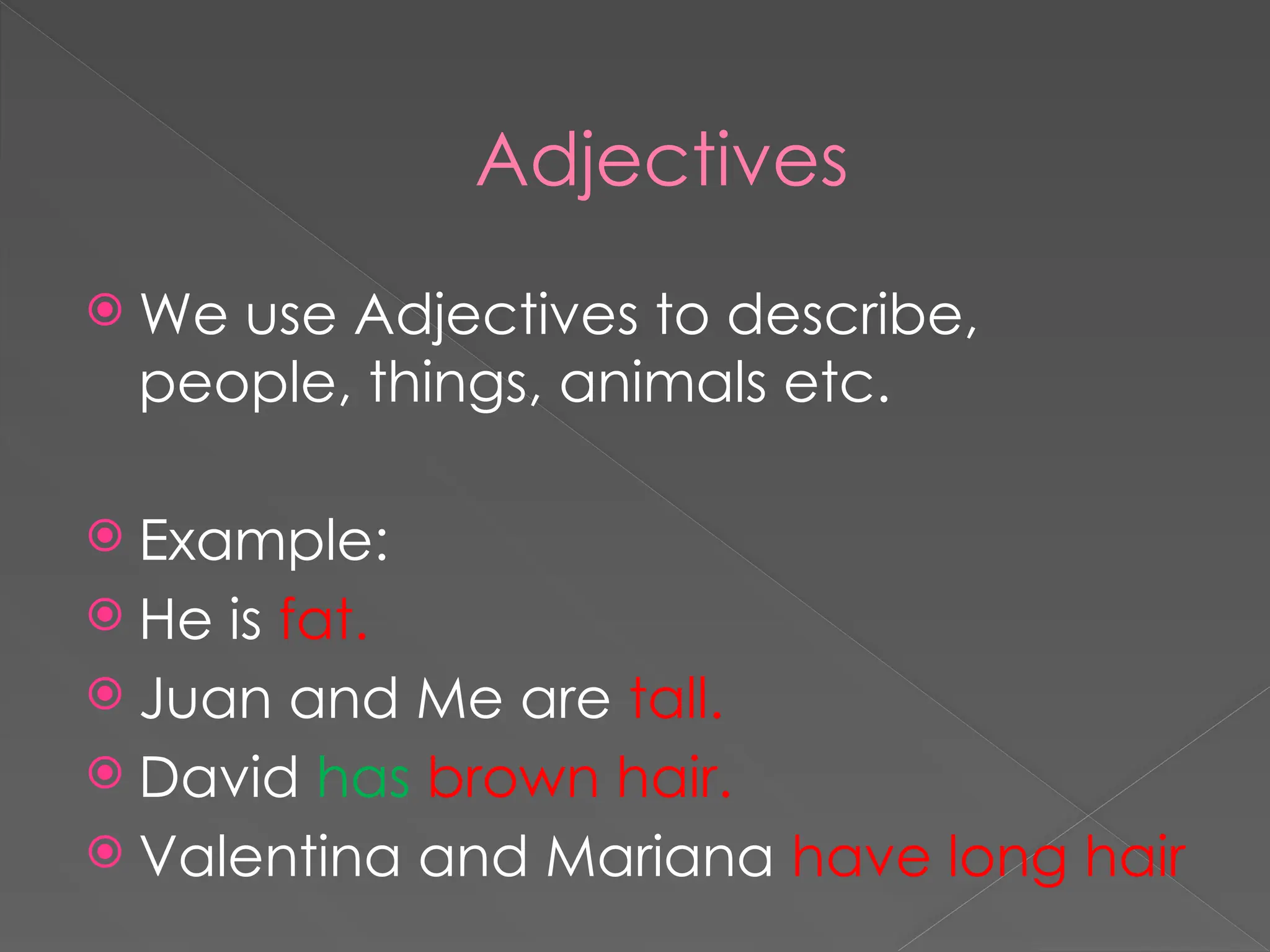
Adjectives serve as essential modifiers within the English language, expanding upon the identity, state, or quantity of nouns and pronouns. By answering questions such as which one, what kind, how many, or whose, these parts of speech transform plain statements into precise, evocative expressions. However, mastering adjective usage extends far beyond vocabulary selection; it requires strict adherence to structural placement, agreement, and stylistic restraint.
When writers deploy modifiers without a clear understanding of their grammatical boundaries, sentences quickly become convoluted or ambiguous. For instance, modifying a single noun with an excessive string of adjectives overwhelms the reader, diluting the impact of the core subject. Furthermore, different types of adjectives—such as descriptive, quantitative, demonstrative, and possessive—interact with nouns under distinct syntactic rules. Recognizing these underlying categories allows writers to construct balanced sentences that communicate precise intent without cognitive friction.
Attributive Versus Predicative Placement
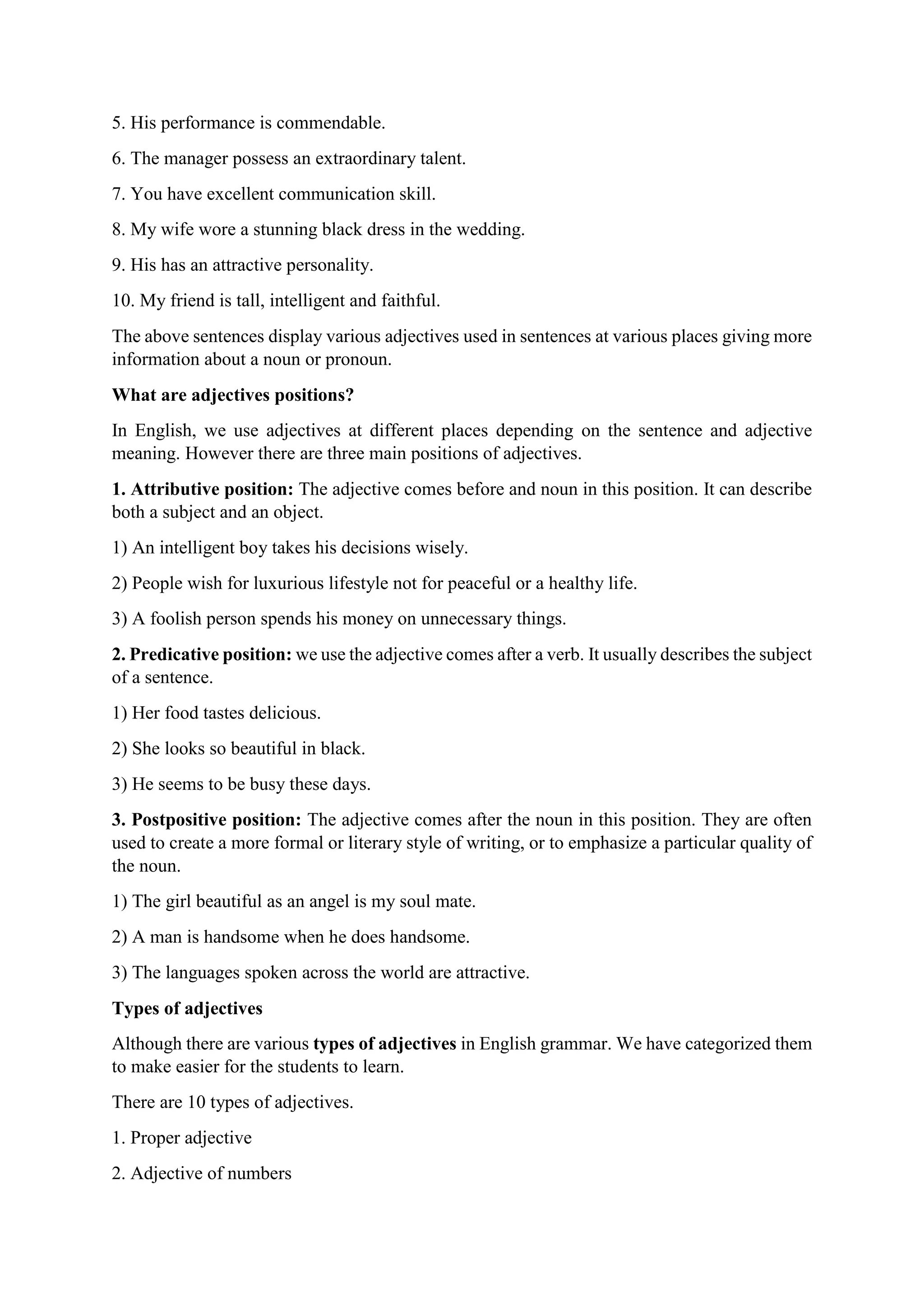
The position of an adjective within a sentence dictates its grammatical relationship to the modified noun. Adjectives generally appear in one of two primary positions: attributive or predicative.
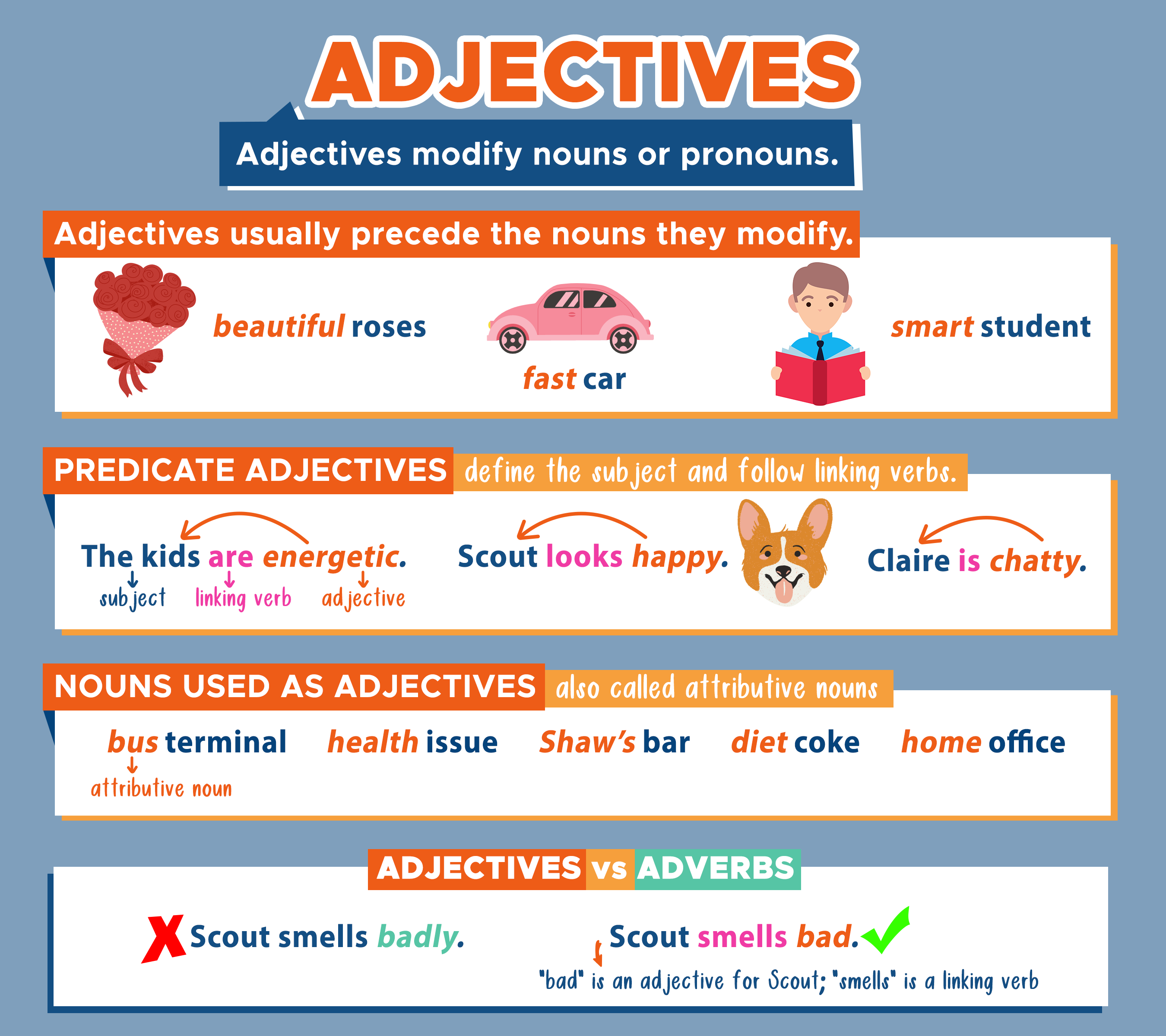
Attributive adjectives sit directly adjacent to the noun they modify, typically placed immediately before it. For example, in the phrase "the weathered wooden fence," both "weathered" and "wooden" function attributively. This placement creates an integrated mental image, immediately narrowing the scope of the noun for the reader.
Conversely, predicative adjectives appear after a linking verb—such as is, seem, become, or sensory verbs like look, taste, and feel—and modify the subject of the clause from a distance. In the sentence "The fence is weathered and wooden," the adjectives complete the predicate rather than nestle against the noun.
Certain adjectives are restricted to only one of these positions. For example, adjectives like alone or afraid are almost exclusively predicative; native speakers do not write about an "afraid child," but rather note that "the child is afraid." Understanding these distributional constraints prevents awkward phrasing and grammatical errors that disrupt the natural flow of text.
The Definitive Rules for Adjective Ordering
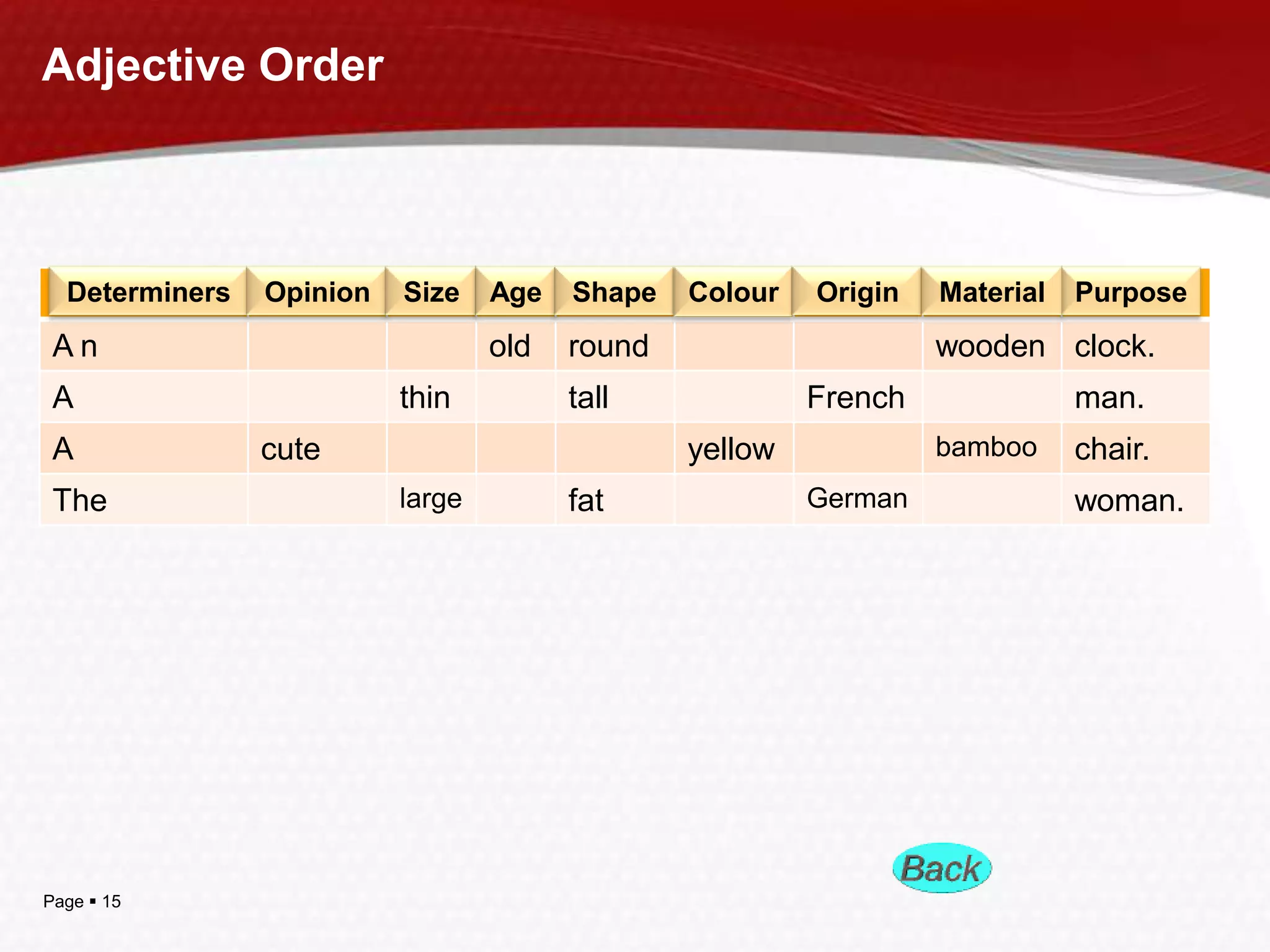
When multiple descriptive adjectives modify the same noun in English, native speakers unconsciously follow a strict, unwritten hierarchy known as coordinate and cumulative adjective ordering. Violating this sequence sounds immediately jarring to an ear attuned to the language, even if the reader cannot pinpoint the exact grammatical violation.
The standard sequence for multiple cumulative adjectives generally moves from subjective evaluations to objective properties. The conventional pedagogical progression follows this structure:
- Opinion: beautiful, horrible, useful
- Size: massive, tiny, tall
- Physical Quality: rough, polished, sharp
- Shape: circular, square, crooked
- Age: ancient, modern, adolescent
- Color: crimson, turquoise, pale
- Origin: Italian, Lunar, domestic
- Material: silken, metallic, wooden
- Purpose: sleeping (bag), running (shoes)
When adjectives belong to the same category or carry equal weight, they are classified as coordinate adjectives. Coordinate adjectives can be reversed in order without changing the meaning and require a comma between them (or the conjunction and). Cumulative adjectives, by contrast, build upon one another sequentially, meaning their order cannot be swapped, and they require no punctuation.
| Feature | Coordinate Adjectives | Cumulative Adjectives |
|---|---|---|
| Order Flexibility | Can be rearranged freely without altering meaning. | Must follow a strict, logical sequence. |
| Punctuation | Separated by commas or the word and. | Never separated by commas. |
| Grammatical Test | Passes the "and" test (e.g., "cold and windy day"). | Fails the "and" test (e.g., cannot say "wooden and antique table"). |
Comparative and Superlative Degrees
Adjectives change form to express degrees of comparison when evaluating differences between items. These variations manifest as the positive, comparative, and superlative degrees, each serving a distinct analytical function.
- Positive Degree: The base form of the adjective, used when no comparison is made (e.g., "The building is tall").
- Comparative Degree: Used to compare two entities, typically formed by adding the suffix -er to short adjectives or placing more before longer adjectives (e.g., "This building is taller than that one").
- Superlative Degree: Used to compare three or more entities, indicating the extreme limit of the quality, formed by adding -est or placing most before the adjective (e.g., "This is the tallest building in the city").
Writers must avoid redundant forms of comparison, such as writing "more faster" or "most unique." Absolute adjectives—those representing qualities that cannot logically exist in degrees, such as dead, unique, infinite, or perfect—technically resist comparison. While colloquial speech frequently bends this rule for emphasis, formal writing requires strict adherence to their absolute nature.
Avoiding Common Pitfalls and Stylistic Errors
Even experienced writers frequently fall into predictable traps regarding adjective usage. Recognizing these common errors ensures cleaner, more professional prose.
- Over-Modification (Purple Prose): Packing a single noun with three or four adjectives slows the narrative pace and weakens the writing. Trust strong nouns to carry the weight of the sentence instead of relying on excessive modifiers.
- Misplaced Modifiers: Placing an adjective too far from the noun it modifies creates absurd mental imagery. Ensure modifiers sit adjacent to their targets to preserve clarity.
- Redundancy: Pairing an adjective with a noun that inherently contains that quality—such as "past history," "future planning," or "circle round"—wastes words and reveals sloppy editing.
- Hyphenation Neglect: Failing to hyphenate compound adjectives acting as a single thought before a noun leads to misreading. Compare "a little used car" (a car that has had minimal use) with "a little-used car" (a compact car that is older).
How to Refine Adjective Usage in Professional Editing
Polishing a manuscript requires a deliberate review of descriptive language during the revision stage. Authors should evaluate every modifier with a critical eye, asking whether the adjective performs necessary structural or semantic work. If an adjective merely repeats information already established by the noun, it should be deleted.
Replacing weak adjectives paired with generic nouns with a single, precise noun often elevates the quality of writing exponentially. For example, replacing "very cold, biting wind" with "blizzard" or "gale" eliminates word clutter while increasing sensory impact. Writers should also audit their reliance on intensifiers like very, really, quite, and extremely. These crutch words rarely add substantive value; replacing them with stronger base adjectives tightens sentence structure and commands greater reader attention.
Frequently Asked Questions
What is the difference between an adjective and an adverb?
An adjective modifies a noun or a pronoun by describing its qualities, states, or quantities. An adverb modifies a verb, an adjective, or another adverb, typically describing manner, place, time, degree, or frequency. For example, in "She is a quick runner," "quick" is an adjective modifying the noun "runner," whereas in "She ran quickly," "quickly" is an adverb modifying the verb "ran."
When should coordinate adjectives be separated by commas?
Coordinate adjectives should be separated by commas when they independently modify the same noun with equal weight. A reliable test is to insert the word "and" between them or reverse their order; if the sentence still sounds natural and retains its original meaning, commas are required. Cumulative adjectives, which rely on a strict logical hierarchy, do not take commas.
Can nouns function as adjectives?
Yes, nouns frequently function as attributive nouns (or noun adjuncts) when placed directly before another noun to describe it. In phrases like "coffee cup," "computer screen," or "history teacher," the first noun modifies the second noun in the exact same manner as a traditional adjective, though grammatically it retains its noun classification.
What are absolute adjectives and why can they not be compared?
Absolute adjectives describe qualities that are absolute and binary, meaning an entity either possesses the quality entirely or not at all. Examples include dead, unique, universal, round, and infinite. Because these qualities do not exist on a sliding scale, phrasing such as "more unique" or "most dead" is grammatically incorrect in formal contexts.
How many adjectives are too many for a single noun?
While grammar rules do not establish a hard numerical limit, stylistic conventions dictate that using more than two or three consecutive adjectives before a noun creates clutter and exhausts the reader. Professional writers prefer strong, specific nouns that require minimal modification over long strings of descriptive modifiers.
What is the difference between attributive and predicative adjectives?
Attributive adjectives appear directly before the noun they modify within the noun phrase, such as "the swift river." Predicative adjectives appear after a linking verb—such as is, become, or feel—in the predicate of the sentence, such as "The river is swift." Certain adjectives are restricted exclusively to one of these positions.