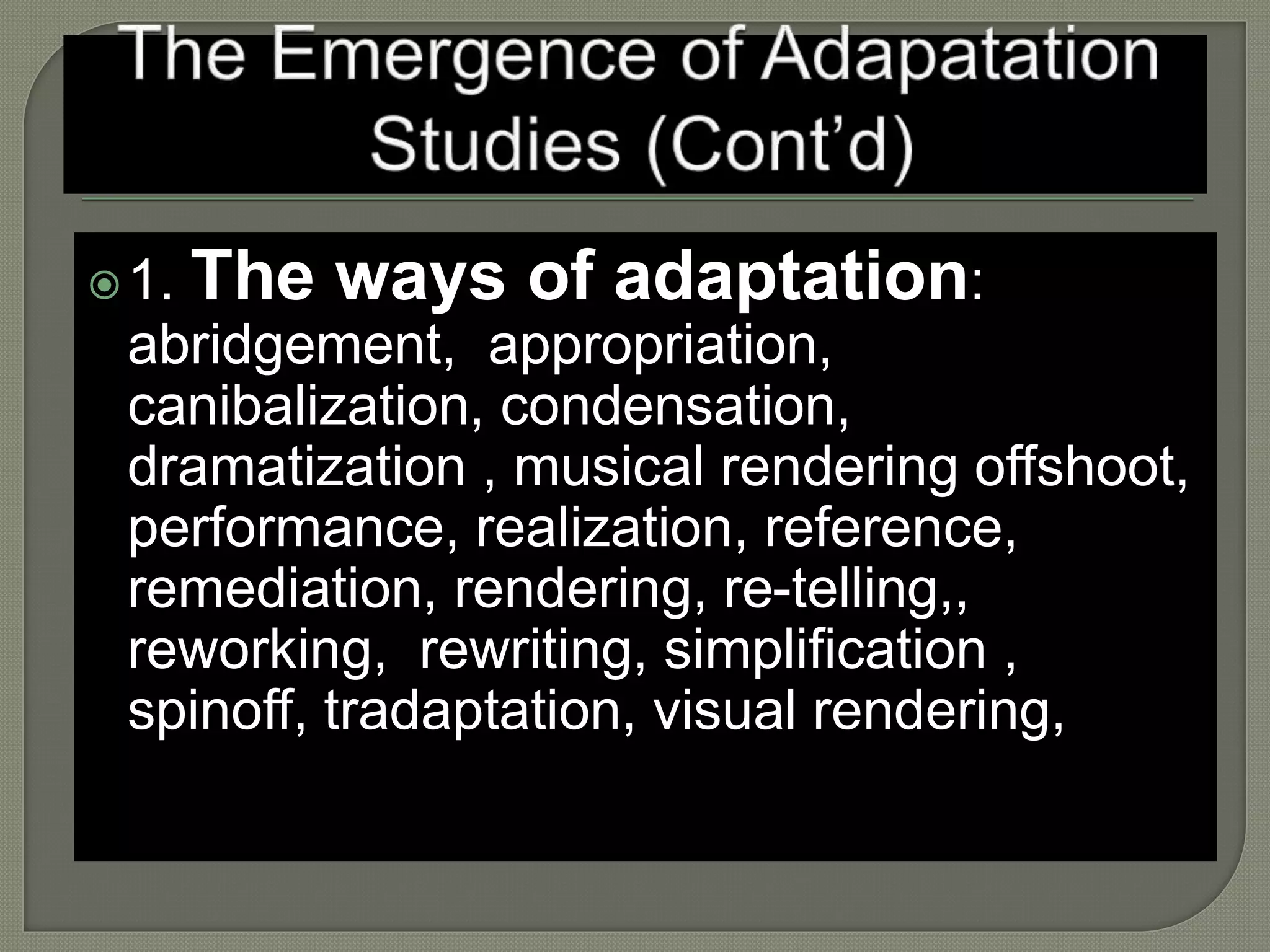
Adaptation studies is an interdisciplinary academic field that examines the transformation of narratives across different media, such as literature, film, theatre, and digital games. It explores the creative, cultural, and industrial processes involved in re-versioning stories, moving beyond simple comparisons of "faithfulness" to investigate how contexts and medium-specific affordances reshape meaning and audience engagement.
The Historical Shift from Fidelity to Intertextuality
For much of the 20th century, the study of adaptation was dominated by "fidelity criticism." This approach measured the value of a film or play based on how closely it adhered to its "original" source, which was almost always a literary text. Critics often viewed the source material as a sacred entity, leading to a pervasive "the book was better" bias. George Bluestone’s 1957 work, Novels into Film, was a foundational text in this era, identifying the inherent tensions between linguistic and visual media but still operating within a framework that prioritized the written word.
By the early 2000s, scholars began to challenge this hierarchy. The "fidelity" model was increasingly seen as restrictive and analytically shallow because it ignored the creative possibilities unique to different media. Researchers began to argue that an adaptation is not a mere copy but a "re-coding" or "re-mediation" of a story. This shift moved the focus from what was "lost" in translation to what was "gained" or "changed" through the affordances of the new medium.
The modern paradigm, established firmly by 2026, views adaptation through the lens of intertextuality—the idea that all texts are related to one another. Adaptation is now understood as a process of "palimpsestuous" creation, where the new work exists as a layer over the old, allowing the audience to experience both simultaneously. This perspective recognizes that the "original" is often itself an adaptation of earlier myths, historical events, or folklore.
Core Theoretical Frameworks in Adaptation Studies
To conduct a rigorous analysis in adaptation studies, researchers rely on several key theoretical frameworks. These theories provide the vocabulary needed to describe how a story changes when it moves from the page to the screen or the digital interface.
Linda Hutcheon’s A Theory of Adaptation
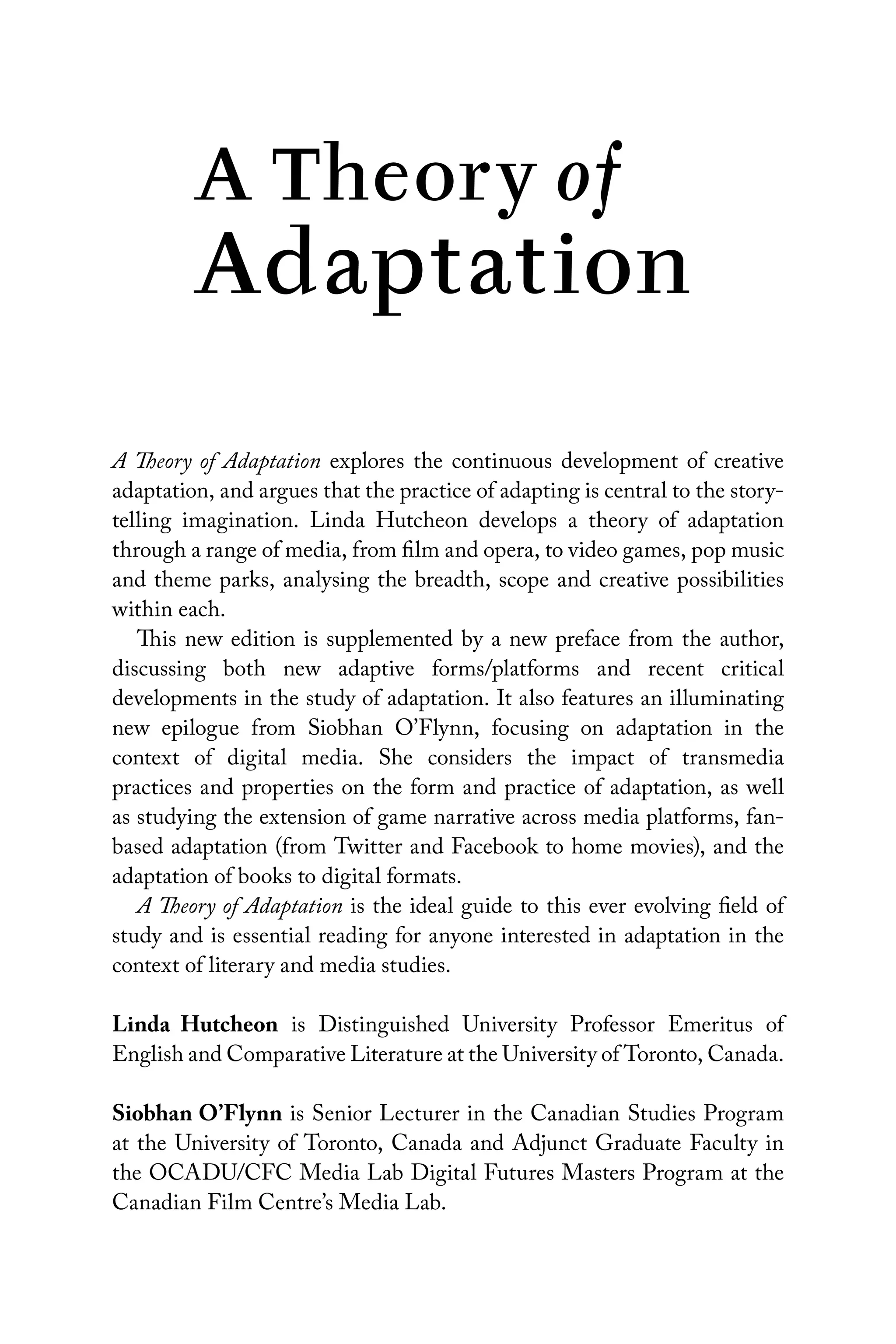
Linda Hutcheon’s A Theory of Adaptation (2006) remains a cornerstone of the discipline. She defines adaptation as both a process and a product. As a process, it involves the creative appropriation and salvaging of stories. As a product, it is an "announced and extensive transposition" of a particular work. Hutcheon emphasizes that adaptation is a form of repetition without replication, where the pleasure for the audience comes from the recognition of the familiar combined with the surprise of the new.
Thomas Leitch and the Post-Fidelity Era
Thomas Leitch, in his influential work Adaptation and Its Discontents (2007), argues against the "moralistic" tone of fidelity criticism. He suggests that we should treat adaptation as a "rhizomatic" process—a network of connections rather than a linear descent from a single source. This allows for the inclusion of sequels, prequels, spin-offs, and even "un-adaptable" meta-fictions within the scope of the study.
Kamilla Elliott and the "Looking-Glass" Model
Kamilla Elliott has contributed significantly by analyzing the relationship between words and images. She critiques the "categorical" separation of media, suggesting that literature and film share more "DNA" than previously thought. Her work explores how adaptations often act as mirrors, reflecting the cultural anxieties and aesthetic preferences of the time in which they are produced.
Essential Methodologies for Analyzing Adapted Works
Analyzing an adaptation requires more than just watching a movie and reading the book it was based on. It requires a systematic approach to identifying changes in narrative structure, character development, and thematic resonance.
- Medium-Specific Analysis: Every medium has "affordances"—things it can do that others cannot. A novel can provide deep internal monologues and complex metaphorical language. A film can use cinematography, soundscapes, and lighting to evoke emotion. A video game allows for agency and procedural storytelling. Methodology begins by identifying how the adaptation utilizes these unique tools.
- Socio-Cultural Context: Adaptations do not happen in a vacuum. A 1940s adaptation of Pride and Prejudice will look and feel very different from a 2005 version or a 2024 digital interactive series. Scholars examine the "historical moment" of production to understand why certain plot points were emphasized or deleted.
- Industrial Constraints: Budgets, casting choices, rating systems (like the MPAA), and platform requirements (Netflix vs. theatrical release) all dictate the final form of an adaptation. Technical SEO for content in 2026 often mirrors this by looking at the "platform-specific" delivery of information.
- Reception Theory: This involves studying how the audience perceives the adaptation. Does the "fanbase" of the original work reject the new version? How do critics' reviews reflect broader cultural shifts?
Categorizing Adaptation Types
Not all adaptations serve the same purpose. Some aim for a literal recreation, while others use the source material as a loose jumping-off point. The following table outlines the standard categories used by scholars to classify these works.
| Adaptation Type | Primary Goal | Relationship to Source | Example |
|---|---|---|---|
| Transposition | Literal Accuracy | High fidelity; aims to "recreate" the experience of the original. | The Lord of the Rings (Jackson) |
| Commentary | Critical Dialogue | Modifies the source to critique or update its themes. | Wide Sargasso Sea (Rhys) |
| Analogy | Cultural Shift | Transfers the plot to a completely different time/place. | Clueless (based on Emma) |
| Abstraction | Stylistic Reinterpretation | Uses the source as a mood or aesthetic inspiration only. | Apocalypse Now (based on Heart of Darkness) |
| Interactive | Agency-Based | Transforms passive narratives into playable experiences. | The Witcher Game Series |
Adaptation in the Digital Age: Games, VR, and AI
As of 2026, the boundaries of adaptation studies have expanded significantly to include immersive and algorithmic media. The transition from linear storytelling (films/books) to non-linear storytelling (games/VR) presents the most significant challenge to traditional theory.
Transmedia Storytelling
Coined by Henry Jenkins, transmedia storytelling involves a narrative that is spread across multiple platforms, where each medium makes a unique and valuable contribution to the whole. For example, a story might begin in a novel, continue in a television series, and conclude in an alternate reality game (ARG). Adaptation studies now focuses on how these "narrative ecosystems" maintain consistency while adapting to different user interfaces.
Ludic Adaptation (Video Games)
When a book is adapted into a video game, the "reader" becomes a "player." The focus shifts from witnessing a character's choices to making those choices. Scholars analyze how "ludonarrative harmony"—the balance between gameplay mechanics and story—affects the adaptation's success. In 2026, we see a rise in "procedural adaptations," where AI generates dynamic story paths based on a set of literary rules or "style guides" derived from the original author's work.
Artificial Intelligence and Re-versioning
The role of AI in adaptation is a burgeoning sub-field. Generative AI tools are now used to "translate" scripts into storyboards or even full-length cinematic sequences. This raises questions about authorship and "algorithmic fidelity." Is an AI-generated adaptation still an artistic work, or is it a statistical average of the source material? Current academic discourse emphasizes the "human-in-the-loop" model, where AI acts as a creative partner rather than a replacement for the adapter.
Common Challenges and Critical Debates
The field is not without its controversies. One of the primary debates involves the concept of "the death of the original." Some scholars argue that in an era of constant reboots and remakes, the "original" source material no longer holds any special status. Others contend that this leads to a "cultural amnesia" where historical context is lost in favor of brand recognition.
Another challenge is the "Western-centric" bias of the discipline. For decades, adaptation studies focused almost exclusively on English-language literature and Hollywood cinema. In recent years, there has been a concerted effort to include "Global South" perspectives, examining how indigenous storytelling traditions and non-Western media (such as Manga or Nollywood cinema) approach the concept of re-versioning.
Frequently Asked Questions
What is the difference between a remake and an adaptation?
A remake is typically a new version of an existing film or game, usually within the same medium. An adaptation involves a change in the medium, such as a book becoming a film or a play becoming a radio drama. However, in modern scholarship, remakes are often studied under the broader umbrella of adaptation because they involve the same processes of re-contextualization.
Why do some adaptations fail despite following the book closely?
Failures often occur when a creator prioritizes "fidelity" over "medium affordance." What works on a page (like a 10-page internal monologue) may feel slow and boring on screen. A successful adaptation understands that to be "true" to the spirit of a work, it must often be "untrue" to its literal structure.
Is "fidelity" still a relevant term in 2026?
While "fidelity" is no longer used as a measure of quality, it remains relevant as a measure of intent. Scholars still analyze how much a work tries to be faithful, as this reveals a lot about the target audience and the commercial goals of the production.
Can a video game be considered a "source text"?
Absolutely. In the current media landscape, video games are frequently the primary source for films and TV shows (e.g., The Last of Us). This has led to the development of "reverse adaptation" studies, looking at how interactive mechanics are "flattened" back into linear narratives.
How does copyright law affect adaptation studies?
Copyright and Intellectual Property (IP) are central to the industry. The "fair use" doctrine and licensing agreements dictate what can be adapted and how. For researchers, understanding the legal constraints helps explain why certain adaptations take creative liberties or avoid specific characters and plot points.
Recommended Paths for Further Research
For those looking to engage more deeply with adaptation studies, the next step is to move beyond casual observation and into structured analysis. Start by selecting a single "transmedia franchise"—such as The Witcher, Dune, or The Last of Us—and map the changes across at least three different media formats.
When conducting this research, focus on the "why" rather than the "what." Instead of listing what was cut from the book, ask: "Why did the cinematic medium necessitate this omission, and how does it change the audience's perception of the protagonist?" Utilizing databases like the Journal of Adaptation in Film & Performance or the Literature/Film Quarterly will provide access to peer-reviewed case studies that model these analytical techniques. Engaging with the "Adaptation Studies Network" or attending conferences like the "Association of Adaptation Studies" annual meeting can also provide critical insights into the latest methodological developments in the field.