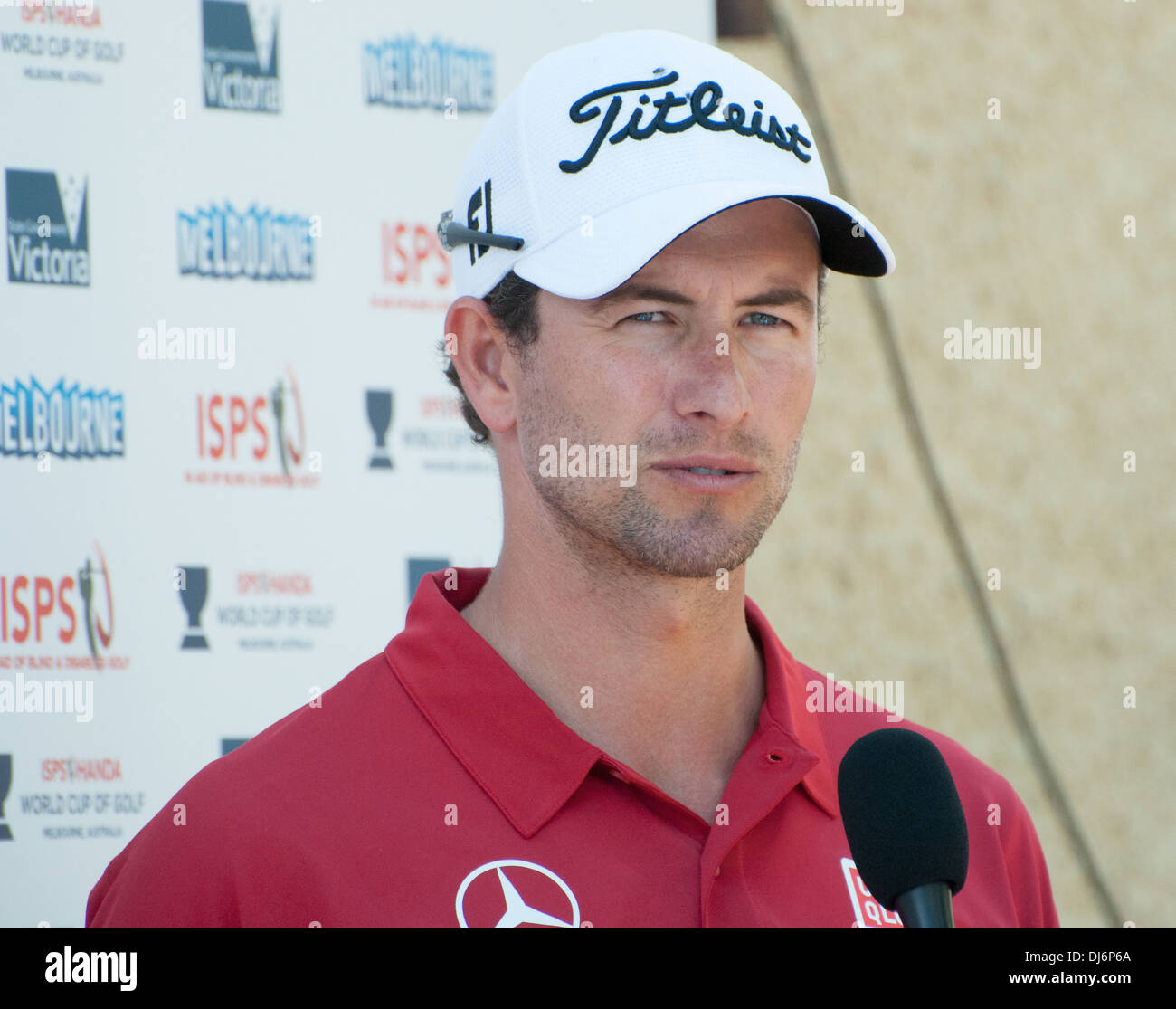
Adam Scott is a premier Australian professional golfer, best known for becoming the first Australian to win the Masters Tournament in 2013 and for reaching the World No. 1 ranking in 2014. With over 30 professional wins globally, he is celebrated for one of the most technically perfect swings in the history of the sport and for his enduring consistency across three decades of elite competition.
The Foundation of a Great: Early Career and "The Swing"
Born on July 16, 1980, in Adelaide, Australia, Adam Scott’s ascent to the pinnacle of professional golf was forecasted almost from the moment he turned professional in 2000. Under the early tutelage of his father, Phil Scott, and later the renowned coach Butch Harmon, Scott developed a swing that many analysts consider the "textbook" model for modern golf. This swing, characterized by its incredible balance, wide arc, and fluid tempo, drew immediate comparisons to a young Tiger Woods—a comparison that was both a compliment and a significant burden for the young Australian.
Scott’s amateur career was a harbinger of the success to come. He was a member of the Golf Australia National Squad and won the Australian Boys' Amateur in 1997 and 1998. After a brief but successful stint at the University of Nevada, Las Vegas (UNLV), where he was an All-American, Scott turned pro and quickly made his mark on the European Tour (now the DP World Tour). His first professional win came at the 2001 Alfred Dunhill Championship in South Africa, a victory that signaled his readiness for the global stage.
The "Harmon era" of Scott’s career focused on precision and power. By refining his ball-striking, Scott became a perennial threat on any course that demanded accuracy from the tee to the green. This technical foundation allowed him to transition seamlessly to the PGA Tour, where he became a full-time member in 2003, quickly capturing his first title at the Deutsche Bank Championship.
Major Milestones: From The Players to World No. 1
The mid-2000s saw Adam Scott establish himself as an elite top-10 player. A pivotal moment in his career profile occurred in 2004 when he won The Players Championship at TPC Sawgrass. At the age of 23, he was the youngest winner in the tournament's history at that time. This victory was crucial because it proved Scott could win on the "Fifth Major," facing the strongest field in golf on one of its most punishing layouts. His nervy par save on the 18th hole, after finding the water with his approach, showcased a competitive grit that critics had previously questioned.
Between 2004 and 2010, Scott became a global winner, collecting titles in Singapore, Australia, Qatar, and the United States. However, his career reached a significant crossroads in the early 2010s. After a period of relative stagnation and struggles with his putting, Scott made two major changes: he hired Steve Williams (Tiger Woods’ former caddie) and transitioned to the long "broomstick" putter.
The results were immediate and transformative. In 2011, he won the WGC-Bridgestone Invitational, further solidifying his status as a big-game hunter. By May 2014, Scott reached the World No. 1 position in the Official World Golf Ranking (OWGR), holding the spot for 11 weeks. This achievement was the culmination of years of technical refinement and represented a peak of Australian golf that had not been seen since the era of Greg Norman.
The 2013 Masters: Ending the Australian Drought at Augusta
No single achievement defines Adam Scott more than his victory at the 2013 Masters Tournament. For decades, Australian golfers—including legends like Greg Norman and Peter Thomson—had tried and failed to secure the Green Jacket. The weight of this history was palpable when Scott arrived at Augusta National in April 2013, particularly following his devastating collapse at the 2012 Open Championship at Lytham, where he let a four-shot lead slip with four holes to play.
The 2013 Masters was a masterclass in psychological resilience. In a rain-soaked final round, Scott battled with Argentine Angel Cabrera. On the 72nd hole, Scott drained a 20-foot birdie putt, shouting "C'mon Aussie!" in what became an iconic moment in Australian sports history. However, Cabrera matched the birdie, forcing a playoff. In the fading light of the second playoff hole (the 10th), Scott rolled in a 12-foot birdie putt to claim the title.
This victory transcended personal achievement; it was a national milestone for Australia. It also validated Scott’s use of the long putter, which had been the subject of significant debate within the R&A and USGA regarding the anchoring of clubs. For Scott, the win was a redemption story, proving that the heartbreak of the previous year’s Open Championship had served as fuel rather than a finishing blow to his career ambitions.
Technical Evolution: The Long Putter and Ball-Striking Dominance
Adam Scott’s technical profile is a study in adaptability. While his ball-striking remained elite for over two decades—consistently ranking high in "Strokes Gained: Tee to Green"—his putting has been his primary variable.
The transition to the long putter (broomstick style) in 2011 was a career-saving move. By anchoring the putter to his chest, Scott was able to stabilize his stroke and eliminate the "yips" that had plagued his short-game performance. When the USGA and R&A implemented the ban on anchoring (Rule 14-1b) in 2016, many expected Scott’s career to decline. Instead, he successfully transitioned to a non-anchored long-putter technique, keeping the club long but away from his body, and eventually experimenting with the "Arm-Lock" and "Plumb-Bob" methods.
Ball-Striking Statistics and Equipment
- Driver: Known for high launch and low spin, Scott has consistently averaged over 300 yards in driving distance throughout the 2010s and early 2020s.
- Irons: He is a longtime Titleist staff player, favoring "blade" style irons that allow for maximum shot-shaping ability.
- Precision: His ability to control trajectory in the wind is a hallmark of his Australian upbringing, making him a perennial favorite at the Open Championship and at challenging venues like Riviera Country Club (where he has won twice).
Professional Statistics and Tournament Victories
The following table outlines the key milestones and statistical highlights of Adam Scott's career as of 2026.
| Achievement Category | Details / Statistics |
|---|---|
| Major Championships | 1 (2013 Masters) |
| Total Professional Wins | 31 (Across PGA, European, and Australasian Tours) |
| PGA Tour Wins | 14 |
| DP World Tour Wins | 11 |
| Highest World Ranking | No. 1 (May 2014) |
| Presidents Cup Appearances | 10 (2003, 2005, 2007, 2009, 2011, 2013, 2015, 2017, 2019, 2022) |
| Career High Earnings | Over $60 Million (PGA Tour Career Earnings) |
| Signature Victories | The Players (2004), WGC-Bridgestone (2011), Genesis Invitational (2005, 2020) |
Global Impact and Leadership in Professional Golf
Beyond his individual accolades, Adam Scott has been a pillar of the international golf community. As a staple of the Presidents Cup International Team, he has often taken on the role of elder statesman and mentor to younger players from Australia, Asia, and South Africa. His commitment to the International Team is legendary, having played in ten consecutive iterations of the event, often as the highest-ranked player on the squad.
Scott's influence also extends to the business and governance of golf. He has served on the PGA Tour Player Advisory Council (PAC), providing a thoughtful, global perspective during tumultuous times in the professional game, including the emergence of competing leagues and the subsequent restructuring of the PGA Tour’s business model.
His philanthropic work through the Adam Scott Foundation has provided significant support for youth education and community development in Australia and Asia. This commitment to "giving back" has ensured that his legacy is not merely defined by his 2013 Green Jacket, but by his contribution to the growth and sustainability of the sport.
Frequently Asked Questions
Has Adam Scott ever won a major other than the Masters?
As of 2026, the 2013 Masters remains Adam Scott's only major championship victory. However, he has a remarkably high number of top-10 finishes in majors, including a runner-up finish at the 2012 Open Championship and third-place finishes at both the PGA Championship and the U.S. Open. His consistency in major championships is among the best of his generation.
Why does Adam Scott use a long putter?
Adam Scott moved to a long putter (broomstick style) in 2011 to combat inconsistencies with his short putting. Despite the 2016 ban on "anchoring" the club against the body, Scott continues to use a long putter because he finds the pendulum-like motion more repeatable and easier on his back. He uses a "non-anchored" stroke that complies with modern USGA rules.
Is Adam Scott retired in 2026?
No, as of 2026, Adam Scott remains an active competitor on the PGA Tour. While he is in the veteran stage of his career (mid-40s), his exceptional fitness and "textbook" swing mechanics have allowed him to maintain a high level of performance and ball speed that rivals younger players. He has frequently expressed a desire to continue competing until he is no longer capable of winning at the highest level.
Who is Adam Scott’s coach?
Throughout his career, Scott has worked with several high-profile coaches. His most famous partnership was with Butch Harmon. In later years, he has worked with Brad Malone (who is also his brother-in-law) to maintain the technical precision of his swing while adapting to the physical changes that come with age.
How many times has Adam Scott played in the Presidents Cup?
Adam Scott has played in the Presidents Cup 10 times, making him one of the most experienced players in the history of the event. He has been a vocal advocate for the International Team, often emphasizing the importance of the event for global golf.
Monitoring Adam Scott’s Career in 2026 and Beyond
For those following Adam Scott's career in 2026, the focus has shifted toward his pursuit of a second major and his potential transition into the senior ranks. His career serves as a blueprint for longevity in professional sports, emphasizing technical soundless over raw power.
Readers looking to track his current performance should monitor the Official World Golf Ranking and the PGA Tour’s FedEx Cup standings. Whether he adds another major to his trophy case or continues to serve as a mentor for the next generation of Australian stars like Cameron Smith and Min Woo Lee, Scott’s place in the Hall of Fame is already secure. To truly appreciate his impact, one should watch his swing in slow motion—a reminder that in the chaotic world of professional golf, there is still room for pure, unadulterated rhythm.