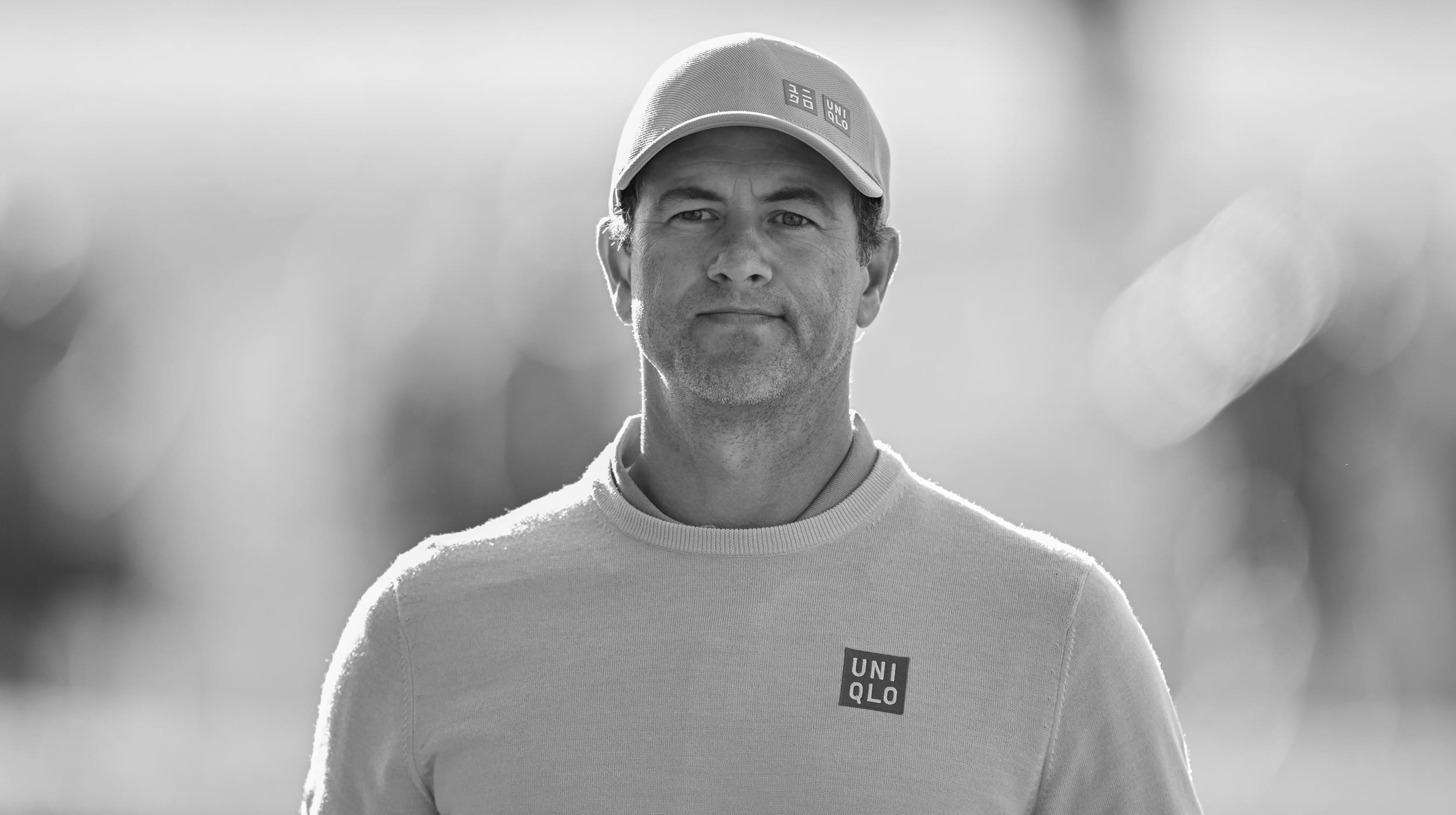
Adam Scott is an Australian professional golfer and former World No. 1, best known for his 2013 Masters victory and his exceptionally fluid, textbook swing. With over 30 professional wins globally, Scott has maintained a high-level competitive presence for over two decades, becoming a central figure in modern golf history.
The Foundations of an Elite Career: Early Life and Amateur Years
Adam Derek Scott was born on July 16, 1980, in Adelaide, South Australia. From a young age, golf was ingrained in his environment; his father, Phil Scott, was a PGA professional and a golf course architect. This exposure provided Adam with a technical foundation that many of his peers lacked. The family moved to the Sunshine Coast when Adam was nine, and later to the Gold Coast, where he refined his skills under the Australian sun, a breeding ground for many of the world's top players.
Scott’s amateur career was marked by rapid progression. He was a member of the Golf Australia National Squad and won the Australian Boys’ Amateur in 1997 and 1998. His talent eventually led him to the United States, where he attended the University of Nevada, Las Vegas (UNLV). During his time as a Runnin' Rebel, he earned All-American honors and began to catch the eye of international scouts and coaches. Unlike many who finish their degree, Scott turned professional midway through 2000, eager to test his mettle on the European and PGA Tours.
His transition was almost immediate. Within his first full year on the European Tour in 2001, he secured a victory at the Alfred Dunhill Championship. This early success validated the "phenom" status he had been given by the media and established him as the next great Australian hope, following in the footsteps of Greg Norman.
Professional Breakthroughs and The Players Championship
The early 2000s saw Adam Scott establish himself as a consistent winner. However, his true arrival on the world stage occurred in 2004 at TPC Sawgrass. At the age of 23, Scott became the youngest winner of The Players Championship, often referred to as golf's "fifth major." His performance on the daunting 17th and 18th holes showcased a mental fortitude that silenced critics who questioned his ability to close out big tournaments.
Winning The Players propelled Scott into the top ten of the Official World Golf Ranking (OWGR) for the first time. During this period, he began working with legendary swing coach Butch Harmon. The collaboration resulted in a swing that was frequently compared to that of Tiger Woods—harmonious, powerful, and technically flawless. This aesthetic appeal made Scott a fan favorite, but his focus remained on the major championships, which remained elusive during the mid-2000s despite his consistent winning on both the PGA and European Tours.
Heartbreak at Lytham and the 2013 Masters Triumph
If there is a defining arc to Adam Scott's career, it is the journey from the 2012 Open Championship to the 2013 Masters. At the 2012 Open at Royal Lytham & St Annes, Scott held a four-shot lead with four holes to play. In a stunning turn of events, he bogeyed the final four holes, losing the Claret Jug to Ernie Els by a single stroke. Many analysts feared such a collapse would permanently damage his psyche.
Instead, Scott used the heartbreak as a catalyst. Working with caddie Steve Williams (formerly Tiger Woods’ caddie), Scott returned to the 2013 Masters with a renewed sense of purpose. On a rainy Sunday at Augusta National, he sank a 20-foot birdie putt on the 72nd hole, letting out a roar of "C'mon Aussie!" that has since become iconic. After a tense playoff against Angel Cabrera, Scott secured the Green Jacket, becoming the first Australian ever to win the Masters. This victory was more than just a personal milestone; it was a national celebration for Australia, a country that had seen many of its greats fall short at Augusta.
Reaching World No. 1 and the Anchoring Ban Transition
Following his Masters victory, Scott’s consistency reached its zenith. In May 2014, he ascended to the World No. 1 ranking, ending Tiger Woods' 60-week reign. He held the top spot for 11 weeks, proving that his game was the most complete in the world. During this era, Scott was a frequent contender in every major, characterized by high greens-in-regulation percentages and a legendary long-putter technique.
However, the career of Adam Scott faced a significant technical hurdle with the implementation of Rule 14-1b, which banned the anchoring of long putters starting in 2016. Having used the broomstick-style putter to great effect (including his Masters win), Scott had to reinvent his short game. Unlike many of his contemporaries who struggled and faded after the ban, Scott experimented with various grips—including the "claw" and unanchored long putters—and eventually found a way to remain competitive, winning the Genesis Invitational in 2020 and remaining a staple in the world's top 50.
Career Statistics and Milestone Achievements
As we look at Adam Scott’s career from the vantage point of 2026, his longevity is perhaps his most impressive stat. He has managed to bridge the gap between the Tiger Woods era and the modern power-game era, maintaining a swing speed and ball-striking capability that rivals players twenty years his junior.
| Category | Statistic / Achievement |
|---|---|
| Professional Wins | 31 (14 PGA Tour, 11 European Tour, 6 Other) |
| Major Championships | 1 (2013 Masters) |
| Highest World Ranking | No. 1 (May 2014) |
| The Players Championship | Winner (2004) |
| Presidents Cup Appearances | 10+ (Record-holding veteran for International Team) |
| Career Earnings | Over $60,000,000 (PGA Tour only) |
| Best Finish in Other Majors | 2nd (Open 2012), T3 (PGA 2018), T4 (US Open 2015) |
His statistical profile highlights a player who prioritized ball striking. Throughout his career, Scott has consistently ranked in the top 20 for "Strokes Gained: Tee-to-Green," a metric that underscores the quality of his driving and iron play.
Technical Analysis: Why the "Adam Scott Swing" is the Standard
For decades, golf instructors have used Adam Scott's swing as the ultimate blueprint. What makes it so effective is the perfect synchronization of the upper and lower body. Scott maintains a wide arc in his takeaway, a stable lower body through the transition, and a clean "follow-through" that minimizes stress on the lower back—a rarity for players with his longevity.
His equipment choices have also been a point of interest. A longtime Titleist staff player, Scott has been known to be meticulous about his gear, often using "offset" irons or specific shaft weights to maintain his flight windows. In recent years, his partnership with Uniqlo has also moved him into the realm of a fashion icon within the sport, emphasizing a clean, classic look that mirrors his approach to the game itself.
Legacy and Influence on Australian Golf
As of 2026, Adam Scott’s influence on the game extends far beyond his own scorecard. He has taken on a mentor role for younger Australian players like Min Woo Lee and Cameron Smith. His commitment to the International Team in the Presidents Cup has made him a legendary figure in that competition, despite the team's long struggle against the United States.
Scott’s legacy is defined by more than just trophies; it is defined by grace. Whether in the face of a crushing defeat at Lytham or the heights of a Masters victory, he has remained one of the most respected and well-liked figures in the locker room. His "Adam Scott Foundation" has also done significant work in providing educational opportunities for youth in Australia and the United States, ensuring his impact is felt off the course as well.
Is Adam Scott still playing professionally in 2026?
Yes, Adam Scott remains an active competitor on the PGA Tour and DP World Tour in 2026. While he has naturally transitioned into a veteran role, his fitness and swing mechanics have allowed him to remain competitive in major championships and select signature events. He continues to be a primary draw for international tournaments, particularly the Australian Open and Australian PGA Championship.
How many Majors has Adam Scott won?
Adam Scott has won one Major championship: the 2013 Masters. Despite having only one victory, his record in Majors is exceptionally strong, with over 20 top-10 finishes across the Masters, U.S. Open, The Open Championship, and the PGA Championship. His consistency in these events is often cited by peers as a mark of his elite status.
What is Adam Scott's putting style now?
Following the 2016 anchoring ban, Adam Scott moved through several variations of putting. In 2026, he primarily utilizes a long putter (broomstick style) but holds it away from his body to comply with Rule 14-1b. He has also successfully used the "claw" grip with a standard-length putter at various points in his late career to combat struggles with short-range consistency.
What are Adam Scott's career earnings?
As of 2026, Adam Scott’s career on-course earnings on the PGA Tour exceed $60 million. When accounting for international wins, sponsorship deals with brands like Titleist and Uniqlo, and his various business ventures, his total career wealth is significantly higher, placing him among the top-earning golfers of his generation.
Why was Adam Scott's win at the Masters so significant?
His 2013 victory was historic because he was the first Australian to win the Masters since the tournament's inception in 1934. Australia had a long history of "near misses" at Augusta, most notably Greg Norman’s heartbreak in 1996. Scott’s win was seen as a "monkey off the back" for an entire golfing nation.
How to Follow Adam Scott’s Career Today
To stay updated on Adam Scott's performance as he continues his journey in 2026, fans should monitor the official PGA Tour Player Profile for real-time scoring and advanced "Strokes Gained" statistics. Additionally, following the Official World Golf Ranking provides context on his standing against the current crop of world-class talent. For those interested in his swing mechanics, many modern golf instruction platforms continue to break down his footage as the gold standard for ball-striking excellence.