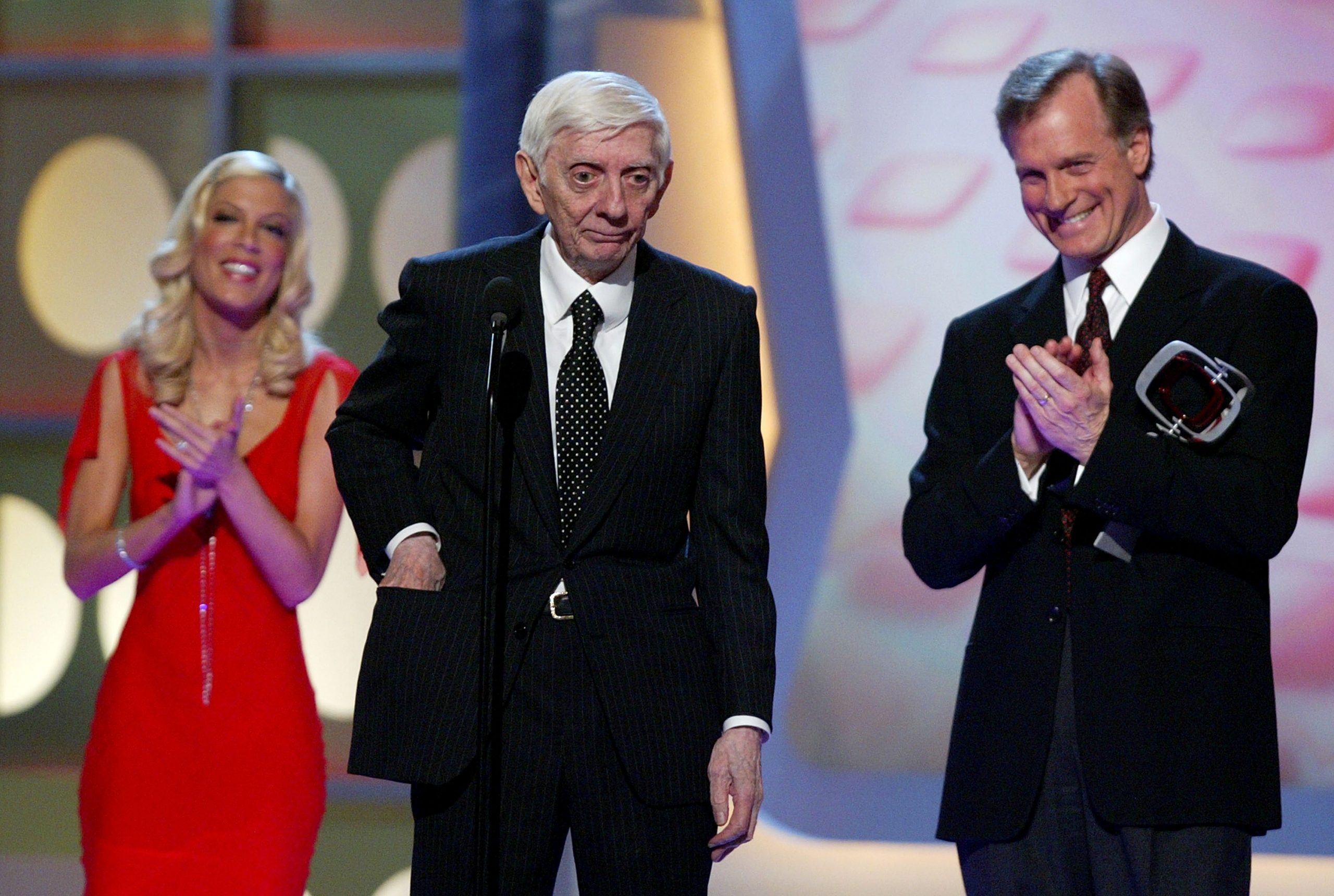
At the time of his death in June 2006, legendary television producer Aaron Spelling had an estimated net worth of $600 million. As the most prolific producer in television history, Spelling amassed his vast fortune through decades of hit network programming, lucrative syndication rights, strategic production partnerships, and world-class real estate holdings.
The Financial Empire of Aaron Spelling: Estimating His Total Estate
Aaron Spelling's financial footprint was unprecedented in the American television industry. Over a career spanning more than five decades, Spelling created, executive produced, or co-produced over 5,000 hours of television programming. His earnings were not derived merely from producer fees; rather, he capitalized early on production company ownership, residual rights, and backend distribution profit-sharing.
At the peak of his career in the late 1970s and 1980s, Spelling was often called the undisputed king of prime-time television. Industry analysts estimated that his personal wealth surpassed half a billion dollars long before his passing in 2006. Adjusted for inflation, his $600 million estate at death would represent over $900 million in modern currency. Unlike many contemporary Hollywood executives who relied strictly on salary packages, Spelling built equity in his content, allowing his wealth to compound exponentially with every network renewal and international syndication deal.
Financial advisors and entertainment attorneys point to Spelling's early deals with major networks—specifically ABC—as the foundation of his wealth. By retaining partial or full ownership of production master tapes and distribution rights through companies like Thomas-Spelling Productions, Aaron Spelling Productions, and later Spelling Entertainment Group, Spelling secured continuous revenue streams that insulated his financial standing even during broadcast slumps.
Building Spelling Television: How Hit Shows Fueled His Fortune
Spelling's financial ascension began in earnest during his partnership with actor Danny Thomas in the late 1960s, creating hit series like The Mod Squad. However, his financial trajectory skyrocketed during his legendary association with ABC in the 1970s and 1980s. At one point in the 1970s, network executives famously joked that ABC stood for "Aaron's Broadcasting Company" because Spelling-produced series occupied nearly one-third of the network's prime-time schedule.
His roster of blockbuster television franchises reads like a history of modern broadcast media:
- The 1970s Hits: Charlie's Angels, The Love Boat, Fantasy Island, Starsky & Hutch, and S.W.A.T. established Spelling as a hitmaker capable of delivering massive, loyal network audiences.
- The 1980s Soap Era: Dynasty and Hotel elevated prime-time drama into high-budget luxury spectacles, securing massive international licensing revenue.
- The 1990s Teen & Young Adult Boom: Beverly Hills, 90210, Melrose Place, and Charmed demonstrated Spelling's rare ability to reinvent his production engine for younger generations, creating global pop-culture phenomena.
- Family & Long-Running Dramas: 7th Heaven became one of the longest-running family dramas in television history, providing consistent cable syndication income for decades.
Each of these shows represented a multi-tiered revenue engine. Production budgets were largely covered by network license fees, while Spelling's companies retained valuable secondary distribution rights. When a series hit the 100-episode milestone required for domestic syndication, Spelling unlocked multi-million-dollar rerun packages across local broadcast stations and international networks.
The Catalog and Syndication Royalties: Long-Term Income Streams
The mechanics of Hollywood distribution mean that television producers who retain equity in their catalogs earn far more from reruns than from original broadcast airings. Spelling was a pioneer in structuring contracts to maximize backend equity.
When Charlie’s Angels entered syndication in the late 1970s, it generated tens of millions of dollars in net profit. Later, Beverly Hills, 90210 and Melrose Place became major revenue drivers in global syndication during the 1990s, sold to dozens of international markets simultaneously. Because Spelling maintained control over Spelling Entertainment Inc., he benefited directly from corporate transactions as well.
In the mid-1990s, media giant Blockbuster Entertainment acquired a controlling interest in Spelling Entertainment Group in a deal that valued the production entity at hundreds of millions of dollars. Later, Viacom absorbed these assets, further solidifying Spelling's liquid payouts and stock equity.
| Revenue Source / Asset Category | Estimated Value / Financial Scope | Primary Revenue Drivers |
|---|---|---|
| Total Net Worth at Passing (2006) | ~$600 Million | Decades of production fees, corporate payouts, and equity sales |
| Spelling Manor (Holmby Hills) | $150 Million (2006 Appraisal) | 56,000 sq ft residential estate; sold in 2011 for $85M |
| Spelling Entertainment Group Sale | Multi-hundred-million valuation | Equity stake acquisition by Blockbuster / Viacom in mid-1990s |
| Syndication & Residual Catalog | Tens of millions annually at peak | Global rerun licensing (90210, Charmed, Dynasty, The Love Boat) |
| Primary Bequest to Children | ~$800,000 each (Tori & Randy) | Direct cash trust distributions outlined in final estate plan |
The Manor and Real Estate Portfolio: Tangible Assets Worth Tens of Millions
Beyond his entertainment catalog, Aaron Spelling's wealth was visibly reflected in his luxury real estate acquisitions. The crowning jewel of his portfolio was "The Manor" (often referred to as Spelling Manor), located in the prestigious Holmby Hills neighborhood of Los Angeles.
Constructed in 1988 on the former estate of legendary performer Bing Crosby, The Manor was a French Chateau-style mansion spanning an astounding 56,000 square feet. Containing 123 rooms—including specialized spaces such as a bowling alley, doll museum, gift-wrapping rooms, and an entire floor dedicated to closet space—it was widely considered the largest single-family home in Los Angeles County.
Building the property cost an estimated $12 million in the late 1980s (roughly $30 million today), but its market appreciation was immense:
- 2006 Estate Valuation: Following Spelling's death, the property was appraised at approximately $150 million.
- 2011 Sale: Spelling's widow, Candy Spelling, listed the mansion for $150 million and eventually sold it to British heiress Petra Ecclestone for $85 million in an all-cash transaction.
- 2019 Resale: The estate resold in 2019 for $119.75 million, setting real estate records for California at the time.
In addition to the Holmby Hills mansion, the Spelling family owned prime oceanfront real estate in Malibu and commercial properties in Southern California, solidifying their tangible asset wealth.
The Estate Settlement: Inheritance, Candy Spelling, and Tori Spelling
One of the most widely discussed aspects of Aaron Spelling's financial legacy was the division of his $600 million estate following his passing in 2006.
Under the terms of Spelling's trust and final estate planning documents, the vast majority of his fortune—including real estate assets, investment portfolios, and ongoing royalty management—was left to his wife of 38 years, Candy Spelling. Candy was designated as the sole executor of the estate trust.
Public attention shifted heavily to Spelling’s children, actress Tori Spelling and actor Randy Spelling, when details of their inheritances emerged:
- Tori Spelling's Distribution: Despite her starring role in her father's mega-hit Beverly Hills, 90210, Tori received a direct inheritance report of approximately $800,000 (after taxes and fees).
- Randy Spelling's Distribution: Randy received a comparable direct payout of roughly $800,000 from the primary trust.
- Estate Control: The remaining balance of the $600 million fortune remained under Candy Spelling's control.
Candy Spelling later explained in media interviews and her memoir that the estate structure was designed by Aaron Spelling to protect family wealth and that larger trust funds had been established separately for grandchildren or structured for long-term distribution. Nevertheless, the vast discrepancy between the overall estate value and the immediate inheritance given to his adult children remains a notable case study in Hollywood estate planning.
Evaluating Aaron Spelling’s Wealth in Today's Market Context
To appreciate Aaron Spelling's financial stature, it is helpful to contrast his model with today's streaming entertainment ecosystem. In the broadcast era of the 20th century, top-tier producers were able to leverage network bidding wars to retain backend equity. Once a show crossed into syndication, every rerun generated passive profit with minimal additional overhead.
In modern Hollywood, major streaming services often utilize "buyout models," paying creators upfront cost-plus fees while retaining long-term global rights. Had Aaron Spelling operated under today's streaming contract structures, he might have earned substantial upfront fees, but he would have missed out on the recurring syndication revenue that transformed his production company into a half-billion-dollar empire.
Furthermore, Spelling's business savvy extended beyond television. He managed overhead tightly, operated his own post-production facilities, and frequently filmed on location assets he controlled. This vertical integration ensured that a significant portion of every dollar spent on a Spelling production flowed back into his corporate entities.
FAQ: Aaron Spelling's Net Worth and Estate
How much was Aaron Spelling worth when he died?
Aaron Spelling had an estimated net worth of $600 million at the time of his death on June 23, 2006. His wealth came from television production fees, company stock sales, syndication royalties, and real estate investments.
Why did Tori Spelling only inherit $800,000 from a $600M estate?
Aaron Spelling's estate plan designated his wife, Candy Spelling, as the primary beneficiary and sole executor of the estate trust. The direct cash distribution to Tori Spelling was structured according to the terms set in his final will and trust agreements prior to his death.
How much did Spelling Manor sell for?
Spelling Manor was listed by Candy Spelling for $150 million following Aaron's death and was sold in 2011 to Petra Ecclestone for $85 million in cash. In 2019, the property was sold again for $119.75 million.
What was Aaron Spelling's most profitable show?
While Charlie's Angels and The Love Boat generated massive early syndication revenues, Beverly Hills, 90210 and Dynasty were among his most lucrative global assets due to extensive international licensing, home video releases, and long-term cable broadcast deals.
Did Aaron Spelling own his production company?
Yes, Spelling founded and owned several production entities throughout his career, including Aaron Spelling Productions and Spelling Entertainment Group. Retaining ownership stakes in these companies allowed him to profit from corporate buyouts, such as Blockbuster's investment in the 1990s.
Strategic Estate Lessons from Aaron Spelling’s Financial Legacy
Aaron Spelling's career offers actionable insights into modern asset creation, content ownership, and wealth preservation:
- Prioritize Equity Over Salary: Spelling's long-term wealth was built on owning master distribution rights and residual shares, not just accepting high upfront production salaries.
- Diversify Into Hard Assets: By channeling entertainment profits into premier residential and commercial real estate like The Manor, Spelling protected his capital against market fluctuations in the entertainment industry.
- Execute Clear Estate Directives: Estate plans involving complex corporate assets and significant wealth require precise trust structures. Creators and business owners must clearly communicate inheritance structures to beneficiaries to minimize public dispute and legal friction.