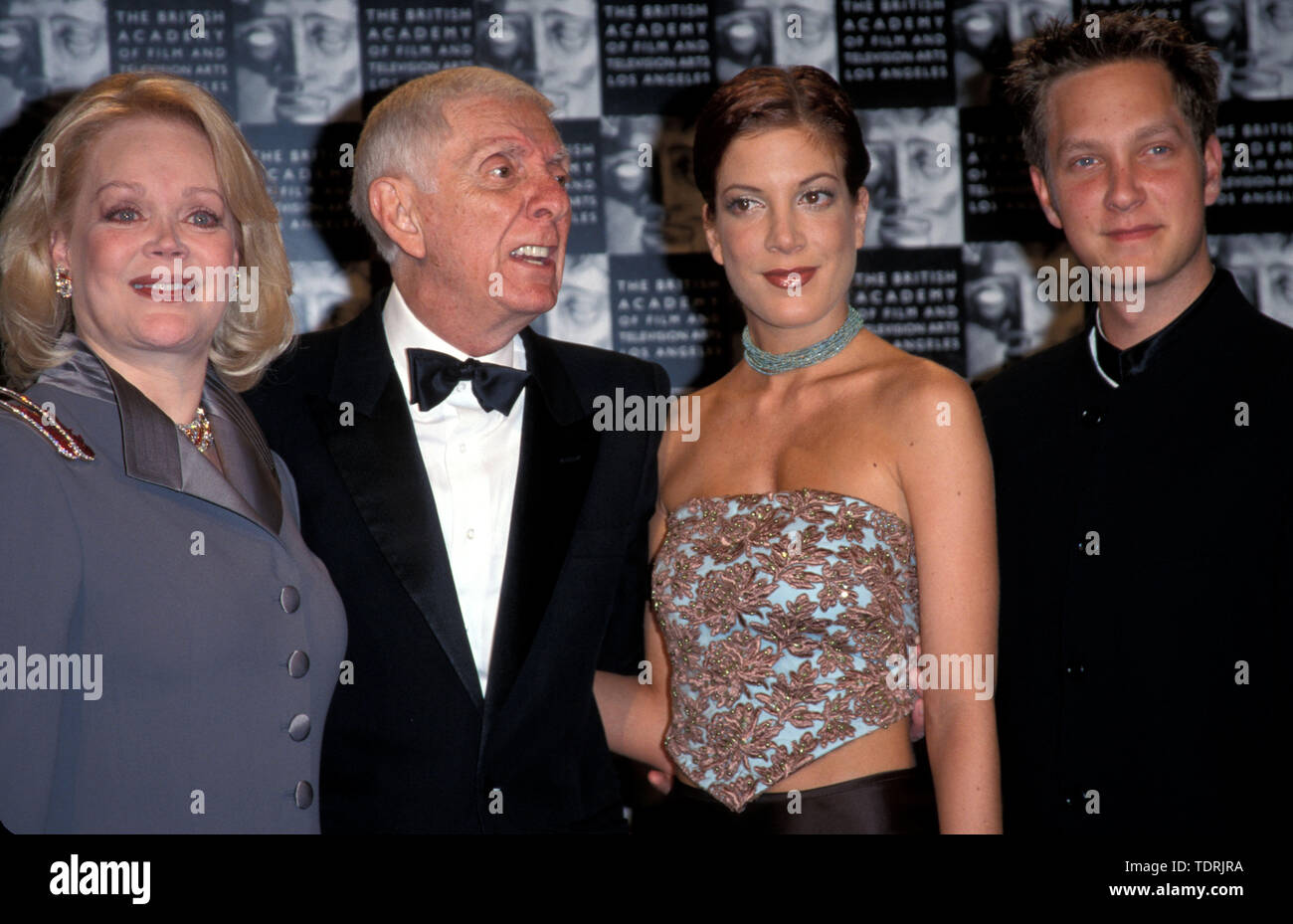
When iconic television producer Aaron Spelling passed away in June 2006 at age 83, he left behind a cultural footprint that defined American prime-time entertainment for five decades and an estate estimated between $500 million and $600 million. His last will and testament allocated the overwhelming majority of his fortune to his wife of 38 years, Candy Spelling, while leaving structured trusts of approximately $800,000 to each of his two children, Tori and Randy Spelling. This financial division, alongside the sale of his famous 123-room Holmby Hills mansion, became one of the most widely analyzed estate outcomes in modern Hollywood history.
The Estate of Aaron Spelling: Will Details, Inheritance, and Financial Distribution
Aaron Spelling’s estate planning remains one of the most publicly discussed high-net-worth successions in the entertainment industry. Having accumulated immense wealth through decades of hit programming, distribution syndication, and production company ownership, Spelling's financial portfolio included master rights, extensive real estate, stock portfolios, and ongoing royalty streams.
The terms of Spelling's will appointed his widow, Candy Spelling, as the primary executor and principal beneficiary of his vast estate. While the total value of the estate was estimated at $500 million to $600 million upon his passing in 2006, public court documents and subsequent probate disclosures revealed that his children, actress Tori Spelling and life coach Randy Spelling, received inheritances of roughly $800,000 each.
- Estimated Total Estate Value (2006): $500,000,000 - $600,000,000
- Candy Spelling (Primary Beneficiary & Executor)
- The Manor (56,000 sq. ft. Holmby Hills Estate)
- Production Intellectual Property & Residual Rights
- Primary Financial Accounts & Investment Portfolios
- Direct Bequests to Children
- Tori Spelling: ~$800,000 (Trust Distribution)
- Randy Spelling: ~$800,000 (Trust Distribution)
- Candy Spelling (Primary Beneficiary & Executor)
The stark disparity between the total estate valuation and the direct disbursements to his adult children sparked widespread media commentary regarding parental intent, estate structuring, and wealth preservation. In public statements and memoirs published in subsequent years, Candy Spelling explained that the inheritance decisions reflected Aaron's intent to protect the family fortune from excessive taxation while encouraging financial self-reliance among his children.
From a legal and wealth management perspective, Aaron Spelling’s will relied heavily on testamentary trusts and inter-vivos family trusts designed to consolidate control within a primary surviving spouse. In high-net-worth Hollywood estates, placing administrative control in a single primary trust is a common asset protection strategy designed to prevent fragmented management of intellectual property rights, syndication royalties, and multi-state real estate assets.
The Legacy of "The Manor": Holmby Hills Real Estate and High-Net-Worth Assets
Central to the financial and physical footprint of Aaron Spelling’s estate was "The Manor," a French chateau-style residence situated on 4.7 acres in the Holmby Hills neighborhood of Los Angeles. Constructed in 1988 for an estimated $12 million, the 56,000-square-foot residence became a tangible symbol of Spelling's supreme commercial success during the golden age of broadcast television.
Featuring 123 rooms—including specialized spaces such as a gift-wrapping room, a double-lane bowling alley, a screening room, and parking for over 100 vehicles—The Manor surpassed the White House in physical square footage, making it one of the largest single-family residences in California.
| Year | Event |
|---|---|
| 1988 | Constructed by Aaron & Candy Spelling for ~$12 Million |
| 2006 | Aaron Spelling passes away; estate control transfers to Candy Spelling |
| 2009 | Property listed for sale at $150 Million |
| 2011 | Sold to Petra Ecclestone for $85 Million (All-Cash Transaction) |
| 2019 | Resold to anonymous buyer for $119.75 Million |
Following Spelling’s death, Candy Spelling listed the estate for sale in 2009 with an asking price of $150 million. In 2011, British heiress Petra Ecclestone purchased the property for $85 million in an all-cash transaction, representing one of the highest residential real estate sales in United States history at the time. The property subsequently resold in 2019 for $119.75 million.
The disposal of The Manor illustrated a fundamental shift in executive estate management: transitioning away from high-maintenance physical real estate holdings toward liquid portfolios, municipal bonds, and diversified private equity trusts. For large Hollywood estates, maintaining ultra-luxury compounds carries astronomical annual carrying costs—including property taxes, specialized security, and facility upkeep—that often necessitate prompt monetization following the creator's death.
From Texarkana to Prime-Time Supremacy: The Rise of a Television Powerhouse
To understand the immense scale of Aaron Spelling's estate, one must examine his rise from humble origins to unprecedented control over network television. Born in Texarkana, Texas, in 1923 to Jewish immigrant parents, Spelling served in the United States Army Air Forces during World War II before pursuing playwriting and acting in Los Angeles.
His transition from character actor to television writer and producer began in the mid-1950s when he joined Dick Powell’s Four Star Television. Recognizing the potential of television syndication and series production, Spelling formed key production partnerships that reshaped prime-time programming over four decades:
- Thomas-Spelling Productions (1966–1972): Partnered with comedian Danny Thomas to produce early television hits like The Mod Squad, establishing Spelling's knack for casting appealing young leads in high-concept dramas.
- Aaron Spelling Productions / Spelling Television (1972–2006): Operating independently and in partnership with producer Leonard Goldberg, Spelling built an enterprise that supplied the ABC network with a continuous stream of top-rated series, leading industry insiders to jokingly refer to ABC as "The Aaron Broadcasting Company."
- Public Offering and Acquisition (1986–1999): Spelling took his production entity public as Spelling Entertainment Inc., which was later acquired by Blockbuster Entertainment and ultimately integrated into Viacom/Paramount entities, generating substantial equity windfalls for Spelling and his partners.
By the time of his death, Spelling held the Guinness World Record for the most prolific television producer in history, with over 218 producer credits and more than 4,300 hours of prime-time television credited to his companies.
Key Pillars of Spelling Television Productions
Aaron Spelling’s production library generated billions of dollars in global broadcast rights, syndication packages, and home video revenues. The table below details the premier television properties that built the Spelling empire and funded the underlying estate assets.
| Production Title | Original Run Years | Primary Network | Cultural & Financial Impact | Legacy & Syndication Status |
|---|---|---|---|---|
| The Mod Squad | 1968–1973 | ABC | Pionered the youth-oriented counterculture police procedural. | Early template for ensemble casting and pop soundtrack integration. |
| Charlie's Angels | 1976–1981 | ABC | Global pop culture phenomenon that redefined female-led action television. | Generated hundreds of millions in global syndication and film reboots. |
| The Love Boat | 1977–1986 | ABC | Popularized anthology storytelling set on a luxury cruise ship. | Boosted the modern cruise line industry and established guest-star driven programming. |
| Dynasty | 1981–1989 | ABC | Prime-time soap opera that defined 1980s high fashion, luxury, and melodrama. | Competed directly with Dallas; generated massive global merchandising sales. |
| Beverly Hills, 90210 | 1990–2000 | FOX | Redefined teen drama; anchored FOX network's rise to major network status. | Spawned spin-offs (Melrose Place), reboots, and multi-generational youth marketing models. |
| 7th Heaven | 1996–2007 | The WB / CW | Longest-running family drama in television history; anchored The WB network. | Demonstrated the broad commercial viability of family-oriented drama series. |
| Charmed | 1998–2006 | The WB | High-rated supernatural drama centered on female empowerment. | Remains a staple in global television syndication and streaming platforms. |
The "Spelling Formula": Narrative Innovation and Commercial Intuition
Aaron Spelling’s extraordinary commercial longevity rested on a distinct production methodology known within Hollywood as the "Spelling Formula." Rather than targeting critical acclaim or niche prestige audiences, Spelling prioritized broad-viewer accessibility, vivid visual aesthetics, and emotional resonance.
Key Characteristics of the Spelling Model
- Visual Glamour and Escapism: Whether showcasing the opulent oil fortunes of Dynasty or the sun-drenched coastal lifestyles of Beverly Hills, 90210, Spelling understood that television audiences craved visual extravagance and lifestyle fantasy.
- Ensemble Casting and Talent Discovery: Spelling possessed an intuitive talent for identifying emerging actors and creating memorable star vehicles. He launched or revitalized the careers of Farrah Fawcett, Joan Collins, Luke Perry, Heather Locklear, Jessica Biel, and Alyssa Milano, among dozens of others.
- Rapid Narrative Pacing: Spelling series favored multi-strand storylines, high-stakes cliffhangers, and rapid episodic resolutions. This format kept audiences engaged across commercial breaks and built long-term viewing habits.
- Cost-Efficient Production Infrastructure: Despite the luxurious on-screen appearances of his shows, Spelling maintained tight production budgets, rigorous shooting schedules, and disciplined cost-controls, ensuring maximum profit margins for syndication sales.
Spelling’s approach to television production altered how broadcast networks scheduled and marketed prime-time programming. By developing shows that appealed simultaneously to youth demographics and broader family audiences, Spelling created durable media franchises capable of generating sustained revenue decades after their initial broadcast.
Estate Planning Lessons from Hollywood's Largest Executive Fortunes
The legal distribution of Aaron Spelling's assets offers critical insight into high-net-worth estate planning, wealth transition strategies, and family legacy management. High-profile entertainment estates present complex challenges that require specialized legal structures to manage intellectual property, tax liabilities, and equitable asset allocation.
- High-Net-Worth Estate Planning Lessons
- Tax Optimization
- Marital Deductions
- Trust Structuring
- Capital Gain Shielding
- IP Management
- Royalty Streams
- Syndication Rights
- Trademark Protections
- Governance & Control
- Sole Executor Models
- No-Contest Clauses
- Asset Liquidation Rules
- Tax Optimization
1. The Power of Unlimited Marital Deduction
Under United States federal tax law, assets transferred to a surviving citizen spouse pass free of federal estate taxes through the unlimited marital deduction. By leaving the majority of his estate to Candy Spelling, Aaron Spelling avoided an immediate estate tax liability upon his passing in 2006, preserving capital within the family trust structure.
2. Managing Intellectual Property vs. Cash Assets
For high-earning creatives, physical real estate and liquid cash represent only a fraction of total estate value. Intellectual property (IP), including master rights, residuals, and trademark licensing, requires continuous professional administration. Consolidating control under a single executor or institutional trustee prevents deadlocks in licensing negotiations and protects long-term syndication cash flows.
3. Mitigating Family Disputes with Explicit Bequests
When an estate plan leaves unequal distributions among heirs, estate planners frequently utilize clear disinheritance clauses, defined trust limits, or no-contest clauses (also known as in terrorem clauses). In the Spelling estate, explicit bequest amounts established clear legal boundaries that minimized successful probate challenges, despite intense public media scrutiny.
Frequently Asked Questions
What was Aaron Spelling's net worth at the time of his death?
At the time of his death in June 2006, Aaron Spelling’s net worth was estimated between $500 million and $600 million. His fortune comprised real estate assets, extensive production libraries, syndication rights, and investment portfolios.
How much money did Tori Spelling inherit from Aaron Spelling's will?
Tori Spelling inherited approximately $800,000 from a trust designated in Aaron Spelling's estate plan. Her brother, Randy Spelling, received a similar amount, while the remainder of the $500M+ estate was left to their mother, Candy Spelling.
What happened to Aaron Spelling's Holmby Hills home, "The Manor"?
Following Aaron Spelling's death, Candy Spelling listed "The Manor" for sale in 2009 for $150 million. It was sold in 2011 to Petra Ecclestone for $85 million in an all-cash deal. In 2019, the property was sold again to an undisclosed buyer for $119.75 million.
How many television shows did Aaron Spelling produce?
Aaron Spelling earned over 218 production credits during his career, generating more than 4,300 hours of prime-time television. The Guinness World Records recognized him as the most prolific television producer in broadcasting history.
Did Tori Spelling contest Aaron Spelling's will in court?
Tori Spelling did not file a formal legal contest against Aaron Spelling's will in probate court. While the minor distribution was the subject of public family discussions and media coverage, the estate distribution proceeded in accordance with the executed legal documents.
Preserving the Legacy: The Long-Term Cultural Footprint of Spelling Television
Aaron Spelling’s enduring legacy stretches far beyond the financial figures of his will or the physical dimensions of his Holmby Hills estate. As television transitioned into the streaming age, the vast Spelling catalog continued to demonstrate immense commercial value. High-profile reboots of Beverly Hills, 90210 (such as 90210 and BH90210), Dynasty, and Charmed prove that Spelling's core narrative principles—ensemble drama, glamorous settings, and compelling character conflict—remain deeply appealing to international audiences.
Furthermore, Spelling's business model established the blueprint for modern executive producers. By maintaining creative control across dozens of simultaneous productions while building an independent library of owned assets, Spelling demonstrated how creative leaders could build lasting media empires.
For creators, estate planners, and media executives, Aaron Spelling represents the ultimate dual study: a creative genius who mastered the mechanics of prime-time television, and an executive whose financial legacy highlights the critical importance of structured estate planning in preserving wealth across generations.