As of the 2026 NFL season, Aaron Rodgers remains one of the most scrutinized figures in professional sports, primarily due to his navigation of significant late-career injuries. His current status is defined by a rigorous maintenance protocol following his 2023 Achilles tendon rupture and subsequent minor lower-body ailments. While he continues to demonstrate elite processing speed and arm talent, his mobility and durability are managed with extreme caution by the New York Jets' medical staff.
The trajectory of Aaron Rodgers' career was fundamentally altered on September 11, 2023, yet his ability to remain an active starter in 2026 is a testament to modern sports medicine. Understanding his current viability requires a deep dive into the 2023 Achilles catastrophe, his history of collarbone fractures, and the cumulative impact of lower-extremity strains on a quarterback whose game was once defined by off-platform brilliance.
The 2023 Achilles Rupture: A Turning Point
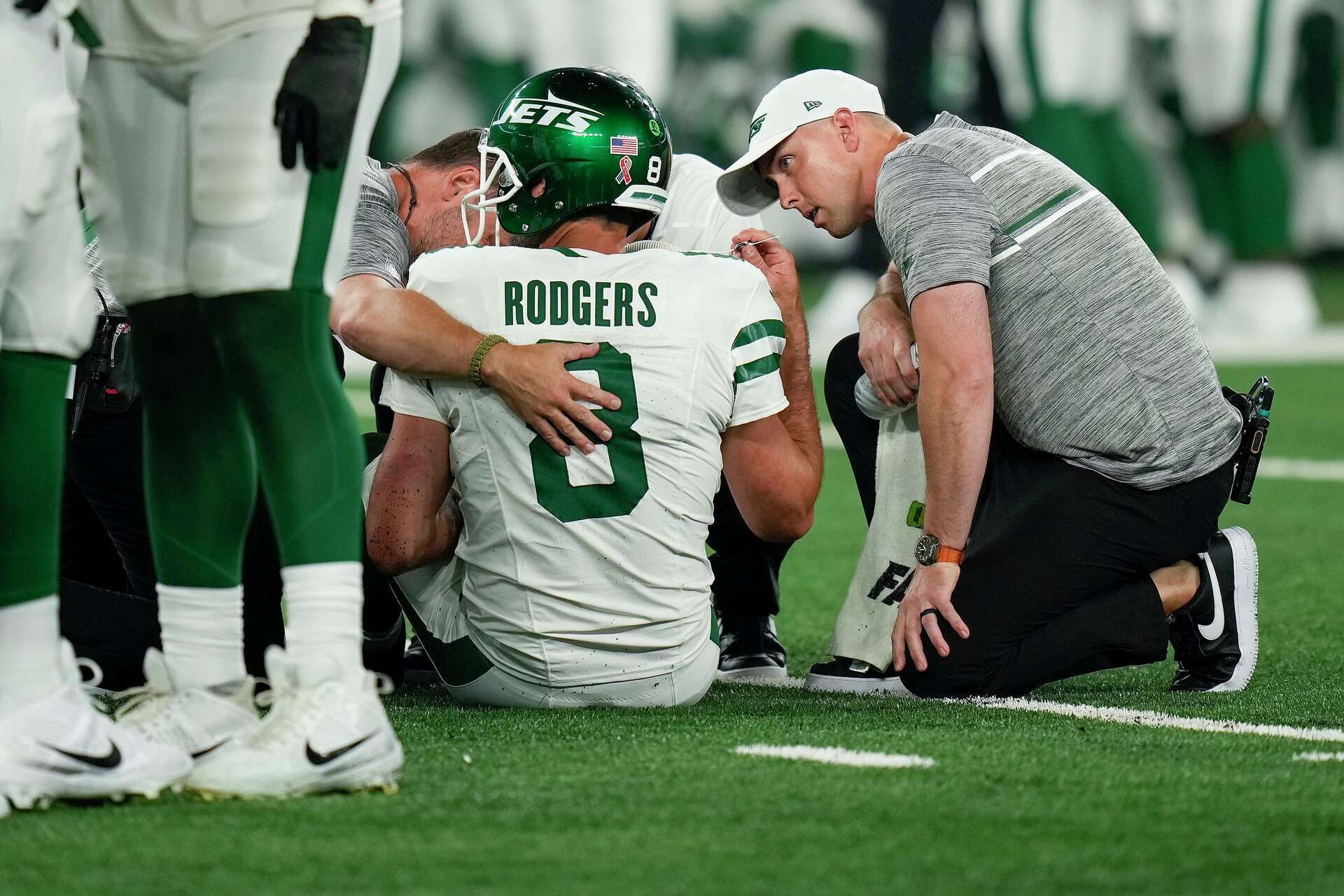
The most significant event in Rodgers’ recent medical history occurred during his debut for the New York Jets in Week 1 of the 2023 season. Just four snaps into the game, Rodgers suffered a complete rupture of his left Achilles tendon while being sacked. This injury is historically a "career-killer" for older athletes, particularly those who rely on the explosive "push-off" motion required for deep-ball mechanics.
Rodgers underwent an innovative surgery known as the "speed bridge" procedure. Unlike traditional Achilles repairs, this method utilizes internal bracing to provide immediate stability, theoretically allowing for a faster transition to weight-bearing exercises. While Rodgers made headlines by attempting a return within the same season, he was ultimately not activated, prioritizing long-term stability for the 2024 and 2025 campaigns.
In 2026, the legacy of this injury manifests as a change in Rodgers' pocket presence. Biomechanical analysis shows a greater reliance on upper-body torque and a more rhythmic, "get-the-ball-out-quick" approach to mitigate the stress on his left leg. The Achilles remains a focal point of his weekly injury report status, requiring extensive daily elasticity work and manual therapy to prevent the "stiffening" that often plagues post-surgical tendons in athletes over 40.
Comprehensive Injury History: The Green Bay Years
Before the New York chapter, Rodgers’ tenure with the Green Bay Packers was marked by high availability, interrupted by specific, high-impact skeletal injuries. These incidents established a baseline for his toughness but also created a roadmap of physical vulnerabilities.
The Collarbone Fractures (2013 and 2017)
Rodgers has suffered two major fractures of his clavicle. The first occurred in 2013 against the Chicago Bears (left, non-throwing side), and the second, more significant injury occurred in 2017 against the Minnesota Vikings (right, throwing side).
- 2013 (Left Clavicle): This was a clean break that did not require surgery. He missed seven games, returning for the regular-season finale to lead a playoff-clinching drive.
- 2017 (Right Clavicle): This injury required the surgical insertion of 13 screws and two plates. Because it was his throwing shoulder, there were concerns about long-term velocity and range of motion. However, Rodgers returned with his arm strength largely intact, though the plates remain a permanent part of his physical profile.
Lower-Body Strains and "God Mode" (2014 and 2021)
Rodgers has a documented history of calf and toe issues that have occasionally limited his mobility. In 2014, a significant calf strain during the late season forced him into a "pure pocket passer" role. Ironically, this period is often cited as some of his best tactical play, as he was forced to win with his mind rather than his legs. In 2021, he suffered a "COVID toe" (dislocated fracture), which he managed throughout an MVP-winning season, proving his high pain tolerance and ability to perform despite structural damage in his feet.
Technical Analysis of Recovery and Longevity
In 2026, the discussion around Rodgers isn't just about whether he can play, but how the mechanics of his aging body dictate the Jets' offensive scheme. A quarterback's power is generated from the ground up. The kinetic chain begins with the back foot (the right foot for the right-handed Rodgers).
When an athlete suffers a major injury to the "drive leg" (the right) or the "lead leg" (the left), it disrupts the transfer of energy. Because Rodgers' 2023 injury was to his left (lead) leg, it impacted his ability to brace and rotate during the follow-through. To compensate in his 40s, Rodgers has worked extensively with biomechanical specialists to refine his "kinetic sequencing."
| Injury Type | Side | Year(s) | Recovery Duration | Long-term Impact as of 2026 |
|---|---|---|---|---|
| Achilles Rupture | Left | 2023 | 9–12 months | Reduced lateral agility; emphasis on quick release. |
| Clavicle Fracture | Right | 2017 | 8 weeks (plus hardware) | Right shoulder requires extensive warm-up; hardware remains. |
| Clavicle Fracture | Left | 2013 | 7 weeks | Minimal impact; non-throwing side. |
| Knee (MCL/Tibial) | Left | 2018 | Played through | General wear and tear; managed with bracing. |
| Calf Strains | Both | Various | 2–4 weeks | Chronic risk factor; requires specific climate management. |
What the Injury Status Means Going Forward
For the New York Jets and Rodgers, the strategy in 2026 is one of "calculated exposure." His injury history dictates three specific operational changes for the franchise:
- Offensive Line Prioritization: The Jets have shifted toward a heavy-protection scheme. The priority is no longer just "blocking" but ensuring that Rodgers rarely has to move off his spot. This reduces the eccentric load on his Achilles and the risk of another high-impact collision on his shoulders.
- The "Premium Backup" Requirement: Unlike his years in Green Bay where he took nearly every snap, the 2026 Jets maintain a high-level veteran backup (or a highly-drafted developmental successor) who is integrated into the first-team reps. This acknowledges that a 42-year-old with an Achilles repair and plated collarbone is unlikely to play 1,000 snaps in a season without a "maintenance" break.
- Climate and Surface Management: There is a significant correlation between cold weather/artificial turf and soft-tissue injuries. As Rodgers continues his career, his management team is notoriously vocal about the quality of playing surfaces. In 2026, Rodgers’ availability is often viewed through the lens of "load management," similar to how NBA stars handle back-to-back games.
Bio-Medical Innovations in Rodgers' 2026 Routine
Rodgers has long been a proponent of alternative and cutting-edge recovery methods. In 2026, his routine likely includes hyperbaric oxygen therapy (HBOT) to increase tissue oxygenation and pulsed electromagnetic field (PEMF) therapy to assist with bone density and cellular repair. These methods are designed to counteract the natural slowing of the healing process that occurs after age 40.
Furthermore, his diet and hydration are tailored to minimize systemic inflammation. Chronic inflammation is the enemy of old injuries; it causes the scar tissue around his 2017 shoulder surgery and 2023 Achilles site to become symptomatic. By maintaining a strictly anti-inflammatory lifestyle, he ensures that the hardware in his body doesn't become a source of daily pain.
Frequently Asked Questions
Did Aaron Rodgers retire after his 2023 Achilles injury?
No, Aaron Rodgers did not retire. Despite the severity of the injury and his age at the time (39), he underwent a specialized "speed bridge" surgery and returned to the active roster for the 2024 season. By 2026, he has established himself as one of the few quarterbacks in NFL history to play at an elite level into his 40s following a major lower-body reconstruction.
How does the hardware in his shoulder affect his throwing?
Rodgers has 13 screws and two plates in his right collarbone from his 2017 surgery. While this does not technically "limit" his arm strength, it does change the sensation and requires a more extensive pre-game warm-up to ensure the surrounding musculature is loose. Medical experts at The Hospital for Special Surgery note that once the bone is fully healed around the hardware, it is often stronger than the original bone, though the risk shifts to the stress points at the ends of the plates.
Is Rodgers more prone to injury now than earlier in his career?
Statistically, yes. As athletes age, the collagen in tendons becomes less elastic, and the recovery time for minor "bumps and bruises" increases. Rodgers' history of calf strains and his 2023 Achilles tear suggest a vulnerability in his lower kinetic chain. This is why his 2026 status is often listed as "Probable" or "Questionable" for minor issues that a younger player might not even report.
What is the "speed bridge" procedure Rodgers had?
The "speed bridge" is an Achilles repair technique that uses high-strength sutures and anchors to pull the tendon tight against the heel bone. Unlike the traditional "cast and wait" method, this allows for early range-of-motion exercises. According to orthopedic reports from the Cleveland Clinic, this procedure is becoming the gold standard for high-performance athletes who cannot afford the muscle atrophy associated with long-term immobilization.
Has he had any concussions?
Earlier in his career (specifically 2010), Rodgers suffered two concussions in a single season. However, due to changes in helmet technology and the NFL's updated "Roughing the Passer" rules, head injuries have not been a major factor in his recent injury history. His primary concerns in 2026 remain skeletal and soft-tissue integrity.
Recommendation for Evaluating Rodgers' Future
For fans, fantasy managers, and analysts, evaluating Aaron Rodgers in 2026 requires looking past the box score and focusing on "snap efficiency." His current status is that of a "high-variance durability" asset.
Next Actions for Observation:
- Monitor Practice Reports: Specifically look for "DNP - Rest" vs. "Limited - Achilles/Calf." In 2026, rest days are a positive sign of proactive management, whereas limited sessions due to lower-body soreness indicate potential game-day limitations.
- Watch the Pocket Movement: In games, observe his "hitch" step. If Rodgers is unwilling to step into his throws or if he is "hopping" off his left foot, it suggests the Achilles or calf is tight, which usually precedes a decline in accuracy.
- Assess the Schedule: Rodgers is significantly more durable on natural grass surfaces. Pay close attention to his performance and recovery when the Jets play on artificial turf, which is notoriously harder on repaired tendons.
Rodgers' journey from a potentially career-ending injury in 2023 to a functioning starter in 2026 is a landmark case in sports medicine. While he is no longer the "scrambler" of his 20s, his current status as a highly-efficient, protected pocket commander represents the final evolution of a legendary career.