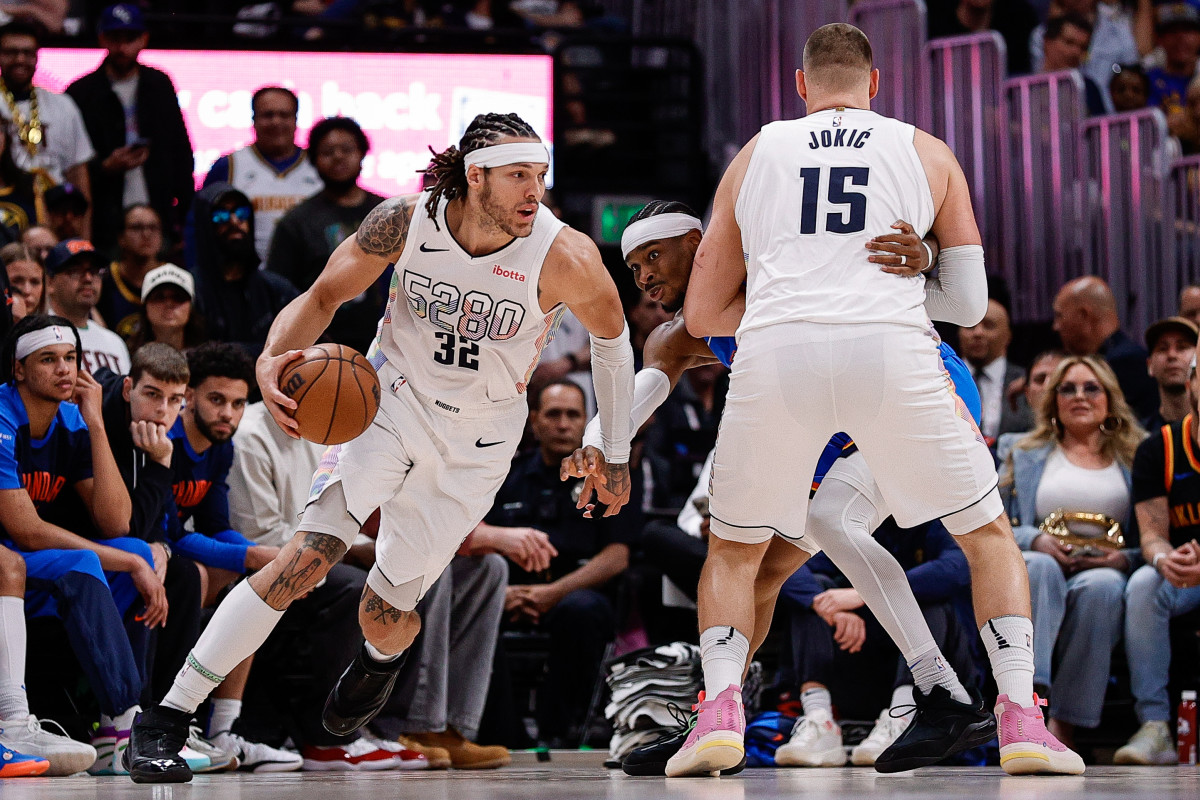
Comparing Aaron Gordon and Aaron Judge highlights how rare physical gifts, Northern California multi-sport backgrounds, and role adaptability define modern professional sports dominance. While Gordon transformed into a championship-winning NBA defensive anchor and rim finisher for the Denver Nuggets, Judge established himself as an American League MVP, home run record holder, and team captain for the New York Yankees.
Northern California Roots and Shared Multi-Sport Foundations
Although Aaron Gordon and Aaron Judge achieved international fame in entirely different professional leagues, their athletic development shares striking geographic and structural parallels. Both athletes spent their formative years in Northern California, refining their coordination across multiple sports before focusing on a single professional path.
Aaron Gordon grew up in San Jose, California, attending Archbishop Mitty High School. Before becoming one of the most decorated high school basketball players in California history—winning back-to-back CIF State Open Division titles—Gordon was an accomplished track athlete, setting youth records in the shot put and high jump. That explosive vertical leap and lateral quickness became the bedrock of his basketball identity.
Aaron Judge was raised roughly 80 miles east in Linden, California, attending Linden High School. Standing well over six feet tall by his teenage years, Judge was a three-sport phenom:
- Football: Played wide receiver and tight end, setting school records for single-season touchdowns and receiving yards. Major college programs recruited him as a tight end.
- Basketball: Starred as a center, averaging a double-double and using his massive frame to dominate the interior.
- Baseball: Played pitcher and first base, eventually choosing to attend Fresno State to focus exclusively on baseball.
This shared multi-sport upbringing fundamentally shaped their biomechanics. Multi-sport participation in high school helped both athletes build elite spatial awareness, trunk stability, and joint durability, enabling them to handle the extreme physical demands of their respective professional careers.
Physical Profiles and Rare Athletic Anomaly Status
In both the NBA and MLB, player height and weight usually dictate specific positional constraints. Aaron Gordon and Aaron Judge stand out because their physical dimensions break standard positional molds.
Aaron Gordon: 6'8" (203 cm) | ~235 lbs (106 kg) | Power Forward / Forward Aaron Judge: 6'7" (201 cm) | ~282 lbs (128 kg) | Outfielder / Designated Hitter
Aaron Gordon: The Modern Versatile Forward
Standing 6-foot-8 with a 7-foot-footprint wing-span and exceptional vertical bounce, Gordon possesses the ideal physical frame for modern basketball. Early in his career with the Orlando Magic, his explosive athleticism made him a human highlight reel, showcased in his iconic Slam Dunk Contest performances. However, as the NBA shifted toward positionless basketball, Gordon’s physical gift manifested in his ability to guard positions 1 through 5, absorption of contact in the post, and high-flying lob finishing off passes from Nikola Jokić.
Aaron Judge: The Unprecedented Baseball Outfielder
At 6-foot-7 and over 280 pounds, Judge is one of the largest position players in major league history. In baseball, players of Judge's size are traditionally restricted to first base or designated hitter duties due to concerns over speed, flexibility, and lateral movement. Judge defied these limits by becoming an elite defensive right fielder and center fielder early in his career, paired with generational exit velocity at the plate. His height creates a wide strike zone, but his unusual core strength allows him to generate historic bat speed without sacrificing plate discipline.
Career Trajectories: From High Prospects to Modern Icons
Both Gordon and Judge entered their professional draft processes with massive expectations, but their paths to stardom required significant career pivoting and technical refining.
Aaron Gordon's Evolution to Champion
Drafted 4th overall by the Orlando Magic in the 2014 NBA Draft after a standout freshman season at the University of Arizona, Gordon initially carried the burden of being a primary scoring option. While he displayed flashes of offensive dominance, his efficiency fluctuated in a primary creator role.
His career trajectory changed dramatically when he was traded to the Denver Nuggets in March 2021. In Denver, Gordon embraced a specialized, high-impact role: acting as the primary perimeter defender against opponent superstars, cutting off off-ball movement, and dominating the offensive glass. This tactical realignment culminated in the 2023 NBA Championship, cementing Gordon’s reputation as one of the league's ultimate high-IQ winning players.
Aaron Judge's Ascent to Captain and MVP
Selected 32nd overall in the 2013 MLB Draft by the New York Yankees out of Fresno State, Judge had to answer early scout concerns about his high strikeout rate and wide strike zone. After making adjustments to his swing mechanics and pitch recognition in the minor leagues, Judge exploded onto the scene in 2017, winning AL Rookie of the Year by hitting 52 home runs.
Judge reached historically unprecedented heights in 2022, breaking Roger Maris’s 61-year-old American League single-season home run record by hitting 62 home runs, capturing the AL MVP award. Named the 16th Captain of the New York Yankees in late 2022, Judge repeated his MVP-level dominance in subsequent seasons, establishing himself as the definitive hitter of his generation.
Tale of the Tape: Comparative Matrix
The table below contrasts the professional profiles, physical attributes, draft milestones, and core career accolades of Aaron Gordon and Aaron Judge.
| Feature / Metric | Aaron Gordon | Aaron Judge |
|---|---|---|
| Sport & League | Basketball (NBA) | Baseball (MLB) |
| Current Team | Denver Nuggets | New York Yankees |
| Primary Position | Power Forward / Forward | Right Fielder / Designated Hitter |
| Height / Weight | 6'8" (2.03 m) / 235 lbs (106 kg) | 6'7" (2.01 m) / 282 lbs (128 kg) |
| Hometown / High School | San Jose, CA (Archbishop Mitty) | Linden, CA (Linden High School) |
| College | University of Arizona | California State University, Fresno |
| Draft Selection | 2014 NBA Draft (1st Round, 4th Overall) | 2013 MLB Draft (1st Round, 32nd Overall) |
| Signature Career Peak | 2023 NBA Champion (Denver Nuggets) | 2022 AL Single-Season HR Record (62 HR) |
| Major Individual Awards | USA Basketball Male Athlete of Year (2013), Dunk Contest Runner-Up | AL MVP (2022, 2024), AL Rookie of the Year (2017) |
| Key Role / Playstyle | Versatile defensive stopper, rim-runner, low-post finisher | Elite power hitter, high OPS+, outfield defensive anchor |
Tactical Roles and On-Field/On-Court Value
Evaluating athletes across different sports requires looking at how their skill sets influence team mechanics, spacing, and game management.
| Athletic Impact Breakdown |
|---|
| Aaron Gordon: Vertical Spacing + Multi-Positional Defense |
| Aaron Judge: Barrel Accuracy + Power Strike Zone Control |
Gordon's Impact on Basketball Analytics
In advanced basketball analytics, Gordon excels in areas that do not always show up in traditional box-score scoring averages:
- Vertical Spacing: By acting as a constant alley-oop threat, Gordon pulls rim defenders away from the perimeter, creating driving lanes for teammates.
- Defensive Versatility: Gordon regularly takes the primary defensive assignment against opposing perimeter stars, ranging from ball-handling guards to physical wings, reducing the defensive load on primary offensive playmakers.
- Offensive Rebounding & Putbacks: His high motor and second-jump speed yield crucial extra possessions in tight postseason games.
Judge's Impact on Baseball Analytics
In modern sabermetrics, Judge ranks among the most valuable offensive players of the 21st century:
- Exit Velocity and Hard-Hit Rate: Judge consistently leads MLB in hard-hit percentage and average exit velocity, making his batted balls difficult for outfielders to field cleanly.
- On-Base Plus Slugging (OPS+): Judge combines extreme power with elite strike-zone discipline, walking at a high rate and forcing pitchers to throw strikes in high-leverage situations.
- Defensive Range: Despite his massive 282-pound frame, Judge posts positive Defensive Runs Saved (DRS) and Outs Above Average (OAA), proving his value extend beyond the batter's box.
Frequently Asked Questions About Aaron Gordon and Aaron Judge
Are Aaron Gordon and Aaron Judge related?
No, Aaron Gordon and Aaron Judge are not related. While they share a first name, hail from Northern California, and are elite professional athletes born in the early 1990s, they come from entirely different families and backgrounds.
Did Aaron Gordon or Aaron Judge play multiple sports in college?
No, neither played multiple sports at the college level. Gordon played one year of college basketball at the University of Arizona before entering the NBA Draft, while Judge focused exclusively on college baseball at Fresno State after declining high school football scholarship offers.
What are the main physical similarities between Aaron Gordon and Aaron Judge?
Both athletes stand near 6-foot-7 to 6-foot-8, putting them at the top percentile of height for athletic movement. Both rely on exceptional core power, explosive footwork, and spatial awareness developed through multi-sport participation during their youth.
Has either athlete won a major championship in their league?
Aaron Gordon won an NBA Championship with the Denver Nuggets in 2023, serving as the starting power forward. Aaron Judge has led the New York Yankees to multiple postseason appearances and American League Championship Series (ALCS) runs, including an American League Pennant.
Which athlete holds an official league record?
Aaron Judge holds the official American League record for most home runs in a single season, hitting 62 home runs in 2022 to surpass Roger Maris’s previous record of 61 set in 1961.
Key Takeaways for Evaluating Elite Multi-Sport Talent
Studying the developmental paths of Aaron Gordon and Aaron Judge yields valuable insights into modern athletic scouting and performance management:
- Embrace Multi-Sport Roots: Early specialization is not mandatory for elite success. Both athletes leveraged high school multi-sport experience to build durable, versatile movement mechanics.
- Role Adaptation Drives Longevity: Elite physical tools create high entry points, but willingness to adjust technical mechanics—such as Gordon focusing on elite defense and off-ball cutting, or Judge refining his strike-zone discipline—determines championship-level impact.
- Physical Anomalies Require Customized Training: Coaching staffs must tailor workload management, mobility exercises, and biomechanical monitoring to help unusually large athletes sustain peak output over long seasons.
EDITORIAL CATEGORY METADATA: