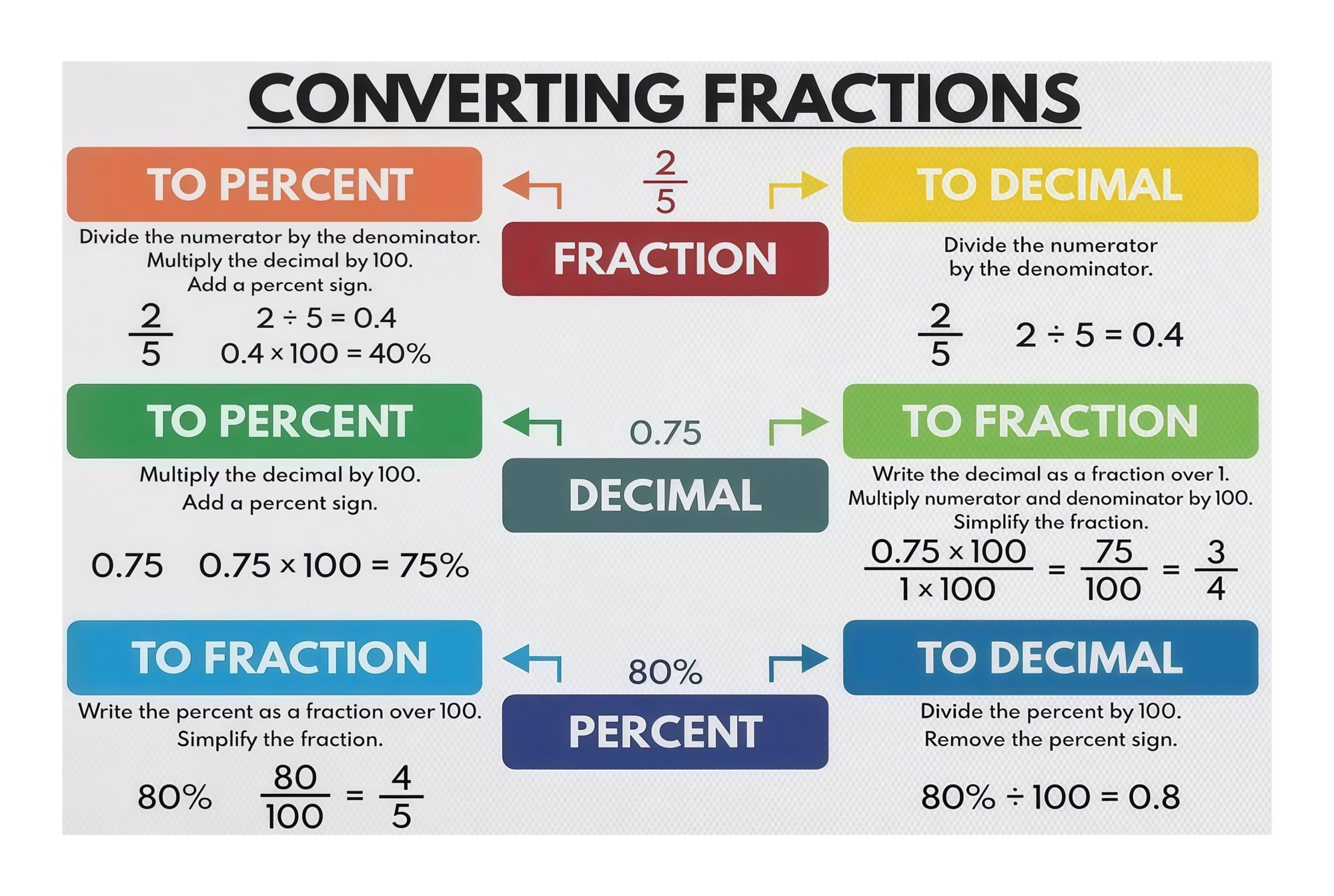
To achieve Grade 6 and 7 mastery, students must fluently convert between fractions, decimals, and percentages. This guide provides step-by-step methods for translating these mathematical expressions, helping learners understand that they are different ways to represent the same value. Mastery ensures a solid foundation for algebra, geometry, and real-world financial literacy in 2026.
The Mathematical "Triple Threat": Why FDP Mastery Matters
In the current 2026 educational landscape, the ability to transition seamlessly between fractions, decimals, and percentages—often referred to as FDP equivalence—is a cornerstone of middle school mathematics. Whether a student is following the Common Core standards in the United States or the Key Stage 3 curriculum in the United Kingdom, Grades 6 and 7 represent a critical pivot point. At this level, math shifts from basic arithmetic to proportional reasoning.
Fractions, decimals, and percentages are essentially three different "languages" used to describe parts of a whole. A fraction like $1/2$ describes a ratio of parts to a total; a decimal like $0.5$ describes that same value through the lens of base-10 place value; and a percentage like $50%$ describes it as a portion of 100. Mastery means not just knowing how to do the math, but understanding which "language" is most efficient for a specific problem. For example, it is often easier to multiply by $0.1$ than it is to calculate $10%$ of a complex number mentally.
As students progress into Grade 7, they encounter more complex scenarios involving interest rates, discounts, and statistical probability. Without a firm grasp of FDP conversions, these higher-level concepts become significantly more difficult. Mastering these conversions allows students to compare values accurately, such as determining whether a "30% off" sale is a better deal than a "1/3 off" promotion.
Converting Fractions: From Parts to Decimals and Percents
The journey to mastery usually begins with fractions because they are the most intuitive way to visualize "parts." However, fractions can be the most difficult to work with when performing addition or comparison. This is why converting them to decimals or percentages is a vital skill.
The Power of Ten: Scaling the Denominator
The simplest way to convert a fraction to a decimal or percentage is to find an equivalent fraction with a denominator of 10, 100, or 1,000. This method is highly effective for "friendly" fractions. If you have $3/5$, you can multiply both the numerator and the denominator by 20 to get $60/100$. Once the denominator is 100, the conversion is instant: the decimal is $0.60$ and the percentage is $60%$.
This method relies on a strong understanding of multiples and factors. Students should be encouraged to recognize "partner numbers" that multiply to reach 100, such as 2 and 50, 4 and 25, or 5 and 20. This mental math shortcut builds the "number sense" required for 2026 mastery standards.
The Universal Method: Long Division
When the denominator is not a factor of 100 (such as 3, 7, or 11), students must use the division method. Every fraction is essentially a division problem: the numerator divided by the denominator. To convert $5/8$ into a decimal, one must divide 5 by 8.
Because 8 does not go into 5, we place a decimal point and add zeros. 8 goes into 50 six times ($48$), with a remainder of 2. Bringing down another zero, 8 goes into 20 twice ($16$), with a remainder of 4. Finally, 8 goes into 40 exactly five times. Thus, $5/8 = 0.625$. To then turn this decimal into a percentage, we multiply by 100 by moving the decimal point two places to the right, resulting in $62.5%$.
Mastering Decimals: The Bridge to Fractions
Decimals are the standard language of digital systems and currency. In 2026, most standardized testing focuses heavily on decimal manipulation. Converting a decimal back into a fraction or a percentage is a matter of understanding place value.
Using Place Value as a Map
To convert a decimal to a fraction, you must "read" the decimal correctly. For example, $0.45$ is not just "zero point four five"; it is "forty-five hundredths." By naming the decimal correctly, the fraction writes itself: $45/100$.
However, Grade 6 and 7 mastery requires students to go a step further and simplify the fraction to its simplest form. In the case of $45/100$, both numbers are divisible by 5 (the Greatest Common Factor). Dividing both by 5 yields $9/20$. This final step is crucial; in most 2026 curricula, a fraction that is not simplified is often considered only partially correct.
The "Move the Dot" Rule for Percentages
Converting decimals to percentages is perhaps the most straightforward conversion. Since "percent" means "per hundred," you are essentially multiplying the decimal by 100.
- Move the decimal point two places to the right.
- Add the $%$ symbol.
A common mistake occurs with single-digit decimals. For example, $0.7$ becomes $70%$, not $7%$. Students must be taught to use "placeholder zeros" to ensure the decimal point moves the full two places. Conversely, $0.07$ correctly converts to $7%$.
The Percentage Pivot: Converting Back to Basics
Percentages are ubiquitous in statistics, grading, and finance. Mastering the conversion from percentages back to fractions or decimals allows students to check their work and perform calculations more easily.
From Percent to Decimal
To convert a percentage to a decimal, you perform the inverse of the decimal-to-percent rule: divide by 100. This involves moving the decimal point two places to the left. If a percentage is a whole number like $85%$, the decimal point is invisible but sits behind the 5 ($85.0%$). Moving it two places left results in $0.85$.
This skill is particularly useful when calculating "percent of a number." If a student needs to find $15%$ of 200, it is often faster to convert $15%$ to $0.15$ and multiply ($0.15 \times 200 = 30$).
From Percent to Fraction
To convert a percentage to a fraction, simply place the percentage value over a denominator of 100 and remove the $%$ sign. For example, $32%$ becomes $32/100$.
The real challenge for Grade 7 students lies in simplifying these fractions. A fraction like $32/100$ can be halved to $16/50$, and halved again to $8/25$. Mastery involves recognizing that 4 is the Greatest Common Factor of 32 and 100, allowing for a faster one-step simplification. For more information on mathematical standards, the National Council of Teachers of Mathematics (NCTM) provides extensive resources on proportional reasoning.
Essential Equivalents: A Mastery Comparison Table
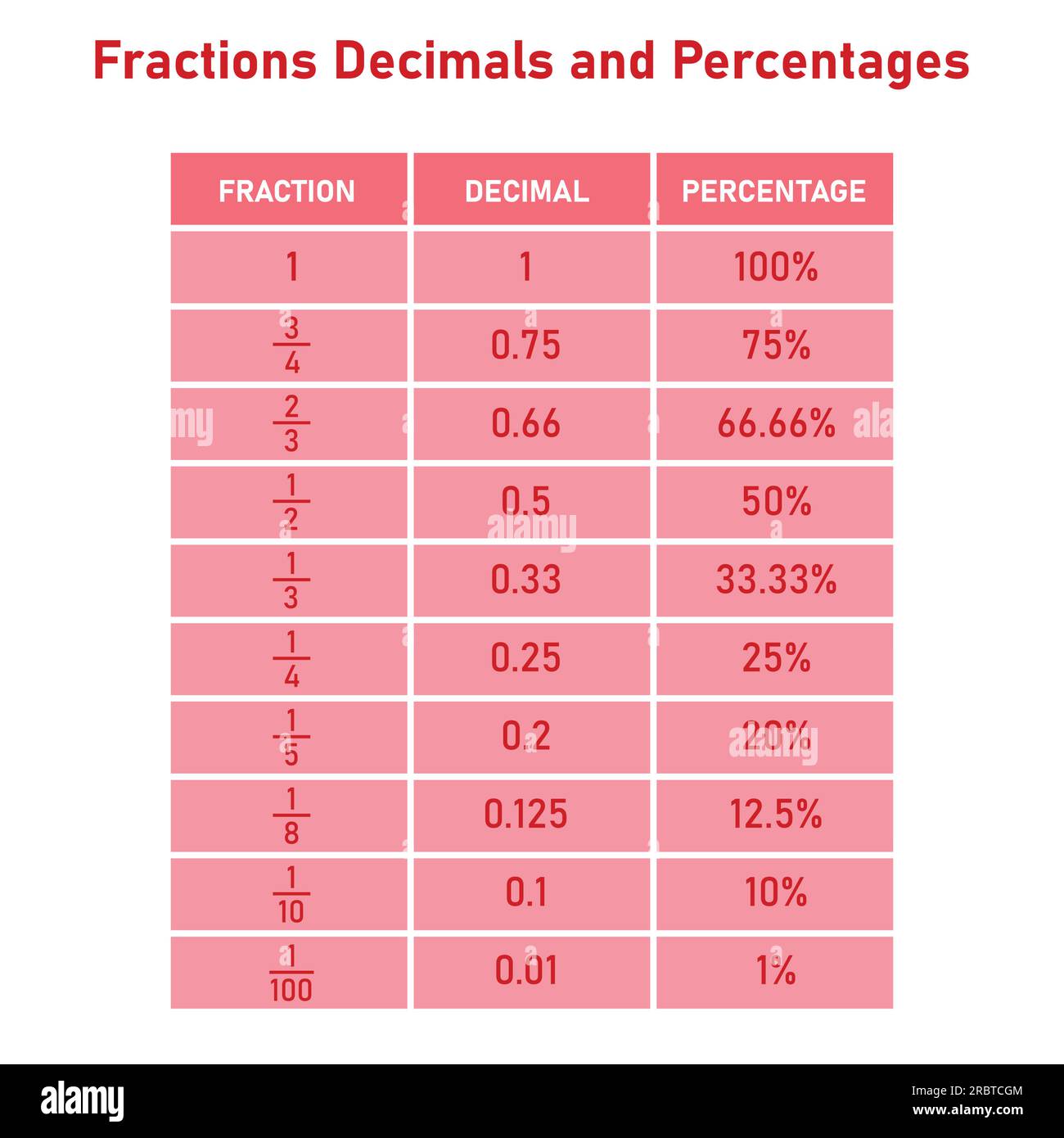
Memorizing common conversions is the "secret weapon" for speed and accuracy. The following table represents the "must-know" values for any student seeking Grade 6 or 7 mastery in 2026.
| Fraction | Decimal | Percentage | Notes |
|---|---|---|---|
| 1/2 | 0.5 | 50% | The basic benchmark |
| 1/4 | 0.25 | 25% | A "quarter" |
| 3/4 | 0.75 | 75% | Three quarters |
| 1/5 | 0.2 | 20% | Fifth part |
| 2/5 | 0.4 | 40% | Two fifths |
| 1/10 | 0.1 | 10% | The tenth benchmark |
| 1/3 | 0.33... | 33.3% | Recurring decimal |
| 2/3 | 0.66... | 66.6% | Recurring decimal |
| 1/8 | 0.125 | 12.5% | Often used in halving 1/4 |
| 3/8 | 0.375 | 37.5% | Intermediate mastery level |
Advanced Challenges: Repeating Decimals and Mixed Numbers
As students move deeper into Grade 7 mastery, they encounter numbers that don't fit neatly into the "denominator of 100" box.
Handling Recurring Decimals
Fractions like $1/3$ or $1/6$ result in repeating (recurring) decimals. In $1/3$, the 3 repeats infinitely ($0.333...$). In 2026 math standards, students are expected to use vinculum notation (a bar over the repeating digit) to represent these values accurately. When converting a repeating decimal back to a fraction, students learn that $0.333...$ is always $3/9$, which simplifies to $1/3$. This "over nine" rule for single repeating digits is an advanced mastery trick.
Mixed Numbers and Improper Fractions
Mastery also requires handling values greater than 1. A mixed number like $1 \frac{1}{2}$ must be converted to an improper fraction ($3/2$) before many conversion operations can be performed.
- As a decimal: $1.5$.
- As a percentage: $150%$.
Students often struggle with the idea of a percentage exceeding $100%$. However, Grade 7 curriculum specifically highlights growth and increase (e.g., "The population grew by $150%$"), making this a vital part of the mastery guide.
Strategic Practice for 2026 Standards
To truly master FDP conversions, students should move away from isolated drills and toward integrated problem-solving. Educators and parents should encourage the use of number lines. Placing $1/4$, $0.3$, and $35%$ on a single number line forces the student to convert all three to a common format (usually decimals) to compare their relative sizes.
Another effective strategy is the use of visual models like 10x10 grids. Shading 25 squares out of 100 visually demonstrates that $25/100$, $0.25$, and $25%$ are identical. This spatial awareness prevents students from making "order of magnitude" errors, such as confusing $0.05$ with $50%$. For those looking to align with national benchmarks, the Common Core State Standards offer specific grade-level trajectories for these skills.
FAQ
How do I convert a fraction to a percentage if the denominator doesn't go into 100?
You must first convert the fraction to a decimal using long division (numerator divided by denominator). Once you have the decimal, multiply it by 100 and add the percent sign. For example, for $1/7$, divide 1 by 7 to get approximately $0.1428$, which then becomes $14.28%$.
Why is it important to simplify fractions after converting from a decimal?
Simplifying fractions is a standard requirement in Grades 6 and 7 because it shows a complete understanding of number relationships. A simplified fraction is easier to use in subsequent calculations and is typically the only form accepted on standardized tests and in professional mathematical communication.
Is $0.5%$ the same as $0.5$?
No. $0.5$ as a decimal is equal to $50%$. On the other hand, $0.5%$ is a very small value, equal to $0.005$ as a decimal or $1/200$ as a fraction. Always remember that the $%$ symbol effectively means "divided by 100."
How can I quickly convert eighths (like 3/8) without a calculator?
The easiest way is to remember that $1/8$ is half of $1/4$ ($0.25$). Therefore, $1/8$ is $0.125$. To find $3/8$, you can simply multiply $0.125$ by 3, which equals $0.375$. This "halving and tripling" technique is a key mastery skill.
What is the fastest way to find a percentage of a number?
Convert the percentage to a decimal and multiply. To find $20%$ of 80, convert $20%$ to $0.2$ and multiply $0.2 \times 80$. Alternatively, find $10%$ by moving the decimal point in 80 one place left (8) and then double it ($8 \times 2 = 16$).
Next Steps for Mastery
The final step in achieving "6 7 Mastery" is application. Students should practice by analyzing real-world data, such as calculating the final price of an item after a percentage discount or interpreting the "percent daily value" on nutrition labels. By applying FDP conversions to everyday life, the mathematical rules move from rote memorization to functional literacy. For continued improvement, focus on timed drills for the "Essential Equivalents" table to build the computational fluency required for high school algebra.