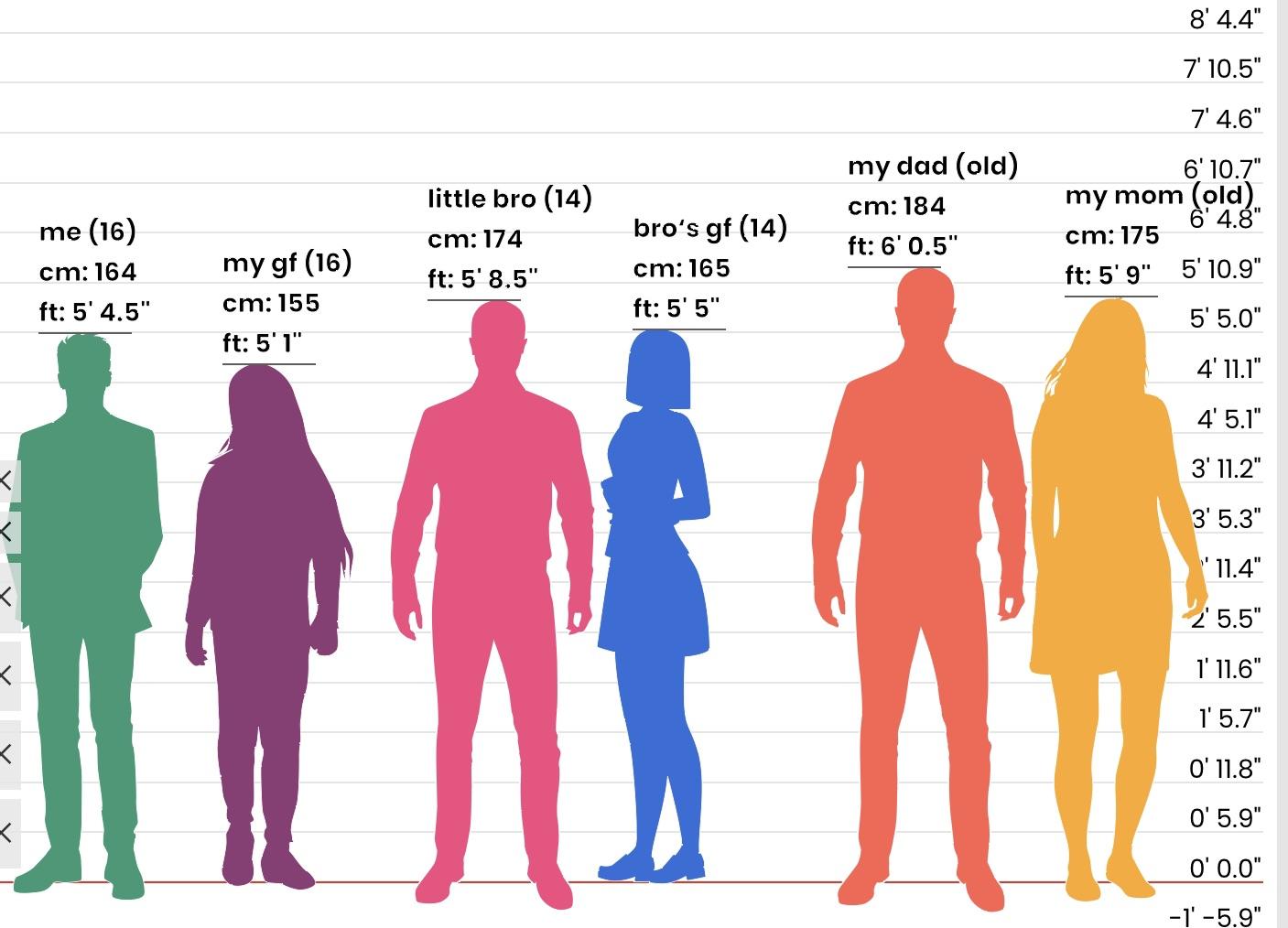
A height of 6'2" (187.96 cm) compared to 5'6" (167.64 cm) represents a substantial 8-inch (20.32 cm) difference. This gap significantly alters visual perspective, physical reach, and societal interaction, placing the taller individual in the 95th percentile and the shorter individual near the median or below, depending on gender and region.
Understanding the Measurements: Imperial to Metric
When analyzing the "showdown" between 6'2" and 5'6", we must first establish the precise mathematical reality of these figures. In the year 2026, while many regions have fully transitioned to the metric system for medical and scientific purposes, the imperial system remains the dominant social standard in the United States, United Kingdom, and Canada.
A person who stands 6 feet 2 inches is roughly 188 centimeters tall. Specifically, 74 inches multiplied by 2.54 cm equals 187.96 cm. Conversely, a person who is 5 feet 6 inches stands at 66 inches, which converts to approximately 167.64 cm. The 20.32 cm gap is not merely a number; it is the approximate length of a standard US postage envelope or a large tablet screen.
In a global context, 6'2" is considered "tall" in almost every nation on Earth. Even in the Netherlands or Montenegro, where average male heights are among the highest in the world, 6'2" remains above the mean. On the other hand, 5'6" occupies a more complex statistical space. For a male in the United States, 5'6" is roughly three inches shorter than the average (which hovers around 5'9"). For a female, 5'6" is approximately two inches taller than the average (which sits near 5'4").
The Visual Reality: What an 8-Inch Gap Looks Like
Visualizing the difference between 6'2" and 5'6" is essential for understanding how these two individuals interact in a shared space. To put it simply, the top of the head of the 5'6" person will typically reach the chin or the lower lip of the 6'2" person.
When standing face-to-face, the 6'2" individual will always be looking downward at a significant angle. Their eye level is roughly 4 to 5 inches higher than their 5'6" counterpart's eye level. This disparity creates a distinct "looming" effect in close quarters. In a crowded room, the 6'2" person can easily see over the heads of most people, including the 5'6" person, providing them with a "periscope" view of their surroundings.
In photography or social media content—a major focus of height comparisons in 2026—this 8-inch gap requires specific framing. If the two are standing side-by-side, the shorter person may appear significantly smaller than they are in isolation, simply because of the scale provided by the taller individual. This is often referred to as the "height contrast effect," where the presence of a tall person makes a person of average height look "short" by comparison.
Physical Reach and Everyday Ergonomics
The functional differences between being 6'2" and 5'6" are most apparent in domestic and public environments designed for the "average" human. Most infrastructure is built to accommodate a range between 5'4" and 6'0", meaning both individuals in this comparison often face unique ergonomic challenges.
Reach and Accessibility
The 6'2" individual has a significant advantage in vertical reach. With an average arm length proportional to their height, they can comfortably reach items on shelves that are 7 to 8 feet high without a step stool. For the 5'6" person, those same shelves are often inaccessible without assistance. This affects everything from grocery shopping to kitchen organization.
Space and Clearance
Conversely, the 5'6" person navigates the world with much greater "spatial efficiency." Public transportation—including airplanes, buses, and subways—is generally comfortable for someone who is 5'6". They have ample legroom and rarely have to worry about their head hitting low-clearance doorways or overhead compartments.
For the 6'2" person, the world often feels "shrunken." Standard airline "economy" seating is notoriously difficult for anyone over 6 feet tall, as their knees often press against the seat in front of them. In 2026, many tall individuals prioritize "extra legroom" upgrades as a necessity rather than a luxury.
| Feature | 5'6" (167.6 cm) | 6'2" (188.0 cm) | Difference/Impact |
|---|---|---|---|
| US Male Percentile | ~15th Percentile | ~95th Percentile | Massive statistical gap |
| US Female Percentile | ~75th Percentile | >99th Percentile | Both are above average |
| Eye Level | Approx. 5'2" | Approx. 5'10" | 8-inch line-of-sight gap |
| Clothing Size | Small/Medium/Regular | Large/XL/Tall | Different retail sections |
| Standard Bed Fit | Plenty of room | Feet near/off edge | 6'2" fits barely on Twin/Full |
| Arm Span | ~66 inches | ~74 inches | 8-inch reach advantage for 6'2" |
Fashion and Clothing Challenges
The retail landscape in 2026 has become more inclusive, yet the 6'2" vs. 5'6" showdown still reveals a divide in how clothing is manufactured and marketed.
The 5'6" Style Guide
A person who is 5'6" often falls into the "Regular" sizing category, but they frequently struggle with pant lengths. Many standard men's trousers come with a 30-inch or 32-inch inseam. A 5'6" male often requires a 28-inch or 29-inch inseam, leading to a reliance on tailors or "Short" specific lines. For women at 5'6", they are in the "sweet spot" for most fashion brands, as many fit models are approximately this height.
The 6'2" Style Guide
At 6'2", a person enters the "Tall" category. While they can often find shirts in standard stores, they frequently encounter the "sleeve length" problem. Standard Large shirts may fit the torso but end two inches short of the wrist. Additionally, finding pants with a 34-inch or 36-inch inseam is more difficult in brick-and-mortar stores, often necessitating online specialized orders. The 6'2" frame is highly sought after in the modeling industry, as it allows clothes to "hang" with a linear elegance that is difficult to replicate on shorter frames.
Athletic Performance: Advantages and Disadvantages
In the realm of sports, height is a tool that can be either a weapon or a hindrance, depending on the discipline.
- Basketball and Volleyball: The 6'2" individual has a massive advantage. In these sports, every inch of vertical reach translates to better shot-blocking, rebounding, and spiking. While 6'2" is considered a "point guard" height in professional basketball, it is "elite" in most recreational and high school settings.
- Combat Sports (Boxing/MMA): The 6'2" person typically possesses a longer reach (jab). However, they must often fight in higher weight classes. The 5'6" person, if they are muscular, may have a lower center of gravity, making them harder to take down in wrestling or judo.
- Gymnastics and Diving: Here, the 5'6" person has the upper hand. A shorter stature allows for a tighter "moment of inertia," meaning they can flip and rotate in the air much faster than someone who is 6'2".
- Long-Distance Running: Both heights can excel, but many elite marathoners tend to be closer to the 5'6" mark. This is due to a more efficient heat dissipation ratio and a lighter frame that puts less stress on the joints over 26.2 miles.
Health and Longevity Considerations
Medical research available in 2026 suggests that height is more than just a physical trait; it is a marker for certain biological trajectories.
The "Tall" Tax on Health
Studies have consistently shown that taller individuals (6'2" and up) may face a higher risk of certain conditions. This includes atrial fibrillation (irregular heart rhythm) and venous thromboembolism (blood clots), partly because blood must be pumped further distances and against greater gravitational pressure. There is also a slight correlation between height and certain types of cancer, hypothesized to be linked to a higher total number of cells in the body.
The "Shorter" Health Profile
Conversely, individuals around 5'6" often enjoy greater longevity on average. There is a famous correlation involving the "FOXO3" longevity gene, which is more commonly found in shorter individuals. However, those on the shorter side of the spectrum may have a slightly higher risk of coronary heart disease if their height is a result of nutritional deficits during development, though this is less common in developed nations in 2026.
Social and Psychological Dynamics
The societal perception of the 6'2" vs. 5'6" difference is perhaps the most debated aspect of this showdown. Sociological studies have long documented "height bias" or "heightism."
Professional Perception
Historically, taller individuals are often perceived as more "leader-like." A 6'2" man is statistically more likely to hold a managerial position than a 5'6" man. This is not due to capability, but rather unconscious biases that associate height with authority and competence. By 2026, corporate diversity, equity, and inclusion (DEI) initiatives have begun to address these physical biases, but the "height premium" in salary still persists in some sectors.
Dating and Social Attraction
In the dating world, particularly on digital platforms, height is a major filter. A 6'2" height is often cited as a "ideal" or "highly desirable" metric for men. Those at 5'6" often report more difficulty in initial matching phases on apps where height is a mandatory disclosure. However, many find that these biases dissipate in face-to-face interactions where personality, confidence, and grooming play a more decisive role than a raw measurement.
Ergonomic Adjustments for Both Heights
Navigating a world built for the "average" means both the 6'2" and 5'6" person should make adjustments to protect their long-term spinal health.
- For the 6'2" Individual: Ensure that computer monitors are raised to eye level to avoid "tech neck." Invest in chairs with adjustable lumbar support that actually reaches the small of the back. Use a standing desk that can extend high enough to prevent slouching.
- For the 5'6" Individual: Use a footrest if your chair is too high, preventing your legs from dangling and cutting off circulation. Ensure that the keyboard tray is low enough so that shoulders remain relaxed. In the kitchen, consider pull-down shelving systems to maximize cabinet utility.
Frequently Asked Questions
Is 6'2" significantly taller than 5'6"?
Yes. An 8-inch difference is very noticeable. It is the difference between being one of the tallest people in a room and being of average or slightly below-average height. In a crowd, the 6'2" person’s head will be entirely above the 5'6" person’s head.
Can a 5'6" person ever look as tall as a 6'2" person?
Not standing side-by-side. However, in solo photos, a 5'6" person can "pose tall" by using low camera angles, wearing monochromatic outfits, and maintaining excellent posture. They will only appear "short" when a reference object—like a 6'2" person or a standard door frame—is in the shot.
Is it better to be 6'2" or 5'6"?
There is no "better" height; both have pros and cons. 6'2" offers social advantages and reach but comes with joint stress and discomfort in public spaces. 5'6" offers physical agility, comfort in travel, and potential longevity benefits but may face societal biases in professional and dating contexts.
What is the height difference in centimeters?
The difference is exactly 20.32 centimeters. 6'2" is 187.96 cm and 5'6" is 167.64 cm.
Embracing Your Stature
Whether you stand at 5'6" or 6'2", the key to the "showdown" is understanding how your height interacts with your environment. For the 5'6" individual, the focus should be on ergonomic accessibility and projecting confidence to overcome societal height biases. For the 6'2" individual, the focus is on maintaining posture and finding specialized products that accommodate a larger frame. In 2026, the world is more adaptable than ever, allowing both heights to thrive through proper lifestyle adjustments and self-awareness.