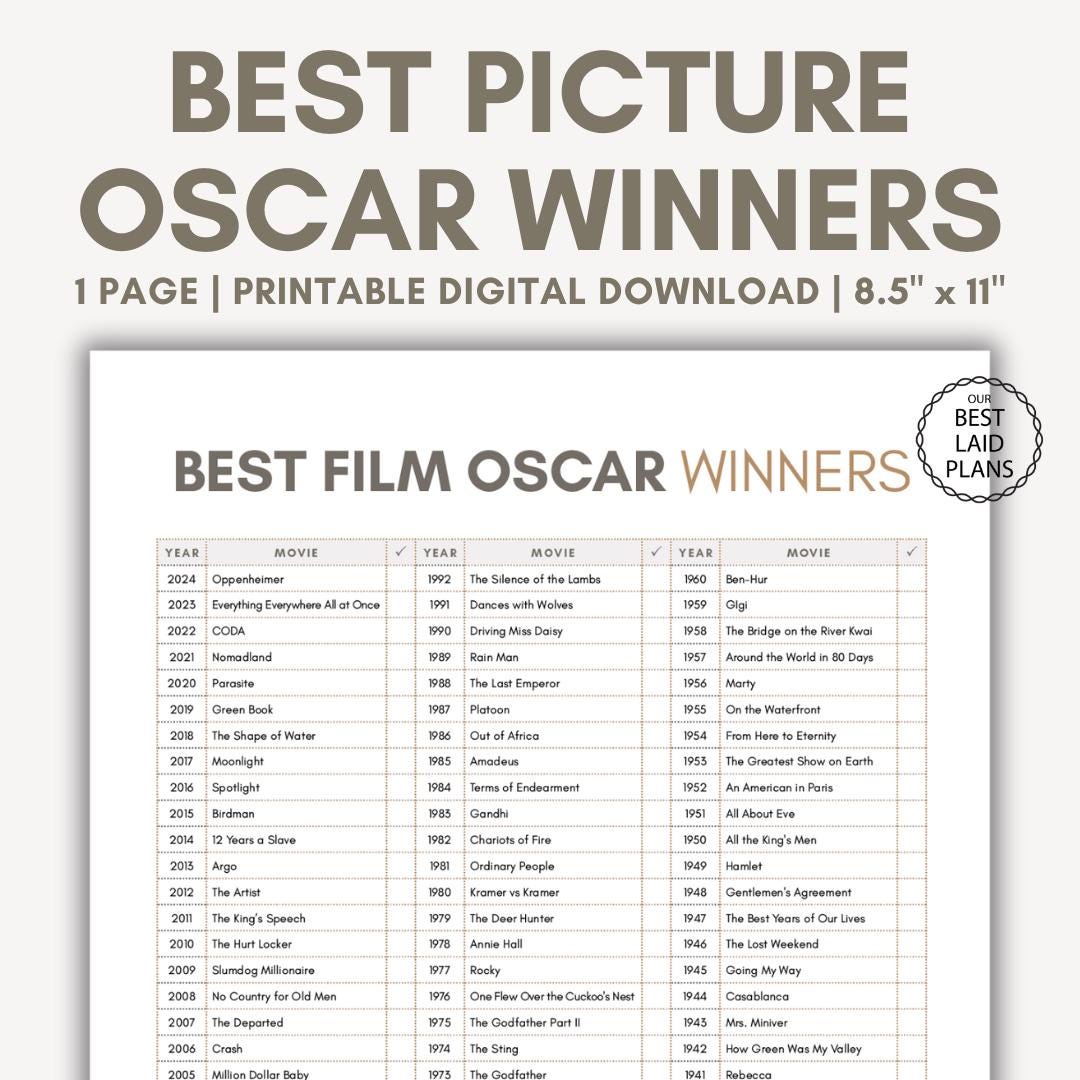
As of the 2026 film season, the most definitive and verified record of Academy Award champions remains the winners of the 96th Academy Awards. This ceremony, which celebrated the highest achievements in filmmaking, saw Oppenheimer dominate the evening with seven wins, including Best Picture, while individual performers like Cillian Murphy and Emma Stone secured their places in cinematic history.
The Academy Awards, colloquially known as the Oscars, represent the pinnacle of professional recognition in the global film industry. Organized by the Academy of Motion Picture Arts and Sciences (AMPAS), the awards are a multi-stage process involving thousands of industry professionals. As we reflect on the champions recognized in this era, the following list provides a comprehensive breakdown of the winners across all 23 competitive categories, documenting the films and individuals that have defined the current standard of excellence.
The 96th Academy Awards: A Historical Overview
The 96th Academy Awards, held at the Dolby® Theatre in Hollywood, served as a landmark event for the industry, particularly as it navigated the post-strike production landscape. The ceremony was characterized by a "return to form" for traditional grand-scale filmmaking, while simultaneously providing space for international features and independent voices.
Christopher Nolan’s Oppenheimer entered the evening as the heavy favorite and successfully converted seven of its thirteen nominations into wins. This performance was significant not only for its volume but for its sweep of the "Major" categories, including Best Picture, Best Director, and Best Actor. The 2025-2026 awards cycle continues to be influenced by the trends set during this ceremony, particularly the industry's renewed interest in historical biopics and high-concept technical mastery.
The diversity of the winners list also highlighted the Academy's expanding global reach. The Zone of Interest, a haunting examination of the Holocaust, became the first United Kingdom production to win Best International Feature Film, signaling a shift in how the Academy views territorial representation in the modern era of 2026.
Major Category Winners: Breaking Down the "Big Six"
In the hierarchy of the Academy Awards, the "Big Six" categories—Best Picture, Director, Lead Actor, Lead Actress, Supporting Actor, and Supporting Actress—receive the highest level of public and critical scrutiny. These winners define the "face" of the year's cinematic output.
Best Picture and Best Director
The win for Oppenheimer as Best Picture was the culmination of a decade-long journey for director Christopher Nolan. Nolan himself secured the award for Best Director, marking his first win in the category despite a prolific career of critical and commercial successes. The film’s victory was attributed to its complex narrative structure, its refusal to rely on CGI for practical effects, and its massive cultural impact.
Lead Acting Categories
Cillian Murphy took home the Oscar for Best Actor for his titular role in Oppenheimer. Murphy’s performance was lauded for its internal intensity and the physical transformation required to portray J. Robert Oppenheimer across several decades.
In the Best Actress category, Emma Stone won her second Academy Award for her role as Bella Baxter in Poor Things. The win was one of the most debated of the night, as she was in a close race with Lily Gladstone (Killers of the Flower Moon). Stone’s win solidified her status as one of the premier actors of the 2020s, recognized for her willingness to take on avant-garde and physically demanding roles.
Supporting Acting Categories
The supporting categories were notable for honoring seasoned veterans and rising stars alike. Robert Downey Jr. won Best Supporting Actor for his portrayal of Lewis Strauss in Oppenheimer, completing a career redemption arc that was widely celebrated by the industry. Meanwhile, Da'Vine Joy Randolph won Best Supporting Actress for The Holdovers. Her performance was cited by critics as the emotional anchor of the film, showcasing a mastery of grief and resilience.
Technical Achievements: The Complete List of Champions
Beyond the high-profile acting and directing awards, the Academy honors the technical crafts that make filmmaking possible. These categories are often where the most innovation is seen, especially as visual and auditory technologies evolve toward the 2026 standards.
| Category | Winner | Film |
|---|---|---|
| Best Picture | Emma Thomas, Charles Roven, Christopher Nolan | Oppenheimer |
| Best Director | Christopher Nolan | Oppenheimer |
| Best Actor | Cillian Murphy | Oppenheimer |
| Best Actress | Emma Stone | Poor Things |
| Best Supporting Actor | Robert Downey Jr. | Oppenheimer |
| Best Supporting Actress | Da'Vine Joy Randolph | The Holdovers |
| Best Original Screenplay | Justine Triet and Arthur Harari | Anatomy of a Fall |
| Best Adapted Screenplay | Cord Jefferson | American Fiction |
| Best Animated Feature | Hayao Miyazaki and Toshio Suzuki | The Boy and the Heron |
| Best International Feature | Jonathan Glazer (UK) | The Zone of Interest |
| Best Documentary Feature | Mstyslav Chernov, Michelle Mizner, Raney Aronson-Rath | 20 Days in Mariupol |
| Best Cinematography | Hoyte van Hoytema | Oppenheimer |
| Best Film Editing | Jennifer Lame | Oppenheimer |
| Best Original Score | Ludwig Göransson | Oppenheimer |
| Best Original Song | Billie Eilish and Finneas O'Connell | "What Was I Made For?" (Barbie) |
| Best Sound | Tarn Willers and Johnnie Burn | The Zone of Interest |
| Best Production Design | James Price, Shona Heath, Zsuzsa Mihalek | Poor Things |
| Best Costume Design | Holly Waddington | Poor Things |
| Best Makeup & Hairstyling | Nadia Stacey, Mark Coulier, Josh Weston | Poor Things |
| Best Visual Effects | Takashi Yamazaki, Kiyoko Shibuya, Masaki Takahashi, Tatsuji Nojima | Godzilla Minus One |
Analysis of Screenplay and Animation Winners
The writing categories often serve as a bellwether for the "intelligence" of the year's cinema. At the most recent ceremony, Justine Triet and Arthur Harari won Best Original Screenplay for Anatomy of a Fall. The film, a French courtroom drama, succeeded in overcoming the "subtitle barrier" to win one of the night’s most prestigious awards, further proving that the Academy’s voting body is becoming more international in its tastes.
In Best Adapted Screenplay, Cord Jefferson won for American Fiction. The film, an adaptation of Percival Everett’s novel Erasure, was a biting satire of the publishing and film industries' commodification of Black trauma. Jefferson’s win was particularly significant as he transitioned from a successful career in journalism and television writing to a major film award winner.
The Best Animated Feature category saw a historic win for Hayao Miyazaki with The Boy and the Heron. This marked Miyazaki’s second Oscar, the first being for Spirited Away over two decades prior. The win reflected the Academy's deep respect for hand-drawn animation in an era increasingly dominated by digital assets and AI-assisted rendering, a topic of much discussion in 2026.
Understanding the Academy’s Voting and Selection Process
To understand how these champions are crowned, one must look at the rigorous selection process managed by the Academy. As of 2026, the membership of AMPAS has grown to over 10,000 professionals, divided into 19 branches.
- The Nomination Phase: Members vote within their specific branches. For example, only actors nominate actors, and only directors nominate directors. However, all voting members are eligible to nominate for Best Picture.
- The Final Balloting: Once the nominations are set, the entire active membership votes on the winners in all categories.
- The Preferential Ballot: For the Best Picture category, the Academy utilizes a preferential (or ranked-choice) voting system. Voters rank the nominees in order of preference. If a film receives more than 50% of the first-place votes, it wins. If not, the film with the fewest first-place votes is eliminated, and its votes are redistributed to the voters' second choices. This process continues until a winner is determined. This system is designed to ensure that the winner has the broadest possible support across the diverse membership.
The Impact of Visual Effects and Sound Design
One of the most notable wins in recent history occurred in the Best Visual Effects category, where Godzilla Minus One took the prize. This was a monumental achievement for several reasons: it was the first time a Japanese production won in this category, and it was achieved with a fraction of the budget typical of Hollywood blockbusters. The win signaled to the industry in 2026 that creativity and efficient workflow can triumph over sheer financial muscle.
Similarly, the win for Best Sound by The Zone of Interest highlighted the importance of auditory storytelling. The film utilized sound to depict the horrors of the Auschwitz concentration camp occurring just outside the frame of the visual narrative. This use of sound as a primary narrative tool, rather than just a technical accompaniment, represented a high point in the craft.
Future Outlook: The Road to the 99th Oscars
As we move through 2026, the focus has already shifted toward the 99th Academy Awards, scheduled for 2027. The Academy continues to implement new diversity and inclusion standards (the Academy Aperture 2025 initiative), which require films to meet specific representation criteria to be eligible for Best Picture.
The "complete list" of champions is never static; it is a living document of the film industry’s evolution. In 2026, we see a greater emphasis on "theatricality"—films that demand to be seen on a large screen—as the industry fights for relevance in a streaming-heavy market. The champions listed above represent the successful navigation of that challenge.
Frequently Asked Questions
What film has won the most Oscars in history?
Currently, three films share the record for the most Academy Award wins, each receiving 11 Oscars: Ben-Hur (1959), Titanic (1997), and The Lord of the Rings: The Return of the King (2003). While Oppenheimer was a dominant force at the 96th ceremony, its seven wins do not place it in the top tier of all-time winners, though it remains one of the most awarded films of the 21st century.
How many categories are there in the Academy Awards?
There are currently 23 competitive categories in the Academy Awards. These include the major categories like Best Picture and Lead Acting, as well as craft categories such as Sound, Film Editing, and Costume Design. In addition to these, the Academy may present Honorary Awards, the Jean Hersholt Humanitarian Award, and the Irving G. Thalberg Memorial Award.
Can a film win an Oscar if it was released on streaming?
Yes. As of the 2026 guidelines, films released on streaming platforms are eligible for Academy Awards provided they have met the minimum theatrical release requirements. These requirements typically involve a one-week qualifying run in a commercial theater in one of six major U.S. metropolitan areas. For Best Picture eligibility, the rules have become stricter, often requiring a more robust theatrical footprint.
Who is the most awarded individual in Oscar history?
Walt Disney holds the record for the most Academy Awards won by an individual. Throughout his career, he received 22 competitive Oscars and four honorary Oscars from a total of 59 nominations. In the modern era, individuals like sound designer Alan Robert Murray and composer Alan Menken have also achieved high win counts, though they remain far behind Disney's historical record.
Why did the Best Sound category merge?
Previously, the Academy presented two separate awards: Best Sound Editing and Best Sound Mixing. These were merged into a single Best Sound category starting with the 93rd Academy Awards. The decision was made to better reflect the collaborative and integrated nature of modern sound post-production, where the distinction between editing and mixing has become increasingly blurred by digital technology.
Practical Steps for Tracking Future Winners
For those looking to stay updated on the "complete list" as new ceremonies occur, the most reliable method is to follow the official Academy of Motion Picture Arts and Sciences database. This searchable archive provides the full history of every nominee and winner since the first ceremony in 1929. Additionally, following the official Oscar "shortlists" released in December of each year provides the best early indication of which films will likely become the champions of the following year.