The 25th Amendment provides the definitive legal framework for presidential succession and the management of executive disability in the United States. It outlines the protocols for filling a vice-presidential vacancy and establishes the procedures for transferring power when a president is temporarily or permanently unable to discharge their duties, ensuring national stability.
Since its ratification in 1967, the 25th Amendment has served as a vital safeguard for the continuity of the American government. While the original text of the Constitution provided a vague outline for succession, it left critical questions unanswered—most notably, whether a Vice President actually "becomes" the President or merely "acts" as one, and how to handle a leader who is alive but incapacitated. As of 2026, the amendment remains the primary legal instrument used to navigate executive transitions, ranging from routine medical procedures to sudden vacancies in the nation’s second-highest office.
The Historical Necessity of the 25th Amendment
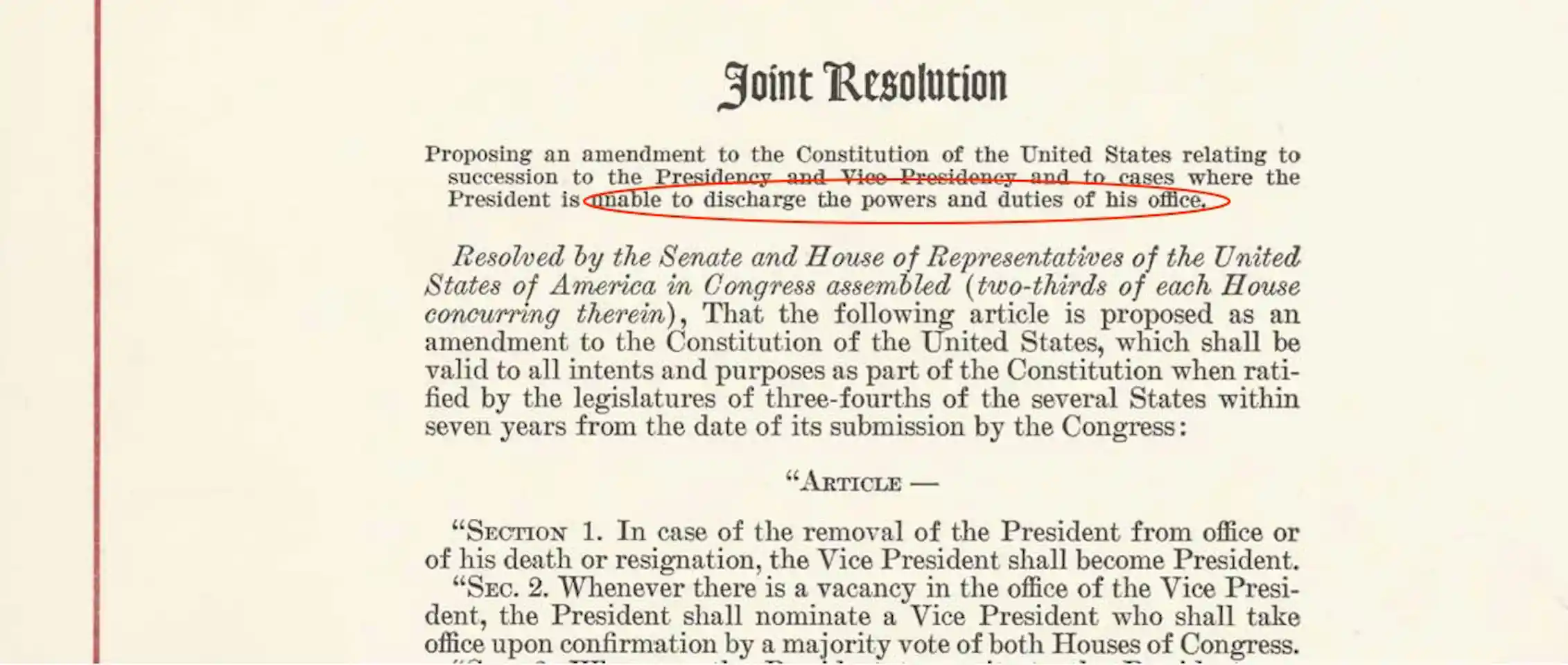
To understand the 25th Amendment, one must look at the constitutional ambiguity that preceded it. Article II, Section 1, Clause 6 of the Constitution stated that in the case of the President’s "Inability to discharge the Powers and Duties of the said Office, the Same shall devolve on the Vice President." However, the text did not clarify if "the Same" referred to the office itself or merely the powers and duties.
This ambiguity led to the "Tyler Precedent" in 1841. When President William Henry Harrison died, Vice President John Tyler insisted on being sworn in as President, rather than serving as an "Acting President." While his move established a functional tradition, it lacked explicit constitutional backing. Furthermore, the nation faced several crises where the President was incapacitated but remained in office—such as James Garfield’s 80-day struggle after being shot and Woodrow Wilson’s lengthy recovery from a stroke. In these instances, the country was effectively leaderless, as there was no legal mechanism to transfer power temporarily without the President losing their office permanently.
The assassination of John F. Kennedy in 1963 was the final catalyst. With the vice presidency vacant for over a year after Lyndon B. Johnson took office, and the next two people in line being the 71-year-old Speaker of the House and the 86-year-old President pro tempore of the Senate, Congress realized the system was too fragile for the nuclear age. The 25th Amendment was proposed to solve these specific vulnerabilities.
Section 1: The Absolute Succession of the Vice President
Section 1 of the 25th Amendment codifies the Tyler Precedent into law. It states: "In case of the removal of the President from office or of his death or resignation, the Vice President shall become President."
This section is the most straightforward but arguably the most important for immediate stability. It clarifies that the Vice President does not merely "act" as the President; they are the President for the remainder of the term. This provides the new executive with the full weight of the office's authority, including the power to appoint a cabinet, command the military, and sign legislation without the cloud of "acting" status. In 1974, this section was utilized when Richard Nixon resigned, making Gerald Ford the first President to take office under this specific provision following a resignation.
Section 2: Filling a Vice Presidential Vacancy
Before the 25th Amendment, if a Vice President died or moved up to the presidency, the office of the Vice President remained vacant until the next general election. This happened 16 times in American history prior to 1967. Section 2 changed this by creating a mechanism for the President to appoint a successor.
Under Section 2, the President nominates a candidate for Vice President who must then be confirmed by a majority vote in both the House of Representatives and the Senate. This ensures that the second-in-command has both executive confidence and legislative legitimacy.
This process has been used twice in history, both during the mid-1970s:
- Gerald Ford (1973): Appointed by Nixon after Spiro Agnew resigned.
- Nelson Rockefeller (1974): Appointed by Ford after Ford ascended to the presidency.
Without Section 2, the line of presidential succession would immediately jump to the Speaker of the House, which could lead to a change in the ruling political party without an election, potentially causing significant partisan friction.
Section 3: Voluntary Transfer of Power for Temporary Disability
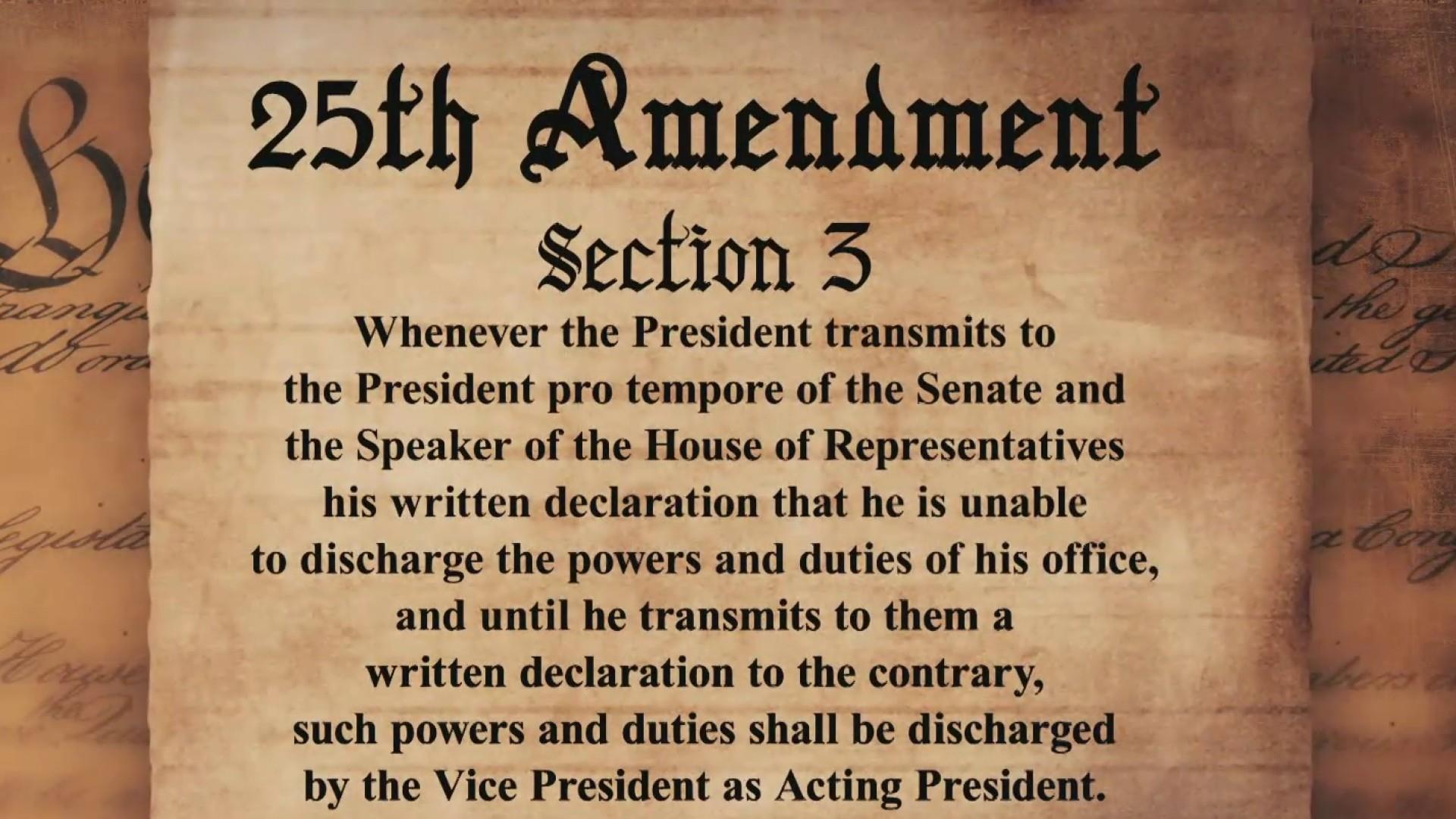
Section 3 addresses the scenario where a President knows they will be unable to perform their duties for a short period—most commonly during surgery or a medical procedure involving anesthesia.
To trigger this, the President must submit a written declaration to the President pro tempore of the Senate and the Speaker of the House of Representatives. Upon this declaration, the Vice President becomes the "Acting President." The President regains their powers by submitting a second written declaration stating they are fit to resume their duties.
Notable Uses of Section 3
While it may seem like a formality, Section 3 is a critical tool for ensuring that there is always a functioning Commander-in-Chief. It has been used most frequently for routine medical procedures:
- 1985: Ronald Reagan transferred power to George H.W. Bush for eight hours during colon surgery.
- 2002 & 2007: George W. Bush transferred power to Dick Cheney during routine colonoscopies.
- 2021: Joe Biden transferred power to Kamala Harris for 85 minutes during a medical procedure.
In each case, the transfer was seamless, and the "Acting President" held full executive authority during the window of the President's incapacity.
Section 4: Involuntary Removal and the "Inability" Clause
Section 4 is the most complex and controversial part of the 25th Amendment. It provides a way to remove a President who is "unable to discharge the powers and duties of his office" but is either unwilling or unable to declare their own incapacity (e.g., if the President is in a coma or suffering from severe cognitive decline).
This section requires two primary actors to initiate:
- The Vice President: The process cannot begin without the Vice President’s consent and signature.
- The Cabinet: A majority of the "principal officers of the executive departments" (currently 15 heads of departments) must also sign the declaration. Alternatively, Congress can designate a different body to perform this role, though it has never done so.
Once the Vice President and the majority of the Cabinet send a written declaration to the leaders of the House and Senate, the Vice President immediately becomes Acting President.
Resolving Disputes
If the President recovers and disputes the claim of inability, they can submit a written declaration stating they are fit. However, if the Vice President and the Cabinet still believe the President is unable, they have four days to send another declaration. At that point, Congress must decide the issue.
- Congress must meet within 48 hours.
- A two-thirds vote in both the House and Senate is required to keep the Vice President as Acting President.
- If the two-thirds threshold is not met, the President resumes their powers.
This high bar is intentional; Section 4 was designed to be a tool for medical necessity, not a political alternative to impeachment.
Summary of the 25th Amendment Procedures
The following table summarizes how the different sections of the 25th Amendment function in practice:
| Section | Scenario | Initiator | Required Approval | Resulting Status |
|---|---|---|---|---|
| Section 1 | Death, Resignation, Removal | Automatic | None (Constitutional Law) | VP becomes President |
| Section 2 | Vice President Vacancy | President | Majority of House & Senate | New VP is sworn in |
| Section 3 | Voluntary Incapacity | President | Written notice to Congress | VP becomes Acting President |
| Section 4 | Involuntary Incapacity | VP + Cabinet | Written notice (Two-thirds of Congress if contested) | VP becomes Acting President |
Comparison: 25th Amendment vs. Impeachment
A common point of confusion is the difference between the 25th Amendment and impeachment (Article I and II). While both can result in a President leaving office, their purposes and standards are entirely different.
Impeachment is a punitive and political process designed to address "Treason, Bribery, or other high Crimes and Misdemeanors." It focuses on the President's actions and misconduct. The process starts in the House (indictment) and is tried in the Senate (conviction).
The 25th Amendment is a procedural and medical safety net. It is not about whether a President did something "wrong," but whether they are physically or mentally capable of doing the job. Section 4 is meant to be a protective measure for the office, not a punishment for the individual. Because it requires the Vice President and the President's own Cabinet to act, it is legally shielded from being used as a simple tool for political disagreement.
Frequently Asked Questions
Who counts as the "Cabinet" for the 25th Amendment?
The "principal officers of the executive departments" refers to the heads of the 15 executive departments (e.g., Secretary of State, Secretary of Defense, Attorney General). Under current law, "acting" secretaries may not count toward the majority unless specifically clarified by a court or subsequent legislation, which is why permanent appointments are vital for the functional application of Section 4.
Can the 25th Amendment be used to permanently remove a President?
Section 1 and Section 2 are permanent. However, Sections 3 and 4 are generally intended to be temporary. While an "Acting President" could theoretically serve out the remainder of a term if the President never recovers, the President technically remains "the President" while the Vice President holds the "powers and duties."
Has Section 4 ever been successfully invoked?
No. As of 2026, Section 4 has never been invoked to remove a President. It has been discussed during various historical periods of political or health crises, but the rigorous requirement for the Vice President and the Cabinet to agree has ensured it is only considered in extreme circumstances.
What happens if the Vice President and the President both become incapacitated?
The 25th Amendment does not cover a double vacancy. In that scenario, the Presidential Succession Act of 1947 takes over. The line of succession flows to the Speaker of the House, then the President pro tempore of the Senate, followed by the Cabinet secretaries in the order their departments were created.
Can a President fire the Cabinet to prevent Section 4?
While a President has the authority to fire Cabinet members at will, doing so to thwart a Section 4 invocation would create a constitutional crisis. If the Vice President and a majority of the Cabinet have already signed the declaration, the transfer of power to the Acting President happens "immediately." Any attempts to fire them after the declaration is sent would likely be legally void or adjudicated by the Supreme Court.
Ensuring Executive Continuity in 2026
The complexity of modern governance and the speed of global crises require a clear, unambiguous chain of command. The 25th Amendment ensures that the United States is never without a functional executive, even for a few hours.
For citizens and legal professionals, understanding these rules is essential for monitoring the health of the republic. The best course of action for maintaining this stability is the prompt and transparent filling of Cabinet and Vice Presidential vacancies as they occur. When the executive branch is fully staffed with Senate-confirmed officials, the mechanisms of the 25th Amendment can function as intended—providing a peaceful, legal, and predictable transition of power regardless of the circumstances.