The 20th century was a transformative era defined by global ideological conflicts, the rapid acceleration of technological innovation, and the dismantling of centuries-old colonial empires. From the devastation of two World Wars to the digital revolution, this period fundamentally restructured human society, shifting the global power balance from European monarchies to a bipolar—and eventually unipolar—geopolitical landscape.
The Dawn of the Modern Age and the First World War (1900–1918)
At the turn of the 20th century, the world was dominated by European imperial powers. The Belle Époque in Europe and the Gilded Age in the United States suggested a period of relative peace and prosperity, yet beneath the surface, tensions were mounting. The "M.A.I.N." causes of conflict—Militarism, Alliances, Imperialism, and Nationalism—created a volatile environment that only required a single spark to ignite.
That spark was the assassination of Archduke Franz Ferdinand in Sarajevo in June 1914. What followed was a catastrophic failure of diplomacy as the alliance systems (the Triple Entente versus the Central Powers) dragged the world into the first "total war." World War I introduced industrialized warfare on a scale never before seen, utilizing tanks, airplanes, chemical weapons, and submarine warfare.
The conflict concluded with the Treaty of Versailles in 1919. While the treaty aimed to establish a lasting peace, its harsh economic reparations and "war guilt" clauses imposed on Germany are widely cited by historians as contributing factors to the political instability that followed. The war also resulted in the collapse of four major empires: the German, Austro-Hungarian, Ottoman, and Russian Empires. The Russian Revolution of 1917, occurring amidst the chaos of the war, birthed the first socialist state, the Soviet Union, setting the stage for the ideological battles of the following decades.
The Interwar Period: Economic Turmoil and the Rise of Extremism (1919–1939)
The period between the two World Wars was characterized by a brief era of social liberation known as the Roaring Twenties, followed by the most severe economic downturn in modern history. In the United States, the 1920s saw the expansion of consumer culture and women’s suffrage, but the 1929 stock market crash exposed the fragility of global financial systems.
The Great Depression was not merely an American phenomenon; it was a global crisis. As international trade collapsed and unemployment skyrocketed, many populations lost faith in liberal democracy and capitalism. This economic desperation provided a fertile breeding ground for extremist ideologies.
- Fascism in Italy: Benito Mussolini rose to power by promising national rejuvenation and order.
- National Socialism in Germany: Adolf Hitler and the Nazi Party leveraged economic misery and resentment over the Treaty of Versailles to dismantle the Weimar Republic.
- Militarism in Japan: Seeking resources and regional dominance, Japan expanded its imperial reach into Manchuria and China.
During this time, the League of Nations, established to prevent future conflicts, proved largely ineffective. It lacked an enforcement mechanism and the participation of the United States, leaving it unable to check the aggressive expansionism of the Axis powers.
World War II and the Reordering of the Global Map (1939–1945)
World War II remains the deadliest conflict in human history, involving the mobilization of over 100 million people across 30 countries. The war was fought on two primary theaters: the European/African front and the Pacific front.
Key developments during this period fundamentally altered the ethical and political landscape of the world:
- The Holocaust: The systematic, state-sponsored genocide of six million Jews and millions of others by the Nazi regime forced the world to confront the depths of human depravity and led to the formalization of "crimes against humanity" in international law.
- Total Mobilization: The war erased the distinction between civilian and military targets, culminating in the firebombing of cities and the deployment of atomic bombs on Hiroshima and Nagasaki in 1945.
- Scientific Advancements: The exigencies of war accelerated the development of radar, jet engines, and penicillin, which would later revolutionize civilian life.
The war ended with the total defeat of the Axis powers and the emergence of two "superpowers": the United States and the Soviet Union. The United Nations (UN) was established in 1945 to replace the failed League of Nations, with a stronger mandate for collective security and the promotion of human rights.
The Cold War Era: Ideology, Proxy Wars, and the Space Race (1947–1991)
The post-war era did not bring a return to traditional peace but rather a state of "Cold War"—a long-term geopolitical, economic, and ideological struggle between Western capitalism and Soviet communism. This era was defined by the concept of Mutually Assured Destruction (MAD), as both superpowers amassed vast nuclear arsenals.
The Cold War was characterized by several critical phases:
- Containment and the Iron Curtain: The U.S. implemented the Marshall Plan to rebuild Western Europe and the Truman Doctrine to contain the spread of communism.
- Proxy Wars: While the U.S. and USSR never engaged in direct military combat, they supported opposing sides in conflicts such as the Korean War (1950–1953) and the Vietnam War (1955–1975).
- The Space Race: What began as a competition for military missile superiority evolved into a pursuit of scientific prestige, leading to the launch of Sputnik (1957) and the Apollo 11 moon landing (1969).
The Cold War effectively ended between 1989 and 1991. The fall of the Berlin Wall symbolized the collapse of communist regimes across Eastern Europe, culminating in the dissolution of the Soviet Union. This transition marked the beginning of a period of globalization and the perceived triumph of market economies.
Decolonization and the Birth of New Nations
While the superpowers were locked in their ideological struggle, a parallel revolution was occurring across Africa, Asia, and the Middle East. The 20th century saw the swift dismantling of the British, French, Portuguese, and Dutch empires.
Decolonization was driven by indigenous nationalist movements and the weakened economic state of European powers following WWII. Significant milestones included:
- The Indian Independence Act (1947): Led by figures like Mahatma Gandhi, India gained independence from British rule, though the subsequent Partition of India and Pakistan resulted in significant violence and displacement.
- The Year of Africa (1960): Seventeen African nations gained their independence in a single year, highlighting the rapid pace of the movement.
- The Suez Crisis (1956): A turning point that signaled the end of Britain and France as the world's primary arbiters of power.
The process of decolonization was often fraught with challenges, as newly formed nations struggled with the legacies of colonial borders, economic dependence, and internal political instability.
Social Revolutions and the Technological Information Age
Beyond geopolitics, the 20th century was a century of profound social change. The Civil Rights Movement in the United States, led by activists such as Dr. Martin Luther King Jr., successfully challenged systemic racial segregation and inspired similar movements worldwide. The "Second Wave" of feminism in the 1960s and 70s expanded the focus from legal rights (suffrage) to social issues like domestic violence, workplace equality, and reproductive rights.
The final quarter of the century witnessed the Information Revolution. The development of the microprocessor led to the rise of personal computing. By the mid-1990s, the public release of the World Wide Web fundamentally changed how humans communicate, consume information, and conduct commerce. This transition from the Industrial Age to the Digital Age is perhaps the most lasting legacy of the 20th century, as it created a globalized world where information could travel instantaneously.
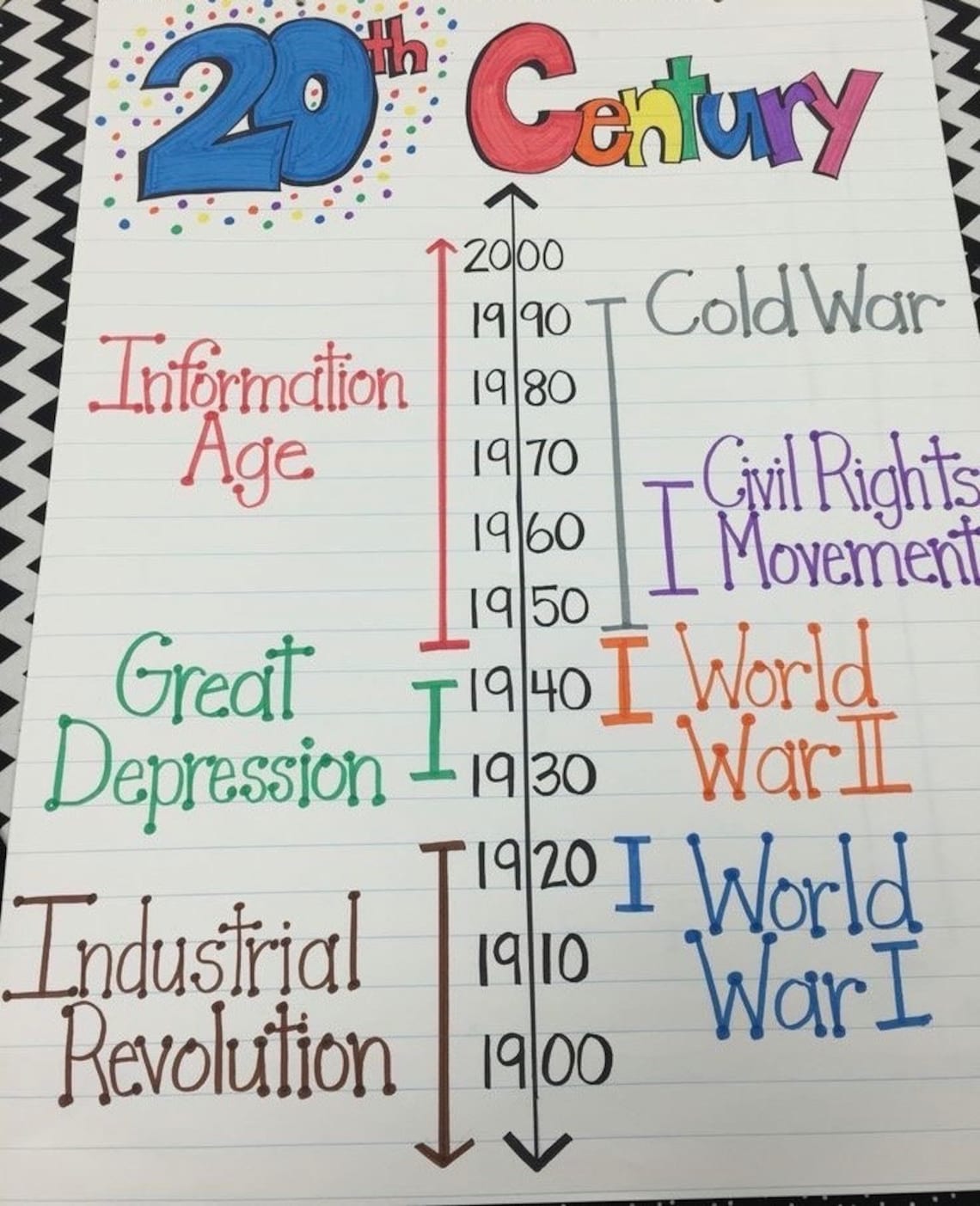
Summary of Major 20th Century Eras
| Era | Primary Focus | Key Turning Point | Global Impact |
|---|---|---|---|
| Imperial Twilight (1900-1914) | Colonial expansion and monarchy | Assassination of Franz Ferdinand | End of traditional European monarchies |
| The Great War (1914-1918) | Industrialized warfare | Treaty of Versailles | Redrawing of European and Middle Eastern maps |
| Interwar Crisis (1919-1939) | Economic instability/Extremism | 1929 Stock Market Crash | Rise of Fascism and Nazism |
| World War II (1939-1945) | Total war and genocide | Atomic bombings (1945) | Establishment of the UN and Superpower era |
| Cold War (1947-1991) | Ideological rivalry | Fall of the Berlin Wall (1989) | Nuclear proliferation and Space exploration |
| Information Age (1970-1999) | Digital technology | Creation of the Internet | Globalization and instant communication |
What was the most significant turning point of the 20th century?
While subjective, many historians point to 1945 as the most significant turning point. This year saw the end of World War II, the first use of nuclear weapons, the founding of the United Nations, and the start of the Cold War. It represented the transition from a multi-polar world led by European empires to a bipolar world led by the U.S. and USSR.
How did technology change daily life in the 20th century?
Technology revolutionized every facet of life, increasing longevity through medical breakthroughs like antibiotics and vaccines. It increased mobility through the mass production of automobiles and commercial aviation. Finally, it transformed the home through the introduction of radio, television, and eventually personal computers, moving society from local to global awareness.
Why is the 20th century often called "The American Century"?
The term, coined by Henry Luce in 1941, refers to the United States' dominant role in global politics, economics, and culture. Throughout the century, the U.S. moved from isolationism to becoming the world's largest economy and military power, exported its cultural products (Hollywood, jazz, fast food), and led the Western alliance through the Cold War.
What were the primary causes of decolonization?
Decolonization was caused by a combination of the moral and economic exhaustion of European powers after World War II, the rise of educated nationalist leaders in the colonies, and the Cold War context where both the U.S. and USSR (officially) supported anti-colonialism to gain influence in the "Third World."
What role did the Great Depression play in 20th-century history?
The Great Depression was a catalyst for radical political change. It discredited the prevailing laissez-faire economic models, leading to the rise of the welfare state (e.g., the New Deal in the U.S.) and providing the economic misery that allowed dictators to seize power in Europe and Asia, directly leading to World War II.
Engaging with 20th Century Primary Sources
To truly understand the complexities of the 20th century, it is essential to move beyond secondary summaries and engage with primary sources. Documents such as the Universal Declaration of Human Rights (1948), the Letters from Birmingham Jail, and even the oral histories of those who lived through the Depression or the World Wars provide a more nuanced view of history.
As of 2026, many of these records are digitized and accessible through institutions such as the National Archives and the British Library. For those conducting research or seeking to understand the roots of modern geopolitical tensions, examining the original treaties and diplomatic correspondence of the post-1945 era remains the most effective next step. By studying the patterns of the 20th century, we gain the necessary context to navigate the challenges of the 21st.